


Japan complex injectable generics market Overview
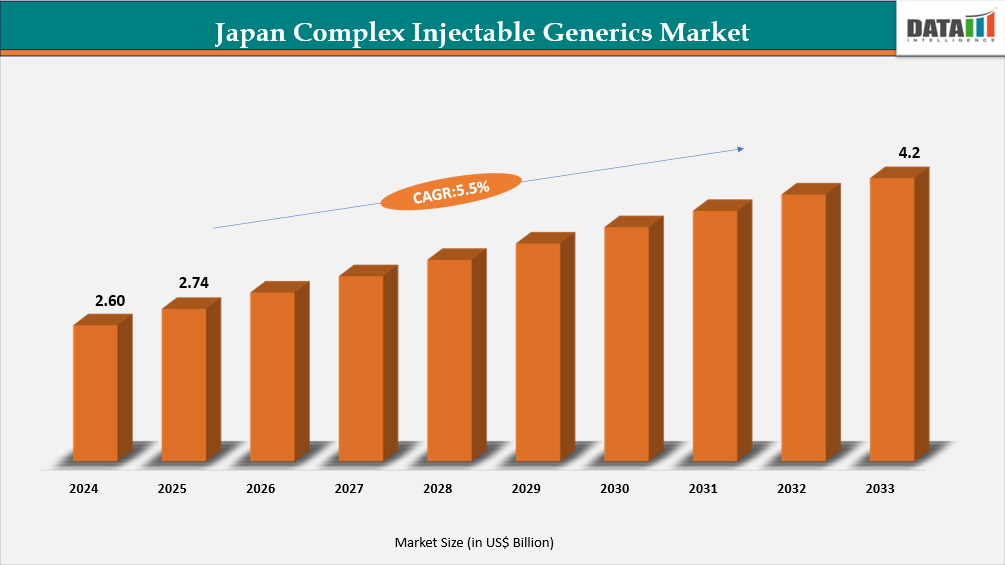
The Japan complex injectable generics market reached US$2.60 Billion in 2024, rising to US$2.74 Billion in 2025 and is expected to reach US$4.2 Billion by 2033, growing at a CAGR of 5.5% from 2026 to 2033.
Japan’s complex injectable generics market is expanding steadily, supported by strong hospital demand, cost-containment policies, and high utilization of injectable therapies in oncology and critical care. Generic medicines already account for around 89% of prescription volume in Japan as of 2025, reflecting government efforts to control healthcare expenditure and encourage substitution of off-patent drugs. The dominance of hospital procurement also supports demand, as most sterile injectables are administered in inpatient or oncology settings where generics are actively adopted to manage treatment costs.
Another key demand driver is Japan’s demographic and disease profile. The country has about 29% of its population aged 65 or older, the highest among major economies, which significantly increases the burden of cancer, cardiovascular diseases, and chronic conditions requiring injectable therapies. More than 1 million new cancer cases are reported annually, and oncology remains the largest application segment for sterile injectable generics, particularly chemotherapy agents administered in hospitals. These structural healthcare trends, combined with stable reimbursement systems and strong domestic manufacturing capabilities, continue to sustain long-term growth in complex injectable generics in Japan.
Complex Injectable Generics Industry Trends and Strategic Insights
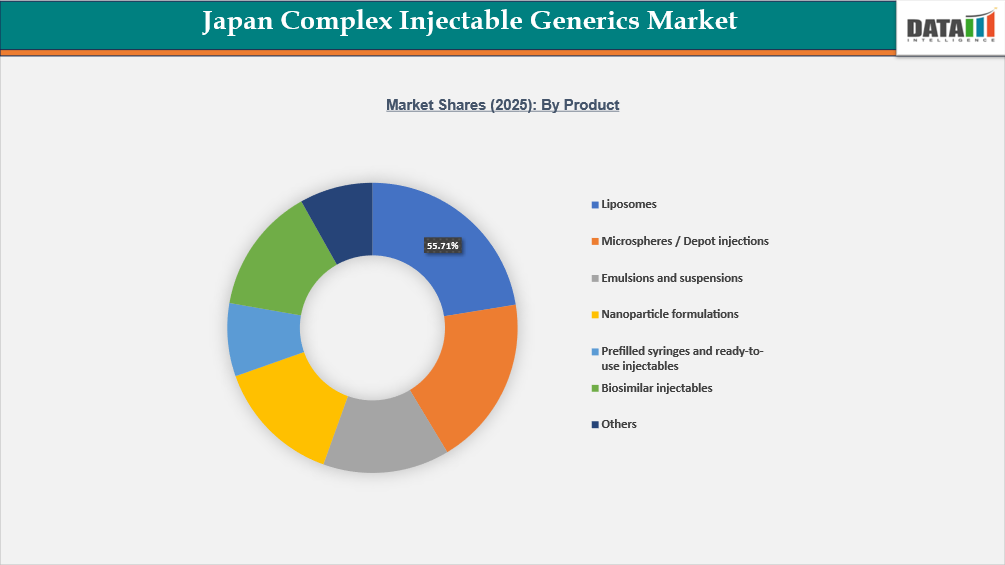
- By product segment, liposomes led the Japan complex injectable generics market, capturing the largest revenue share of 55.71% in 2025.
Japan Complex Injectable Generics Market Size and Future Outlook
- 2025 Market Size: US$2.74 Billion
- 2033 Projected Market Size: US$4.2 Billion
CAGR (2026–2033): 5.5%
Source : DataM Intelligence
For More Detailed information Request for Sample
Market Dynamics
Rising oncology incidence and demand for injectable chemotherapy generics
Japan continues to face a high and growing cancer burden, which directly increases the need for injectable chemotherapy and supportive medicines. More than 1.0 million new cancer cases were reported in Japan in 2022, and cancer remains the leading cause of death, accounting for roughly one-third of total deaths. The most common cancers, colorectal, lung, stomach, breast, and prostate, often require multi-cycle chemotherapy, many of which are administered intravenously in hospital settings. This large and sustained patient pool is a fundamental demand driver for complex injectable generics.
Treatment patterns in Japan further reinforce demand for injectable oncology drugs. Clinical utilization data show that injectable anticancer medicines are predominantly administered in hospitals, and chemotherapy remains widely used across both inpatient and outpatient settings, with tens of thousands of patients receiving chemotherapy daily in large hospitals. In addition, Japan’s extensive network of over 400 cancer treatment centers and universal health insurance coverage supports consistent access to oncology care and repeated treatment cycles, sustaining long-term demand for cost-efficient generic injectables.
Segmentation Analysis
The Japan complex injectable generics market is segmented based on product, therapeutic application, molecule type, route of administration, end-user and region.
Liposomes Product Drive Sustained Demand for Complex Injectable Generics
The growing burden of cancer in Japan is a major factor sustaining demand for liposomal injectable generics. More than 70% of new cancer cases in Japan occur in patients aged 65 and older, reflecting the country’s rapidly aging population and rising oncology treatment needs. In addition, cancer remains the leading cause of mortality and is projected to significantly increase healthcare expenditure, reinforcing long-term demand for advanced chemotherapy formulations and supportive injectables. Liposomal formulations are increasingly preferred in oncology because they reduce systemic toxicity and improve drug delivery, making them suitable for elderly and high-risk patients.
Adoption of liposomal drugs is also expanding due to clinical and manufacturing advances and wider availability of generic versions. Liposomal doxorubicin use in Japan is growing steadily, with forecasts indicating around 7% annual growth in demand, supported by hospital oncology programs and government-backed healthcare innovation. In Asia, Japan accounts for a meaningful share of doxorubicin demand, with liposomal formulations contributing to steady market expansion and technological adoption in infusion-based chemotherapy. Increasing cancer prevalence, improving survival rates, and expansion of hospital-based infusion therapy continue to sustain demand for liposome-based complex injectable generics across the country.
Competitive Landscape
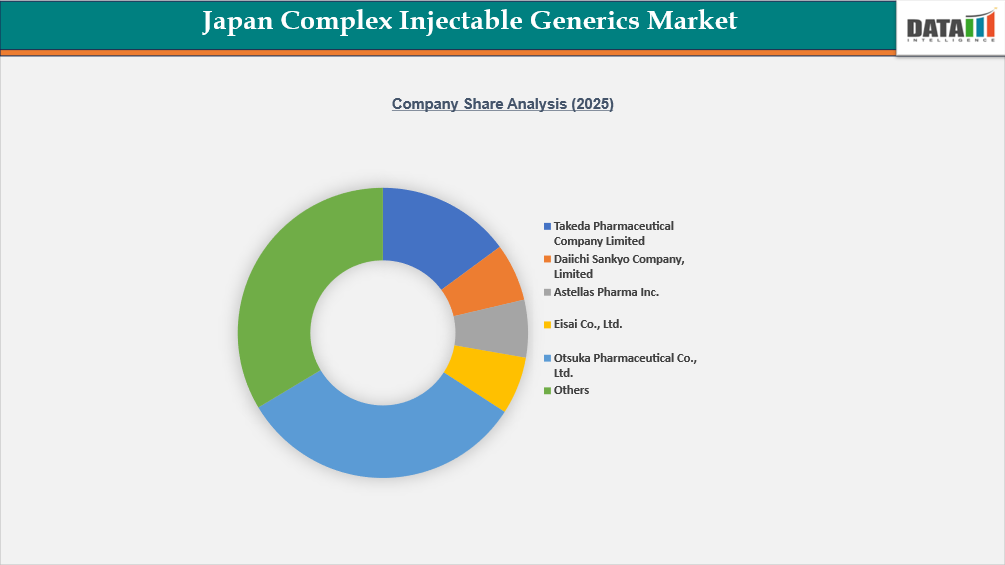
The competitive landscape of the Japan complex injectable generics market is moderately consolidated, with strong participation from domestic pharmaceutical manufacturers such as Nichi-Iko, Sawai, Towa Pharmaceutical, and Fuji Pharma, which focus on hospital-based injectables and cost-competitive formulations. Takeda, Daiichi Sankyo, Astellas, Otsuka, Mitsubishi Tanabe, and Kyowa Kirin maintain a presence through specialty injectables, biosimilars, and partnerships, leveraging established regulatory and distribution networks.
Companies such as Nippon Kayaku, Mochida, and Meiji Seika Pharma compete in oncology and anti-infective injectables, where demand is driven by aging demographics and hospital procurement programs. Strategic alliances, technology licensing, and portfolio expansion in liposomal drugs, depot injections, and biosimilar injectables are key competitive strategies shaping the market.
Key Developments
- In January 2026, Otsuka Pharmaceutical Co., Ltd. and Towa Pharmaceutical Co., Ltd. formed a strategic partnership to strengthen pharmaceutical manufacturing and ensure a stable supply of medicines in Japan. The collaboration includes transferring and outsourcing production of selected Otsuka products and utilizing originator data to support the development of generic formulations. This initiative reflects a growing trend in the complex injectable and sterile generics market, where partnerships between innovator and generic manufacturers help address supply shortages and production complexity. Such collaborations are expected to improve manufacturing resilience, accelerate generic drug availability, and support long-term market growth.
What Sets This Japan Complex Injectable Generics Market Intelligence Report Apart
- Latest Data & Forecasts – Comprehensive and up-to-date market intelligence with forecasts through 2033, covering Japan demand by key segmentation, with country analysis.
- Regulatory Intelligence – In-depth assessment of Japan pharmaceutical regulatory frameworks impacting market development and commercialization, including FDA, EMA, NMPA, PMDA, and CDSCO requirements, clinical trial pathways, labeling standards, patent exclusivity, and post-marketing surveillance.
- Competitive Benchmarking – Structured benchmarking of leading innovator and generic manufacturers based on product portfolios, pipeline strength, geographic reach, pricing strategies, clinical differentiation, and partnerships in the market.
- Actionable Strategies & Cost Dynamics – Strategic insights into lifecycle management, generic entry risks, combination therapy positioning, pricing pressures, and manufacturing cost structures, supported by expert perspectives from various specialists, regulatory advisors, and pharmaceutical executives.





























































