


Hypersonic Vehicle Market Overview
Military modernization cycles are increasingly centered on speed, survivability, and precision, placing hypersonic systems at the core of next generation defense strategies. Hypersonic vehicles, capable of exceeding Mach 5, are no longer experimental assets but are transitioning into deployable platforms across major global powers.
This market matters now because hypersonic capability is becoming a benchmark for strategic deterrence. Governments are accelerating procurement, testing, and deployment timelines, while defense contractors are scaling up R&D and production capabilities. For decision makers, timing is critical as early participation aligns with long term defense contracts and multi decade funding pipelines.
Hypersonic Vehicle Market Scope
| Metric | Details |
| Market Size (2025) | USD 8.29 Billion |
| Market Size (2035) | USD 29.59 Billion |
| CAGR | 11.40% |
| Historic Years | 2023–2024 |
| Base Year | 2025 |
| Forecast Period | 2026–2035 |
| Segments Covered | Vehicle Type, Component, Application, Region |
| Leading Region | North America |
| Fastest Growing Region | Asia-Pacific |
For more details on this report – Request for Sample
Hypersonic Vehicle Market Key Takeaways
- The hypersonic vehicle market growth at 11.4% CAGR reflects sustained, long cycle defense funding rather than short term commercial demand fluctuations.
- The military and defense segment holds 45.7% market share, confirming its position as the core revenue contributor.
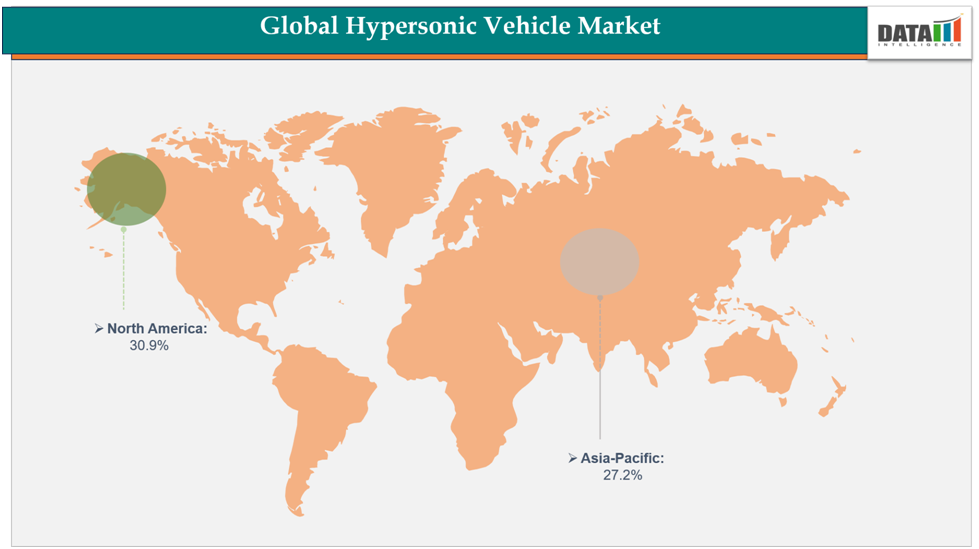
- North America accounts for 30.9% of the hypersonic vehicle market share, driven by large scale R&D programs and advanced testing infrastructure.
- Asia-Pacific holds 27.2% share and is the fastest growing region due to increasing geopolitical tensions and defense modernization.
- Continuous investments in propulsion systems, thermal protection materials, and AI-based guidance technologies are accelerating system performance improvements.
- High development and testing costs continue to restrict market entry, concentrating competition among a limited number of global defense primes.
- Increasing frequency of hypersonic flight tests and validation programs signals a transition from experimental phases to early stage deployment.
- Government focus on indigenous hypersonic capabilities is reshaping supply chains and reducing dependency on foreign technologies.
- Expansion across air, land, and naval platforms is broadening application scope and strengthening multi-domain operational capabilities.
- Rising emphasis on missile defense and counter hypersonic systems is creating parallel demand alongside offensive hypersonic platforms.
Market Dynamics: Procurement Momentum and Technology Acceleration
Defense Spending and Strategic Competition
The hypersonic vehicle market analysis shows that rising defense budgets are the primary growth engine. Countries are prioritizing hypersonic capabilities to strengthen deterrence, enhance strike precision, and counter emerging threats.
Programs across the U.S., China, India, and Japan highlight a clear shift toward indigenous development and reduced reliance on external suppliers. This is creating long term opportunities for defense contractors and subsystem providers.
Technology Development and Testing Ecosystem
Advancements in propulsion, aerodynamics, and materials are enabling practical deployment of hypersonic systems. Technologies such as scramjet engines, thermal protection systems, and AI-based guidance are improving performance and reliability.
Frequent testing, including high speed flight trials and glide vehicle validation, is accelerating commercialization within defense ecosystems.
Cost Structure and Program Complexity
Despite strong demand, high development and operational costs remain a major constraint. Hypersonic systems require:
- Advanced materials capable of withstanding extreme temperatures
- Specialized testing facilities
- Long development cycles with high failure risk
These factors create high entry barriers and limit the competitive landscape to a small group of global players.
Segment Insights: Defense Applications Dominate Strategic Demand
Segmented by vehicle type (hypersonic glide vehicles, hypersonic cruise missiles, hypersonic aircraft and spaceplanes), by component (propulsion systems, aerostructures and materials, avionics and guidance systems, warheads), by application (military and defense, space exploration and satellite deployment, commercial aviation), and by Region - Share, Trends, and Forecast to 2035.
Military and Defense: Core Revenue Engine
The military and defense segment holds 45.7% of the hypersonic vehicle market share, driven by demand for:
- Long-range precision strike capabilities
- Missile defense systems
- Strategic deterrence
Deployment across air, land, and naval platforms highlights the versatility of hypersonic systems. Governments are prioritizing rapid strike capabilities, making this segment central to future growth.
Vehicle Type Innovation
Hypersonic glide vehicles and cruise missiles are leading development efforts due to their operational flexibility and effectiveness in contested environments. Investments in reusable hypersonic platforms and space-based applications are also gaining attention.
Regional Outlook: Strategic Competition Shapes Demand
North America: Innovation and Deployment Leadership
North America leads the hypersonic vehicle market, accounting for 30.9% share. The U.S. continues to invest heavily in hypersonic weapons development, supported by strong defense budgets and advanced research institutions.
Programs such as missile interceptors and experimental test flights highlight the region’s focus on both offensive and defensive capabilities.
Asia-Pacific: Fastest-Growing Strategic Market
Asia-Pacific holds 27.2% market share and is witnessing the fastest growth. China’s advancements in Mach 10 missile systems and Japan’s indigenous programs underscore the region’s strategic focus.
India’s defense programs further contribute to regional expansion, with ongoing development of hypersonic missiles and advanced combat systems.
Europe: Collaborative Defense Innovation
Europe is investing in collaborative programs and research partnerships to strengthen its position in hypersonic technologies. While trailing North America and Asia-Pacific, the region is focusing on joint development initiatives and technology sharing.
Competitive Landscape: Defense Giants Lead with Integrated Capabilities
The hypersonic vehicle market report highlights a concentrated competitive environment dominated by major defense contractors, including:
- Lockheed Martin Corporation
- RTX
- Northrop Grumman
- Boeing
- BAE Systems
- Thales
- MBDA
- L3Harris Technologies
- HERMEUS Corp
- Hypersonic Launch Systems Pty Ltd
These companies are leveraging:
- Deep R&D investments
- Government contracts
- Integrated system capabilities
Lockheed Martin, for instance, continues to lead with advanced hypersonic glide vehicle programs and strong partnerships with defense agencies.
Recent Developments
In July 2026, Lockheed Martin Corporation progressed its hypersonic systems program with advanced flight testing and integration of next-generation guidance technologies. The innovation focuses on precision targeting and hypersonic maneuverability. This supports evolving defense capabilities.
In June 2026, Northrop Grumman Corporation expanded its hypersonic propulsion developments with advanced scramjet engine testing and thermal protection systems. The development enhances high-speed performance and durability. This supports next-generation hypersonic platforms.
In May 2026, Raytheon Technologies Corporation (RTX) introduced upgraded hypersonic propulsion and guidance technologies for defense applications. The development improves targeting accuracy and system reliability. This benefits military operations.
In April 2026, Boeing Company strengthened its hypersonic research initiatives with new design concepts and simulation technologies for high-speed vehicles. The innovation focuses on aerodynamics and thermal management. This supports aerospace advancements.
In March 2026, Aerojet Rocketdyne Holdings, Inc. (L3Harris Technologies) introduced advanced propulsion systems for hypersonic vehicles with improved thrust and fuel efficiency. The development enhances mission performance. This benefits defense applications.
Regulatory and Policy Environment
The hypersonic vehicle market operates within a tightly controlled regulatory environment shaped by national security priorities and international arms control considerations. Governments impose strict export controls, technology transfer restrictions, and classification protocols to safeguard sensitive technologies related to propulsion systems, guidance, and materials. These regulations influence collaboration models, often limiting cross-border partnerships and requiring domestic development capabilities for critical components.
At the same time, increasing geopolitical tensions are prompting policy shifts that accelerate funding approvals, streamline testing permissions, and prioritize rapid deployment of hypersonic systems. Defense procurement policies are evolving to support faster acquisition cycles and encourage innovation through public-private partnerships. However, regulatory complexities, including compliance with international treaties and risk of escalation, continue to shape how countries develop, test, and deploy hypersonic technologies.
Economic & Investment Analysis
The hypersonic vehicle market is heavily influenced by government spending cycles rather than traditional commercial demand. Capital allocation is concentrated in defense budgets, with long-term funding commitments ensuring stability.
Return on investment is linked to:
- Multi-year defense contracts
- Technology licensing and partnerships
- Lifecycle maintenance and upgrades
Economic risks include budget reallocations and geopolitical shifts, but overall funding visibility remains strong due to the strategic importance of hypersonic capabilities.
Strategic Insights and Analyst Perspective
The hypersonic vehicle market forecast indicates sustained expansion driven by defense priorities and technological advancements. The competitive landscape will remain concentrated, with a few dominant players controlling the majority of contracts.
Opportunities exist in:
- Subsystem manufacturing
- Advanced materials
- Testing infrastructure
- AI-based guidance systems
Companies that align with government programs and invest in scalable technologies will strengthen their market position.
Report Benefits
This hypersonic vehicle market report supports:
- Defense contractors in aligning with procurement programs and technology roadmaps
- Investors in understanding long-term government-backed growth potential
- Component manufacturers in identifying high-demand subsystems
- Strategy teams in evaluating market entry and partnership opportunities
- Policy analysts in tracking geopolitical and regulatory developments
Target Audience
- Defense contractors and aerospace companies
- Government and defense agencies
- Technology providers and component manufacturers
- Investors and financial institutions
- Research organizations and policy analysts
The global hypersonic vehicle market report delivers a detailed analysis with 62 key tables, more than 53visually impactful figures, and 195 pages of expert insights, providing a complete view of the market landscape.





























































