


Hydrogen Testing Market Overview
The market includes laboratory, field and digital testing services used to establish whether hydrogen production systems, storage vessels, pipelines, valves, compressors, refuelling equipment, fuel cells, materials and final hydrogen products meet safety, performance, purity and environmental requirements. Hydrogen testing is moving from a project-specific engineering service into a recurring compliance and asset-integrity function as governments, industrial companies and transport operators increase investment in low-emissions hydrogen.
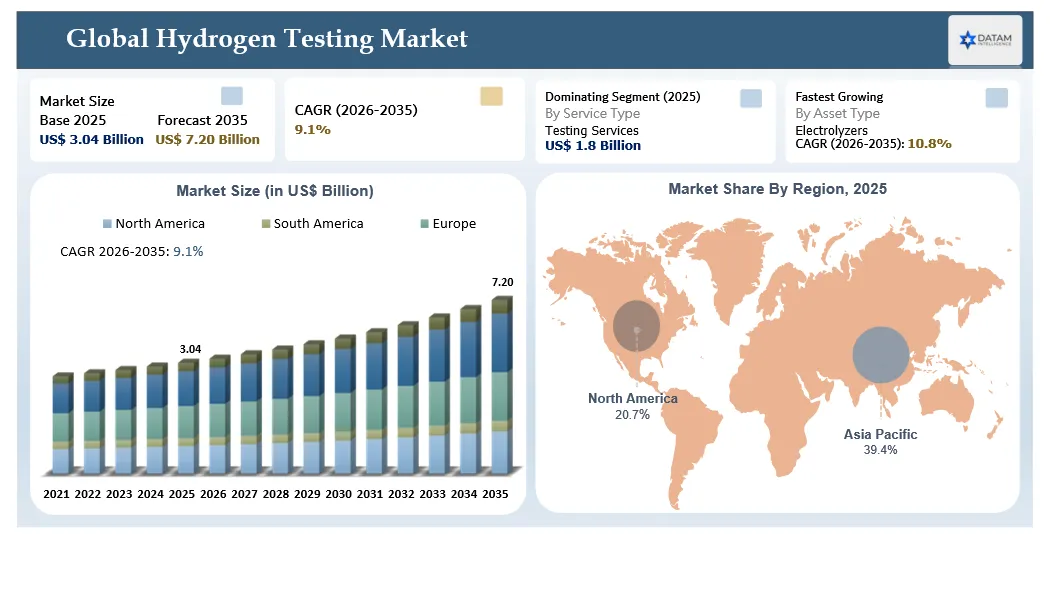
The demand base is supported by a much larger hydrogen economy. The International Energy Agency reported that global hydrogen demand reached almost 100 million tonnes in 2024, increasing by 2% from 2023. More than 200 low-emissions hydrogen projects had reached committed investment status by 2025, while announced low-emissions production capacity for 2030 was revised to around 37 million tonnes per year after project delays and cancellations. The reduction in the project pipeline strengthens the value of testing because developers need to reduce commissioning risk, demonstrate bankability and qualify equipment before scarce capital is released.
Testing requirements extend across the full value chain. Electrolyzers require electrical, pressure, gas-purity, efficiency, durability and materials testing. Storage systems require burst, fatigue, permeation, leak, fire and environmental testing. Pipelines require hydrogen embrittlement, fracture toughness, fatigue crack growth and weld qualification. Refuelling stations require dispenser, hose, valve, metering and fuel-quality verification. ISO 19880-5:2025 specifies requirements for hydrogen dispenser hoses at pressures up to 70 MPa and temperatures from minus 40 degrees Celsius to 65 degrees Celsius. These requirements create recurring demand for accredited laboratories, inspection bodies, certification organizations and specialized equipment suppliers.
The market outlook through 2035 will be shaped by the conversion of pilot projects into operating assets, the repurposing of natural gas infrastructure, stricter hydrogen-origin certification, the growth of mobility and industrial applications and the need to validate components under high-pressure hydrogen exposure. Commercial opportunities will concentrate in materials compatibility, purity analysis, electrolyzer performance, pipeline integrity, refuelling infrastructure, digital monitoring and certification support.
Hydrogen Testing Market Snapshot
| Metric | Details |
| 2025 Market Size | US$ 3.04 Billion |
| 2035 Projected Market Size | US$ 7.20 Billion |
| CAGR 2026-2035 | 9.1% |
| Largest Region | Europe |
| Fastest Growing Region | Asia-Pacific |
| Largest Service Segment | Testing |
| Fastest Growing Asset Segment | Electrolyzers and hydrogen infrastructure |
| Report Coverage | Safety, performance, purity, materials, certification, pricing, regional opportunity and competitive landscape |
Hydrogen Testing Market Key Takeaways
- The market is estimated at US$ 3.04 billion in 2025 and projected to reach US$ 7.20 billion by 2035, with a CAGR of 9.1% during 2026-2035.
- Europe is the largest regional market because it combines hydrogen policy, cross-border infrastructure, industrial decarbonization projects and a mature testing, inspection and certification ecosystem.
- Asia-Pacific is expected to be the fastest growing region due to electrolyzer manufacturing, fuel-cell mobility programs, industrial hydrogen demand and new testing capacity in China, Japan, South Korea, India and Australia.
- Component and materials testing is the largest testing category because hydrogen can affect metals, polymers, seals, coatings and welds through embrittlement, permeation and accelerated fatigue.
- Electrolyzer and production-system testing is among the fastest growing categories as developers need proof of efficiency, gas quality, stack durability, electrical safety and operating-envelope performance.
- Hydrogen purity testing gains importance wherever hydrogen is used in proton-exchange-membrane fuel cells, where contaminants can damage catalysts and reduce system life.
- Pipeline testing will become a strategic opportunity as gas network operators assess hydrogen blending, dedicated transmission networks and repurposing of existing steel pipelines.
- ISO 19880-5:2025 covers hydrogen dispenser hoses and assemblies for service up to 70 MPa, showing how updated standards translate directly into qualification and retesting demand.
- Element announced a US$10 million investment in hydrogen testing equipment and infrastructure, while TÜV SÜD opened a dedicated hydrogen laboratory in Garching in 2026.
- Testing buyers increasingly want lifecycle support covering design validation, conformity assessment, commissioning, periodic inspection, failure analysis and digital condition monitoring.
Hydrogen Testing Market Scope
| Scope Item | Coverage |
| By Service Type | Testing, inspection, certification, calibration, validation, failure analysis and technical advisory |
| By Testing Type | Material compatibility, mechanical integrity, leak and permeation, pressure, purity, electrical, environmental, fire, performance and durability |
| By Asset Type | Electrolyzers, fuel cells, storage vessels, pipelines, valves, compressors, dispensers, hoses, sensors and balance-of-plant |
| By Value Chain Stage | Production, conditioning, storage, transportation, distribution, refuelling and end-use |
| By End-Use Industry | Energy, chemicals, refining, mobility, steel, power, aerospace, marine, rail and industrial manufacturing |
| By Delivery Model | Laboratory testing, field testing, mobile testing, on-site inspection and digital monitoring |
| By Region | North America, Europe, Asia-Pacific, South America, Middle East and Africa |
Hydrogen Testing Market Economic and Investment Analysis
Hydrogen testing is attractive because it is an enabling service required before large capital assets can operate. Revenue is less dependent on hydrogen commodity prices than project development, though cancellations can delay demand. Capital intensity varies. Gas-quality laboratories require advanced analyzers and sampling capability, while high-pressure materials laboratories require chambers, cycling rigs, safety systems and specialist staff. Element’s US$10 million investment program and TÜV SÜD’s 2026 laboratory opening demonstrate that major TIC companies expect sustained demand. Investment returns are strongest when equipment can serve several asset types and when the provider offers certification or field services alongside testing.
Hydrogen Testing Investment Trends in the Market
- Expansion of high-pressure cycling and hydrogen embrittlement laboratories.
- New electrolyzer and fuel-cell performance test stands with dynamic load capability.
- Investment in chromatography and trace contaminant analysis for fuel quality testing.
- Mobile and on-site testing units for pipelines, stations and industrial projects.
- Digital platforms for calibration records, compliance evidence and remote monitoring.
- Partnerships between laboratories, universities, equipment manufacturers and standards bodies.
Strategic Indicators for Hydrogen Testing Market
High Regulation Impact
Hydrogen testing is driven by pressure-equipment, hazardous-area, transport, fuel-quality and environmental requirements. Updated standards create direct qualification demand.
High Investment Activity
Global TIC companies are expanding hydrogen laboratories and equipment, while governments support research and demonstration infrastructure.
Supply Constraint
High-pressure chambers, cryogenic facilities and specialist engineers remain limited, creating queues for complex programs.
Pricing Power
Specialized tests command premium pricing because few laboratories can reproduce realistic hydrogen exposure and provide internationally accepted certification.
Procurement Pressure
Customers want shorter qualification cycles, multi-standard acceptance and transparent test data that can support lenders and regulators.
Technology Adoption
Automation, AI-assisted analysis, remote monitoring and digital certificates are expanding the value of testing services.
Regional Expansion
Europe leads current demand, while Asia-Pacific offers the strongest capacity and project growth opportunity.
Hydrogen Testing Industry Analysis
Porter’s Five Forces
Entry barriers are moderate to high because accredited hydrogen testing requires specialized equipment, safety systems, recognized procedures and technical talent. Buyer power is moderate because large manufacturers and project developers can tender globally, but limited capacity reduces leverage for complex tests. Supplier power is relevant for high pressure equipment, analytical instruments and specialist gases. Substitution is low where testing is mandatory. Rivalry is increasing as global TIC firms and specialized laboratories expand.
Supply and Value Chain
The value chain begins with test-equipment manufacturers, gas suppliers, sensor companies, standards bodies and accreditation organizations. Laboratories and inspection companies convert these inputs into qualification, certification and lifecycle assurance. Engineering firms, equipment manufacturers, project developers and operators are the principal buyers. Data platforms and field-service companies are becoming more important as testing extends into operation.
Pricing Analysis
Pricing depends on pressure, temperature, duration, sample preparation, accreditation, reporting and whether destructive analysis is required. Routine gas-quality tests can be priced per sample, while high-pressure fatigue or fracture programs are project-based. Field inspections are priced by site, asset and travel. Premium pricing is strongest for cryogenic, high-pressure, long-duration and multi-standard programs.
Regulatory Analysis
Hydrogen assets are governed through a combination of pressure-equipment, hazardous-area, transport, refuelling, fuel-quality and environmental rules. ISO 19880-2:2025 and ISO 19880-5:2025 are important for dispensers and hoses. ISO 14687 supports hydrogen fuel quality. ASME, SAE, IEC, EN and national requirements apply depending on the asset and location.
Innovation and R&D Trends
R&D is focused on hydrogen embrittlement, weld performance, composite storage, cryogenic transfer, rapid gas analysis, sensor validation and accelerated durability. Research is also improving the link between laboratory tests and field life. Collaborative facilities allow companies to access expensive equipment without building internal laboratories.
Sustainability and ESG Analysis
Testing supports ESG claims by verifying hydrogen carbon intensity, equipment efficiency, leakage and product origin. Poorly controlled hydrogen leakage can reduce climate benefits, while inaccurate emissions accounting can undermine green premiums. Independent verification will become important for offtake contracts and trade.
Go-To-Market Strategy
New providers should enter through a focused capability such as purity analysis, mobile leak testing, electrolyzer performance or materials compatibility. Accreditation and partnerships with certification bodies are critical. Regional laboratories should connect with universities and global TIC networks to gain methods, referrals and international acceptance.
Demand-Supply Gap
The greatest supply gaps are in high-pressure hydrogen embrittlement testing, cryogenic liquid-hydrogen testing, long-duration cycling and field purity analysis. Capacity is concentrated in Europe, North America and selected Asian markets. Emerging project regions often rely on overseas laboratories, increasing logistics and turnaround time.
Compliance Roadmap
A typical roadmap begins with requirements mapping, material screening, prototype testing, design validation, type certification, production quality assurance, commissioning and periodic inspection. Early engagement reduces the risk that a product fails after major design and tooling decisions have been made.
AI Impact Analysis of Hydrogen Testing Market
AI can improve test planning, anomaly detection, image analysis and predictive maintenance. Pressure-cycle data can be screened for abnormal leak signatures or changes in component compliance. Machine-vision systems can classify surface defects and fracture morphology. Models can combine laboratory results with field data to estimate remaining life. AI also supports standards search and report preparation, reducing administrative time. The main constraint is data quality. Hydrogen tests are expensive and datasets can be small, proprietary or generated under different conditions. AI outputs must therefore remain traceable to validated methods and engineering review.
Disruption Analysis of Hydrogen Testing Market
The market is being disrupted by three shifts. First, testing is moving upstream into design and bankability rather than being performed only for final compliance. Second, field sensors and digital records are extending assurance into operation. Third, hydrogen-origin and carbon-intensity verification are expanding the market beyond physical equipment. These shifts favour providers that combine laboratory science, certification, digital tools and industry-specific engineering. Laboratories limited to generic pressure testing may face price pressure, while specialists in hydrogen compatibility, purity and lifecycle integrity can defend premium margins.
Hydrogen Testing Market BCG Matrix: Company Evaluation
STAR
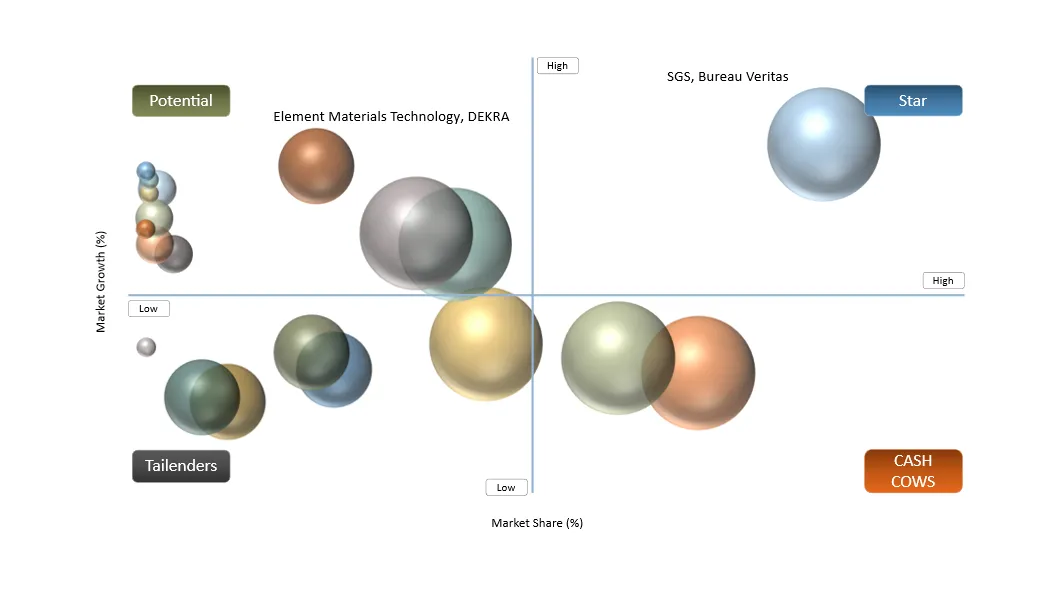
The market leaders in the Hydrogen Testing market include SGS, Bureau Veritas, TÜV SÜD, Intertek, and DNV as a result of their superior global testing, inspection, and certification (TIC) offerings along with extensive hydrogen service offering. They provide services in the area of hydrogen production, transportation, storage, and usage in the form of material testing, leak detection, pressure testing, among others. They have a wide network of laboratories and are engaged in various big hydrogen infrastructure projects.
POTENTIAL
The companies such as Element Materials Technology, DEKRA, UL Solutions, Kiwa, and RINA are enhancing their footprint in the Hydrogen Testing Market by developing hydrogen safety testing and certification solutions. The companies are now concentrating on various new applications, including fuel cells, electrolyzers, hydrogen storage, and hydrogen refueling infrastructure. The rise in investments in green hydrogen projects and changing regulations are presenting numerous opportunities for the companies to develop their market share.
Hydrogen Testing Market Dynamics
Driver Impact Analysis
| Driver | Impact | Demand Concentration | Impacted Use Case | Strategic Effect |
| Committed hydrogen projects | 27% | Europe, Asia-Pacific, North America | Electrolyzers, storage and certification | Expands qualification and commissioning demand |
| Infrastructure regulation | 23% | Global | Pipelines, vessels and refuelling | Creates mandatory testing and periodic inspection |
| Purity and emissions certification | 18% | Mobility and export projects | Gas analysis and chain of custody | Adds recurring product-assurance services |
| Laboratory investment | 16% | Europe and North America | Materials and component testing | Improves capacity and technical depth |
| Risk and insurance requirements | 14% | Large projects and operators | Integrity and failure analysis | Moves testing into lender and insurer due diligence |
Driver: Expansion of low-emissions hydrogen projects and committed capital
The largest driver is the gradual conversion of hydrogen projects from announcements into committed investments and operating assets. The IEA reported more than 200 committed low-emissions hydrogen investments by 2025. Each project requires testing during equipment selection, factory acceptance, construction, commissioning and operation. Lenders and offtakers increasingly request independent evidence of electrolyzer performance, hydrogen quality, safety systems and availability assumptions. The 25% reduction in announced 2030 capacity compared with the prior year also increases scrutiny because capital is concentrating in projects with stronger technical and commercial foundations. Testing reduces uncertainty around stack degradation, compressor reliability, storage integrity and pipeline compatibility. This creates opportunities for laboratories, field inspectors, certification bodies and digital monitoring providers. The strongest demand will come from projects that need bankable performance data and cross-border certification.
Driver: Growth of hydrogen infrastructure and pressure-system regulation
Hydrogen infrastructure includes pipelines, storage vessels, refuelling stations, compressors, valves, hoses and metering systems. These assets operate under pressure and often in hazardous environments, making testing a prerequisite for permitting and insurance. ISO 19880-5:2025 specifies testing and safety requirements for dispenser hoses up to 70 MPa. Updated standards create replacement and recertification demand because suppliers must show that materials and assemblies meet current requirements. Pipeline conversion is another major opportunity. Operators need fracture toughness, fatigue crack growth, weld and defect assessments before introducing hydrogen into existing gas networks. This testing is technically demanding and cannot be replaced by conventional natural-gas qualification alone.
Driver: Rising emphasis on hydrogen purity, origin and emissions certification
Hydrogen buyers increasingly need evidence of both physical quality and environmental attributes. Fuel cells are sensitive to contaminants such as carbon monoxide, sulfur compounds, ammonia, water and hydrocarbons. Producers therefore require sampling, chromatography and validated quality-management systems. At the same time, governments and buyers want proof that low-emissions hydrogen meets carbon-intensity thresholds. This creates demand for metering, chain-of-custody verification, electricity matching, emissions calculation and certification audits. Testing companies can expand from equipment safety into hydrogen product assurance. The opportunity is strongest in export projects, industrial supply contracts and mobility networks where fuel quality or carbon intensity directly affects product acceptance.
Driver: Investment in specialized laboratories and test infrastructure
Testing capacity is expanding because conventional laboratories often lack high-pressure hydrogen chambers, safe gas handling, long-duration cycling equipment and accredited contaminant analysis. Element announced a US$10 million investment in hydrogen testing equipment and infrastructure. TÜV SÜD opened a dedicated hydrogen laboratory in Garching in 2026, with capabilities spanning material qualification, design validation, certification and market approval. These investments validate the commercial opportunity and also raise customer expectations. New entrants must offer specialized equipment, recognized accreditation or location advantages. Capacity expansion will reduce bottlenecks but may also create regional competition for skilled engineers and complex test programs.
Driver: Need to reduce failure, downtime and insurance exposure
Hydrogen leaks, embrittlement failures, seal degradation and purity excursions can create safety events, production losses and reputational damage. Asset owners therefore use testing to identify weak materials, validate maintenance intervals and support insurance. Failure analysis becomes particularly valuable when a component cracks, leaks or underperforms because the root cause may involve material selection, manufacturing defects, hydrogen exposure or operating conditions. Insurers and lenders are likely to increase technical due diligence as project sizes grow. This shifts testing from a regulatory cost toward a risk-reduction investment.
Restraint Impact Analysis
| Restraint | Drag | Primary Impact | Affected Segment | Strategic Effect |
| Specialized infrastructure cost | 22% | Laboratory capacity | High-pressure and cryogenic testing | Raises pricing and limits regional access |
| Fragmented standards | 19% | Certification | International market access | Causes repeat testing and delay |
| Project cancellations | 17% | Demand timing | New project qualification | Creates utilization risk |
| Skills and long cycles | 15% | Delivery capacity | Materials and durability testing | Extends turnaround times |
| Lab-to-field correlation | 12% | Buyer confidence | Lifetime and inspection decisions | Requires field monitoring and modelling |
Restraint: High cost and limited availability of specialized hydrogen test infrastructure
Hydrogen testing requires pressure-rated laboratories, ventilation, hazardous-area equipment, gas supply, safety systems and trained personnel. High-pressure cycling and long-duration fatigue programs can occupy equipment for weeks or months. Small suppliers may face long queues or high costs, while laboratories need sufficient utilization to justify capital expenditure. Testing at cryogenic temperature or in pure hydrogen is even more specialized. These constraints can delay qualification and encourage customers to limit test scope. Regional capacity expansion will reduce some bottlenecks, but highly specialized programs are likely to remain expensive through the forecast period.
Restraint: Fragmented standards and evolving certification rules
Hydrogen standards are expanding, but gaps remain across new applications, materials and large-scale systems. A product may face different requirements in Europe, North America and Asia. Certification rules for hydrogen origin and carbon intensity are also evolving. Manufacturers can be forced to repeat tests, modify designs or delay launch while regulators interpret new requirements. Testing providers need to maintain expertise across many standards and explain where equivalence is accepted. The lack of harmonization increases cost and can discourage smaller companies from entering international markets.
Restraint: Hydrogen project delays, cancellations and uncertain utilization
The hydrogen project pipeline has experienced cancellations and downward revisions because of high production cost, weak offtake and policy uncertainty. The IEA reduced the announced 2030 low-emissions hydrogen project pipeline from 49 million tonnes to around 37 million tonnes per year. Only a limited share had reached final investment decision. Testing demand depends on projects moving beyond feasibility. Laboratories that invest too early can face underutilized capacity. Providers therefore need a diversified customer base spanning conventional hydrogen, mobility, pipelines, research and industrial assets.
Restraint: Long qualification cycles and shortage of specialist skills
Hydrogen testing often involves repeated pressure cycles, crack growth measurement and validation under several operating conditions. Programs can take months, particularly when failures require redesign. Skilled metallurgists, pressure-system engineers, analytical chemists and certification specialists are limited. Recruiting and retaining these professionals raises operating costs. Customers may also lack internal expertise to define the correct test plan, leading to scope changes and delays. Providers that offer early engineering consultation can reduce this restraint, but the talent shortage remains structural.
Restraint: Difficulty translating laboratory results into real operating life
Accelerated tests are necessary, but they do not always reproduce every combination of pressure, temperature, impurity, stress and defect found in service. Operators may struggle to convert laboratory data into inspection intervals or remaining-life decisions. This creates basis risk between a passed test and actual field performance. Digital monitoring and field validation can improve confidence, but they add cost and data complexity. The market needs stronger correlation between standardized tests and long-duration service evidence.
Hydrogen Testing Market Segment Analysis
The global market is segmented by service type, testing type, asset type, value chain stage, end-use industry, delivery model, customer type and region. Each segmentation represents a different buyer decision and revenue pool. The following analysis adds operational evidence, standards context and commercial implications to the market sizing framework.
By Service Type: Testing Remains the Largest Revenue Pool
Testing remains the largest service segment because every hydrogen asset requires evidence that materials, components and systems can operate safely under the intended pressure, temperature, flow and purity conditions. Laboratory testing covers tensile strength, fracture toughness, fatigue crack growth, slow strain rate, permeation, burst, cycling and contaminant analysis. Field testing includes leak detection, pressure verification, weld inspection, sensor calibration and commissioning support. Certification adds a recurring layer because manufacturers need conformity with ISO, SAE, ASME, EN, IEC, national pressure-equipment and hazardous-area requirements. Testing providers increasingly package these services into product-development programs that begin with material screening and continue through prototype validation, certification and production surveillance. This model improves customer retention and raises the value per asset. The new TÜV SÜD hydrogen laboratory in Garching was designed to support the entire product lifecycle, from early development and material qualification through certification, production monitoring and market approval. Buyers prefer integrated providers when they are entering several jurisdictions because a single test program can be structured around multiple standards. Small specialist laboratories remain important for hydrogen embrittlement, high-pressure cycling and advanced gas analysis, where deep technical expertise matters more than global scale.
By Testing Type: Materials Compatibility and Mechanical Integrity Lead
Materials compatibility testing is central to the market because hydrogen can diffuse into metals and alter ductility, fracture resistance and fatigue behaviour. The risk is especially important in high-strength steels, weld heat-affected zones, fasteners, pressure vessels, valves and pipelines. Testing programs use slow strain rate, constant-load, fatigue crack growth, fracture toughness and hydrogen permeation methods to determine whether a material is suitable for a particular pressure, temperature and hydrogen purity. A 2025 review of pipeline testing methods found that standards and research are expanding rapidly as operators evaluate pure hydrogen and hydrogen-natural-gas blends. Non-metallic materials also require testing because seals, liners, hoses and composite matrices can experience swelling, blistering, permeation or rapid gas decompression. Mechanical integrity testing is therefore increasingly paired with microscopy, chemical characterization and failure analysis. This creates white space for laboratories able to reproduce operating environments rather than testing only in air. Providers that can test at high pressure, cycle components for long durations and measure crack growth under hydrogen exposure will capture premium work from pipeline, storage and mobility clients.
By Asset Type: Electrolyzers and Storage Systems Create the Fastest Testing Expansion
Electrolyzers are moving from small demonstration units to multi-megawatt and gigawatt project concepts, which increases the need for stack, subsystem and plant-level testing. Buyers need to verify electrical consumption, hydrogen purity, dynamic response, pressure performance, degradation, water quality tolerance and balance-of-plant reliability. Testing also covers power electronics, controls, gas separation, dryers, compressors and safety shutdowns. Storage assets require a different mix of tests, including burst, pressure cycling, leak, permeation, fire resistance and environmental exposure. Composite cylinders used in mobility are exposed to repeated high-pressure filling, while stationary vessels must demonstrate long-term integrity and compatibility with valves, liners and seals. Pipeline and underground storage projects add fracture, weld and geomechanical requirements. These asset categories are attractive because testing begins before commercial deployment and continues through periodic inspection. As low-emissions hydrogen production is expected to increase from current levels through 2030, developers will need independent validation to compare electrolyzer vendors, support warranties and satisfy lenders. Laboratories that can link component testing with full-system performance will gain share.
By Value Chain Stage: Transportation and Refuelling Carry the Highest Safety Burden
Hydrogen production testing focuses on electrolyzer or reformer performance, emissions, gas quality and process safety. Conditioning requires verification of compression, liquefaction, purification and conversion to carriers such as ammonia or liquid organic hydrogen carriers. Transportation adds pipeline, tube trailer, cryogenic tank and shipping requirements. Refuelling is among the most safety-intensive stages because high-pressure hydrogen is dispensed near vehicles and the public. ISO 19880-2:2025 specifies requirements for hydrogen dispensers, while ISO 19880-5:2025 addresses hoses and assemblies up to 70 MPa. Refuelling stations also require checks for pressure ramp rates, temperature compensation, metering, communication protocols, leak detection and hydrogen quality. Pipeline operators need evidence that existing materials, welds and defects remain within acceptable integrity limits under hydrogen exposure. The testing opportunity therefore expands as hydrogen moves from production sites into public and industrial distribution networks. Providers that combine station commissioning, periodic inspection, gas sampling and remote diagnostics can create recurring revenue rather than one-time project work.
By End-Use Industry: Energy, Mobility and Industrial Decarbonization Drive Distinct Requirements
Energy and utility buyers need testing for electrolyzers, storage, pipelines, turbines, blending systems and grid-support applications. Mobility requires certified tanks, valves, dispensers, hoses, fuel cells and crash-related safety systems. Steel, refining and chemicals use larger hydrogen volumes and focus on process reliability, purity and integration with existing equipment. Aerospace and marine applications add weight, vibration, cryogenic and fire requirements. Rail and heavy-duty transport need durability under repeated duty cycles and variable weather. These differences create multiple specialist markets inside hydrogen testing. A test method suitable for a stationary electrolyzer may be insufficient for a vehicle cylinder or liquid-hydrogen aircraft component. Suppliers that understand the operating context can translate standards into realistic test profiles, reducing the risk of over-testing or missed failure modes. As hydrogen adoption spreads into new end uses, customers will place greater value on sector-specific engineering support and certification roadmaps.
By Delivery Model: Laboratory Testing Is Being Complemented by Field and Digital Services
Laboratory testing remains essential for controlled high-pressure exposure, destructive testing, contaminant analysis and accelerated durability. Field testing is growing because large electrolyzers, pipelines, storage assets and refuelling stations cannot be assessed only through removed samples. Mobile laboratories and portable analyzers support gas purity, leak detection, weld inspection and commissioning at project sites. Digital monitoring creates a further service layer by using sensors, analytics and digital records to track pressure cycles, leak events, temperature excursions and component degradation. This information can guide inspection intervals and support warranty decisions. Testing companies are investing in connected instrumentation and data platforms because customers want evidence that remains accessible throughout the asset lifecycle. The strongest business model combines accredited laboratory results with field verification and continuous monitoring. This approach helps customers move from periodic compliance toward risk-based maintenance.
By Standards and Certification Pathway: Global Market Access Becomes a Core Buying Requirement
Hydrogen products often need approval across several markets, each with different combinations of ISO, EN, SAE, ASME, IEC and national requirements. Manufacturers therefore buy testing programs that can support multiple certificates rather than repeating the same work in each country. Fuel quality requirements are particularly important for fuel-cell applications. The ISO 19880 series is the central framework for hydrogen refuelling stations, while ISO 14687 defines hydrogen fuel quality. Grade D hydrogen for proton-exchange-membrane fuel cells requires very high purity and tight control of contaminants. Pressure equipment, hazardous-area electrical systems and transportable vessels introduce additional compliance routes. Certification complexity can slow product launches, which raises demand for early regulatory mapping and pre-compliance testing. Testing providers with recognized accreditation, international notification status and local regulatory relationships can reduce time to market and protect customers from redesign costs.
By Customer Type: Equipment Manufacturers Generate Development Demand, Operators Generate Recurring Demand
Equipment manufacturers use testing during material selection, prototype development, type approval and production quality control. Their spending is concentrated before commercial launch but can be substantial when a platform needs several test iterations. Project developers use independent testing to compare vendors, validate performance guarantees and satisfy investors. Asset owners and operators generate recurring demand through commissioning, periodic inspection, gas-quality monitoring, failure analysis and life-extension studies. Utilities and pipeline companies require long-term integrity programs, while refuelling networks need repeat calibration and safety checks. Public research institutions and standards bodies purchase advanced testing to develop new methods and fill gaps in existing standards. The most attractive customers are those with fleets or standardized product platforms because one qualification program can lead to repeated testing across many units.
Hydrogen Testing Market Geographical Penetration
Asia-Pacific Hydrogen Testing Market Outlook
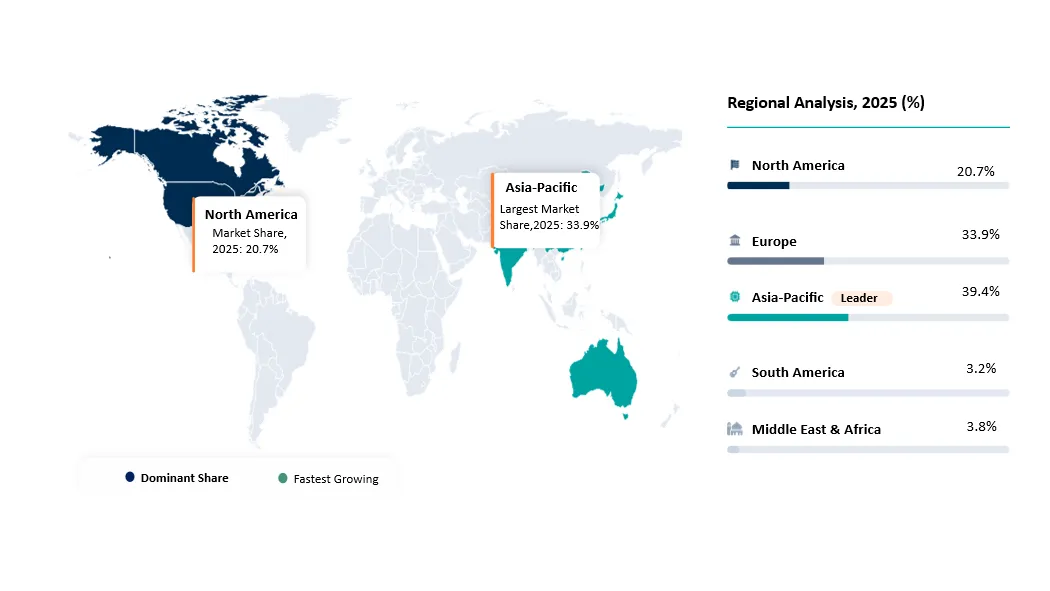
Asia-Pacific is expected to be the fastest-growing region. China combines large electrolyzer manufacturing capacity, fuel-cell vehicle programs and industrial hydrogen use. Japan and South Korea have established hydrogen mobility and fuel-cell ecosystems that require component, station and fuel-quality testing. India is expanding electrolyzer manufacturing and project development under the National Green Hydrogen Mission, which creates demand for domestic certification and laboratory capacity. Australia is focused on export-oriented hydrogen and ammonia projects, where emissions certification, gas quality and shipping-related testing are important. Regional buyers need internationally recognized accreditation because many products are intended for export. The opportunity is strongest for providers that can combine local laboratory capacity with global certification acceptance.
North America Hydrogen Testing Market Outlook
North America is a high-value market for hydrogen testing because it includes fuel-cell mobility, industrial hydrogen, pipeline research, electrolyzer manufacturing and federal hydrogen-hub investment. U.S. laboratories have strong capabilities in materials science, pressure systems and national-laboratory research. Project developers need testing for tax-credit eligibility, emissions intensity, equipment safety and hydrogen quality. Canada adds opportunities in heavy-duty transport, industrial decarbonization and export projects. Mexico offers emerging potential around industrial gases and manufacturing. Buyers prioritize compliance with ASME, SAE, NFPA, UL and ISO requirements, plus evidence that products can be approved across state and provincial jurisdictions.
Europe Hydrogen Testing Market Outlook
Europe is the largest current market because hydrogen policy is closely linked with industrial decarbonization, cross-border networks and equipment regulation. Germany, France, the Netherlands, the UK, Italy and Spain are investing in electrolyzers, pipelines, storage and industrial use. Europe also has a dense network of TÜV organizations, notified bodies, research institutes and materials laboratories. The 2026 TÜV SÜD laboratory expansion in Garching demonstrates continuing investment in dedicated capacity. European buyers place strong emphasis on CE marking, pressure equipment, ATEX, fuel quality and renewable-hydrogen certification. Cross-border infrastructure increases the value of harmonized testing and digital documentation.
South America Hydrogen Testing Market Outlook
South America presents growth opportunities in Brazil, Chile, Argentina and Colombia. Chile and Brazil have large renewable resources and export ambitions, which create demand for electrolyzer qualification, ammonia-related testing, emissions certification and port infrastructure assessment. Existing oil, gas and chemical industries provide a base of inspection and laboratory capability that can be adapted to hydrogen. The key constraint is project timing. Many developments remain early stage, so providers should combine hydrogen services with conventional industrial testing to maintain utilization.
Middle East and Africa Hydrogen Testing Market Outlook
The Middle East is developing large hydrogen and ammonia projects linked to low-cost renewable power, natural gas and export infrastructure. Saudi Arabia, UAE, Oman and Egypt require testing across electrolyzers, pipelines, storage, ammonia conversion and marine loading. Africa also presents longer-term opportunities in South Africa, Morocco, Namibia and Kenya. Export projects will need credible carbon-intensity certification and international product acceptance. Harsh climate, dust, heat and remote locations create additional environmental and field-testing requirements. Local partnerships and mobile testing capacity will be important because permanent specialist laboratories remain limited in many markets.
Country Opportunity Matrix
| Country | Priority Testing Opportunity | Buyer Intent |
| Germany | Electrolyzers, pipelines, components and certification | Cross-border approval, pressure equipment and industrial project support |
| U.S. | Materials, hubs, storage, refuelling and carbon intensity | Bankability, ASME/SAE compliance and lender assurance |
| China | Electrolyzers, fuel cells and manufacturing qualification | Scale, domestic standards and export acceptance |
| Japan | Fuel quality, mobility and fuel-cell durability | High reliability and long-duration performance |
| South Korea | Mobility, storage and industrial systems | OEM qualification and station safety |
| India | Electrolyzers, industrial projects and domestic labs | Localization, cost and international accreditation |
| Australia | Export hydrogen, ammonia and emissions certification | Traceability, shipping and bankability |
| Saudi Arabia | Large production projects and export terminals | Project commissioning and international product acceptance |
| UAE | Industrial use, mobility and export infrastructure | Integrated testing and field support |
| Brazil | Industrial hydrogen and export projects | Local capability and international certification |
Hydrogen Testing Market Competitive Landscape
- Global TIC companies compete through accreditation breadth, geographic reach and the ability to combine testing, inspection and certification.
- Specialist laboratories compete through deeper high-pressure, embrittlement, cryogenic or gas-analysis capability.
- National laboratories and research institutes influence method development and handle technically difficult programs.
- Equipment manufacturers increasingly build internal test capacity but still use independent laboratories for certification and customer confidence.
- Digital monitoring companies are entering the market through connected sensors, analytics and risk-based inspection platforms.
- Partnerships are increasing because no single provider has every hydrogen capability across all regions.
Key Companies of Hydrogen Testing Market
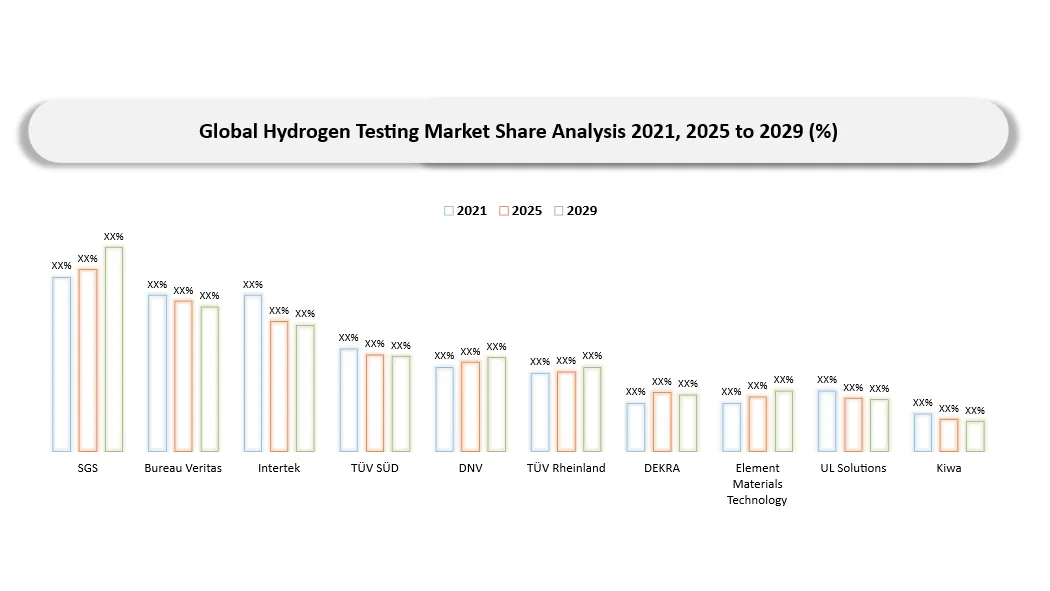
- SGS
- Bureau Veritas
- Intertek
- TÜV SÜD
- TÜV Rheinland
- DEKRA
- DNV
- Element Materials Technology
- UL Solutions
- Applus+
- Kiwa
- RINA
- Lloyd’s Register
- CSA Group
- HORIBA
- Emerson
- ABB
- Siemens Energy
- Fraunhofer Institutes
- National Renewable Energy Laboratory
Company Profile Coverage
Each company profile includes company overview, hydrogen testing portfolio, laboratory footprint, accreditation, sector focus, strategic positioning, partnerships and recent developments. The competitive analysis compares global TIC providers, specialized laboratories, engineering assurance companies and research organizations.
Hydrogen Testing Market Recent Developments
- April 2026: TÜV SÜD opened a dedicated hydrogen testing laboratory in Garching near Munich. The facility supports material compatibility, component qualification, design validation, certification, production monitoring and global market approval.
- 2025-2026: Element Materials Technology continued a US$10 million global investment program in hydrogen testing equipment and infrastructure, including high-pressure and materials capabilities.
- July 2025: ISO published ISO 19880-5:2025, updating requirements for hydrogen dispenser hoses and hose assemblies used at pressures up to 70 MPa.
- 2025: ISO published ISO 19880-2:2025 for gaseous-hydrogen fuelling-station dispensers, reinforcing component and system test requirements for public refuelling infrastructure.
- 2025: The IEA reported that global hydrogen demand had reached almost 100 million tonnes in 2024 and that more than 200 low-emissions hydrogen projects had reached committed investment status.
- 2025: Research and standards activity increased around hydrogen embrittlement, weld heat-affected zones and fatigue crack growth for pipelines being considered for hydrogen service.
Procurement Playbook for Hydrogen Testing Buyers
A buyer should begin by defining the asset, operating envelope, applicable standards and commercial decision that the test must support. The test plan should distinguish mandatory certification from optional engineering validation. Samples should be representative of production material, including welds, heat treatment and manufacturing tolerances. The contract should define data ownership, confidentiality, witness rights, failure handling, repeat testing and report acceptance. For long programs, buyers should request interim data and schedule checkpoints. Multi-country product launches require early agreement on whether one laboratory report can support several certificates. Field and laboratory evidence should be linked so that operating anomalies can be compared with qualification assumptions. Procurement teams should evaluate the laboratory’s accreditation scope, safety record, equipment availability, specialist staff and ability to explain results to regulators or insurers.
Capability Investment Priorities for Testing Providers
Testing providers should prioritize capabilities where demand is defensible and supply remains constrained. High-pressure hydrogen embrittlement, fatigue crack growth, composite vessel cycling, cryogenic transfer and trace contaminant analysis offer stronger barriers than generic inspection. Equipment investment should be supported by anchor customers or multi-sector utilization. A pressure chamber may serve pipelines, valves, storage and mobility components, improving economics. Accreditation planning should begin before equipment installation because method validation and quality systems affect commercial launch. Providers should also invest in sample preparation, microscopy, failure analysis and engineering interpretation, which increase value around the core test. Mobile field units can extend customer relationships into commissioning and operation. Digital record systems should preserve raw data, calibration, environmental conditions and approvals so that reports remain useful throughout the asset life.
Risk Framework for Hydrogen Asset Qualification
Qualification risk can be grouped into material, design, manufacturing, operating and compliance categories. Material risk includes embrittlement, permeation and chemical incompatibility. Design risk includes stress concentration, sealing and thermal expansion. Manufacturing risk includes weld defects, surface damage and inconsistent heat treatment. Operating risk includes pressure cycles, contaminants, temperature extremes and misuse. Compliance risk arises when standards are misinterpreted or market requirements change. A robust program maps each risk to a test, analysis or inspection method. Critical assumptions should be documented, especially where accelerated tests are used to predict service life. Failures should trigger root-cause analysis rather than simple retesting. This framework allows spending to concentrate on failure modes with the greatest safety or commercial consequence.
Hydrogen Purity and Sampling Strategy
Hydrogen purity testing is only as reliable as the sampling method. Samples can be contaminated by lines, cylinders, moisture, lubricants or ambient air. A testing program should define sampling points, purge procedures, containers, transport time and detection limits. Fuel-cell hydrogen requires analysis of contaminants that can poison catalysts or affect membranes. Industrial applications may tolerate different specifications, so the laboratory must use the correct quality grade. Continuous analyzers can detect trends, while accredited laboratory analysis provides reference results and dispute resolution. Suppliers should retain chain-of-custody records and calibration evidence. As hydrogen trade expands, standardized sampling and independent verification will become important for contracts and certification.
Pipeline Conversion Testing Roadmap
Pipeline conversion begins with records review, material identification and network segmentation. Operators then select representative samples from pipes, welds and fittings. Laboratory work may include chemistry, hardness, tensile properties, fracture toughness, fatigue crack growth, slow strain rate and permeation. Defect assessments should consider dents, gouges, corrosion and weld heat-affected zones. Pressure and blending scenarios need to reflect intended operation. Results feed integrity models and determine whether pressure reduction, replacement, coating, monitoring or inspection changes are required. Field pilots provide evidence before network-wide conversion. Periodic monitoring is needed because hydrogen exposure can interact with cyclic loading and existing defects. This roadmap creates a multi-year testing opportunity rather than a single qualification event.
Strategic Outlook to 2035
By 2035, hydrogen testing will be more closely integrated with asset management, product passports and commercial contracting. Large projects will use qualification data to establish performance guarantees, maintenance intervals and insurance terms. Operators will maintain digital records of pressure cycles, gas quality, calibration and inspection history. Test laboratories will use field data to improve accelerated methods and reduce uncertainty in remaining-life estimates. Standards will become more complete, though differences between jurisdictions will continue to create demand for regulatory advisory. Market growth will depend on the pace of hydrogen deployment, but testing intensity per project is likely to rise because buyers are becoming more selective and risk conscious. The most resilient providers will serve both conventional and low-emissions hydrogen, several asset categories and multiple stages of the lifecycle. Strategic investment should focus on scarce capabilities, recognized accreditation and partnerships that provide access to customers before equipment reaches final qualification. Laboratories that remain disconnected from project developers and operators may face irregular utilization, while integrated assurance providers can build recurring relationships through commissioning, inspection, purity monitoring and life-extension studies.
Analyst View / Opinion on Hydrogen Testing Market
- Hydrogen testing will grow as a risk-management and bankability service rather than only as a compliance expense.
- Materials compatibility and pipeline integrity will remain technically defensible segments with strong pricing power.
- Electrolyzer performance and durability testing will gain importance as buyers compare suppliers and enforce guarantees.
- Purity and carbon-intensity verification will expand the market beyond physical component testing.
- Europe will remain the largest testing ecosystem, while Asia-Pacific will generate the strongest new capacity demand.
- Long-term winners will combine accredited laboratories, field service, certification and digital lifecycle data.
Hydrogen Testing Market Target Audience
| Industry | Who Should Buy This Report? | Reason to Buy |
| Testing and TIC companies | CEOs, strategy heads, laboratory managers | Identify capability gaps, investment priorities and regional opportunities |
| Hydrogen equipment manufacturers | Product, engineering and certification teams | Plan qualification, standards and market access |
| Project developers and EPCs | Project directors and procurement teams | Select test partners and reduce commissioning risk |
| Pipeline and utility companies | Integrity and asset managers | Assess repurposing, materials and inspection needs |
| Industrial gas companies | Quality, operations and business development | Benchmark purity, supply and customer compliance needs |
| Investors and consultants | Private equity, infrastructure funds and advisors | Screen laboratories, service platforms and expansion opportunities |
Why Choose DATAM?
- Data-driven insights covering market sizing, test capability, standards, buyer criteria, pricing and regional opportunity.
- Post-purchase analyst support for capability benchmarking, partner identification and market-entry questions.
- White papers and case studies on hydrogen embrittlement, electrolyzer testing, purity and pipeline conversion.
- Annual updates reflecting standards, project pipelines, laboratory investment and competitive developments.
- Specialized emerging-market coverage across Asia-Pacific, Middle East, South America and Africa.
- Buyer-intent analysis focused on how testing decisions are made and where budgets will be allocated.
What DATAM Uniquely Provides
- Detailed 10-year market predictions by service, test type, asset, value-chain stage, end use, delivery model and region.
- Capability mapping for high-pressure, purity, pipeline, electrolyzer, storage and field testing.
- Country-level recommendations for TIC companies, manufacturers, developers, utilities and investors.
- AI impact, disruption, pricing intelligence, demand-supply gap and investment analysis.
- Partner identification and potential-customer mapping across the hydrogen ecosystem.




























































