


Chromatography Market Overview
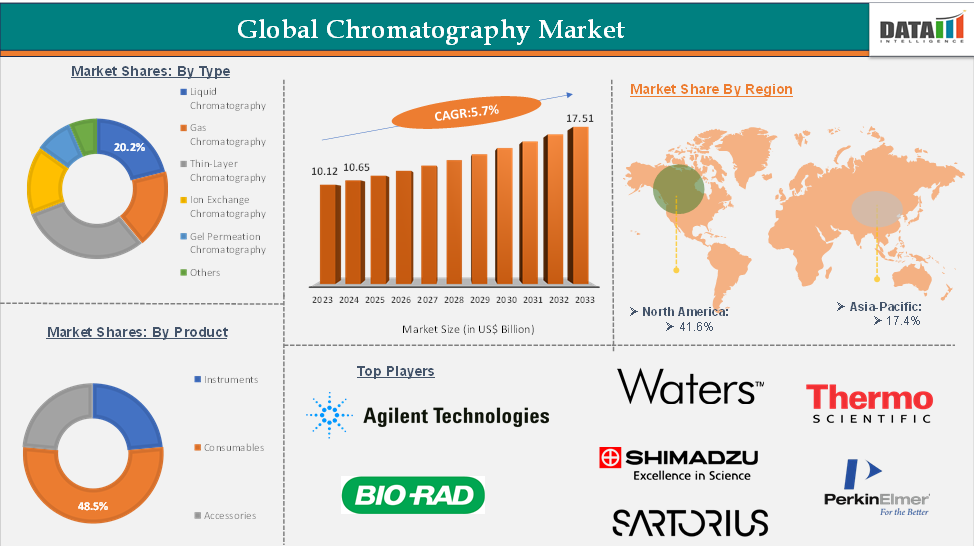
The global chromatography market reached US$ 10.12 billion in 2023, with a rise of US$ 10.65 billion in 2024, and is expected to reach US$ 17.51 billion by 2033, growing at a CAGR of 5.7%during the forecast period 2025-2033.
The chromatography market is undergoing a significant transformation, driven by advancements in analytical technologies, automation, and integration with digital platforms. Innovations such as high-performance liquid chromatography (HPLC), ultra-high-performance liquid chromatography (UHPLC), and mass spectrometry coupling are enhancing sensitivity, resolution, and speed of analysis.
The market is also trending toward miniaturized, portable chromatography systems, enabling real-time, on-site testing across industries like environmental monitoring, food safety, and clinical diagnostics. Additionally, AI and data analytics are being integrated to streamline data interpretation and improve accuracy. The push for green chromatography techniques, such as solvent-free or reduced-solvent methods, reflects a growing focus on sustainability.
As pharmaceutical R&D, biotechnology, and forensic testing continue to expand, chromatography is becoming increasingly central to quality control, compliance, and precision diagnostics, fueling market growth across global sectors.
Chromatography Market Key Takeaways
- North America remains a leading region, supported by strong adoption of advanced analytical technologies across pharmaceuticals, biotechnology, and research laboratories.
- Asia-Pacific is expected to witness the fastest growth, driven by expanding pharmaceutical manufacturing, biotechnology research, and laboratory infrastructure across China, India, Japan, and South Korea.
- Pharmaceutical and biotechnology applications remain major contributors to chromatography demand, particularly for drug development, quality control, and biomolecule analysis.
- Liquid chromatography continues to be widely adopted because of its precision and suitability for complex pharmaceutical, biological, and environmental samples.
- Automation and advanced chromatography systems are improving laboratory productivity through faster analysis, higher accuracy, reduced manual intervention, and better data management.
- Environmental testing is creating additional opportunities as laboratories increasingly use chromatography to detect contaminants, pesticides, pollutants, and other trace compounds.
- Mass spectrometry integration is strengthening chromatography workflows by enabling more sensitive identification and quantification of complex compounds.
- AI, software, and laboratory automation are becoming increasingly important, supporting predictive maintenance, automated workflows, real-time monitoring, and more efficient analytical decision-making.
Executive Summary
Chromatography Market Dynamics: Drivers & Restraints
Driver: Increasing Demand for Pharmaceutical and Biopharmaceutical Analysis
The increasing demand for pharmaceutical and biopharmaceutical analysis is significantly driving the chromatography market. As the development of new drugs, biologics, and vaccines accelerates, there is a growing need for precise analytical techniques to ensure product quality, purity, and safety. Chromatography plays a critical role in every stage of the pharmaceutical lifecycle.
The rise of complex biologics and biosimilars, which require advanced purification and characterization, has further intensified reliance on high-performance liquid chromatography (HPLC), gas chromatography (GC), and other techniques.
Regulatory agencies such as the U.S. FDA and EMA mandate detailed analytical data, making chromatography indispensable for regulatory compliance. As pharmaceutical R&D spending increases globally and personalized medicine gains traction, the demand for robust, sensitive, and high-throughput chromatographic systems is expected to continue growing, significantly boosting the market.
Restraint: High Cost of Equipment and Maintenance
The high cost of chromatography equipment and its ongoing maintenance can significantly hinder the growth of the chromatography market, particularly in small laboratories and emerging economies. Advanced systems such as HPLC, UHPLC, and mass spectrometry-coupled instruments require substantial initial investment, often reaching tens or even hundreds of thousands of dollars.
Beyond the purchase price, routine calibration, servicing, replacement of columns, detectors, and software upgrades contribute to high operational expenses. These costs can be prohibitive for academic institutions, low-resource clinical settings, and small-scale testing facilities, limiting their ability to adopt or upgrade chromatography technologies.
Chromatography Market Segmentation Analysis
The global chromatography market is segmented based on type, product, system type, end-user, and region.
Product:
The instruments segment is expected to have 24.8% of the chromatography market share.
The instruments segment is poised to hold a dominant share of the global chromatography market, especially in liquid chromatography (LC) systems, which accounted for over 55% of instrument revenue in 2023–2024. These systems are critical for high-precision applications in pharmaceuticals, environmental testing, food safety, and clinical diagnostics. For instance, Waters Corporation's Alliance iS HPLC system, introduced in March 2023, significantly enhanced operational intelligence and quality control workflows, reducing errors by up to 40% in QC settings.
Investment in next-generation chromatography hardware is further accelerating growth in the instruments sector. As such, this segment is expected to continue leading the market, supported by increasing demand across regulated industries and ongoing technological innovation.
Chromatography Market Geographical Shares
The North America chromatography market was valued at 41.60% market share in 2024
North America remains the dominant region in the global chromatography market, driven by a strong pharmaceutical and biotechnology industry, advanced healthcare infrastructure, and strict regulatory standards that mandate precise analytical testing. The presence of major chromatography equipment manufacturers, such as Agilent Technologies, Waters Corporation, Danaher Corporation, and Thermo Fisher Scientific, further strengthens the region’s leadership. Ongoing investments in R&D, especially in drug development, personalized medicine, and biologics, continue to boost demand for high-performance chromatography systems.
Additionally, regulatory bodies like the U.S. FDA require rigorous quality control, encouraging widespread adoption of chromatography in pharmaceutical and environmental testing. With a well-established market and consistent technological innovation, North America is expected to maintain its leading position in the coming years.
Chromatography Market Competitive Landscape and Key Players
The major players in the chromatography market include Bio-Rad Laboratories, Inc., Agilent Technologies, Inc., Shimadzu Corporation, Thermo Fisher Scientific Inc., Waters Corporation, PerkinElmer, Sartorius AG, Danaher Corporation, Hitachi High-Tech Corporation, and Bruker, among others.
Chromatography Market Key Developments
July 2026: Agilent Technologies expanded its Altura HPLC column portfolio with new size exclusion chromatography and PLRP-S columns designed for biotherapeutic analysis, including peptides, proteins, oligonucleotides, and conjugated therapeutics.
- June 2026: Waters Corporation launched BioResolve Peptide and GTxResolve Lipid Phenyl-Hexyl+ and C18+ reversed-phase columns to accelerate characterization of GLP-1 peptides, insulin, and lipid nanoparticles, with up to 3x faster analysis.
- May 2026: Agilent Technologies introduced a Multi-Attribute Method workflow combining LC/HRMS instrumentation, software, columns, consumables, and standards to support routine pharmaceutical and biopharmaceutical quality control.
- April 2026: BrightSpec and Restek launched SpectrAline cartridges, a new preconcentration column solution for molecular rotational resonance applications designed to improve sensitivity and sample loading for challenging matrices.
- March 2026: Shimadzu launched the Nexera IC ion chromatograph for quantitative analysis of ionic species in applications including water quality testing, environmental analysis, and laboratory workflows.
- February 2026: BÜCHI Labortechnik introduced its Pure Excellence Chromatography Systems, including the C-905, C-910, C-915, and C-950, supporting flash chromatography and preparative HPLC purification workflows.
- January 2026: ChromaNik Technologies launched SunShell Peptide C9 and SunShell Protein C8 columns, designed to improve separation performance and reproducibility for peptide and protein LC-MS analysis.
Global Chromatography Market: Scope
Metrics | Details | |
CAGR | 5.7% | |
Market Size Available for Years | 2022-2033 | |
Estimation Forecast Period | 2025-2033 | |
Revenue Units | Value (US$ Bn) | |
Segments Covered | Type | Liquid Chromatography, Gas Chromatography, Thin-Layer Chromatography, Ion Exchange Chromatography, Gel Permeation Chromatography, Others |
Product | Instruments, Consumables, Accessories | |
| System Type | Single Use Systems, Multi-Use Systems |
| End-User | Pharmaceutical & Biotechnology Companies, Food & Beverage Companies, Research Institutes, Others |
Regions Covered | North America, Europe, Asia-Pacific, South America, and the Middle East & Africa | |
The global chromatography market report delivers a detailed analysis with 56 key tables, more than 53 visually impactful figures, and 195 pages of expert insights, providing a complete view of the market landscape.
Suggestions for Related Report
For more Laboratory Equipment-related reports, please click here




























































