


Europe Electrical Digital Twin Market Size
Europe Electrical Digital Twin Market Size reached US$ 426.22 million in 2024 and is expected to reach US$ 1,151.05 million by 2032, growing with a CAGR of 13.4% during the forecast period 2025-2032.
Europe’s electrical digital twin market is advancing through large-scale public funding and cross-border grid harmonization. The TwinEU project, launched in 2024, is the first to create a federated ecosystem for digital twins across 15 EU countries. Germany is piloting AI-integrated twins for grid stress testing under real-time renewable loads. France’s RTE is using digital twins to simulate extreme weather impacts on substations. The EU’s focus on energy data spaces is also enabling secure, shared digital infrastructure modeling across utilities.
Electrical Digital Twin Market Trend
A unique trend in the European market is the collaborative effort between the European Network of Transmission System Operators for Electricity (ENTSO-E) and the EU Distribution System Operators (DSO) Entity. In December 2022, they signed a declaration of intent to develop a digital twin of the European electricity grid. This initiative aims to enhance the efficiency and smartness of the grid, contributing to the goals set under the REPowerEU Plan by building an affordable, secure, sustainable and independent European energy system.
Europe Electrical Digital Twin Market Key Takeaways
- USD 1.15 billion is the 2032 market opportunity. Europe’s electrical digital twin market is expanding from USD 426.22 million in 2024, reflecting rising investment in smart grids, renewable integration, grid modernization and digital infrastructure.
- Grid modernization is becoming the primary adoption catalyst. Europe’s aging electricity infrastructure faces increasing pressure from decentralized and intermittent renewable generation, creating demand for digital twins that improve real-time visibility, grid stability and operational planning.
- Pan-European digital twins are moving from concept to infrastructure strategy. The TwinEU project, launched in 2024 across 15 EU countries, is developing a federated ecosystem of digital twins to support interoperable energy infrastructure modeling and renewable-heavy grid planning.
- Cloud deployment is gaining strategic momentum. Cloud-based electrical digital twins enable scalable infrastructure, real-time data processing, centralized monitoring and cross-border collaboration, making them increasingly important for distributed European energy systems.
- Renewable integration is increasing digital twin intensity. As solar and wind penetration rises, utilities require more sophisticated simulation, forecasting and monitoring capabilities to manage variable generation, optimize energy distribution and maintain grid resilience.
- AI, IoT, edge computing and 5G are transforming digital twin capabilities. These technologies enable real-time virtual models of electrical assets, faster data processing, predictive maintenance and scenario simulation for applications ranging from asset failure prediction to optimal energy dispatch.
- Predictive maintenance is becoming a high-value use case. Digital twins allow utilities and grid operators to monitor asset performance, identify potential failures and optimize maintenance decisions, helping reduce operational costs and improve power-system reliability.
- Interoperability and legacy-system integration remain critical challenges. High implementation costs, aging infrastructure and the need to integrate modern digital twin platforms with existing systems can slow adoption, particularly among organizations with limited technology budgets.
- Regulation and public investment are accelerating market development. European decarbonization targets, smart-grid initiatives and large-scale grid modernization investments are creating a favorable environment for digital twin adoption across utilities and grid infrastructure operators.
- The competitive landscape is shifting toward intelligent grid optimization. Leading players including General Electric, Microsoft, Hitachi, Schneider Electric and ABB are positioning digital twin technologies around grid efficiency, predictive analytics, asset management and resilient power infrastructure.
Europe Electrical Digital Twin Market Scope
| Metrics | Details | |
| By Twin Type | Digital Gas & Stream-Power Plant, Digital Wind Farm, Digital Grid, Digital Hydropower Plant, Others. | |
| By Usage Type | Product Digital Twin, Process Digital Twin, System Digital Twin. | |
| By Deployment Mode | Cloud, On-premises. | |
| By Application | Asset Performance Management, Business & Operations Optimization, Fault Detection & Predictive Maintenance, Performance Optimization, Others. | |
| By End-User | Utilities, Grid Infrastructure Operators, Others. | |
| By Country | Germany, UK, France, Spain, Italy, Rest of Europe | |
| Report Insights Covered | Competitive Landscape Analysis, Company Profile Analysis, Market Size, Share, Growth |
Explore the Future of the Europe Electrical Digital Twin Market
Get a comprehensive sample report covering Europe Electrical Digital Twin Market trends, technology advancements, competitive landscape, application insights, and growth opportunities. Request your sample today to understand the key factors shaping the future of digital twin technology across Europe’s electrical infrastructure. Request Sample Report Today!
Europe Electrical Digital Twin Market Dynamics
Integration of Renewable Energy Sources into Aging Grid Infrastructure
The integration of renewable energy sources into Europe's aging power grid is a significant driver for the adoption of electrical digital twin technologies. As the continent accelerates its transition to clean energy, the existing grid infrastructure, much of which is over 40 years old, struggles to accommodate the decentralized and intermittent nature of renewable energy. This challenge necessitates advanced solutions to ensure grid stability and efficiency.
Recent events underscore the urgency of modernizing Europe's power infrastructure. In April 2025, a massive power outage across the Iberian Peninsula highlighted the vulnerabilities of the current grid system. The blackout, which affected Spain, Portugal and parts of France, was attributed to the mismanagement of renewable energy within an outdated grid, emphasizing the need for advanced monitoring and control systems.
Recognizing these challenges, the European Union has outlined substantial investments to upgrade the power grid. The European Commission estimates that achieving the 'Fit for 55' target, which mandates 42.5% renewable power in the grid by 2030, will require over US$ 664.57 billion in investments this decade. A significant portion of this investment is directed towards digitalization, including the deployment of smart grids and advanced monitoring systems.
High Initial Implementation and Integration Costs
High initial implementation and integration costs are a significant restraint on the growth of the electrical digital twin market in Europe. Developing and deploying digital twin systems necessitates substantial investments in advanced sensors, data acquisition systems, modeling software and IT infrastructure. These costs can be particularly burdensome for small and medium-sized enterprises (SMEs), which constitute over 99% of businesses in the EU, according to Eurostat. The financial barrier posed by these initial expenses limits the accessibility of digital twin technologies to larger organizations with sufficient budgets.
Furthermore, the integration of digital twin solutions with existing legacy systems adds to the complexity and cost. Many organizations, especially in the manufacturing and utilities sectors, rely on older infrastructure that may not be compatible with modern digital technologies. This necessitates costly upgrades and extensive customization, creating a barrier for businesses seeking to implement digital twin systems seamlessly.
The European Union recognizes these challenges and has initiated projects like TwinEU to address them. TwinEU, launched in January 2024 with a budget of over US$ 28.68 million, aims to develop a federated ecosystem of digital twin solutions across Europe. The project involves 75 partners from 15 countries and focuses on creating interoperable digital replicas of energy infrastructure, facilitating optimal management and planning in scenarios with high integration of renewable energy sources.
Electrical Digital Twin Market Segment Analysis
The Europe electrical digital twin market is segmented based on twin type, usage type, deployment mode, application, end-user and country.
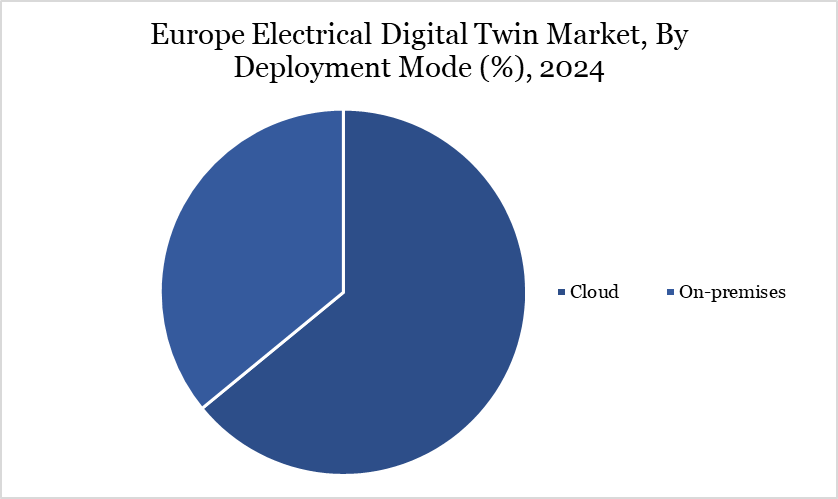
Advancements in Cloud-Based Twin are Expected to Drive the Segment Growth
Advancements in cloud-based digital twin technologies are significantly driving growth in the Europe electrical digital twin market, highlighting a strong shift toward scalable, remotely accessible infrastructure. This growth aligns with the European Commission’s focus on expanding secure cloud services under its Digital Strategy. Cloud platforms enable real-time data processing, centralized monitoring and cross-border collaboration among utilities and grid operators, making them essential for managing complex, distributed energy systems and accelerating smart grid transformation across Europe.
Electrical Digital Twin Market Geographical Share
Smart Grid Advancements Drive the Market in Europe
Europe has experienced notable expansion in the electrical digital twin market, fueled by its focus on smart grid advancements, renewable energy integration and industry digitalization. Digital twins, which create virtual replicas of physical electrical systems, are being increasingly adopted to optimize operations, reduce costs and enhance predictive maintenance capabilities.
The European Union's progress in transitioning to clean electricity, particularly through solar and wind power, is significantly influencing the electrical digital twin market. As solar power surpassed coal in 2024 and the share of renewables rose to 47%, there is increasing demand for advanced digital solutions to manage this growing complexity in the grid. The shift away from fossil fuels, alongside a steady decline in gas power, is driving the need for efficient, real-time monitoring and predictive tools, like digital twins, to ensure grid stability and optimize energy distribution.
Additionally, regulatory support and investments in grid modernization projects are fueling growth. For instance, in January 2024, the TwinEU project was launched to create a digital twin of the entire European electricity grid. The initiative brings together grid and market operators, technology providers and research centers to develop a pan-European digital twin through the federation of local twins.
Europe Electrical Digital Twin Market Technological Analysis
The Europe electrical digital twin market is being transformed by the convergence of advanced technologies such as AI, IoT, high-performance computing and edge connectivity. Digital twins enable utilities to create real-time virtual models of physical grid components, enhancing system visibility, predictive maintenance and performance optimization.
The rollout of 5G networks and edge computing across the EU backed by initiatives like the “Path to the Digital Decade” has significantly reduced data latency, which is essential for responsive grid control and dynamic load management. These advancements are especially important for integrating variable renewable energy sources, such as wind and solar, into Europe’s energy mix. AI-powered analytics further allow operators to simulate and forecast scenarios ranging from asset failure to optimal energy dispatch, driving operational efficiency and stability.
Electrical Digital Twin Market Major Players
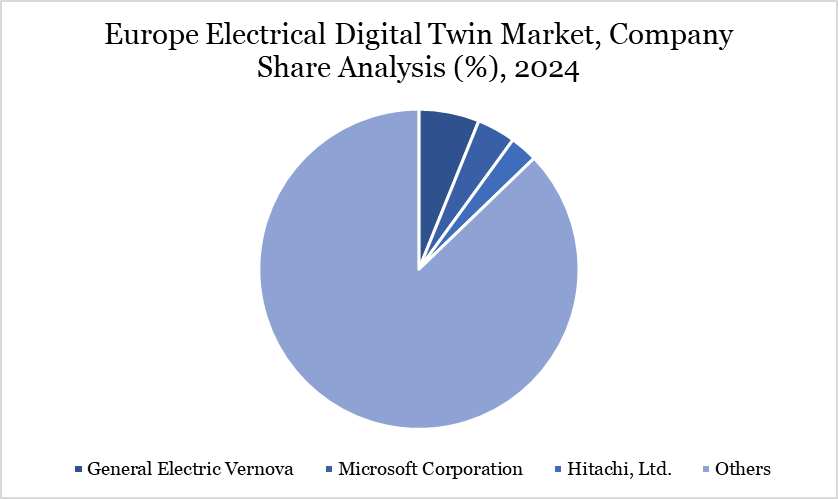
The major players in the market include General Electric Verona, Microsoft Corporation, Hitachi Ltd., Schneider Electric SE, ABB Ltd. and others.
Electrical Digital Twin Market Recent Developments
- July 2026 – ABB strengthens digital modeling for distributed energy systems
ABB made a strategic investment in UK-based Gridcog to expand advanced modeling capabilities for microgrids, distributed energy resources (DERs), renewable generation, and energy storage. The collaboration supports faster design, comparison, and validation of complex energy projects, strengthening digital twin and simulation capabilities across Europe. - June 2026 – Schneider Electric advances electrical digital twin applications
Schneider Electric highlighted the growing role of electrical digital twins in transforming real-time power monitoring data into actionable operational insights. Integration of EcoStruxure Power Monitoring Expert with ETAP enables organizations to connect live electrical data with system-level models for scenario analysis, reliability improvement, and predictive decision-making. - June 2026 – ABB integrates electrical assets into NVIDIA digital twin platform
ABB expanded its collaboration with NVIDIA by integrating SimReady 3D digital assets, including medium-voltage switchgear, electrical distribution equipment, and UPS systems, into NVIDIA Omniverse DSX Blueprint. The solution enables engineers to model and validate electrical, thermal, and computing infrastructure in digital twins before physical deployment. - June 2026 – AVEVA, Schneider Electric and Heriot-Watt University advance digital twins for net-zero infrastructure
AVEVA, Schneider Electric and Heriot-Watt University announced a collaboration to explore digital twin technologies for smarter, lower-carbon energy and transport infrastructure. The initiative is expected to support improved infrastructure planning, energy efficiency, and digital transformation across the UK and wider European market. - May 2026 – ABB invests $200 million in European grid transformation
ABB announced approximately $200 million of investments across Europe to expand medium-voltage technology manufacturing and accelerate next-generation electrical distribution infrastructure. The investments across Italy, Bulgaria, Finland, Germany, Norway and Poland are expected to support utilities and industries modernizing power networks, creating additional demand for digitally enabled grid technologies. - March 2026 – Schneider Electric and ETAP launch physics-based digital twin for utilities
Schneider Electric and ETAP introduced a physics-based digital twin solution designed to help utilities and critical infrastructure operators strengthen grid resilience and accelerate modernization. The solution combines engineering-grade electrical simulation with lifecycle modeling, enabling operators to analyze grid conditions and infrastructure changes before implementation. - March 2026 – European Commission accelerates electricity-grid digital twin deployment
The European Commission outlined continued support for transmission and distribution system operators to develop and deploy digital twin solutions, including a dedicated toolbox aimed at improving interoperability, scalability and practical adoption. The initiative is intended to improve grid utilization, renewable integration, resilience and investment decisions across Europe. - January 2026 – ABB strengthens European grid digitalization through Netcontrol acquisition
ABB announced the acquisition of Netcontrol, a provider of electrical grid automation solutions for utilities and critical infrastructure operators. The move strengthens ABB’s grid automation portfolio and supports the growing need to digitalize electricity networks as Europe integrates more renewable generation and manages increasingly complex grid conditions. - 2026 – EU digitalization initiatives prioritize digital twins for distribution grids
EU energy digitalization programs are increasingly focusing on real-time grid observability, digital twins, distributed energy resource integration, demand forecasting, and flexibility management. These priorities are supporting the development of digitalized distribution networks capable of integrating solar, batteries, EV charging and heat pumps more efficiently. - 2026 – ABB advances automated digital twin creation for DC grids
ABB's 2026 Startup Challenge highlighted automated digital twin creation for DC grid assets, focusing on simulation models for converters and circuit breakers used in hardware-in-the-loop environments. The initiative targets applications including microgrids, renewable energy, EV charging infrastructure, industrial facilities and buildings.
Why Choose DataM?
- Data-Driven Insights: Dive into detailed analyses with granular insights such as pricing, market shares and value chain evaluations, enriched by interviews with industry leaders and disruptors.
- Post-Purchase Support and Expert Analyst Consultations: As a valued client, gain direct access to our expert analysts for personalized advice and strategic guidance, tailored to your specific needs and challenges.
- White Papers and Case Studies: Benefit quarterly from our in-depth studies related to your purchased titles, tailored to refine your operational and marketing strategies for maximum impact.
- Annual Updates on Purchased Reports: As an existing customer, enjoy the privilege of annual updates to your reports, ensuring you stay abreast of the latest market insights and technological advancements. Terms and conditions apply.
- Specialized Focus on Emerging Markets: DataM differentiates itself by delivering in-depth, specialized insights specifically for emerging markets, rather than offering generalized geographic overviews. This approach equips our clients with a nuanced understanding and actionable intelligence that are essential for navigating and succeeding in high-growth countrys.
- Value of DataM Reports: Our reports offer specialized insights tailored to the latest trends and specific business inquiries. This personalized approach provides a deeper, strategic perspective, ensuring you receive the precise information necessary to make informed decisions. These insights complement and go beyond what is typically available in generic databases.
Target Audience
- Manufacturers/ Buyers
- Industry Investors/Investment Bankers
- Research Professionals
- Emerging Companies




























































