


Dystrophin Gene Therapy Market Size
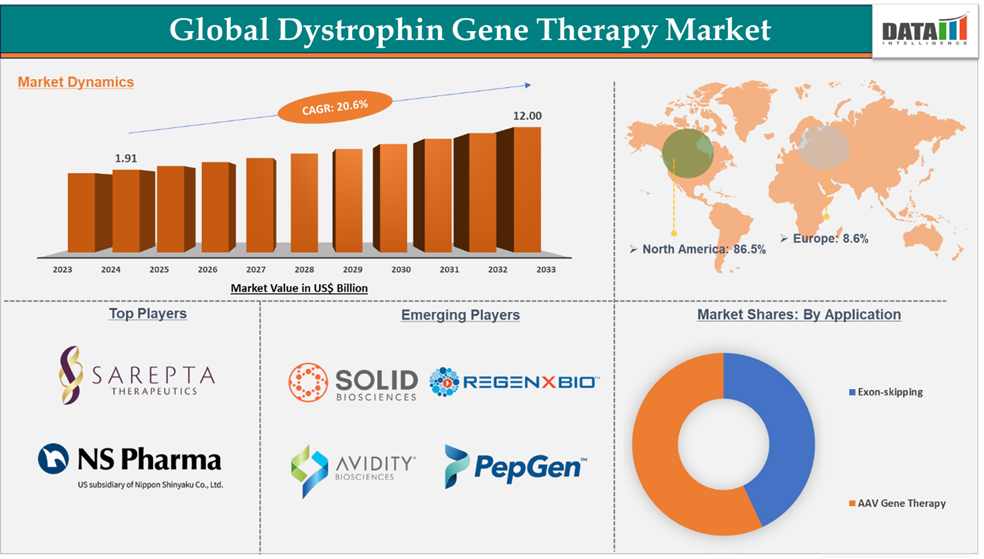
Dystrophin Gene Therapy Market reached US$ 2.30 Billion in 2025 and is expected to reach US$ 12.00 Billion by 2033, growing at a CAGR of 20.6% during the forecast period 2026-2033.
The Dystrophin Gene Therapy market is experiencing significant growth due to the rising development of advanced gene therapies and a growing number of patients with high unmet needs. However, the high cost of dystrophin gene therapies and the complexity in conducting clinical trials can significantly hinder their adoption. The strategic partnerships and collaborations are a key opportunity for market expansion in the forecast period.
Dystrophin Gene Therapy Market Executive Summary
For more details on this report - Request for Sample
Key Takeaways
- North America accounted for approximately 48-52% of the global Dystrophin Gene Therapy Market share in 2025, driven by increasing regulatory support for rare disease therapeutics, expanding clinical research activities, and significant investments supporting gene therapy commercialization initiatives.
- Adeno-associated viral (AAV) vector-based therapies represented nearly 65-70% of total market revenue in 2025 owing to their widespread adoption across dystrophin gene delivery programs and demonstrated therapeutic potential in Duchenne Muscular Dystrophy applications.
- Duchenne Muscular Dystrophy treatment applications contributed approximately 80-85% of overall market demand in 2025, supported by increasing diagnostic capabilities and expanding adoption of precision medicine approaches across rare disease management programs.
- More than 75% of newly announced clinical development initiatives globally are focused on next-generation micro-dystrophin technologies, optimized vector engineering platforms, and innovative gene-editing approaches designed to improve therapeutic efficacy and safety profiles.
- Biotechnology and pharmaceutical organizations accounted for nearly 70% of total market investments in 2025, reflecting increasing expenditures supporting clinical development programs, manufacturing infrastructure expansions, and strategic commercialization initiatives.
- Micro-dystrophin technologies are anticipated to contribute approximately 40-45% of future commercialization opportunities through 2033 owing to increasing clinical validation activities and expanding therapeutic applications worldwide.
- Asia-Pacific is projected to register the fastest regional growth during the forecast period owing to improving rare disease diagnosis capabilities, expanding biotechnology infrastructure, and rising investments supporting advanced therapeutic innovations across emerging healthcare markets.
- Patient-centric reimbursement programs and value-based healthcare models are expected to account for approximately 30-35% of future market access initiatives globally, substantially strengthening treatment accessibility across major pharmaceutical markets.
- More than 60% of strategic collaborations announced across the market involve manufacturing partnerships, clinical development programs, and advanced gene delivery technologies, highlighting the increasing importance of technological innovation worldwide.
- The Dystrophin Gene Therapy Market is projected to witness substantial growth through 2033, driven by continuous technological advancements, expanding clinical development activities, and increasing investments supporting rare disease therapeutic innovations.
Dystrophin Gene Therapy Market Scope
| Metrics | Details | |
| CAGR | 20.6% | |
| Market Size Available for Years | 2025-2033 | |
| Estimation Forecast Period | 2026-2033 | |
| Revenue Units | Value (US$ Mn) | |
| Segments Covered | Therapeutic Approach | Exon-skipping, AAV Gene Therapy |
| Therapy | Elevidys, Exondys 51, Amondys 45, Viltepso, Vyondys 53 | |
| Regions Covered | North America, Europe, Asia-Pacific, South America, and the Middle East & Africa | |
Dystrophin Gene Therapy Market Dynamics: Drivers & Restraints
The rising development of advanced gene therapies is driving the market growth
With the introduction of exon skipping therapies and AAV gene therapy, the DMD treatment landscape has been experiencing significant growth. Several companies are investing in developing advanced gene therapies that can address the DMD population with high unmet needs. There are several gene therapies, which are currently in clinical development, that are expected to make market entry in the forecast period and drive the overall market growth.
For instance, REGENXBIO's RGX-202, an investigational gene therapy for Duchenne muscular dystrophy, has shown consistent and robust microdystrophin expression in two new patients. The treatment showed 122.3% and 31.5% more expression in patients aged 3-7, respectively. RGX-202 was localized to the sarcolemma and was well-tolerated, with no serious adverse events or special interest (AESI) reported. The company plans to share more phase 1/2 functional data in 2025.
In November 2024, REGENXBIO announced that the first patient had been dosed in the pivotal phase 3 portion of AFFINITY DUCHENNE, and the company plans to submit a Biologics License Application (BLA) by mid-2026.
In the forecast period, several such novel gene therapies are expected to be launched commercially and boost the overall market growth.
High cost of dystrophin gene therapies may restrain the market growth
Although gene therapies have revolutionized the Duchenne muscular dystrophy treatment landscape, their high cost can be a significant restraining factor for their adoption. For instance, the cost of Elevidys, a revolutionary AAV vector-based gene therapy for DMD, can cost up to US$ 3.2 million per single dose administration, making it one of the most expensive treatments on the market.
Patients who are living in low-income countries or middle-class families, and those who don’t have proper insurance coverage, may not have access to these advanced therapies. More often, due to their higher cost, payers may employ stringent eligibility criteria to get access. This economic challenge poses a significant restraint on the growth of dystrophin gene therapies globally.
Dystrophin Gene Therapy Market Regulatory and Accelerated Approval Landscape Analysis
The Dystrophin Gene Therapy Market operates within an evolving regulatory environment characterized by increasing support for rare disease therapeutics addressing significant unmet clinical needs. Regulatory authorities worldwide continue emphasizing comprehensive clinical validation requirements, long-term patient monitoring initiatives, and manufacturing quality standards governing advanced therapeutic products. Accelerated approval pathways supporting innovative gene therapies are anticipated to improve commercialization timelines across major healthcare markets. Additionally, evolving regulatory frameworks supporting personalized medicine initiatives are expected to substantially influence future market developments globally.
Dystrophin Gene Therapy Market Manufacturing and Commercialization Landscape Analysis
Commercial manufacturing capabilities remain strategically important across dystrophin gene therapy commercialization activities worldwide. Manufacturers are increasingly investing in scalable production technologies supporting viral vector manufacturing operations, quality assurance programs, and commercial-scale bioprocessing capabilities. Strategic collaborations involving biotechnology organizations and specialized manufacturing partners continue accelerating commercialization initiatives globally. Investments supporting manufacturing automation technologies and supply chain optimization activities are anticipated to substantially strengthen future market expansion across advanced therapeutics manufacturing ecosystems.
Dystrophin Gene Therapy Market Patient Access and Reimbursement Analysis
Patient access remains among the most significant determinants influencing commercialization activities across rare disease therapeutics globally. Healthcare systems are increasingly evaluating innovative reimbursement models supporting access to high-value gene therapies capable of addressing significant unmet medical needs. Outcome-based reimbursement frameworks and value-based healthcare initiatives are anticipated to substantially improve patient accessibility across major pharmaceutical markets. Growing collaborations involving healthcare providers, payers, and therapeutic developers are expected to significantly strengthen future treatment accessibility worldwide.
Dystrophin Gene Therapy Market Investment, Funding, and Strategic Collaboration Analysis
Public and private sector investments supporting dystrophin gene therapy innovations continue creating substantial commercialization opportunities globally. Biotechnology organizations, pharmaceutical companies, and institutional investors are increasingly allocating resources toward clinical development programs, manufacturing infrastructure expansions, and technological innovation initiatives. Strategic licensing agreements, research collaborations, and acquisition activities are expected to significantly accelerate market developments throughout the forecast period. Furthermore, increasing investments supporting rare disease therapeutics are anticipated to strengthen future market competitiveness considerably.
Dystrophin Gene Therapy Market Supply Chain and Cold Chain Logistics Analysis
Supply chain resilience remains critically important across advanced therapeutic commercialization activities worldwide. Manufacturers are increasingly investing in integrated supply chain capabilities supporting vector production technologies, quality management systems, and specialized cold chain logistics requirements governing temperature-sensitive therapeutic products. Strategic initiatives supporting geographically diversified manufacturing operations are anticipated to substantially improve supply reliability across major healthcare markets. Additionally, advancements involving digital supply chain monitoring technologies are expected to improve operational efficiencies considerably throughout the forecast period.
Dystrophin Gene Therapy Market Emerging Technologies and Pipeline Analysis
Emerging technologies involving genome editing platforms, next-generation viral vectors, targeted delivery systems, and combination therapeutic approaches are substantially transforming future market opportunities. Innovations supporting improved transgene expression capabilities and enhanced therapeutic durability are expected to significantly strengthen commercialization prospects globally. Furthermore, increasing diversification across rare disease therapeutic pipelines is anticipated to expand future treatment opportunities considerably throughout the forecast period.
Dystrophin Gene Therapy Market Segment Analysis
The global dystrophin gene therapy market is segmented based on therapeutic approach, therapy, and region.
Exon-skipping in the therapeutic approach segment accounted for 57.0% of the market share in 2024 in the global dystrophin gene therapy market
Mutations in the dystrophin gene cause DMD by preventing the dystrophin protein from functioning properly. Exon-skipping therapies target these genetic alterations by using antisense oligonucleotides (ASOs) to "skip" defective exons in the dystrophin gene transcript. This process restores the gene's reading frame, resulting in the creation of a truncated but functional dystrophin protein. Such improvements indicate a fundamental shift in DMD therapy strategies, putting exon-skipping at the forefront of the market.
For instance, the approval of many exon-skipping medicines by regulatory agencies, including Eteplirsen (Exondys 51), Golodirsen (Vyondys 53), Casimersen (Amondys 45), and viltolarsen (viltepso), has strengthened the segment's position. These medicines are intended to address certain mutations, exons 51, 53, and 45, that affect approximately 30% of DMD patients with susceptible mutations. All these therapies combinedly generated US$ 1.09 billion in revenue in 2024, which is approximately 57% of the overall market share.
The good clinical outcomes associated with this therapy, such as enhanced dystrophin synthesis in muscle fibers and prospective improvements in muscular function, have attracted the attention of both healthcare providers and patients. As additional medicines are approved and introduced into the market, the dependence on exon-skipping techniques is projected to increase, propelling the market growth.
Dystrophin Gene Therapy Market Geographical Analysis
North America dominated the dystrophin gene therapy market with the highest share of 86.5% in 2024
North America’s dominance is contributed to by various factors, including the rising prevalence of DMD, recent approvals, advanced healthcare infrastructure, strong research and development (R&D) capabilities, and a favorable regulatory environment.
Furthermore, North America's regulatory landscape plays a crucial role in its market dominance. The United States Food and Drug Administration (FDA) has launched steps to speed up the approval process for novel medicines, particularly those tackling uncommon diseases such as DMD. The FDA's Orphan Drug Designation program incentivizes firms to explore medicines for uncommon illnesses, allowing new therapies to reach the market more quickly.
The prevalence of DMD is increasing day by day. For instance, according to the National Institute of Health, the estimated incidence is one per 3600 male live-born newborns. Some studies suggest that DMD affects 2 out of every 10,000 people in the United States.
The increasing number of approvals also contributes the largest market share in this region. For instance, in June 2024, the FDA announced the accelerated approval of ELEVIDYS (delandistrogene moxeparvovec-rokl), an adeno-associated virus-based gene therapy, for the treatment of ambulatory pediatric patients aged 4 to 5 years with Duchenne muscular dystrophy (DMD) and a confirmed mutation in the DMD gene.
This indication is authorized under rapid approval, based on the expression of ELEVIDYS micro-dystrophin seen in patients treated with ELEVIDYS.
Moreover, the majority of approved gene therapies are readily available in the U.S. market, and the manufacturers generate a major portion of the product revenue from the country, which is a significant contributing factor to North America’s dominance.
Dystrophin Gene Therapy Market Major Players
The major players in the dystrophin gene therapy market are Sarepta Therapeutics, Inc., and NS Pharma, Inc.
Dystrophin Gene Therapy Market Emerging Players
The major players in the dystrophin gene therapy market are REGENXBIO Inc., Solid Biosciences Inc., PepGen Inc., and Avidity Biosciences, among others
Recent Development in Dystrophin Gene Therapy Market
- May 2026: Sarepta Therapeutics advanced its next-generation dystrophin gene-therapy pipeline focused on improving delivery efficiency, micro-dystrophin expression durability, and long-term functional outcomes in Duchenne muscular dystrophy (DMD) patients.
- April 2026: Pfizer expanded clinical development programs for AAV-based gene therapies targeting DMD, strengthening global regulatory engagement and scaling manufacturing capabilities for rare disease treatments.
- March 2026: REGENXBIO reported progress in its RGX-202 Duchenne gene therapy program, focusing on enhanced muscle tissue targeting and improved dystrophin protein expression.
- February 2026: Solid Biosciences announced updated clinical data from its micro-dystrophin gene therapy candidate, highlighting improved safety profile and early functional stabilization trends in treated patients.
- January 2026: Roche increased investment in neuromuscular gene therapy research through collaborations aimed at advancing vector engineering and scalable manufacturing for Duchenne muscular dystrophy treatments.
- December 2025: Novartis strengthened its AAV gene therapy development strategy, focusing on next-generation delivery systems to enhance skeletal and cardiac muscle targeting in dystrophin-related disorders.
- November 2025: FDA (U.S. Food and Drug Administration) accelerated regulatory review pathways for rare disease gene therapies, supporting faster clinical translation of dystrophin replacement technologies.
- October 2025: Pfizer and academic partners expanded manufacturing-scale optimization programs to address vector production bottlenecks in AAV-based dystrophin gene therapies.
- September 2025: Sarepta Therapeutics initiated expanded-access programs for eligible Duchenne muscular dystrophy patients to improve early real-world treatment availability.
- August 2025: National Institutes of Health increased funding support for next-generation gene-editing and exon-skipping technologies complementing dystrophin gene therapy approaches for muscular dystrophy.
Dystrophin Gene Therapy Market Future Market Trends (2026-2035)
The Dystrophin Gene Therapy Market is expected to witness substantial growth throughout the forecast period driven by increasing adoption of advanced therapeutics technologies, expanding precision medicine initiatives, and continuous technological advancements across rare disease treatment capabilities. Future market expansion will be supported by innovations involving next-generation gene delivery technologies, manufacturing advancements, and strategic collaborations across the global biotechnology ecosystem. Additionally, increasing investments supporting commercialization activities and regulatory developments are anticipated to significantly influence future market dynamics across major healthcare economies.
Who Should Buy This Report?
This report is designed for biotechnology companies, pharmaceutical organizations, rare disease therapy developers, Contract Development and Manufacturing Organizations (CDMOs), healthcare technology providers, academic research institutions, and strategic consulting firms seeking actionable insights into emerging dystrophin gene therapy technologies and commercialization opportunities. Institutional investors, venture capital organizations, business development teams, and manufacturing leaders can leverage the report to evaluate investment trends, technological developments, and competitive dynamics shaping the global market. Furthermore, healthcare providers, regulatory stakeholders, and translational medicine researchers can utilize the report to support informed decisions related to product development initiatives, manufacturing expansion strategies, and long-term commercialization planning activities.
Why Should You Buy This Report?
This report provides comprehensive market intelligence on the Dystrophin Gene Therapy Market by delivering valuable insights into technological advancements, clinical development trends, regulatory developments, and investment opportunities across major global markets. It enables stakeholders to identify high-growth opportunities across rare disease therapeutics, next-generation gene delivery technologies, and advanced therapeutic platforms while evaluating evolving market adoption patterns worldwide. Furthermore, the report supports strategic decision-making related to product innovation initiatives, manufacturing capacity expansion strategies, strategic partnerships, and market entry opportunities by providing in-depth analyses of competitive dynamics, regional growth opportunities, and future technological developments expected to shape the industry through 2033.



























































