


Disposable Medical Sensors Market Overview
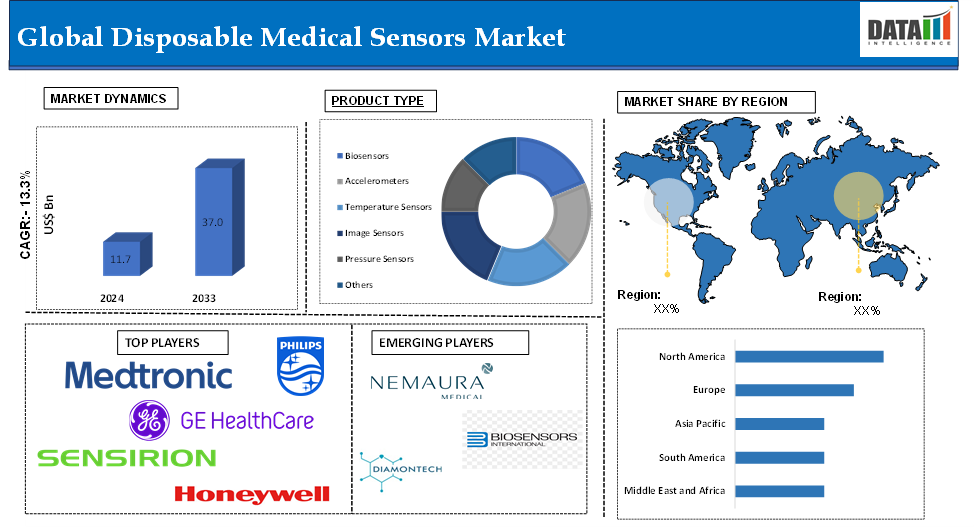
The Global Disposable Medical Sensors Market reached US$ 11.7 billion in 2024 and is expected to reach US$ 37.0 billion by 2033, growing at a CAGR of 13.3% during the forecast period 2025-2033.
Disposable medical sensors are compact, lightweight, and cost-effective devices used in healthcare settings to detect and measure physiological changes in the body. They measure parameters like temperature, heart rate, respiratory rate, glucose levels, and oxygen saturation. Common applications include patient monitoring, diabetes management, and detecting infections. Their disposable nature reduces cross-contamination risk, enhances patient safety, and simplifies device handling and maintenance.
Key Takeaways
- North America accounted for around 38.2% of the Disposable Medical Sensors market share in 2025, supported by high adoption of patient monitoring devices, advanced healthcare infrastructure, and growing demand for single-use medical technologies.
- Asia-Pacific held approximately 30.8% market share in 2025 and is expected to register the fastest CAGR during the forecast period, driven by expanding healthcare access, rising chronic disease prevalence, and increasing healthcare investments across China, India, and Japan.
- Growing emphasis on infection prevention and hospital-acquired infection (HAI) control is accelerating the adoption of disposable sensors in hospitals, ambulatory surgical centers, and home healthcare.
- Increasing demand for continuous patient monitoring in ICUs, emergency care, and remote healthcare is driving the use of disposable ECG, SpO₂, temperature, and pressure sensors.
- Technological advancements in wearable, wireless, and miniaturized disposable sensors are improving patient comfort, clinical accuracy, and workflow efficiency.
- Medical device manufacturers are focusing on cost-effective, biocompatible, and sustainable sensor materials, while expanding product portfolios through strategic partnerships and product innovations.
- The market continues to benefit from the rising number of surgeries, aging populations, and chronic disease management, creating sustained demand for disposable medical sensing solutions worldwide.
Disposable Medical Sensors Market Executive Summary
For more details on this report – Request for Sample
Disposable Medical Sensors Market Drivers and Restraints
Increasing Technological Advancements
Technological advancements have significantly impacted the global disposable medical sensors market, leading to the development of smaller, more efficient sensors that can be integrated into wearable devices, patches, and implantable systems. These sensors enable continuous patient monitoring for vital signs, glucose levels, and cardiac activity, reducing hospital visits and promoting proactive healthcare management. Materials science advancements have led to sensors with higher biocompatibility, durability, and sensitivity, ensuring minimal discomfort and improved clinical outcomes. Wireless communication technologies like Bluetooth and NFC have enhanced the usability of disposable sensors, enabling seamless data transmission to smartphones, cloud systems, and medical devices, crucial for remote patient monitoring and telemedicine.
For instance, in January 2024, Medtronic has received CE Mark approval for its MiniMed 780G system with Simplera Sync, a disposable, all-in-one continuous glucose monitor. This device requires no fingersticks or overtape, offers an improved user experience, and is half the size of previous Medtronic sensors.
Limited Regulatory Approvals and Standards
The global disposable medical sensors market is hindered by limited regulatory approvals and standards. The approval process for medical devices varies across regions, creating a complex landscape for manufacturers to navigate. This lack of uniform global standards can lead to delays in product development, increased costs, and time-to-market for new sensors. Changes or inconsistencies in regulatory policies can also disrupt the market, making it difficult for manufacturers to maintain consistent product offerings. As a result, the introduction of disposable medical sensors slows overall industry growth.
Disposable Medical Sensors Market Segment Analysis
The global disposable medical sensors market is segmented based on product type, sensor type, application, end user and region.
Product Type:
Biosensors segment is expected to dominate the Disposable Medical Sensors market share
The biosensors segment holds a major portion of the disposable medical sensors market share and is expected to continue to hold a significant portion of the disposable medical sensors market share during the forecast period.
Biosensors are vital in the global disposable medical sensors market, providing real-time monitoring of biological markers essential for patient care and disease management. These sensors detect biochemical reactions, allowing continuous monitoring of critical parameters like glucose levels, blood oxygen saturation, and lactate levels. Medical Biosensors are cost-effective, easy to use, and disposable after a single use, reducing infection risk and enhancing patient safety. The growing prevalence of chronic diseases like diabetes and cardiovascular disorders drives demand for biosensors in clinical and home healthcare settings. As biosensor technology advances, they are expected to play a more integral role in personalizing healthcare and improving patient outcomes.
For instance, in January 2023, a new biosensor chip developed by NIST, Brown University, and CEA-Leti identifies biomarkers by measuring binding between DNA strands and the device. This modular design lowers costs by making it easier to mass produce and allowing the most expensive components to be reused. This could increase accessibility to high-quality diagnostics, as traditional methods can be laborious, expensive, or limited in their findings.
Application:-
Patient Monitoring segment is the fastest-growing segment in Disposable Medical Sensors market share
The patient monitoring segment is the fastest-growing segment in the disposable medical sensors market share and is expected to hold the market share over the forecast period.
Patient monitoring is among the fastest-growing sections of the market, and disposable sensors are fast becoming standard with regard to patient monitoring. In both the rural and urban areas of developing countries, there has emerged a growing demand for in-home patient monitoring. Such increasing demand has permitted companies to rely heavily on medical device sensors for patient monitoring purposes.Remote patient monitoring helps doctors and hospitals maintain a watch on patients outside the traditional setting of the clinic, where technology can help provide 24/7 data between patients and physicians.
For instance, in January 2023, Blue Spark Technologies is launching a unique multi-sensor remote patient monitoring platform, VitalTraq, which includes a contactless vital sign measurement sensor, Remote Photoplethysmography (rPPG). This allows patients, clinicians, and researchers to collect digital measurements of vital signs like Heart Rate, Heart Rate Variability, Blood Pressure, and Respiratory Rate in a single contactless patient experience.
Why Disposable Medical Sensors Market Matters in 2026-2033
The global healthcare industry is rapidly advancing toward connected, patient-centric, and infection-free care.
Disposable medical sensors are transforming patient monitoring by enabling accurate real-time data collection, reducing the risk of cross-contamination, improving clinical efficiency, and supporting the growing adoption of remote healthcare and wearable medical technologies.
Several macroeconomic and healthcare trends are driving market growth:
- Rising prevalence of chronic diseases
- Increasing demand for continuous patient monitoring
- Growing adoption of wearable and remote healthcare devices
- Higher focus on infection prevention and patient safety
- Expansion of home healthcare services
- Advancements in biosensor and wireless monitoring technologies
- Increasing healthcare digitalization and IoT integration
- Growing aging population worldwide
- Rising hospital admissions and surgical procedures
- Government investments in smart healthcare infrastructure
Analyst View
DataM Intelligence Analyst Perspective
The disposable medical sensors market is transitioning from conventional patient monitoring toward an intelligent, connected, and preventive healthcare ecosystem.
The long-term success of the disposable medical sensors market will depend on:
- Continuous sensor accuracy improvements
- Cost-effective large-scale manufacturing
- Integration with AI-powered healthcare platforms
- Expansion of remote patient monitoring programs
- Regulatory compliance and product quality standards
- Adoption of wireless and wearable healthcare technologies
- Strategic collaborations between medical device manufacturers and healthcare providers
- Healthcare infrastructure modernization
North America continues to lead the market through advanced healthcare infrastructure, high adoption of digital health technologies, and strong investments in medical innovation. Europe benefits from stringent infection control regulations and expanding remote care initiatives. Asia-Pacific is emerging as the fastest-growing region, driven by expanding healthcare access, rising chronic disease burden, increasing medical device manufacturing, and government investments in digital healthcare. India is becoming a promising growth market, supported by healthcare modernization, expanding telemedicine services, and increasing demand for affordable patient monitoring solutions.
Disposable Medical Sensors Market Geographical Share
North America is expected to hold a significant position in the Disposable Medical Sensors market share
North America holds a substantial position in the disposable medical sensors market and is expected to hold most of the market share due to strong healthcare infrastructure, rising healthcare spending, and advanced technology. The region's emphasis on improving patient outcomes and optimizing healthcare delivery encourages the use of disposable medical sensors in hospitals, clinics, and home-care settings. The rising prevalence of chronic diseases like diabetes and cardiovascular conditions demands continuous monitoring, which disposable medical sensors can efficiently address. Key market players and significant sensor innovation investments further accelerate market growth.
For instance, according to Centers for Medicare & Medicaid Services in 2023, health care spending grew 7.5% to US$ 4.9 trillion, reaching US$ 14,570 per person, accounting for 17.6% of the nation's Gross Domestic Product.
Hence, the rising healthcare costs necessitate cost-effective solutions for patient monitoring and outcomes. Disposable medical sensors offer real-time monitoring for various conditions, enabling continuous tracking of vital signs, chronic disease management, and early detection, potentially reducing hospital readmissions and emergency care costs. This trend is expected to accelerate the disposable medical sensors market growth.
Europe is growing at the fastest pace in the Disposable Medical Sensors market
Europe holds the fastest pace in the disposable medical sensors market and is expected to hold most of the market share due to robust healthcare systems, government investments, and favourable reimbursement policies are encouraging the integration of disposable sensors for preventive care and chronic disease management. The adoption of wearable and remote patient monitoring devices is growing due to the convenience and cost-effectiveness of these devices. The strong regulatory framework in Europe ensures then safety and efficacy of medical devices, fostering trust in disposable medical sensors.
For instance, in May 2024, Dexcom has launched the Dexcom ONE+ continuous glucose monitor (CGM) in the UK, using Dexcom's established sensor design and user feedback. The platform is designed for people treating type 1 or type 2 diabetes with insulin, using the latest-generation G7 sensor. The CGM is expected to be completed in Q1 2024. The system also adds notes at specific moments, such as meals, insulin administration, and sports activities, replacing traditional fingersticks to provide a clear picture of how daily choices affect glucose levels.
Disposable Medical Sensors Market Competitive Landscape
The Disposable Medical Sensors Market is characterized by the presence of established global medical device manufacturers, healthcare technology providers, biosensor developers, and patient monitoring solution companies focused on advancing single-use sensing technologies for infection prevention, remote patient monitoring, and digital healthcare. Leading companies such as Medtronic Plc, Honeywell International Inc., GE HealthCare, Koninklijke Philips N.V., Sensirion AG, Analog Devices, Inc., Gentag Inc., Smiths Medical, ACE Medical Devices, and Abbott Laboratories maintain a strong market presence through continuous product innovation, advanced biosensor development, strategic partnerships, and investments in connected healthcare technologies.
Collectively, these companies account for a significant share of the global disposable medical sensors ecosystem, with Medtronic, Abbott Laboratories, GE HealthCare, and Philips recognized among the leading market participants due to their extensive product portfolios, global distribution networks, strong research and development capabilities, and growing adoption of disposable sensing solutions across hospitals, diagnostic centers, home healthcare, and wearable medical devices.
Key Developments
- In June 2026, Danaher Corporation completed its US$9.9 billion acquisition of Masimo, strengthening its patient monitoring and disposable sensor portfolio, including pulse oximetry and hospital monitoring technologies.
- In June 2026, MiniMed announced the European launch of Instinct continuous glucose monitoring (CGM) sensors, developed in partnership with Abbott, expanding disposable sensor options for diabetes management across Europe.
- In June 2026, MiniMed and Abbott expanded their strategic collaboration to integrate dual glucose-ketone disposable sensors into MiniMed's automated insulin delivery platforms, enhancing diabetes monitoring capabilities.
- In June 2026, ALR Technologies announced the acquisition of CGM Medical Technology Singapore to strengthen in-house manufacturing of disposable continuous glucose monitoring (CGM) sensors and accelerate commercialization of next-generation wearable medical sensors.
Disposable Medical Sensors Market Investment & Funding Analysis
Global investment in the Disposable Medical Sensors Market continues to grow rapidly as healthcare systems prioritize infection prevention, remote patient monitoring, digital health, and point-of-care diagnostics. Increasing demand for single-use medical devices, wearable healthcare technologies, and AI-enabled patient monitoring solutions is attracting significant funding from medical device manufacturers, healthcare technology companies, venture capital firms, and strategic investors.
Key Investment Areas by Disposable Medical Sensors Market
Disposable Biosensor Technologies: Investment is accelerating in advanced biosensor platforms that enable accurate, real-time monitoring while reducing the risk of cross-contamination across clinical and home healthcare settings.
Wearable Medical Sensors: Funding is expanding for next-generation wearable sensors that support continuous health monitoring, chronic disease management, and personalized patient care.
Remote Patient Monitoring Solutions: Healthcare providers and technology companies are investing in connected monitoring systems that improve patient outcomes, reduce hospital readmissions, and enable efficient virtual care.
Single-Use Diagnostic Devices: Growing demand for rapid diagnostics and infection control is driving investment in disposable diagnostic sensors used across hospitals, laboratories, and point-of-care environments.
Smart Healthcare IoT Platforms: Investment continues to strengthen in IoT-enabled healthcare ecosystems that integrate disposable sensors with cloud-based analytics, AI, and electronic health records.
Hospital Infection Control Technologies: Healthcare organizations are increasing investments in disposable sensing technologies that support infection prevention, patient safety, and compliance with evolving healthcare standards.
Strategic Recommendations for Disposable Medical Sensors Market
For Medical Device Manufacturers
Medical device companies should expand their disposable sensor portfolios by investing in next-generation biosensor technologies, AI-enabled monitoring solutions, and strategic collaborations with healthcare providers to strengthen product innovation and accelerate commercialization.
For Investors
Investors should prioritize scalable digital health companies, wearable sensor manufacturers, and connected healthcare platforms while closely monitoring regulatory approvals, reimbursement policies, and long-term adoption trends in remote patient monitoring.
For Healthcare Providers
Healthcare organizations should accelerate the adoption of disposable medical sensors to improve infection prevention, enhance clinical workflow efficiency, support continuous patient monitoring, and advance digital healthcare transformation.
Why Buy This Disposable Medical Sensors Market Report?
The Disposable Medical Sensors Market Report provides comprehensive market intelligence designed to help business leaders, investors, healthcare organizations, and technology providers make informed strategic decisions. It delivers detailed insights into market size, growth forecasts, competitive landscape, technology innovations, regulatory developments, investment activity, and emerging opportunities across global markets.
What's Included in the Disposable Medical Sensors Market Growth?
The report delivers a complete analysis of the global market, including market size and forecasts, regional outlook, competitive benchmarking, pricing trends, technology assessment, regulatory analysis, supply chain evaluation, market share analysis, investment landscape, company profiles, strategic recommendations, and emerging industry trends to support data-driven business planning.
Who Should Buy This Disposable Medical Sensors Market Analysis?
This report is designed for medical device manufacturers, disposable sensor companies, biosensor technology developers, diagnostic equipment manufacturers, healthcare providers, hospitals, pharmaceutical companies, contract manufacturing organizations (CMOs), digital health companies, venture capital firms, institutional investors, government healthcare agencies, and market intelligence professionals seeking actionable insights into the rapidly evolving disposable medical sensors industry.
Key Benefits for Stakeholders for the Report
The Disposable Medical Sensors Market Report provides stakeholders with comprehensive, data-driven insights to support strategic decision-making, strengthen competitive positioning, and identify future growth opportunities across the global healthcare ecosystem. By evaluating market trends, technological innovation, competitive developments, regulatory changes, and investment activity, the report enables organizations to develop effective business, product, and investment strategies.
Understanding Emerging Healthcare Sensing Trends
Gain valuable insights into evolving trends in disposable medical sensors, including biosensor technologies, wearable medical devices, remote patient monitoring, smart diagnostics, and connected healthcare solutions driving the future of healthcare.
Evaluating Global Market Expansion Opportunities
Identify high-growth regions, emerging healthcare markets, and expanding opportunities across hospitals, diagnostic laboratories, ambulatory care centers, home healthcare, and point-of-care testing applications.
Analyzing Technology Innovation and Digital Healthcare Transformation
Understand advancements in AI-powered medical sensors, IoT-enabled healthcare platforms, smart wearable devices, disposable biosensors, and next-generation diagnostic technologies that are reshaping patient care.
Identifying Strategic Investment and Partnership Opportunities
Evaluate investment potential, mergers, acquisitions, research collaborations, and strategic partnerships among medical device manufacturers, healthcare providers, technology companies, and investors to capitalize on market growth.
Benchmarking Leading Industry Participants
Assess the competitive landscape by analyzing product portfolios, innovation strategies, market positioning, manufacturing capabilities, and business expansion initiatives of leading disposable medical sensor companies.
Assessing Market Drivers, Challenges, and Regulatory Developments
Understand the impact of infection prevention requirements, reimbursement policies, healthcare regulations, pricing dynamics, supply chain developments, and increasing demand for digital health solutions on market growth.
Supporting Product Innovation and Commercialization
Leverage actionable market intelligence to accelerate product development, optimize commercialization strategies, strengthen customer engagement, and align innovation with evolving healthcare and patient monitoring needs.
Enabling Data-Driven Business and Investment Decisions
Utilize reliable forecasts, market analysis, competitive intelligence, and investment insights to improve strategic planning, resource allocation, business expansion, and long-term growth in the Disposable Medical Sensors Market.
Disposable Medical Sensors Market Scope
| Metrics | Details | |
| CAGR | 13.3% | |
| Market Size Available for Years | 2025-2032 | |
| Estimation Forecast Period | 2025-2033 | |
| Revenue Units | Value (US$ Bn) | |
| Volume (Units) | ||
| Segments Covered | Product Type | Biosensors, Accelerometers, Temperature Sensors, Image Sensors, Pressure Sensors, Others |
| Sensor Type | Implantable Sensors, Strip Sensors, Wearable Sensors | |
| Application | Patient Monitoring, Imaging, Therapeutics, Fitness and Wellness Monitoring, Others | |
| End User | Hospitals and Clinics, Diagnostic Centers, Home Healthcare, Others | |
| Regions Covered | North America, Europe, Asia-Pacific, South America, and Middle East & Africa | |
Why Purchase the Report?
- Pipeline & Innovations: Reviews ongoing clinical trials, product pipelines, and forecasts upcoming advancements in medical devices and pharmaceuticals.
- Product Performance & Market Positioning: Analyzes product performance, market positioning, and growth potential to optimize strategies.
- Real-World Evidence: Integrates patient feedback and data into product development for improved outcomes.
- Physician Preferences & Health System Impact: Examines healthcare provider behaviors and the impact of health system mergers on adoption strategies.
- Market Updates & Industry Changes: Covers recent regulatory changes, new policies, and emerging technologies.
- Competitive Strategies: Analyzes competitor strategies, market share, and emerging players.
- Pricing & Market Access: Reviews pricing models, reimbursement trends, and market access strategies.
- Market Entry & Expansion: Identifies optimal strategies for entering new markets and partnerships.
- Regional Growth & Investment: Highlights high-growth regions and investment opportunities.
- Supply Chain Optimization: Assesses supply chain risks and distribution strategies for efficient product delivery.
- Sustainability & Regulatory Impact: Focuses on eco-friendly practices and evolving regulations in healthcare.
- Post-market Surveillance: Uses post-market data to enhance product safety and access.
- Pharmacoeconomics & Value-Based Pricing: Analyzes the shift to value-based pricing and data-driven decision-making in R&D.
The global disposable medical sensors market report delivers a detailed analysis with 70+ key tables, more than 65 visually impactful figures, and 234 pages of expert insights, providing a complete view of the market landscape.
Target Audience
- Manufacturers: Pharmaceutical, Medical Device, Biotech Companies, Contract Manufacturers, Distributors, Hospitals.
- Regulatory & Policy: Compliance Officers, Government, Health Economists, Market Access Specialists.
- Application & Innovation: AI/Robotics Providers, R&D Professionals, Clinical Trial Managers, Pharmacovigilance Experts.
- Investors: Healthcare Investors, Venture Fund Investors, Pharma Marketing & Sales.
- Consulting & Advisory: Healthcare Consultants, Industry Associations, Analysts.
- Supply Chain: Distribution and Supply Chain Managers.
- Consumers & Advocacy: Patients, Advocacy Groups, Insurance Companies.
- Academic & Research: Academic Institutions.
Latest Related Reports by Disposable Medical Sensors Market
The Disposable Medical Sensors Market is closely connected with the broader digital healthcare ecosystem, including medical sensors, wearable sensing technologies, remote patient monitoring, telehealth, and connected healthcare solutions. As healthcare providers increasingly adopt real-time patient monitoring, AI-enabled diagnostics, and home-based care models, disposable medical sensors are becoming essential for improving clinical outcomes, infection prevention, and healthcare efficiency.
Explore the following related reports for deeper insights into the technologies driving the future of smart healthcare.
The Medical Sensors Market forms the foundation of modern healthcare monitoring by enabling accurate measurement of physiological parameters across hospitals, diagnostic centers, and home healthcare settings. Continuous advancements in biosensors, MEMS technology, wireless connectivity, and AI-powered diagnostics are driving innovation in patient monitoring, medical imaging, and critical care applications.
The Wearable Sensor Market is experiencing rapid growth as demand increases for continuous health monitoring, fitness tracking, chronic disease management, and personalized healthcare. Innovations in miniaturized sensors, wireless communication, and smart wearable devices are expanding the use of wearable technologies across consumer health and clinical applications.
The Telehealth and Remote Patient Monitoring Market is transforming healthcare delivery by enabling virtual consultations, continuous patient monitoring, and real-time health data sharing. Growing adoption of connected medical devices, cloud-based healthcare platforms, and digital health technologies is improving access to care while reducing hospital admissions and healthcare costs.
The Japan Remote Patient Monitoring Market is expanding steadily due to the country's aging population, increasing prevalence of chronic diseases, and strong government support for digital healthcare transformation. Rising adoption of wearable medical devices, connected monitoring systems, and home healthcare technologies is creating significant opportunities for disposable medical sensors in Japan's evolving healthcare ecosystem.





























































