


Disinfection Robot Market Overview
The growing demand for safety, efficiency, and automation in infection control is reshaping the disinfection robot market, as these advanced systems are becoming indispensable tools for modern hygiene management. By offering consistent, chemical-free, and scalable disinfection solutions, robots are enabling hospitals, airports, schools, and commercial facilities to maintain higher standards of cleanliness while reducing reliance on manual labor. Furthermore, rapid innovations in UV-C, hydrogen peroxide vapor, and AI-powered navigation technologies are aligning with global expectations for faster, safer, and smarter disinfection, while the expansion of applications beyond healthcare into public transport, hospitality, and retail is creating new opportunities for widespread deployment and long-term market growth.
Key Market highlights
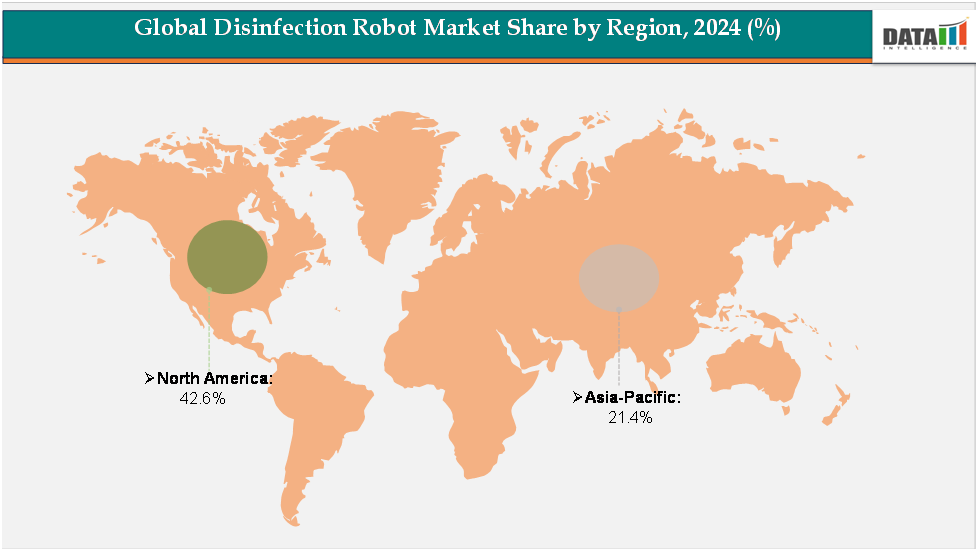
- North America leads the disinfection robot market with over 42.6% revenue share, driven by the advanced healthcare infrastructure, strong emphasis on infection control, and the early adoption of robotic technologies across hospitals, airports, and commercial facilities. The presence of leading technology providers and supportive regulatory frameworks further strengthens the region’s dominant position.
- Asia-Pacific is the fastest-growing region, holding around 21.4% of the market, fueled by rapid healthcare modernization in China, Japan, South Korea, and India, coupled with rising government investments in smart hospitals, growing public awareness of hygiene, and the expanding role of robotics startups offering cost-effective disinfection solutions.
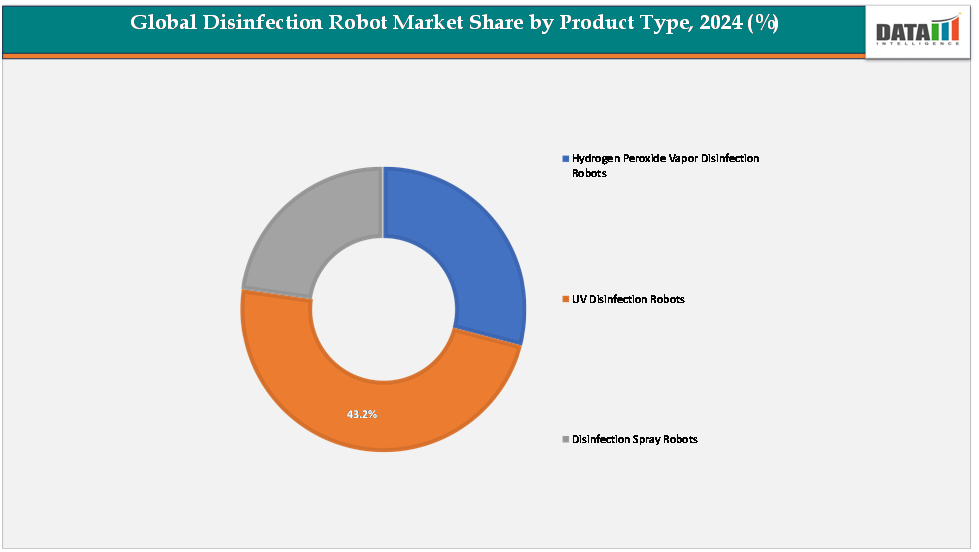
- UV Disinfection Robots dominate the disinfection robot market, accounting for approximately 43.2% of global revenue, as healthcare providers and public facilities increasingly rely on UV-C technology for its proven efficacy, chemical-free operation, and cost-effectiveness in delivering rapid and reliable disinfection at scale.
Market Size & Forecast
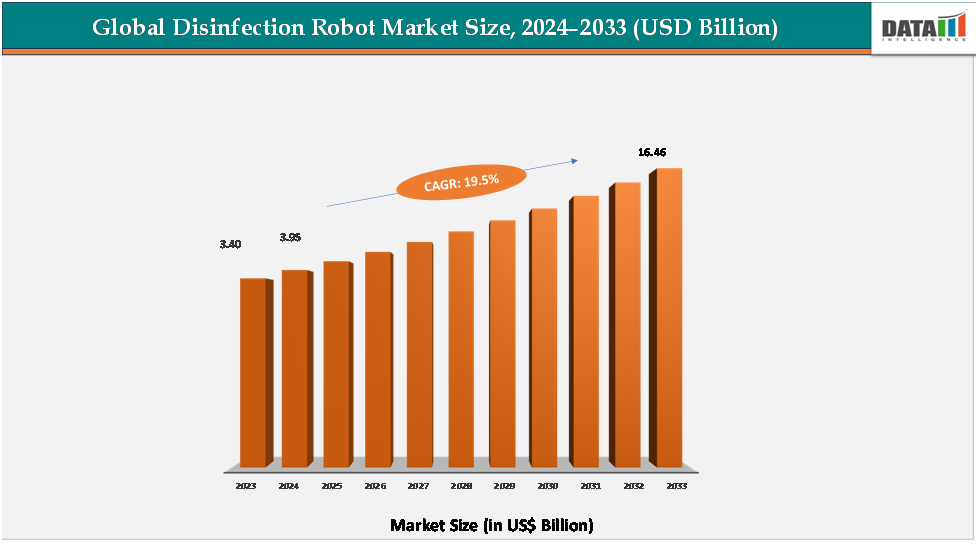
- 2025 Market Size: US$ 4.72 billion
- 2033 Projected Market Size: US$ 19.67 billion
- CAGR (2026–2033): 19.5%
- North America: Largest Market
Asia Pacific: Fastest-growing market
Source : Datam Intelligence Email : [email protected]
Disinfection Robot Market Drivers & Restraints
Driver: Rising Focus on Infection Control in Healthcare Facilities
The rising focus on infection control in healthcare facilities is expected to be one of the most significant drivers of the disinfection robot market, as hospitals and clinics across the globe prioritize patient and staff safety while striving to minimize the burden of hospital-acquired infections (HAIs). Healthcare-associated infections remain a major challenge, contributing to increased morbidity, prolonged hospital stays, and higher healthcare costs, thereby compelling facilities to adopt more advanced and reliable disinfection solutions.
Traditional cleaning methods, though widely used, often leave gaps in coverage due to human error, limited reach in high-touch or hard-to-access areas, and inconsistent adherence to hygiene protocols. Disinfection robots, equipped with technologies such as UV-C light, hydrogen peroxide vapor, and autonomous navigation systems, offer a standardized, efficient, and evidence-based approach to sterilizing hospital rooms, operating theaters, and intensive care units. For instance, in March 2023, Tru-D Smart UVC, part of PDI Healthcare’s environment of care solutions, unveiled its next-generation intelligent UVC disinfection products. Tru-D has been a pioneer in UVC disinfection and remains a recognized leader in the field. The adoption of UVC disinfection systems surged during the COVID-19 pandemic and has since evolved into a standard practice across healthcare facilities.
Their ability to work continuously, reduce reliance on manual labor, and ensure validated levels of microbial elimination is transforming infection prevention strategies in healthcare. Furthermore, with regulatory authorities and accreditation bodies tightening guidelines on hygiene standards, healthcare organizations are increasingly investing in robotic disinfection systems to comply with safety benchmarks and build trust with patients.
Restraint: High Initial Investment and Maintenance Costs
High initial investment and maintenance costs pose a substantial restraint to the growth of the Disinfection Robot Market, particularly in small and mid-sized healthcare facilities, schools, and commercial establishments with limited budgets. Advanced disinfection robots, especially those equipped with UV-C or hydrogen peroxide vapor systems and AI-powered autonomous navigation, often require significant upfront capital expenditure, which many organizations view as a barrier compared to traditional cleaning methods that demand lower immediate costs.
For more details on this report, Request for Sample
Disinfection Robot Market Segmentation Analysis
The global disinfection robot market is segmented by type, technology, end-user, and region.
Type:
The UV disinfection robots segment is estimated to have 43.2% of the Disinfection Robot market share.
UV disinfection robots currently hold the dominant position in the disinfection robot market, driven by their widespread adoption in hospitals, airports, schools, and commercial facilities for fast, chemical-free, and effective disinfection. These robots utilize UV-C light to inactivate a broad spectrum of pathogens, including bacteria, viruses, and fungi, within minutes, offering a reliable solution for high-touch surfaces and enclosed spaces. Their ease of use, lower operating costs compared to chemical-based systems, and the absence of harmful residues make them especially attractive in healthcare environments where patient and staff safety is paramount.
Furthermore, continuous technological advancements in autonomous navigation, remote monitoring, and IoT integration have enhanced their efficiency and appeal, encouraging large-scale deployment worldwide. The COVID-19 pandemic accelerated the adoption of UV disinfection robots across multiple sectors, solidifying their position as the market leader. Thus, UV disinfection robots are expected to remain the dominant segment in the coming years.
The hydrogen peroxide vapor (HPV) disinfection robots segment is estimated to have 26.4% of the Disinfection Robot Market share.
Hydrogen Peroxide Vapor (HPV) Disinfection Robots represent the fastest-growing segment, gaining traction due to their ability to achieve complete room decontamination and provide a higher level of sterilization compared to UV systems. These robots disperse vaporized hydrogen peroxide, which penetrates even hard-to-reach surfaces and crevices, making them especially valuable in critical healthcare settings such as operating rooms, isolation wards, and intensive care units. With the rising focus on preventing hospital-acquired infections (HAIs) and ensuring compliance with stringent hygiene standards, demand for HPV robots is expanding rapidly.
Healthcare facilities are increasingly recognizing their superior efficacy in eradicating resilient pathogens, including spores, thereby justifying the expenditure. Advancements in vapor dispersion control, automation, and reduced cycle times are also enhancing their practicality, encouraging broader adoption. As global healthcare infrastructure modernizes and infection control protocols become more rigorous, HPV disinfection robots are projected to witness the highest growth trajectory, emerging as a critical tool for comprehensive sterilization in sensitive environments.
Disinfection Robot Market Geographical Analysis
The North America disinfection robot market was valued at 42.6%market share in 2024
North America is expected to dominate the disinfection robot Market, supported by its advanced healthcare infrastructure, high awareness of infection control, and early adoption of robotic technologies. Hospitals and clinics in the United States and Canada face significant challenges with hospital-acquired infections (HAIs), which cost billions of dollars annually, prompting large-scale investment in innovative disinfection technologies.
The strong presence of leading robotics companies, combined with partnerships between healthcare providers and technology developers, further strengthens the region’s leadership. Moreover, government agencies and accreditation bodies such as the CDC and Joint Commission are increasingly enforcing stringent hygiene standards, encouraging facilities to adopt evidence-based robotic disinfection solutions. Beyond healthcare, disinfection robots are also being deployed in airports, schools, corporate offices, and hospitality venues across North America, reflecting their expanding applications.
The Europe disinfection robot market was valued at 23.8% market share in 2024
Europe holds a significant position in the Disinfection Robot Market, underpinned by its strong regulatory frameworks, high standards of hospital hygiene, and proactive efforts to reduce infection rates across healthcare facilities. Countries like Germany, France, the UK, and the Nordics have been early adopters of robotic disinfection systems, particularly in healthcare settings where patient safety is a top priority. The European Union’s focus on infection prevention policies and sustainability initiatives is also driving the demand for eco-friendly and automated disinfection solutions.
Furthermore, the region’s robust research and development ecosystem, combined with collaborations between robotics companies and healthcare institutions, supports continuous innovation in this space. Beyond hospitals, disinfection robots are increasingly being used in airports, public transportation, and hospitality sectors to ensure safe environments.
The Asia-Pacific disinfection robot market was valued at 21.4% market share in 2024
Asia-Pacific is emerging as the fastest-growing region in the disinfection robot market, fueled by rapid urbanization, rising healthcare expenditures, and government-backed initiatives to modernize hospital infrastructure. Countries such as China, Japan, South Korea, and India are heavily investing in smart healthcare technologies to strengthen infection control measures in the wake of the COVID-19 pandemic and other public health challenges. High population density and the growing demand for advanced healthcare services are creating a fertile ground for the adoption of disinfection robots, particularly in large hospitals and public spaces such as transportation hubs and educational institutions.
Additionally, the Asia-Pacific is home to a growing number of robotics manufacturers and technology startups offering cost-effective solutions tailored for regional needs, which is further driving adoption. Expanding e-commerce channels, improving awareness of hygiene standards, and the region’s push toward automation across industries are reinforcing the market’s rapid growth.
Disinfection Robot Market Competitive Landscape
The major players in the disinfection robot market include OMRON Corporation, Advanced Intelligent Systems (AIS), Aeolus Robotics Inc., Skytron (Infection Prevention Technologies), Altoros, Xenex Disinfection Services Inc., OTSAW Digital Pte Ltd, Techmetics Robotics, Wolf-e Robotics, UVD ROBOTS (BLUE OCEAN ROBOTICS), among others.
OTSAW Digital Pte Ltd:
OTSAW Digital Pte Ltd, a Singapore-based robotics company, has made a strong mark in the Disinfection Robot Market with its O-RX, the world’s first UV-C LED disinfection autonomous robot. Designed to deliver over 99.999% germicidal efficacy, O-RX uses eco-friendly UV-C LED technology, autonomous navigation, and remote monitoring to provide safe, efficient, and chemical-free disinfection in hospitals, malls, and public facilities. With proven trials in live environments and successful testing against coronaviruses, OTSAW is positioning itself as a key innovator in infection control, offering sustainable and scalable robotic hygiene solutions globally.
Key Developments of the Disinfection Robot Market
June 2026: Loop Robots expanded the deployment of its SAM® autonomous UV-C disinfection robot at Meander Medical Center, reflecting broader adoption of automated hospital disinfection after successful clinical implementation. The deployment reinforces the use of autonomous room mapping, digital audit trails, and chemical-free UV-C surface disinfection in healthcare environments.
- April 2026: TOMI Environmental Solutions announced a major upgrade of its SteraMist iHP Robot, redesigning the platform into a more autonomous, mobile robotic system with enhanced maneuverability and domestic lithium-powered operation. The development targets next-generation automated decontamination across healthcare, transportation, and emerging robotic applications.
- February 2026: Loop Robots reported that its SAM® UV-C disinfection robot was fully integrated into operating room workflows at Tergooi Medical Center within a week. The implementation demonstrated rapid deployment of autonomous UV-C disinfection with minimal workflow disruption while improving standardized infection prevention processes.
Key Takeaways
- The growing emphasis on infection prevention, healthcare safety, and automated hygiene management is emerging as a key market trend, with healthcare providers and commercial facilities increasingly deploying autonomous UV-C and hydrogen peroxide vapor disinfection robots to improve operational efficiency and reduce healthcare-associated infections.
- North America maintains a leading position, accounting for more than 42.6% of the global market share, supported by advanced healthcare infrastructure, strong infection control standards, early adoption of robotics technologies, and widespread deployment across hospitals, airports, and commercial facilities.
- Asia-Pacific is projected to witness the fastest growth, holding approximately 21.4% of the global market, driven by rapid healthcare modernization across China, Japan, South Korea, and India, increasing government investments in smart hospitals, and the expansion of robotics innovation across the region.
- The rising incidence of healthcare-associated infections (HAIs), combined with stricter hygiene regulations and growing demand for standardized disinfection protocols, is accelerating the adoption of autonomous robotic disinfection systems across healthcare and public environments.
- Continuous advancements in AI-powered navigation, autonomous mobility, UV-C irradiation, and hydrogen peroxide vapor technologies are enhancing the effectiveness, consistency, and scalability of robotic disinfection solutions across diverse end-use applications.
- Industry participants are increasingly prioritizing investments based on technological innovation, autonomous capabilities, proven infection control performance, regulatory compliance, and long-ter
- Growing adoption of robotic disinfection solutions across hospitals, laboratories, airports, educational institutions, hospitality facilities, retail spaces, and public transportation infrastructure is creating significant long-term opportunities for manufacturers offering intelligent, automated, and chemical-free disinfection technologies.
Disinfection Robot Market Scope
| Metrics | Details | |
| CAGR | 19.5% | |
| Market Size Available for Years | 2023-2033 | |
| Estimation Forecast Period | 2026-2033 | |
| Revenue Units | Value (US $Bn) | |
| Segments Covered | Service Type | Hydrogen Peroxide Vapor Disinfection Robots, UV Disinfection Robots, Disinfection Spray Robots |
| Product Type | Fully Autonomous, Semi-autonomous | |
| End-User | Hospitals, Clinics, Laboratories, Research Institutes, Life Science Companies | |
| Regions Covered | North America, Europe, Asia-Pacific, South America, and the Middle East & Africa | |
Why Purchase This Report?
The Disinfection Robot Market report provides comprehensive intelligence for robotics manufacturers, healthcare providers, facility management companies, investors, infection prevention specialists, and policymakers seeking to understand the evolving adoption of autonomous disinfection technologies across healthcare and commercial environments.
- Gain detailed insights into market drivers, restraints, opportunities, and emerging technology trends shaping the disinfection robot industry.
- Assess the impact of healthcare-associated infection (HAI) prevention initiatives, automation trends, and hygiene regulations on market growth.
- Understand technology adoption across UV-C, hydrogen peroxide vapor (HPV), and autonomous mobile disinfection robot platforms.
- Evaluate demand patterns across hospitals, life sciences facilities, hospitality, transportation, education, and public infrastructure sectors.
- Benchmark leading market participants, recent product innovations, partnerships, and competitive positioning.
- Identify high-growth opportunities associated with AI-enabled navigation, smart facility automation, and autonomous cleaning ecosystems.
- Support investment planning, product development, market expansion, and long-term business strategy.
The global disinfection robot market report delivers a detailed analysis with 70 key tables, more than 66 visually impactful figures, and 195 pages of expert insights, providing a complete view of the market landscape.
Target Audience
- Manufacturers/ Buyers
- Industry Investors/Investment Bankers
- Research Professionals
- Emerging Companies
- Strategic consulting and market intelligence organizations.
- Research institutions focused on robotics, automation, healthcare technologies, and infection prevention.





























































