


Dental X-Ray Market Size and Forecast
The Dental X-Ray Market will reach US$ 2.72 billion in 2026, up from US$ 2.50 billion in 2025, and is projected to reach US$ 5.82 billion by 2035, registering strong growth at a CAGR of 8.8% during the forecast period from 2026 to 2035.
A dental X-ray, also known as dental radiography, is a diagnostic imaging technique used to capture detailed images of the teeth, gums, jawbones, and surrounding oral structures. These images help dental professionals identify, diagnose, and monitor a variety of dental and oral health conditions. Dental X-rays are essential for detecting issues not visible during a routine dental examination. They provide insights into conditions such as cavities, fractures, bone loss, impacted teeth, abscesses, and tumors. They play a vital role in treatment planning for procedures like root canals, dental implants, and orthodontics.
The dental X-ray market has experienced significant growth in recent years, driven by technological advancements, rising demand for cosmetic dentistry and increasing prevalence of dental disorders. The global increase in dental conditions such as cavities, periodontal diseases, and oral cancers necessitates advanced diagnostic tools like dental X-rays for early detection and effective treatment. For instance, according to the World Health Organization estimates, oral diseases affect nearly 3.5 billion people. Untreated dental caries affects 2.5 billion people and severe periodontal disease affects 1 billion people.
Dental X-Ray Market Executive Summary
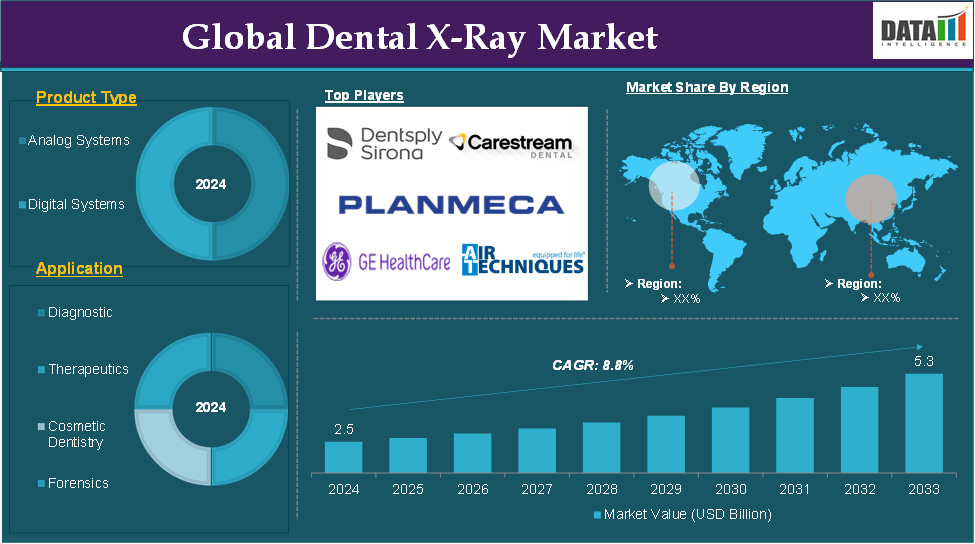
For more details on this report - Request for Sample
Dental X-Ray Market Key Takeaways
- North America accounted for approximately 40-45% of the global Dental X-Ray Market share in 2025, driven by increasing adoption of digital dentistry technologies, expanding cosmetic dentistry procedures, and significant investments supporting advanced diagnostic imaging capabilities.
- Digital X-ray systems represented nearly 65-70% of total market revenue in 2025 owing to their superior diagnostic accuracy, lower radiation exposure, and increasing adoption across dental clinics and hospitals worldwide.
- Intraoral imaging applications contributed approximately 50-55% of overall market demand in 2025, supported by their widespread utilization across preventive dentistry, restorative procedures, and periodontal disease diagnosis.
- More than 75% of newly launched dental imaging technologies globally incorporate digital imaging capabilities, artificial intelligence-assisted diagnostics, or cloud-enabled data management functionalities designed to improve treatment planning efficiencies.
- Dental clinics and specialty dental centers accounted for nearly 60-65% of total market demand in 2025, reflecting increasing investments supporting advanced diagnostic imaging infrastructure and patient-centric dental care initiatives worldwide.
- Cone Beam Computed Tomography technologies are anticipated to contribute approximately 30-35% of future commercialization opportunities through 2033 owing to their expanding applications across implant dentistry, orthodontics, and maxillofacial surgical procedures.
- Asia-Pacific is projected to register the fastest regional growth during the forecast period owing to expanding dental tourism activities, improving healthcare infrastructure, and increasing investments supporting digital dental technologies across emerging economies.
- Artificial intelligence-enabled dental imaging technologies are expected to account for approximately 35-40% of future product innovations globally, substantially strengthening diagnostic precision and personalized treatment planning capabilities.
- More than 60% of strategic collaborations announced across the market involve digital imaging technologies, product innovation initiatives, and healthcare technology partnerships, highlighting the increasing importance of technological innovation worldwide.
Dental X-Ray Market Scope
| Metrics | Details | |
| CAGR | 8.8% | |
| Market Size Available for Years | 2018-2035 | |
| Estimation Forecast Period | 2025-2035 | |
| Revenue Units | Value (US$ Bn) | |
| Volume (Units) | ||
| Segments Covered | Product Type | Analog Systems and Digital Systems |
| Imaging Type | Intraoral X-Rays and Extraoral X-Rays | |
| Application | Diagnostic, Therapeutics, Cosmetic Dentistry and Forensics | |
| End-User | Hospitals, Dental Clinics, Dental Diagnostic Centers, Forensic Laboratories and Dental Academic & Research Institutes | |
| Regions Covered | North America, Europe, Asia-Pacific, South America, and Middle East & Africa | |
Dental X-Ray Market Dynamics: Drivers & Restraints
Rising technological advancements in dental X-ray imaging
The rising technological advancements in dental X-ray imaging are significantly driving the growth of the dental X-ray market and are expected to drive the market over the forecast period. Artificial Intelligence (AI) is being integrated into dental X-ray systems to assist in the analysis of X-ray images. AI algorithms can identify abnormalities, such as cavities, bone loss, or tumors, more quickly and accurately than manual analysis. AI-powered dental imaging improves diagnostic accuracy, reduces the workload for practitioners, and accelerates the diagnostic process, leading to better patient outcomes.
For instance, in October 2024, Pearl has introduced Calibrate, the first AI-powered clinical calibration and training solution for clinicians, educators, and payers. The multi-purpose tool will assist a wide variety of users in honing their dental x-ray evaluation abilities and overcoming the inconsistencies associated with diagnostic imaging in dentistry. Both the University of California-Los Angeles and the University of the Pacific's Arthur A. Dugoni School of Dentistry have obtained American Dental Education Association (ADEA) funds to employ Calibrate in their study, which will be completed in Q2 2025.
The development of portable and handheld dental X-ray devices has expanded the reach of dental diagnostics, allowing for mobile dental clinics, home care settings, and emergency situations. These devices provide flexibility for dental professionals to perform diagnostics in remote or underserved areas, where traditional large imaging systems may not be available.
For instance, in February 2024, Mid America Dental Sales, a dental technology reseller, introduced the X4 Handheld, a new x-ray equipment. This invention uses a Carbon Nano Tube (CNT) X-ray tube to increase efficiency while remaining lightweight at 4 pounds. According to the company's press release, CNT tube technology is more streamlined than traditional filament vacuum x-ray tubes.
Radiation concerns
The radiation concerns associated with dental X-rays are expected to hamper the growth of the dental X-ray market. Although the radiation dose from dental X-rays is relatively low, repeated exposure, especially over a long period, can increase the risk of radiation-induced cancer. This is particularly concerning for vulnerable populations such as pregnant women and children. Concerns about radiation exposure may discourage patients from opting for regular X-ray procedures, especially those who perceive the risk as outweighing the benefits. This reluctance can limit the frequency of dental check-ups that involve X-rays.
Ensuring compliance with radiation safety standards involves additional costs for dental practices, such as purchasing protective equipment (e.g., lead aprons), upgrading machines to meet safety standards, and staff training. These costs may hinder the adoption of dental X-ray systems in smaller practices, thus slowing down market growth. The added operational costs and regulatory burden may deter smaller and mid-sized dental clinics from adopting the latest X-ray technologies.
Some patients and healthcare providers are exploring alternatives to traditional X-rays that either offer lower radiation or avoid radiation exposure entirely. Techniques such as intraoral cameras are non-radiation-based alternatives that provide visual images of the inside of the mouth, though with less detailed diagnostic information compared to X-rays and optical coherence tomography (OCT), a non-invasive imaging technology that can provide high-resolution images of soft tissue structures and may be considered as a low-radiation alternative.
Dental X-Ray Market Trends & Insights
Digital Transition Is Reshaping the Dental X-Ray Market
The dental X-ray market is undergoing a gradual transition from conventional analog equipment toward digital imaging. Digital systems offer faster image acquisition, simplified image storage, easier image sharing and compatibility with modern dental software. As dental practices replace older equipment, digital sensors and digitally integrated imaging platforms are expected to capture an increasing share of new installations.
Analog Systems Face Long-Term Replacement Pressure
Analog X-ray systems continue to serve cost-sensitive dental practices, but their long-term market position is under pressure from digital alternatives. Film processing, chemical requirements, additional workflow time and repeated imaging requirements can make analog systems less attractive for practices seeking faster and more integrated diagnostic workflows.
Intraoral Imaging Remains Essential for Routine Diagnosis
Intraoral X-ray systems remain a core component of dental diagnostics because they provide detailed visualization of individual teeth and surrounding structures. Their applications include caries assessment, periodontal evaluation, root and periapical examination, restorative treatment planning and endodontic procedures.
Extraoral Imaging Creates a High-Growth Opportunity
Extraoral imaging is gaining importance as dental practices increasingly require broader anatomical visualization. Panoramic systems and CBCT equipment can support orthodontics, implant planning, oral surgery, temporomandibular joint assessment and complex treatment planning.
Cosmetic Dentistry Is Creating Additional Imaging Demand
The expansion of cosmetic dentistry is creating incremental demand for dental imaging. Radiographic assessment can help clinicians evaluate tooth structure, roots, bone support and existing dental conditions before procedures such as restorative treatments, veneers, contouring and other aesthetic interventions.
Dental Diagnostic Centers Are Becoming Important End Users
Specialized dental diagnostic centers represent an emerging opportunity because they provide dedicated imaging services and can operate advanced equipment such as panoramic X-ray and CBCT systems. Their focus on diagnostic services can support higher utilization of sophisticated imaging equipment.
Dental Imaging Is Moving Toward Treatment Planning
Dental X-rays are increasingly being used beyond basic disease detection. Imaging is becoming an important component of treatment planning for implants, orthodontics, endodontics, oral surgery and restorative procedures. This increases demand for systems capable of delivering detailed, high-resolution and three-dimensional information.
Dental X-Ray Market Regulatory & Compliance Opportunity
Regulatory compliance remains a significant consideration in the dental X-ray market because manufacturers must meet requirements related to radiation safety, device performance, quality management, labeling and clinical documentation. Compliance requirements can influence product development timelines, commercialization strategies and market-entry costs.
For manufacturers expanding internationally, differences in regulatory requirements across markets increase the importance of local regulatory expertise, certification capabilities and specialized distribution partnerships.
Dental X-Ray Distribution & Market Expansion Strategy
Market expansion is increasingly supported by regional distributors, specialized dental-equipment dealers and technology partnerships. Manufacturers can strengthen their presence by combining direct sales with established local distribution networks, particularly in markets where regulatory requirements, purchasing practices and healthcare infrastructure differ significantly.
Emerging markets provide opportunities for cost-effective digital systems, while developed markets offer stronger replacement demand for advanced imaging platforms and integrated digital workflows.
Dental X-Ray Market Segment Analysis
The global dental X-ray market is segmented based on product type, imaging type, application, end-user and region.
Product Type:
The digital systems segment is expected to dominate the dental X-ray market share
Digital X-ray systems provide much higher image quality compared to traditional film-based systems. This enables dental professionals to detect issues like cavities, bone loss, infections and tumors with greater precision. Digital images can be enhanced with various software tools, allowing dental practitioners to zoom in, adjust contrast, and sharpen details, providing better diagnostic clarity.
For instance, in October 2023, PreXion, Inc. announced a pair of important product releases to supplement its already vast dental imaging product line. The company unveiled its new Evolve Sensor intraoral dental digital imaging sensor, along with the 3-in-1 PreXion3D Evolve CBCT, PAN and CEPH, which is described as a complete dental imaging solution in a single product.
One of the biggest advantages of digital X-ray systems is their ability to reduce radiation exposure by up to 90% compared to traditional film-based systems. This has helped address public concerns about radiation, making digital systems the preferred choice. The reduced radiation exposure not only helps ensure patient safety but also helps dental practices comply with stricter regulations regarding radiation safety.
Dental X-Ray Market Geographical Share
North America is expected to hold a significant position in the dental X-ray market share
North America particularly the United States is known for its early adoption of cutting-edge technologies, including digital dental X-rays, AI-powered imaging systems and Cone Beam Computed Tomography (CBCT). Dental professionals in North America are quick to adopt the latest imaging systems due to their high quality and cost-effectiveness in the long run. The rapid adoption of digital X-rays and other advanced systems in North America drives the demand for these products, leading the region to hold the largest market share.
For instance, in April 2024, DentiMax launched a all-new 1.5 Open Sensor. In terms of size, image quality and price, DentiMax reports that this new digital x-ray sensor has exceeded their customers’ expectations and is based off years of feedback from dental clinicians. The Size 1.5 Open Sensor boasts a compact design, making it 11% smaller than its predecessor the Size 2 Open Sensor. This reduction in size enhances patient comfort and ease of positioning.
The growing trend of cosmetic dentistry, driven by increasing demand for aesthetic treatments such as teeth whitening, veneers, and orthodontics, also contributes to the increased use of dental X-rays in North America. Cosmetic dental procedures require detailed diagnostic imaging to plan treatments accurately. Digital X-ray systems play a crucial role in this, increasing their demand in North American dental practices.
Asia-Pacific is growing at the fastest pace in the dental X-ray market
The growing prevalence of dental diseases, such as cavities, gum diseases, and oral cancer, in APAC countries is creating a higher demand for diagnostic imaging. Many APAC countries are shifting towards preventive dental care, where regular check-ups and early diagnosis using technologies like X-rays are essential. For instance, according to the World Health Organization (WHO), 90% of people in Asia will experience some form of dental disease in their lifetime, leading to a greater need for dental diagnostics and imaging systems.
With the increasing affordability of advanced dental imaging technologies, more dental clinics in APAC countries can now afford digital X-ray systems. Digital systems are also more cost-effective in the long term compared to traditional film-based X-rays, driving adoption in emerging economies. For instance, companies like Carestream Health and Planmeca have established manufacturing plants and service centers in China and India, ensuring lower prices and easy access to their advanced digital X-ray systems.
Dental X-Ray Market Major Global Players
The major global players in the dental X-ray market include Planmeca Oy, Dentsply Sirona, MEDITRIX, Carestream Dental LLC, ACTEON Group, Air Techniques, Inc., GE HealthCare, THE YOSHIDA DENTAL MFG. CO., LTD., VATECH INDIA PVT. LTD., Zimed Healthcare Inc. and among others.
Recent Developments in Dental X-Ray Market:
- July 2026: Planmeca Oy continued advancing AI-powered dental imaging through its Romexis software ecosystem, with automated tooth detection, numbering and image organization supporting faster interpretation of intraoral X-rays.
- May 2026: Dentsply Sirona launched Smart View – Detect, an FDA-cleared AI-enabled diagnostic aid designed to identify teeth with periapical radiolucencies in CBCT scans, strengthening the integration of AI into dental imaging workflows.
- May 2026: Dentsply Sirona expanded its U.S. distribution footprint through an enhanced agreement with Atlanta Dental Supply, supporting broader access to its connected dental technology portfolio.
- March 2026: Dentsply Sirona, in collaboration with Siemens Healthineers, announced FDA clearance of a dental-dedicated MRI system, expanding non-ionizing imaging capabilities and complementing conventional X-ray and CBCT technologies.
- June 2026: Carestream Dental continued strengthening its digital imaging portfolio, with dental practices increasingly adopting CBCT, intraoral sensors and integrated imaging software for diagnosis and treatment planning.
- June 2026: ACTEON Group continued expanding its digital dentistry and imaging ecosystem, supporting the growing adoption of advanced diagnostic technologies across dental clinics and specialty practices.
- June 2026: Air Techniques continued strengthening its dental imaging portfolio through panoramic imaging, intraoral systems and integrated imaging software.
- May 2026: Air Techniques marked 60 years of X-ray innovation, highlighting its ScanX and VistaSystem imaging portfolio and the integration of AI-driven functionality into modern dental imaging workflows.
- April 2026: VATECH continued strengthening its dental diagnostic imaging position following its reported 20-year patent leadership, with hundreds of patent applications and granted patents covering dental diagnostic imaging technologies.
- April 2026: VATECH India continued expanding access to digital dental imaging technologies in the Indian market, supported by its portfolio of low-dose and high-resolution X-ray and CBCT systems.
Dental X-Ray Market Future Market Trends (2026-2035)
The Dental X-Ray Market is expected to witness sustained growth throughout the forecast period driven by increasing adoption of digital dentistry technologies, expanding cosmetic dentistry applications, and continuous advancements across intelligent diagnostic imaging capabilities worldwide. Future market expansion will be supported by artificial intelligence-enabled diagnostics, connected healthcare innovations, personalized treatment planning capabilities, and cloud-integrated digital imaging platforms.
Growing investments supporting manufacturing innovations, regulatory advancements, and healthcare infrastructure development are anticipated to substantially strengthen commercialization opportunities across major healthcare economies. Furthermore, increasing demand for minimally invasive dental procedures and technologically advanced treatment solutions is expected to positively influence future market dynamics globally.
Organizations prioritizing technological innovation, strategic collaborations, and digital healthcare transformation initiatives are anticipated to achieve considerable competitive advantages within the evolving Dental X-Ray Market.
Why Choose DataM?
Technological Innovations: DataM evaluates advances in digital intraoral X-ray systems, CMOS/CCD sensors, PSP technology, panoramic imaging, cephalometric systems, CBCT, portable X-ray units, AI-assisted image analysis, cloud connectivity and integrated dental imaging software.
Product Performance & Market Positioning: The report evaluates dental X-ray systems based on image quality, radiation dose, detector sensitivity, resolution, acquisition speed, portability, software integration, workflow efficiency, reliability, maintenance requirements and compatibility with digital dental platforms.
Real-World Evidence: DataM connects market developments with applications across general dentistry, endodontics, periodontics, implantology, orthodontics, pediatric dentistry and oral and maxillofacial surgery. The report also evaluates the growing role of CBCT and digital imaging in complex treatment planning.
Market Updates & Industry Changes: The report tracks digital imaging adoption, CBCT launches, AI integration, portable X-ray developments, sensor innovations, software partnerships, cloud-based imaging, regulatory developments and dental-clinic modernization.
Competitive Strategies: DataM analyzes how leading companies strengthen their positions through digital sensor development, CBCT platforms, AI-enabled software, integrated imaging ecosystems, strategic partnerships, product launches, distribution networks and expansion into emerging dental markets.
Pricing & Market Access: The report evaluates pricing based on imaging modality, detector technology, image resolution, CBCT capabilities, portability, software functionality, installation requirements, maintenance and clinical application while assessing purchasing patterns across dental clinics, hospitals, DSOs and academic institutions.
Market Entry & Expansion: DataM identifies opportunities created by digital dentistry adoption, dental disease burden, clinic modernization, CBCT penetration, AI-assisted diagnostics and expanding dental infrastructure. The report outlines strategies involving local distribution, technology partnerships, software integration, regulatory alignment and expansion into high-growth Asia-Pacific markets.
Target Audience
- Dental Imaging Manufacturers - For product and technology strategy.
- Dental Clinics & DSOs - For equipment investment decisions.
- Dental Software Companies - For imaging integration opportunities.
- Distributors - For regional market expansion.
- Investors - For market and competitive analysis.
- Dental Healthcare Providers - For technology adoption planning.
The global dental X-ray market report delivers a detailed analysis with 70 key tables, more than 63 visually impactful figures, and 159 pages of expert insights, providing a complete view of the market landscape.



























































