


Butyrate Supplements Market Size and Overview
The global Butyrate Supplements market reached an estimated US$ 1.46 billion in 2025 and is expected to reach US$ 4.02 billion by 2035, growing with a CAGR of 10.7% during the forecast period 2026-2035. The market includes sodium, calcium, magnesium and tributyrin-based products positioned for digestive health, intestinal barrier support, microbiome balance, immune resilience and broader metabolic wellness. Growth is being supported by consumer familiarity with the gut microbiome and increasing acceptance of postbiotics as direct functional metabolites rather than live microorganisms.
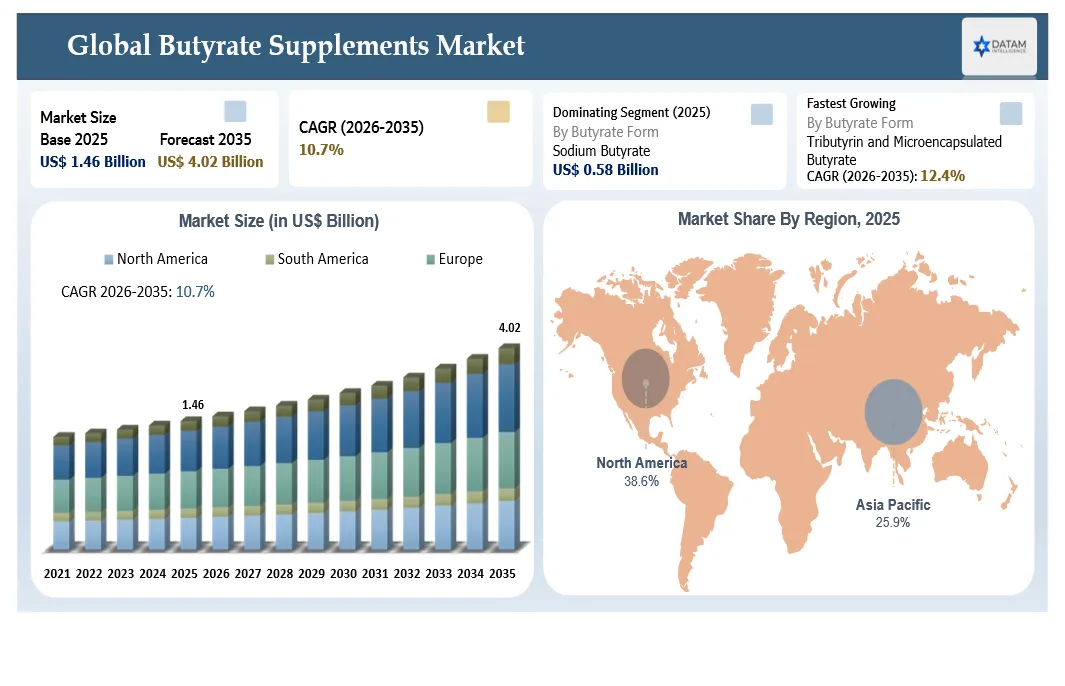
Microencapsulated sodium butyrate and tributyrin are attracting attention because they can improve tolerability, reduce odor and support delivery farther along the gastrointestinal tract. Single-ingredient capsules remain the commercial base, while synbiotic combinations are expanding through practitioner channels and premium e-commerce. Brands are increasingly differentiating through delayed-release technologies, branded ingredients, clinical evidence, third-party testing and condition-specific positioning.
North America leads through supplement spending, practitioner adoption, digital commerce and rapid product launches. Europe has a strong clinical and pharmacy-oriented market, particularly for microencapsulated sodium butyrate. Asia-Pacific is expected to grow fastest as digestive health awareness, functional nutrition spending and online retail expand. Market development remains constrained by uneven clinical evidence, terminology confusion between prebiotics, probiotics and postbiotics, and the need for responsible structure-function claims.
| Metric | Details |
| 2025 Market Size | US$ 1.46 Billion |
| 2035 Projected Market Size | US$ 4.02 Billion |
| CAGR 2026-2035 | 10.7% |
| Largest Region | North America |
| Fastest Growing Region | Asia-Pacific |
| Largest Form | Sodium Butyrate |
| Fastest Growing Form | Tributyrin and Microencapsulated Butyrate |
Butyrate Supplements Market Key Takeaways
- Sodium butyrate remains the largest form because it is familiar to practitioners, widely available and supported by established capsule and microencapsulation technologies.
- Tributyrin and advanced delivery formats are expected to grow fastest because they address odor, taste and gastrointestinal-release limitations associated with conventional salts.
- E-commerce is the largest channel, enabling education-led marketing, subscription purchasing and rapid comparison of dosage, formulation and branded ingredients.
- Intestinal barrier support is becoming a high-value use case as consumers connect digestive comfort with permeability, inflammation and microbiome function.
- Synbiotic formulas are gaining share because brands can combine direct butyrate delivery with substrates and microorganisms intended to support endogenous production.
- Practitioner recommendation remains important for credibility, dose selection and use among consumers with persistent gastrointestinal concerns.
- Regulatory differentiation between food use, dietary supplement use and therapeutic claims requires careful formulation and marketing review.
- Long-term leadership will depend on delivery performance, clinically meaningful outcomes, transparent dosing, sensory control and responsible claim language.
Butyrate Supplements Industry Trends and Strategic Insights
- The category is moving from basic mineral salts toward branded postbiotic systems with delayed release, colon bioavailability and condition-specific evidence.
- Microencapsulation is becoming a core differentiator because conventional butyrate has a strong odor and can release before reaching the lower gastrointestinal tract.
- Brands are combining butyrate with prebiotic fibers, probiotics, digestive enzymes and mucosal-support ingredients to create broader gut-health platforms.
- Consumer education is shifting from microbiome composition toward microbial function, including short-chain fatty acid production and intestinal energy metabolism.
- Practitioner and pharmacy channels are supporting higher-priced formulations, while mass e-commerce is increasing price competition and private-label entry.
- Clinical research is expanding around irritable bowel symptoms and intestinal diseases, although evidence should not be interpreted as approval for disease treatment.
Butyrate Supplements Market Scope
| Metrics | Details |
| 2025 Market Size | US$ 1.46 Billion |
| 2035 Projected Market Size | US$ 4.02 Billion |
| CAGR | 10.7% |
| By Butyrate Form | Sodium, Calcium-Magnesium, Tributyrin, Microencapsulated and Other Derivatives |
| By Product Type | Single Ingredient, Synbiotic, Fiber, Probiotic and Multi-Ingredient Blends |
| By Health Application | Digestive Comfort, Barrier Support, Microbiome, Immune, Metabolic and Recovery |
| By Dosage Form | Capsules, Softgels, Tablets, Powders and Liquids |
| By Consumer Group | Digestive Concerns, Healthy Aging, Active Consumers, Practitioner-Guided and General Wellness |
| By Distribution Channel | E-Commerce, Pharmacies, Nutrition Stores, Practitioner and Other Retail |
Why does this report matter in 2026?
The year 2026 is an important transition point because butyrate is moving from a specialist practitioner ingredient into the broader postbiotic and microbiome-support market. A 2025 Doctor’s Best launch brought a tributyrin-based branded ingredient into mainstream supplement retail, while new clinical evidence publicized by DSM-Firmenich highlighted a synbiotic plus microencapsulated sodium butyrate approach for adults with irritable bowel symptoms. These developments increase consumer visibility and place greater pressure on brands to explain delivery technology, dose and evidence quality.
The report matters because the category is technically fragmented. Sodium butyrate, mineral salts, tributyrin and encapsulated forms differ in odor, release pattern, payload concentration, tolerability and manufacturing requirements. Commercial opportunity also varies by channel. Practitioner products can command premium pricing through education and protocol use, while e-commerce brands need clearer claims, subscription economics and strong review performance. The study separates these opportunities and identifies where formulation technology creates defensible value.
Strategic decisions made in 2026 on branded ingredients, clinical substantiation, packaging, channel partnerships and regulatory review will shape market position through the remainder of the decade. The category is early enough for focused entrants to build authority, yet established enough that unsupported claims or commodity formulations face rapid comparison. The report supports portfolio prioritization, product development, manufacturing selection and market-entry planning.
Butyrate Supplements Market White Space & Investment Opportunities
- Colon-targeted and delayed-release delivery offers white space for products that improve local availability while reducing odor and upper-gastrointestinal exposure.
- Condition-specific synbiotic formulas can combine butyrate with selected prebiotics and probiotics for digestive comfort, irregularity or post-antibiotic recovery positioning.
- Healthy aging formulas can connect butyrate with fiber intake, immune resilience and metabolic wellness while avoiding unsupported anti-aging claims.
- Pediatric and family formats remain underdeveloped because taste, dose flexibility and clinician guidance require specialized product design.
- Practitioner education platforms can improve appropriate use, reduce confusion and support premium formulations with transparent evidence.
- Biomarker and digital-gut-health studies could strengthen differentiation by linking supplementation to short-chain fatty acid exposure, symptoms and adherence.
Butyrate Supplements Future Market Transformation
The market is expected to transform from a niche digestive supplement category into a broader postbiotic platform. Product architecture will increasingly combine a defined butyrate source with delivery technology, complementary ingredients and a clear consumer pathway. Tributyrin, microencapsulated salts and controlled-release capsules will gain importance as brands compete on bioavailability and tolerability rather than ingredient presence alone.
Commercial models will also become more integrated. Brands will use online education, practitioner networks, symptom tracking and subscription programs to improve repeat purchase. Ingredient suppliers will provide clinical packages, formulation support and claim guidance. Contract manufacturers with odor-control, lipid handling and encapsulation expertise will gain strategic value because butyrate products can be difficult to manufacture and package consistently.
By 2035, leading portfolios are likely to span direct butyrate delivery, endogenous production support and multi-biotic combinations. Companies may segment products by digestive comfort, barrier support, metabolic wellness or sports recovery. Evidence quality will become more visible as retailers, practitioners and consumers compare dose, delivery form and study design. The strongest franchises will connect formulation science with credible education and measurable user outcomes.
Butyrate Supplements Market Buyer Decision-Making Criteria
Consumers and practitioners prioritize form, dose, release technology, odor control, tolerability and clarity of intended use. Tributyrin may appeal through a concentrated lipid format, while sodium or mineral butyrate products are familiar and easier to compare. Buyers assess whether a product discloses the active butyrate amount, uses delayed-release technology, includes clinically relevant companion ingredients and provides clear instructions for gradual use.
Retailers and distributors evaluate claim compliance, third-party testing, shelf stability, packaging odor control, return rates and review quality. Practitioner buyers also consider whether the company offers education, literature and protocol guidance. Price remains important, but products that demonstrate better tolerability, transparent sourcing and convenient dosing can maintain premium positioning.
Butyrate Supplements Market Economic & Investment Analysis
The category has attractive unit economics because products are lightweight, shelf stable and well suited to direct-to-consumer distribution. Premium pricing is supported by branded ingredients, microencapsulation, delayed-release capsules and practitioner endorsement. Gross margins can be strong, although costs rise when formulations require specialized coating, lipid handling, odor-resistant packaging or low-volume manufacturing. Customer acquisition cost is a key variable because many consumers do not search specifically for butyrate until they encounter educational content or practitioner advice.
Market sizing should distinguish one-time trial purchases from persistent users. Digestive supplements often experience high experimentation and switching, so forecasts need retention assumptions by formulation and channel. Subscription programs, practitioner protocols and bundled gut-health regimens can increase lifetime value. E-commerce review quality and tolerability are therefore economic assets because strong odor or gastrointestinal discomfort can reduce repeat purchase and raise return rates.
Investment value is highest for companies that own differentiated delivery technology, branded ingredients, clinical evidence or practitioner distribution. Commodity sodium butyrate products face price comparison and private-label competition. Strategic buyers may prioritize brands with strong recurring revenue, proprietary formulations and cross-selling potential across probiotics, prebiotics and digestive enzymes. Ingredient suppliers can create value by licensing technology and supporting multiple finished-product brands.
Risk-adjusted planning should include regulatory claim review, raw-material qualification, encapsulation capacity, packaging compatibility and sensitivity to online advertising costs. The market remains early, and clinical findings do not automatically translate into approved disease claims. Companies that invest in substantiation and compliance before scale can reduce enforcement and reputation risk while improving retailer acceptance.
Butyrate Supplements Investment Trends in the Market
- Capital is moving toward tributyrin and microencapsulated butyrate platforms that improve delivery, odor control and product differentiation.
- Brands are investing in synbiotic combinations that pair direct butyrate delivery with prebiotics and probiotics for broader microbiome positioning.
- Practitioner-led companies are expanding education, telehealth partnerships and protocol-based distribution to improve consumer confidence and retention.
- Ingredient suppliers are funding clinical studies, bioavailability work and branded-ingredient marketing to support premium pricing and licensing.
- Direct-to-consumer companies are increasing spending on subscriptions, symptom tracking and personalized gut-health recommendations.
- Contract manufacturers are adding coating, lipid encapsulation and odor-management capabilities to serve the growing postbiotic category.
Strategic Indicators for the Butyrate Supplements Market
High Regulation Impact
Dietary supplements are regulated differently from medicines, and manufacturers remain responsible for safety, labeling and claim compliance. Tributyrin has recognized food-use status under 21 CFR 184.1903, but that status does not authorize therapeutic claims. Companies must evaluate ingredient identity, intended use, dosage and market-specific requirements.
High Investment Activity
Investment is increasing around postbiotics, microbiome function and delivery technologies. The category attracts established supplement brands, ingredient suppliers and practitioner companies seeking adjacent growth beyond probiotics.
Supply Chain Disruption
Butyrate salts, tributyrin, capsule coatings and specialized packaging can have concentrated supplier bases. Strong odor and hygroscopicity increase handling requirements. Companies are qualifying alternate suppliers and testing packaging compatibility.
Pricing Volatility
Pricing varies by salt, branded ingredient, encapsulation method, dose and channel. Commodity products compete on cost, while clinically supported tributyrin and delayed-release systems command premiums.
Procurement Pressure
Retailers and practitioners seek verified identity, contaminant testing, stable odor control and reliable supply. Brands with weak documentation may face slower onboarding or delisting.
New Technology Adoption
Microencapsulation, lipid delivery, delayed-release capsules and multi-biotic formulation are changing product performance. Adoption depends on manufacturability, evidence and consumer tolerance.
Regional Expansion Opportunity
North America offers scale, Europe has strong clinical and pharmacy demand, and Asia-Pacific provides growth through e-commerce and functional nutrition. Local claims and ingredient rules require country-specific review.
Government Policy Support
Broader public-health emphasis on fiber intake, digestive health and responsible supplement manufacturing supports category awareness indirectly. Policy does not substitute for product-specific safety and claim substantiation.
Pricing Intelligence
Companies should benchmark cost per active butyrate dose, capsule burden, release technology and channel margin. Transparent dose comparison can improve trust and reduce purely price-based competition.
AI Impact Analysis of Butyrate Supplements Market
AI can support formulation design by comparing ingredient compatibility, release profiles, sensory constraints and published evidence. Natural-language tools can help scientific teams screen clinical literature and identify gaps by dose, population and endpoint. Predictive analytics can also improve demand planning, subscription retention and consumer segmentation across digestive comfort, barrier support and metabolic wellness.
Consumer-facing AI may improve education by translating complex microbiome concepts into practical product guidance. However, automated recommendations create risk when they imply diagnosis or disease treatment. Companies need clinical governance, transparent disclaimers and escalation pathways for consumers with severe or persistent symptoms. AI is most valuable when it improves education and operational efficiency without replacing professional care.
Disruption Analysis of Butyrate Supplements Market
Direct microbial metabolites are disrupting a gut-health market historically dominated by probiotics and fiber. Butyrate supplements offer a more immediate proposition because they deliver a functional molecule rather than relying entirely on microbial colonization or fermentation. This can attract consumers who have not responded to conventional probiotics, while also creating competition with prebiotic strategies intended to increase endogenous butyrate production.
Delivery technologies are disrupting product economics by allowing smaller doses, reduced odor and more targeted release. Synbiotic combinations are also blurring category boundaries across probiotics, postbiotics and digestive supplements. Retail shelves and online search results may therefore shift from ingredient-based navigation toward outcome-based bundles. Brands that explain these differences clearly can build authority, while poorly differentiated products risk commoditization.
Butyrate Supplements Market BCG Matrix: Company Evaluation
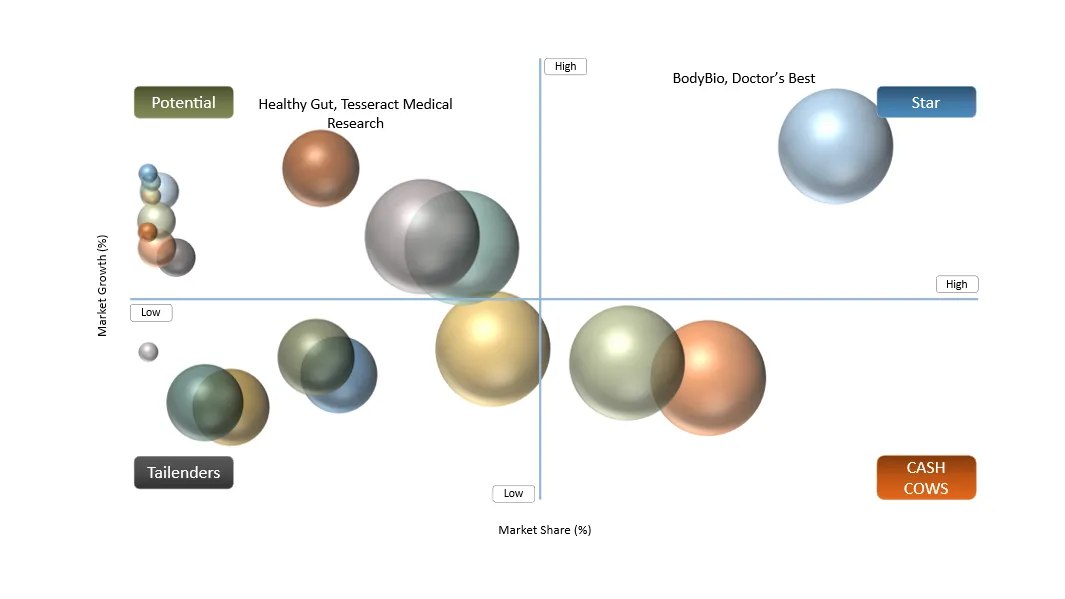
| Quadrant | Representative Companies | Strategic Interpretation |
| Stars | BodyBio, Doctor’s Best | Strong brand visibility, differentiated butyrate platforms and expanding consumer demand. |
| Potential | Healthy Gut, Tesseract Medical Research, Healus | Innovative delivery or practitioner positioning with room to scale distribution. |
| Cash Cows | Designs for Health, Pure Encapsulations, Metagenics | Established practitioner channels and recurring digestive-health portfolios. |
| Tailenders | Small private-label brands | Limited differentiation, weak evidence and high exposure to price comparison. |
Butyrate Supplements Market Dynamics
Driver Impact Analysis
| Driver | Market Growth Impact | Demand Concentration | Impacted Use Case | Strategic Impact |
| Rising gut-health awareness | High | Global e-commerce | Digestive comfort and barrier support | Expands consumer search and trial. |
| Growth of postbiotics | High | Premium supplements | Metabolite-based wellness | Creates a new functional category beyond probiotics. |
| Improved delivery technology | Medium-High | Tributyrin and microencapsulation | Odor control and colon delivery | Raises tolerability and premium pricing. |
| Practitioner adoption | Medium | Clinical channels | Persistent digestive concerns | Improves credibility and repeat purchase. |
Driver: Growing Interest in Gut Barrier and Microbiome Function
Consumers increasingly understand that digestive wellness involves microbial metabolites, intestinal integrity and immune signaling. This expands demand beyond conventional probiotics. Butyrate has a clear educational narrative because it is a short-chain fatty acid produced from fiber fermentation and used by colon cells. Brands that translate this biology into responsible, easy-to-understand claims can attract consumers seeking targeted gut support.
Restraint Impact Analysis
| Restraint | Drag on Growth | Primary Impact Area | Impacted Use Case | Strategic Impact |
| Low consumer familiarity | High | Education | Mainstream retail | Raises acquisition cost and slows conversion. |
| Odor and taste | High | Product experience | Capsules and powders | Reduces adherence and repeat purchase. |
| Uneven evidence | Medium-High | Claims and practitioner trust | Condition-specific use | Limits aggressive positioning. |
| Regulatory complexity | Medium | Market entry | International expansion | Requires claim and ingredient review. |
Restraint: Sensory and Delivery Limitations
Conventional butyrate has a strong rancid odor and can create an unpleasant aftertaste. Poorly designed products may release early in the gastrointestinal tract, reducing user acceptance and the intended delivery profile. These limitations increase formulation cost and make packaging selection important. Companies need encapsulation, enteric coating or tributyrin formats that improve experience without obscuring the actual dose.
Butyrate Supplements Market Segment Analysis
The global Butyrate Supplements market is segmented based on Butyrate Form, Product Type, Health Application, Dosage Form, Consumer Group, Distribution Channel and region.
By Butyrate Form
Sodium Butyrate Will Retain the Largest Commercial Base
Sodium butyrate leads because it is widely available, familiar to practitioners and compatible with capsule and microencapsulation technologies. Tributyrin and advanced encapsulated forms will grow faster because they improve odor control, payload delivery and consumer experience. Calcium-magnesium blends appeal to buyers seeking buffered mineral forms, while other derivatives remain niche. Competitive advantage will depend on disclosed active dose and release performance.
By Product Type
Synbiotic and Postbiotic Blends Will Gain Share
Single-ingredient products remain the largest category because they offer clear dosing and simple comparison. Synbiotic and postbiotic blends will gain share as brands combine butyrate with prebiotic fibers, probiotics and mucosal-support ingredients. These products support broader claims and higher basket value, though complexity increases the need for formulation rationale and evidence. Multi-ingredient formulas perform well in practitioner and premium e-commerce channels.
By Health Application
Intestinal Barrier Support Will Be a High-Value Growth Segment
Digestive comfort and regularity generate the largest consumer demand, while intestinal barrier support is becoming a high-value growth segment. The concept connects butyrate with colonocyte energy, mucosal integrity and microbiome function. Immune and metabolic positioning will expand more gradually because claims require careful substantiation. Sports and recovery applications remain emerging and are most relevant when linked to gastrointestinal resilience.
By Dosage Form
Capsules Will Remain the Dominant Format
Capsules dominate because they mask odor, support delayed release and simplify dosing. Softgels are well suited to tributyrin and lipid-based delivery, while tablets face formulation constraints. Powders allow flexible dosing but require stronger flavor management. Liquids remain niche due to sensory and stability challenges. Premium formats will differentiate through lower capsule burden and targeted release.
By Consumer Group
Adults With Digestive Concerns Will Drive Core Demand
Adults with digestive concerns represent the largest user base because they actively search for solutions and are more likely to follow practitioner guidance. Healthy aging consumers offer growth through interest in microbiome and immune resilience. Active consumers may adopt butyrate for digestive tolerance and recovery, although evidence is still emerging. General wellness buyers require simpler education and lower-friction products.
By Distribution Channel
E-Commerce Will Continue to Lead
E-commerce leads because the category requires education and benefits from reviews, subscriptions and direct comparison. Practitioner channels support premium products and condition-specific guidance. Pharmacies provide credibility in Europe and selected markets. Health stores remain important for discovery, while supermarkets are limited by low consumer familiarity. Omnichannel brands can use digital education to support retail conversion.
Butyrate Supplements Market Geographical Penetration
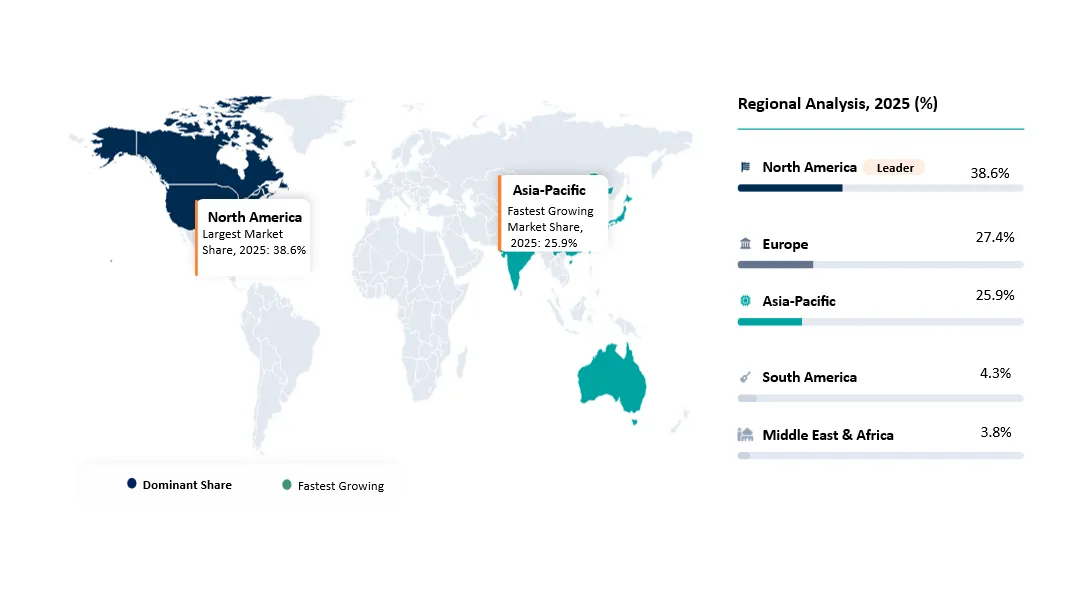
| Region | 2025 Share | Market Position |
| North America | 38.6% | Largest |
| Europe | 27.4% | Established |
| Asia-Pacific | 25.9% | Fastest Growing |
| South America | 4.3% | Emerging |
| Middle East and Africa | 3.8% | Developing |
U.S. Butyrate Supplements Market Landscape
The U.S. is the largest national market through high supplement spending, strong direct-to-consumer commerce and rapid adoption of postbiotic terminology. Practitioner brands and branded tributyrin ingredients support premium positioning. The 2025 Doctor’s Best launch increased mainstream visibility. Growth will depend on responsible claims, evidence communication and repeat-purchase performance.
Germany Butyrate Supplements Market Outlook
Germany has a pharmacy-oriented digestive health market and strong consumer interest in clinically positioned products. Microencapsulated sodium butyrate and practitioner guidance are important. Regulatory scrutiny of claims supports demand for well-documented formulations and conservative communication.
Japan Butyrate Supplements Market Trends
Japan offers opportunity through functional nutrition, healthy aging and microbiome research. Consumers value quality, dosage convenience and scientific substantiation. Local partnerships and regulatory review are essential because product classification and permissible claims differ from North America.
China Butyrate Supplements Market Outlook
China is an emerging market supported by e-commerce, digestive wellness interest and local manufacturing. Premium imported brands can attract urban consumers, while domestic brands compete on price and social-commerce reach. Trust, testing and education will determine growth.
Brazil Butyrate Supplements Market Outlook
Brazil has a growing supplement and pharmacy market with strong interest in digestive comfort and probiotics. Butyrate remains less familiar, creating opportunities for practitioner education and combined formulations. Affordability and regulatory registration influence adoption.
Middle East and Africa Butyrate Supplements Market Outlook
Demand is concentrated in the Gulf, Israel and South Africa. E-commerce, private healthcare and premium wellness retail create entry points. Limited awareness and variable regulation require distributor partnerships, Arabic-language education and careful market selection.
Butyrate Supplements Market Competitive Landscape
- Competition is fragmented across practitioner brands, direct-to-consumer companies, ingredient suppliers and private-label manufacturers.
- Differentiation depends on butyrate form, active dose, release technology, odor control, evidence and channel credibility.
- BodyBio and Doctor’s Best benefit from recognizable butyrate positioning, while practitioner brands compete through protocol integration and professional trust.
- Ingredient suppliers influence the market by providing branded tributyrin, microencapsulation and formulation support to multiple finished-product companies.
- E-commerce lowers entry barriers but increases price transparency, advertising costs and reputational exposure through reviews.
- Partnerships with practitioners, contract manufacturers and clinical researchers are becoming important for product development and launch readiness.
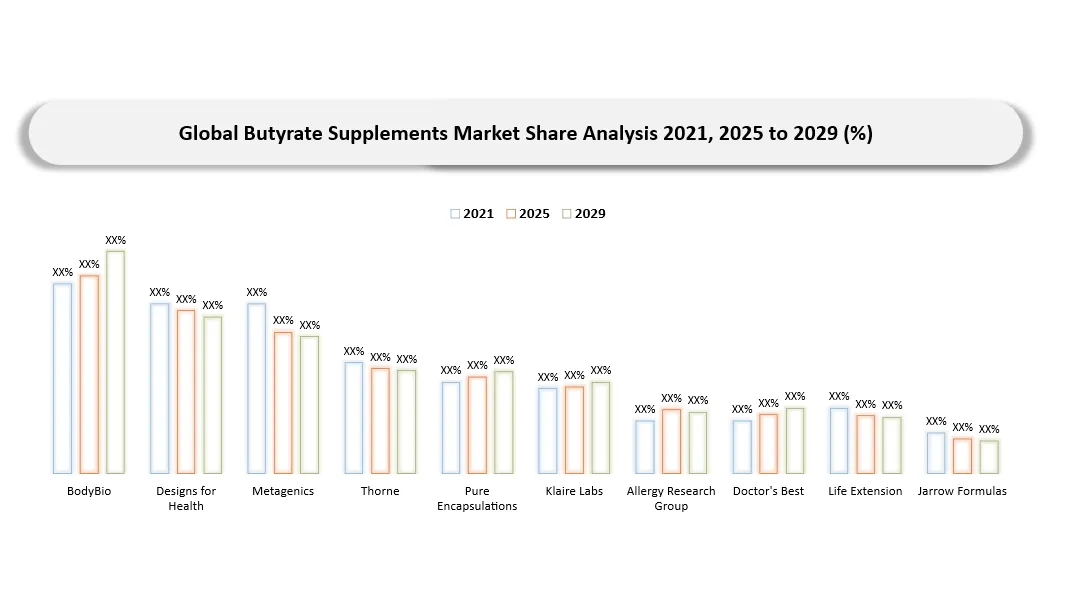
Key Companies of Butyrate Supplements Market
- BodyBio
- Healthy Gut
- Doctor’s Best
- Designs for Health
- Allergy Research Group
- Tesseract Medical Research
- Healus
- Nutri Advanced
- Klaire Labs
- DaVinci Laboratories
- Genestra Brands
- Seeking Health
- Pure Encapsulations
- Integrative Therapeutics
- Metagenics
- Thorne
- Life Extension
- Jarrow Formulas
- DSM-Firmenich
- Compound Solutions
Butyrate Supplements Market Major Pain Points
- Low mainstream understanding of butyrate and postbiotics.
- Strong odor and taste in conventional formulations.
- Unclear comparison of salts, tributyrin and encapsulated forms.
- Uneven clinical evidence by dose and health condition.
- Risk of disease-treatment claims that exceed supplement regulations.
- High customer acquisition cost for education-heavy products.
- Variable disclosure of active butyrate content.
- Dependence on specialized manufacturing and packaging.
Butyrate Supplements Market Recent Developments
- July 2025: DSM-Firmenich highlighted clinical evidence for a capsule combining prebiotics, probiotics and microencapsulated sodium butyrate in adults with irritable bowel symptoms, strengthening interest in synbiotic-butyrate combinations.
- April 2025: Doctor’s Best launched High Absorption Postbiotic Butyrate with CoreBiome tributyrin, positioning colon bioavailability and intestinal barrier support for mainstream supplement consumers.
- November 2025: A peer-reviewed clinical review evaluated sodium butyrate and microencapsulated forms in intestinal diseases, increasing scientific attention to delivery technology and condition-specific evidence.
- 2025-2026: Supplement brands expanded postbiotic and gut-barrier portfolios through tributyrin, delayed-release capsules and multi-biotic formulas.
- 2026: Retail and practitioner education increasingly separated direct butyrate supplementation from prebiotic fiber strategies intended to increase endogenous production.
Analyst View / Opinion on Butyrate Supplements Market
The Butyrate Supplements market has moved beyond a narrow practitioner niche, but it is still early enough that category education and formulation quality will determine winners. The central commercial challenge is translating microbiome science into a product experience that consumers can tolerate and understand. A high-quality formula must deliver a clear active dose, control odor and explain whether it uses a salt, tributyrin or targeted-release system.
- Sodium butyrate will remain the volume base, while tributyrin and microencapsulated products capture premium growth.
- Intestinal barrier and digestive comfort positioning will generate the strongest near-term demand.
- Synbiotic blends can increase value but need a clear formulation rationale rather than ingredient stacking.
- Practitioner channels will remain influential because consumer self-selection is difficult in an evidence-sensitive category.
- E-commerce will drive scale, but review quality and repeat purchase will expose poorly tolerated products quickly.
- Long-term leadership will depend on clinical substantiation, transparent dosing, compliance and delivery performance.
Butyrate Supplements Market Target Audience
| Industry | Who Should Buy This Report? | Reason to Buy This Report |
| Supplement Brands | Portfolio, innovation and commercial teams | Assess formulation, channel and positioning opportunities. |
| Ingredient Suppliers | Postbiotic, encapsulation and mineral suppliers | Identify customers and premium technology needs. |
| Contract Manufacturers | Capsule, softgel and coating providers | Evaluate capacity and technical requirements. |
| Practitioners | Dietitians, clinics and integrative health providers | Understand evidence, formats and consumer pathways. |
| Retail and E-Commerce | Buyers, marketplaces and pharmacy chains | Assess category growth, pricing and brand differentiation. |
| Investors and Consultants | Private equity, venture capital and advisors | Evaluate market size, risks and acquisition targets. |
| Regulatory and Testing | Consultants, laboratories and quality teams | Understand compliance, claims and testing needs. |
Why Choose DATAM?
- Data-driven insights combining market sizing, product mapping, pricing, channel analysis and regional opportunity.
- Post-purchase analyst consultations for product strategy, ingredient selection and market entry.
- Annual updates covering launches, research, regulation and competitive changes.
- Specialized focus on emerging functional ingredients and consumer-health categories.
- Actionable analysis connecting formulation science with commercial execution.
What DATAM Uniquely Provides
- Ten-year forecasts across form, product type, application, dosage form, consumer group, channel and region.
- Technology analysis separating salts, tributyrin and microencapsulated delivery.
- Buyer-focused assessment of dose, tolerability, claims and repeat purchase.
- Country-level views linking regulation, retail structure and consumer awareness.
- Strategic recommendations for partnerships, formulation and launch positioning.


























































