


Bio Based Packaging Market Size
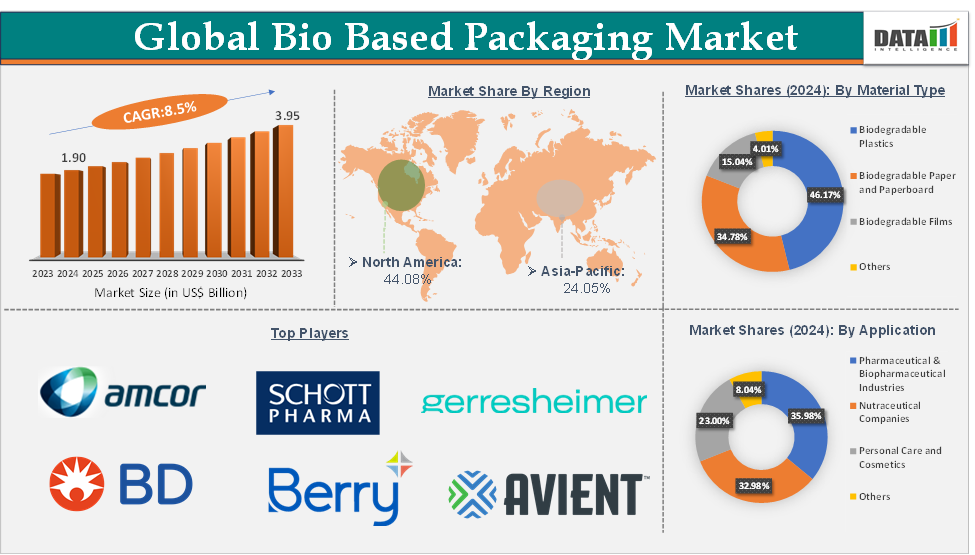
Bio Based Packaging Market reached US$ 1.90 Billion in 2024 and is expected to reach US$ 3.95 Billion by 2033, growing at a CAGR of 8.5% during the forecast period 2025-2033.
The demand for bio-based packaging in the healthcare sector has been growing steadily as healthcare companies and consumers alike recognize the importance of sustainability and reducing the environmental impact of packaging materials. For instance, according to the Association of the British Pharmaceutical Industry (ABPI), about 70 to 80% of the carbon footprint sits in the manufacturing process and as the designers and inventors of those manufacturing processes say the decisions made will live with that product for the rest of its useful life as a medicine.
Executive Summary
For more details on this report – Request for Sample
Bio Based Packaging Market Dynamics: Drivers & Restraints
Rising sustainability goals of pharmaceutical companies are significantly driving the bio based packaging market growth
Major pharmaceutical companies are setting ambitious sustainability targets, such as achieving net-zero emissions or reducing their carbon footprint, by integrating sustainability into their corporate strategies by using bio-based packaging materials to meet these goals. Thus, the demand for biobased packaging is booming.
For instance, in October 2024, TekniPlex Healthcare unveiled the first ISCC PLUS-certified bio-based PVC compounds, offering a sustainable alternative for medical packaging. Its new materials are designed for use in medical packaging applications like tubing, films for trays, pouches, and other plastic components, providing eco-friendly options. Made with renewable energy, its compounds reduce CO2 emissions by up to 90%, helping the healthcare industry create more sustainable packaging without losing performance or safety.
Regulatory bodies, such as the FDA and EMA, are increasingly focused on reducing the environmental impact of packaging materials in the healthcare sector. These regulations encourage the adoption of sustainable practices, including the use of bio-based packaging materials, by obtaining certifications like ISO compliance.
For instance, in January 2024, Avient Corporation, a leading provider of specialized and sustainable material solutions and services, announced it is highlighting its portfolio of bio-based polymer solutions at Pharmapack 2024. These solutions include bio-based polymer colorants and additives and bio-derived thermoplastic elastomers with lower product carbon footprint (PCF) values, substantiated by Avient’s PCF Calculator, certified by TÜV Rheinland for ISO 14067 compliance.
Stringent regulatory requirements are hampering the growth of the bio based packaging market
Stringent regulatory requirements significantly hamper the growth of the bio-based packaging market by creating barriers that complicate compliance, increase costs, and limit market adoption. These regulations are particularly stringent in the healthcare sector due to the critical nature of pharmaceutical packaging. Bio-based packaging must meet the same rigorous standards as traditional materials for safety, sterility, and functionality in pharmaceutical applications. This includes rigorous biocompatibility tests, stability tests, and compatibility with the drug or medical device within the packaging.
For instance, the FDA requires bio-based packaging materials to undergo extensive testing to demonstrate that they do not interact negatively with the contents, such as pharmaceuticals or medical devices. Like, materials must not leach harmful substances or compromise the integrity of the drug or device. These requirements make the regulatory process more complex and time-consuming for bio-based materials compared to traditional plastics.
Bio Based Packaging Market Segment Analysis
The global bio based packaging market is segmented based on material type, application, and region.
The biodegradable plastics from the material type segment are expected to hold 46.17% of the market share in 2024 in the bio based packaging market
Biodegradable plastics are derived from renewable resources like corn starch, sugarcane, or polylactic acid (PLA). These materials can break down more easily in natural environments, reducing the overall environmental footprint compared to conventional plastics, which can persist for hundreds of years in landfills. Biodegradable plastics can be engineered to have similar properties to traditional plastics, such as durability, moisture resistance, and chemical resistance, making them suitable for packaging pharmaceuticals and medical devices. Market players are developing numerous brands for biodegradable plastics, further boosting the segment growth.
For instance, in October 2024, Bayer launched a first-of-its-kind in the healthcare industry, polyethylene terephthalate (PET) blister packaging on its renowned brand, Aleve. Realized in partnership with pharma packaging specialist Liveo Research, this innovative solution reduces the carbon footprint of this packaging by 38% and marks a stride in environmental stewardship by eliminating the use of polyvinyl chloride (PVC).
Rising investments in biodegradable plastics are also increasing the market demand. For instance, in September 2024, Darmstadt-based BIOVOX announced the successful closing of its €2.2 million seed round. The round was led by High-Tech Gründerfonds (HTGF) with significant participation from Beteiligungs-Managementgesellschaft Hessen mbH (BMH) and a group of existing and new investors, as well as members of the business angel club Better Ventures and Business Angels FrankfurtRheinMain. The investment will enable BIOVOX to accelerate the development and production of its portfolio of innovative bioplastic solutions designed to revolutionize the healthcare industry.
Bio Based Packaging Market Geographical Analysis
North America is expected to dominate the global bio based packaging market with a 44.08% share in 2024
North America, particularly the United States and Canada, has a strong regulatory framework that encourages the adoption of sustainable packaging materials in the healthcare sector. The US FDA and Canadian regulatory bodies are pushing for more sustainable solutions to reduce the environmental impact of pharmaceutical packaging.
For instance, the FDA has issued guidance on the use of environmentally friendly packaging materials, including bio-based plastics, to ensure the safety and efficacy of pharmaceuticals. The directive is aimed at promoting packaging that is not only effective in protecting products but also sustainable.
In North America, there is a growing consumer preference for environmentally friendly products, which influences pharmaceutical companies to seek sustainable packaging solutions. Consumers are becoming more aware of the environmental impact of packaging materials and are demanding more eco-friendly options. This trend is particularly strong among younger demographics, who are more likely to choose sustainable products. For instance, the survey conducted by Accenture found that 83% of US consumers believe it's important for companies to design environmentally friendly products.
Asia-Pacific is growing at the fastest pace in the bio based packaging market, holding 24.05% of the market share
The Asia-Pacific region is witnessing significant economic growth, especially in countries like China, India, and Japan. This economic development is leading to an increased demand for healthcare products, which in turn drives the need for sustainable packaging solutions. As disposable incomes rise and urbanization accelerates, consumers are becoming more aware of the environmental impact of packaging and are increasingly demanding eco-friendly alternatives.
For instance, in China, the healthcare packaging market is expanding rapidly due to an aging population and increased healthcare spending. This growth is prompting the adoption of bio-based packaging to meet the demands of the pharmaceutical industry, which is under pressure to reduce waste and comply with stricter environmental regulations.
Major pharmaceutical companies in the APAC region are setting ambitious sustainability targets and are actively seeking bio-based packaging solutions to meet these goals. For example, companies like Cipla, Sun Pharmaceutical Industries, and Aurobindo Pharma in India are increasingly using bio-based packaging materials to meet global standards and enhance their sustainability profiles.
Bio Based Packaging Market Major Players
The major global players in the bio based packaging market include Amcor plc, Gerresheimer AG, SCHOTT Pharma, Becton, Dickinson, and Company, DS Smith, Berry Global Inc., Smurfit Kappa, Sanner GmbH, Avient Corporation, and Bormioli Pharma S.p.A., among others.
Bio Based Packaging Market Key Developments
In May 2025, Primex makes Sulapac available for packaging manufacturers across the U.S., Prime Sulapac sheets, a safe, sustainable, and high-performance alternative to traditional plastics. Designed with both environmental responsibility and manufacturing versatility in mind, the new material marks a major step forward in the sustainability transition of the thermoforming industry. Frequently used as a replacement for traditional plastics like PS, PP, and PET, Prime Sulapac excels in packaging inserts and other thermoformed products, including point-of-sale displays, logistic trays, single-use packaging, and blister cards.
In November 2024, UPM Biochemicals, Selenis and Bormioli Pharma have partnered to produce the world’s first pharmaceutical bottles made from partially wood-based PET. This bottle takes sustainability in pharma packaging to a whole new level. As the high regulatory and performance requirements for pharma packaging may limit the use of new or recycled materials, this bottle uses standard PET, which is made with UPM’s world-first wood-based BioMEG, UPM BioPura, to take a real step forward in the sustainable transformation of the pharmaceutical sector.
In July 2024, Aluflexpack, a manufacturer of premium flexible packaging solutions, announced the development of a new product: the 4∞ Form. This blister pack, designed specifically for the pharmaceutical industry, is constructed entirely of lacquered aluminium, offering a sustainable and recyclable alternative to traditional multimaterial packaging. The 4∞ Form solution addresses growing concerns about the environmental impact within the pharmaceutical packaging sector.
Market Scope
Metrics | Details | |
CAGR | 8.5% | |
Market Size Available for Years | 2022-2033 | |
Estimation Forecast Period | 2025-2033 | |
Revenue Units | Value (US$ Bn) | |
Segments Covered | Material Type | Biodegradable Plastics, Biodegradable Paper and Paperboard, Biodegradable Films, and Others |
Application | Pharmaceutical & Biopharmaceutical Industries, Nutraceutical Companies, Personal Care and Cosmetics, and Others | |
Regions Covered | North America, Europe, Asia-Pacific, South America, and the Middle East & Africa | |
The global bio based packaging market report delivers a detailed analysis with 54 key tables, more than 44 visually impactful figures, and 167 pages of expert insights, providing a complete view of the market landscape.




























































