


Bio-based Leather Market Size
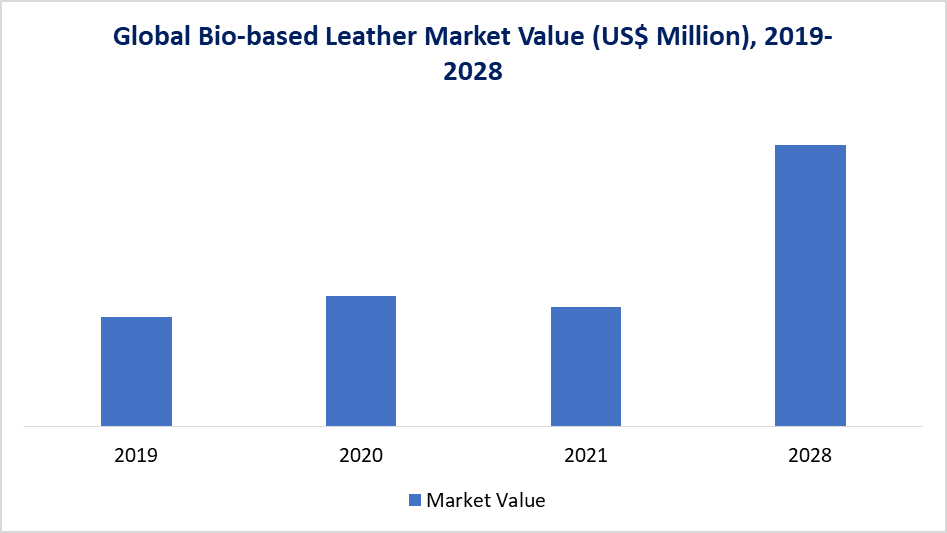
The global bio-based leather market size was valued at US$179.8 million in 2025 and is projected to reach US$456.2 million by 2033, growing at a CAGR of 7.9% during 2026–2033.
Compared to other synthetic leathers, bio-based leather is more scratch-resistant and has a softer surface. Bio-based leather is phthalate-free and as a result, it has received official clearance and is exempt from stringent regulations, and accounts for a significant portion of the globally synthetic leather market. Bio-based leather is commonly used in footwear, bags, wallets, seat covers, and sports equipment, among other things.
Collagen, the main structural component of cowhides, is the fundamental component of this bio-based leather. As a result, the finished product closely resembles animal leather. Collagen comes in a variety of shapes so bio-based leather comes with various shapes and features. Bio-based leather fabric is made up of 70% renewable materials and provides increased performance as well as environmental protection.
Source: DataM Intelligence
Bio-based Leather Market Scope
| Metrics | Details |
| Market CAGR | 7.9% |
| Segments Covered | By Source, By End-User, By Sales Channel and By Region |
| Report Insights Covered | Competitive Landscape Analysis, Company Profile Analysis, Market Size, Share, Growth, Demand, Recent Developments, Mergers and acquisitions, New Product Launches, Growth Strategies, Revenue Analysis, and Other vital insights. |
| Fastest Growing Region | Asia Pacific |
| Largest Market Share | North America |
To Get a Free Sample Click here
Market Dynamics and Trends
The growing demand for eco-friendly and cruelty-free in the global market is expected to act as a driver that caters to the growth of the global bio-based leather market. Further, animal and synthetic leather's health and environmental impact also substantially drive the market. However, the limitations associated with manufacturing processes and lackadaisical market growth of bio-based leather are expected to restrict the market growth.
Health and environmental impact of animal and synthetic leather
Animal leather and its manufacturing have a severe impact on the well-being of both humans and nature alike. The first and foremost among them is the degradation of natural ecosystems and the extinction of several animal species, mostly reptiles. The growing public awareness of animal abuse and broad environmental deterioration has piqued the curiosity of many entrepreneurs and consumers who are seizing the opportunity to make a difference.
Secondly, traditional pre-tanning and tanning procedures release a multitude of chemicals ranging from salts to sulfides and acids into the land and water bodies. Furthermore, in addition to polluting the ground and other water sources, rearing the animals whose skin is finally turned into leather necessitates a large amount of water and pastureland cleared of trees. The respective factors seriously impact the environment and play a pivotal role in its destruction. In addition, chemicals such as arsenic used in leather tanning are carcinogenic and have been linked to lung cancer. However, the manufacturing of bio-based leather has no negative effects since natural fibers such as flax or cotton fibers blended with palm, soybean, corn and other plants are being used to make bio-based leather. Similarly, pineapple leaves that are considered a waste product also find application to manufacture bio-based leather used in shoes, handbags, and other high-market demand items.
The fact that bio-based leather and its manufacturing addresses all the aforementioned problems as opposed to animal-based or PU/PVC-based leather, the respective factor could act as a major market driver for the global bio-based leather market's growth in demand and sales. Due to the market's infancy, there is still much room for new participants, and numerous manufacturers are also entering the market with innovative materials and production processes. For instance, MycoWorks, a bio-based leather manufacturer, makes water-resistant and fully biodegradable leather from mushroom mycelium utilizing an eco-friendly, robust process through intense research.
The limitations associated with manufacturing processes and lackadaisical market growth of bio-based leather
Although bio-based leather is a superior alternative to real leather plastic-based faux leather, still requires chemical processing to get a leather-like feel and durability, posing environmental issues. For instance, though Pinatex is manufactured from discarded pineapple leaves, it is non-biodegradable because it is covered with a petroleum-based substance for added durability.
Similarly, apple leather is created by coating a cotton/polyester canvas with 50% apple waste mixed with 50% polyurethane. Since these chemical additives utilized in the manufacturing of bio-based leather cause a negative impact on the environment during its deterioration or recycling, the limitations in manufacturing technologies that require chemical additives could be considered a major market restrain.
Further, the bio-based leather market is still in its infancy as only a few small-scale producers manufacture and employ the respective products on a wide scale. Since they are unavailable globally and exist unknown in emerging economies, the bio-based products market prospects are diminished in the global market. Furthermore, the presence, dominance, and popularity of previously established real and synthetic leather also restrain the bio-based leather market.
Market Segment Analysis
The global bio-based leather market is segmented based on source, end-use, sales channel, and region.
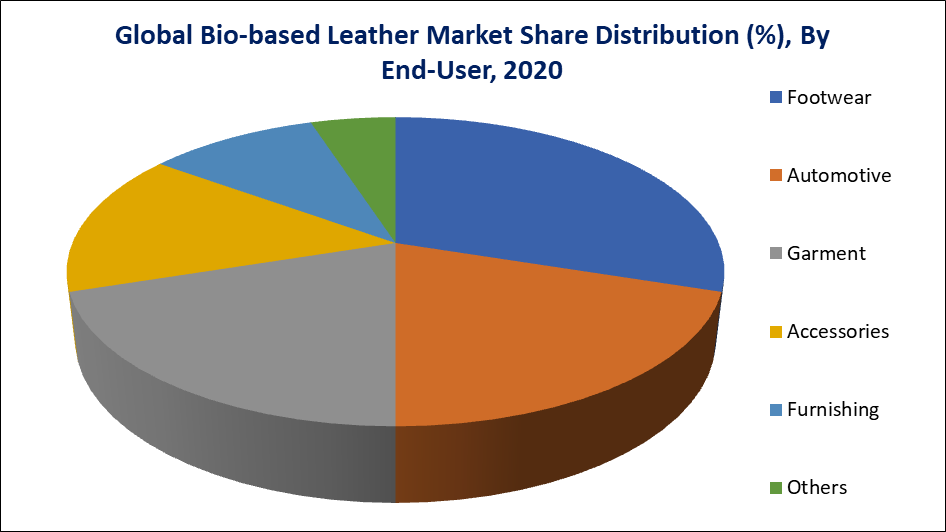
The growing demand for eco-friendly and cruelty-free products in footwear allows the respective sector to dominate the end-user segment of the global bio-based leather market.
The global bio-based leather market is segmented into automotive, footwear, garment, accessories, furnishing, and others based on end-use. Since customers and fashion brands are increasingly looking for a sustainable and cruelty-free alternative to leather, the footwear sector dominates the bio-based leather market.
As plant or mushroom sources of bio-based leather are uncomplicated to grow, collect, and completely biodegradable, many fashion footwear brands have already switched to bio-based leather. Further, the fact that traditional leather has a carbon footprint of 40 times that of plant-based leather and synthetic leather derived from plastics has a carbon footprint of 17 times that of plant-based leather also motivates many footwear manufacturers to switch to bio-based leather.
For instance, on July 18, 2021, Nike launched a range of shoes manufactured utilizing Piatex, a vegan leather replacement produced by Ananas Anam.
Source: DataM Intelligence
Market Geographical Share
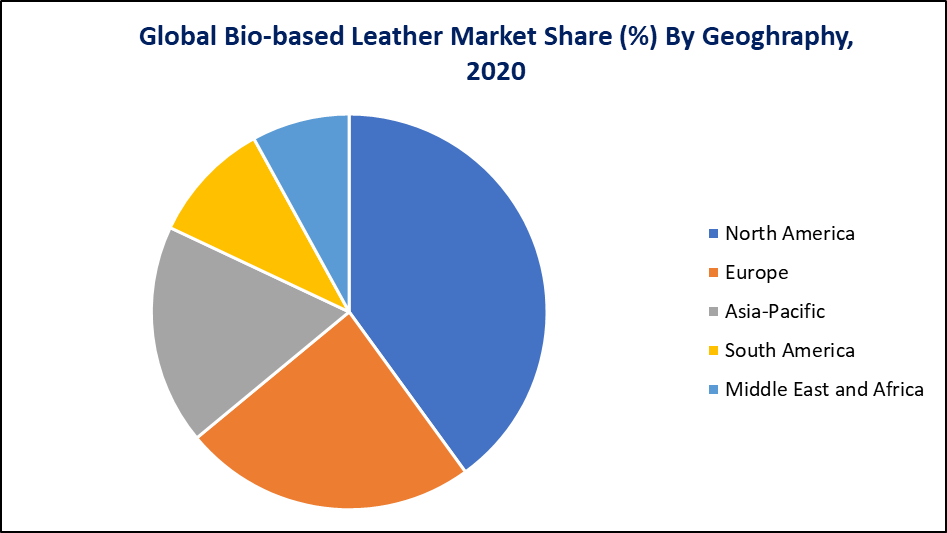
The growing advancements in production processes and growing demand from various industrial verticals allow North America to dominate the regional segment of the global bio-based leather market.
North America dominates the regional segment of the global bio-based leather market due to high demand, application development, and product innovation in the region's bio-based leather market. The desire for sustainable leather in the North American fashion industry, a global hub of the fashion industry, is also considered a significant factor that offers considerable growth to the region's bio-based leather market.
Europe follows North America in the regional segment of the bio-based leather market, driven by the need for footwear from the fashion and sports industries of the region. The renewability and comparable or even better performance are also reasons that propel the bio-based leather market in Europe for the footwear sector.
Further, growing veganism, stringent environmental rules, and the promotion of bio-based leather by several regulatory groups, including PETA, are also critical factors that drive the bio-based leather market in both regions.
Source: DataM Intelligence
Market Companies and Competitive Landscape
The global bio-based leather market is stagnant in terms of the number and size of global and local competitors. The market is categorized as consolidated because of the presence of only a few manufacturers controlling most of the market share. Toray Industries Inc, Bolt Threads Inc, Ananas Anam Ltd, Modern Meadows, Nat-2, Natural Fiber Welding Inc, Ultrafabrics, MycoWorks, ECCO Leather, and VEGEA are some of the major market players. The key market stakeholders utilize market tactics such as mergers, acquisitions, product launches, contributions, and partnerships to gain competitive advantages and recognition in their respective markets.
For instance, on January 13, 2023, MycoWorks, a manufacturer of fungal-based biomaterial that can replace animal and synthetic leather, raised $125 million in Series C funding to build a production plant and scale up production of its flagship product Reishi. Series C includes new investors such as SK Networks and Mirabaud Lifestyle Impact and Innovation Fund, as well as several other new and existing investors.
Ananas Anam Ltd
Overview: Ananas Anam is known for Piñatex, an innovative natural textile made from pineapple leaf fiber. The company was founded in 2013 and in February 2020, the company began the development project for Piñatex by experimenting with decoration and other value-added processes. The company collaborated with the Centre for Circular Design at Chelsea College of Arts (UAL) to discover new functions and applications for our bio-based, non-woven, sustainable material.
Product Portfolio:
- Piñatex: The product is a cutting-edge natural textile created from discarded pineapple leaf fiber. Since the leaves are a by-product of the existing pineapple harvest, no additional environmental resources are required to manufacture them. Pilates is suitable for usage in fashion, accessories, and upholstery and has been utilized by over 1000 brands globally, including Hugo Boss, H&M, and the Hilton Hotel Bankside.
Key Development:
- October 2026: BSF Enterprise Advances Cultivated Leather Commercialization with Luxury Fashion Brands – BSF Enterprise, through its subsidiary Lab-Grown Leather Ltd., advanced commercial evaluation programmes with two leading global luxury fashion houses for its Elemental Lux™ cultivated leather. Initial material samples were delivered and invoiced to one partner, while the second partnership moved into funded tanning validation and product prototyping, with further testing planned for 2027.
- September 2026: CSIR-CLRI Promotes Agricultural Waste-Based Leather Alternatives in India – India's CSIR-Central Leather Research Institute (CSIR-CLRI) advanced the development of leather-like materials using agricultural residues, including coffee husks, rice straw, wheat straw, banana waste, and mango waste. The institute signed a technology licensing agreement with Bengaluru-based startup Husk & Hide on August 27, 2026, to commercialize coffee-husk-based leather alternatives for fashion and lifestyle applications.
- May 2026: SQIM Launches Ephea Uma Mycelium-Based Material for Luxury Accessories – Italian biotechnology company SQIM introduced Ephea Uma, a mushroom-mycelium-based material, in a global luxury accessories collection. The launch represents progress in bringing fungal biomaterials into premium fashion applications and highlights growing interest in biofabricated alternatives to conventional leather.
- January 2026: UNCAGED Innovations Expands Commercial Adoption of Grain-Based Leather – UNCAGED Innovations announced that five independent fashion brands had incorporated its ELEVATE plant-based leather material into luxury products. The material is developed using grain by-products such as soy, corn, and wheat, supporting the adoption of agricultural waste-derived materials in handbags, accessories, and other fashion applications.
- November 2025: Qorium Raises €22 Million to Scale Cultivated Leather Production – Netherlands-based biotechnology company Qorium secured €22 million in Series A funding from Invest-NL, LIOF, and existing investors to accelerate the commercialization of its cultivated leather technology. The investment supports the installation of additional bioreactor systems at its Maastricht facility and the expansion of production capabilities and commercial partnerships.
- August 2025: Hyundai CRADLE Partners with UNCAGED Innovations for Sustainable Automotive Materials – Hyundai Motor Group's global open innovation hub, Hyundai CRADLE, partnered with UNCAGED Innovations to develop grain-based, animal-free leather alternatives for automotive interiors. The collaboration focuses on using agricultural by-products to develop materials with reduced environmental footprints, supporting the automotive industry's transition toward sustainable interior materials.
- June 2025: Beyond Leather Materials Introduces Leap Flex Apple-Based Material – Danish company Beyond Leather Materials launched Leap Flex, an upgraded version of its apple-waste-based leather alternative. The material offers enhanced flexibility, stretchability, and durability, targeting applications such as upholstered furniture and products with curved or complex designs.
Why Purchase the Report?
- To visualize the Global Bio-based leather market segmentation by source, end-user, sales channel, and region and understand key commercial assets and players.
- Identify commercial opportunities in the Global Bio-based leather market by analyzing trends and co-development.
- Excel data sheet with numerous bio-based leather market-level data points with four segments.
- PDF report consisting of cogently put together market analysis after exhaustive qualitative interviews and in-depth market study.
- Product mapping available as excel consisting of key products of all the major market players
The global bio-based leather market report would provide approximately 61 tables, 63 figures, and almost 180 pages.
Target Audience
- Bio-based Leather Manufacturers/ Buyers
- Industry Investors/Investment Bankers
- Research Professionals
- Emerging Companies
- Logistics companies
- Distributors/ Suppliers




























































