


Atrazine Market Overview
The Global Atrazine Market reached USD 1.95 billion in 2025 and is expected to reach USD 3.12 billion in 2033, growing at a CAGR of 6.9% during the forecast period(2026-2033)
Farmers are increasingly more focused on enhancing agricultural productivity to meet the developing demand for food. By coping with weeds, that may compete with crops for vitamins, sunlight, and water, atrazine can assist in boosting crop yield. To manipulate weeds in plants such as corn, millet, sugarcane, and barley, glyphosate is predominantly utilized in agriculture.
The volume of cultivated land and farming practices immediately impact the demand for atrazine. For instance, a better quantity of corn plantations may additionally lead to an increased demand for atrazine. According to the European Union (EU) Wheat Monitoring Agency, wheat production in the EU is anticipated to attain 135.0 million metric lots (MMT) in the advertising year (MY) 2023/2024, an upward push of 0.9 MMT (1%) from the previous year and 2% above the 5-12 months common. As wheat manufacturing grows, atrazine herbicides may be vital to enhance crop productivity.
Atrazine Market Scope and Summary
| Metrics | Details |
| CAGR | 6.9% |
| Size Available for Years | 2023-2033 |
| Forecast Period | 2026-2033 |
| Data Availability | Value (US$) |
| Segments Covered | Type, Form, Crop Type, Distribution Channel, Mode of Application, Stage of Application and Region |
| Regions Covered | North America, Europe, Asia-Pacific, South America and Middle East & Africa |
| Fastest Growing Region | Asia-Pacific |
| Largest Region | North America |
| Report Insights Covered | Competitive Landscape Analysis, Company Profile Analysis, Market Size, Share, Growth, Demand, Recent Developments, Mergers and Acquisitions, New Equipment Type Launches, Growth Strategies, Revenue Analysis, Porter’s Analysis, Pricing Analysis, Regulatory Analysis, Supply-Chain Analysis and Other key Insights. |
For more details on this report - Request for Sample
Atrazine Market Dynamics and Trends
Increasing Research and Development Activities
Atrazine, a widely identified disruptor of the endocrine system, has been associated with numerous health issues, including the development of cancer. Consequently, mounting issues have arisen concerning atrazine's environmental effect, mainly due to the initiation of studies efforts aimed toward growing more ecologically pleasant herbicides. In light of these issues, agrochemical corporations have made widespread investments in studies and development endeavors to formulate herbicides that can be environmentally sustainable.
As a response, the market demand has witnessed a shift closer to the utilization of bio-based totally and organic herbicides, in addition to the adoption of integrated pest control (IPM) techniques. Prominent groups usually interact in research and development activities to provide progressive solutions to cope with the problems surrounding atrazine. These endeavors, in turn, foster a demand for the expansion of the market.
More Selective Herbicides are in High Demand
Farmers are actively seeking greater custom-designed herbicides that could effectively dispose of weeds while causing no harm to their vegetation. This developing demand has caused the development of herbicides which might be drastically extra selective compared to atrazine, which has been relied upon by using maize, sorghum, and sugar cane manufacturers inside the United States for over half a century to ensure sustainable food manufacturing.
Moreover, Syngenta has highlighted that atrazine no longer simplest contributes to international meal safety however additionally plays a critical position in keeping the surroundings and shielding key animal habitats. Through the merchandising of conservation tillage and no-till farming practices, atrazine assists farmers in preventing an estimated 85 million lots of soil erosion yearly. Additionally, atrazine, in conjunction with simazine, a closely related herbicide, saves American consumers from $4.3 to almost $6.2 billion every year, in most cases with the aid of reducing prices of meat, eggs, dairy merchandise, and ethanol used as fuel.
Furthermore, Indian sugarcane manufacturers now have entry to to BASF's groundbreaking herbicide referred to as Vesnit, which is in particular designed to efficiently manage each grassy and broadleaf weed. This progressive product is set to be available in March 2022 and guarantees to noticeably decorate post-emergence weed control for manufacturers, in the end leading to healthier crop yields. It is worth noting that India is the second-largest global producer of sugarcane. However, the superiority of numerous grassland and broadleaf weeds poses a big undertaking for Indian sugarcane manufacturers.
Availability of Alternative Herbicides
The presence of replacement weed killers holds the potential to substantially impact the boom of the atrazine market growth. When more efficient or green weed killers turn out to be handy, they may without delay compete inside the weed killer market demand with Atrazine. Farmers would possibly opt for these alternatives, reducing the demand for Atrazine.
In addition, companies are developing innovative answers as substitutes for Atrazine, which will avert the expansion of the marketplace in the course of the projected duration. For instance, on July 21, 2023, Syngenta unveiled a unique product called Storen, which contains bicyclopyrone, mesotrione, S-metolachlor, and pyroxasulfone. This product has received approval from the EPA for usage in 2024. Storen may be used for both pre- and post-emergence remedies in field corn and seed corn. It efficiently controls more than seventy-four one-of-a-kind weed species.
As alternative options that doubtlessly have fewer environmental concerns benefit reputation, regulatory bodies might also assess and impose stricter regulations on the use of Atrazine. This may want to in addition obstruct its market position enlargement. For example, on June 26, 2023, MEPs from the Environment Committee expressed their stance on safeguarding groundwater and surface water bodies from infection, as well as enhancing water first-class requirements. The MEPs are known for greater stringent standards for glyphosate, bisphenol (overall bisphenol), atrazine, medicinal drugs, and non-relevant pesticide metabolites.
Atrazine Market Segmentation
The global atrazine market is segmented based on type, form, crop type, distribution channel, mode of application, stage of application and region.
Demand for Cereal Crop Production
Atrazine, an extensively used herbicide within the cultivation of cereal vegetation, plays a critical function in coping with unwanted plants. The class of grains emerges because the maximum profitable. Essential crops along with wheat, corn, rice, and barley play an important role in nourishing the arena's population. Atrazine successfully combats a numerous variety of plants, together with both grass and broadleaf weeds. The competition from these weeds can considerably impact the yield of cereal vegetation, particularly corn and wheat. By helping in the management of weed populations, atrazine promotes the growth of healthier and greater productive cereal plants.
Following the Food and Agriculture Organization's contemporary estimation, international cereal manufacturing is projected to grow by 5.9 million tonnes (zero 2 percent) in July compared to the previous month. This record-breaking output reaches an extraordinary excessive of 2,819 million tonnes, marking a 1.1% yr-on-year boom. The primary element behind the surge is the stepped-forward forecast for worldwide wheat production, which's expected to upward push by 0.9 percent to attain 783.3 million tonnes. However, this discernment still falls brief utilizing 18.4 million tonnes compared to the report set in 2022.
Global Atrazine Market Geographical Penetration
North America Dominates the Atrazine Market
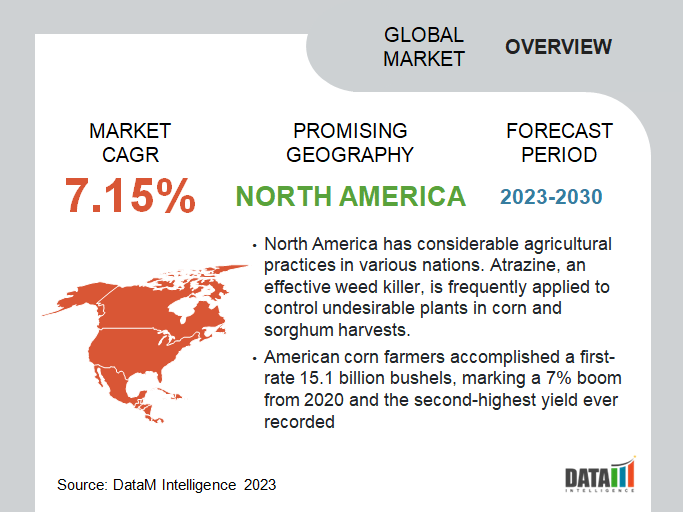
The market of Atrazine in North America dominated due to its considerable agricultural practices. Atrazine, an effective weed killer, is frequently applied to control undesirable plants in corn and sorghum harvests. It has been extensively employed as an herbicide in the United States for numerous years. The US is a tremendous agricultural producer, and atrazine is drastically used to combat weeds in corn, soybeans, wheat, and different plants.
American corn farmers accomplished a first-rate 15.1 billion bushels, marking a 7% boom from 2020 and the second-highest yield ever recorded. The corn yield inside the United States is estimated to reach a record-breaking 177.0 bushels in step with acre, surpassing the 2020 yield of 171.4 bushels in line with acre by way of 5.6 bushels.
Additionally, the grain region harvested, which stands at a substantial 85.4 million acres, has seen a 4% upward push as compared to the figures supplied by the USDA in 2020. Consequently, the demand for cereals and crops necessary to control weeds and increased production potential is using the boost of the atrazine market in North America.
Competitive Landscape
The major global players include Syngenta, FMC Corporation, Nufarm, ADAMA, Drexel Chemical Company, Zagro, Sipcam Agro USA, Inc., Rallis India Limited, Rainbow Agro and Bharat Group
Recent Developments
- In March 2026, Syngenta AG continued advancements in atrazine-based herbicide formulations.
The focus is on improving weed control efficiency while minimizing environmental impact.
This supports sustainable crop protection practices in large-scale farming. - In February 2026, Corteva Agriscience emphasized regulatory compliance and product stewardship for atrazine usage.
The company worked on safer application technologies and farmer education programs.
This aims to ensure responsible use amid tightening environmental regulations. - In January 2026, BASF SE expanded research on integrated weed management solutions involving atrazine.
The initiative combines chemical and biological approaches for enhanced effectiveness.
It helps reduce herbicide resistance and improve long-term crop productivity.
Why Purchase the Report?
- To visualize the global atrazine market segmentation based on type, form, crop type, distribution channel, mode of application, stage of application, and region, as well as understand key commercial assets and players.
- Identify commercial opportunities by analyzing trends and co-development.
- Excel data sheet with numerous data points of atrazine market-level with all segments.
- PDF report consists of a comprehensive analysis after exhaustive qualitative interviews and an in-depth study.
- Product mapping available as Excel consisting of key products of all the major players.
The global atrazine market report would provide approximately 85 tables, 87 figures and 198 Pages.
Target Audience 2026
- Manufacturers/ Buyers
- Industry Investors/Investment Bankers
- Research Professionals
- Emerging Companies




























































