


AI in Medication Management Market Overview
Medication safety is becoming a top priority for healthcare systems as the cost of errors, both clinical and financial, continues to escalate. AI is increasingly being embedded into medication management workflows to address this challenge, shifting the market from basic reminder tools to advanced clinical decision support systems.
The current phase of the market is defined by a transition from consumer focused reminder apps to integrated clinical intelligence platforms. Healthcare providers, payers, and digital health companies are increasingly investing in AI-driven solutions to reduce medication errors, improve patient adherence, and optimize treatment outcomes. This shift is particularly relevant given the global cost of medication errors, estimated at USD 42 billion annually, making this market strategically important for both healthcare systems and technology providers.
Market Scope
| Metric | Details |
| Market Size (2025) | USD 593.58 Million |
| Market Size (2035) | USD 1,187.71 Million |
| CAGR | 8.00% |
| Historic Years | 2023–2024 |
| Base Year | 2025 |
| Forecast Period | 2026–2035 |
| Segments Covered | Technology, Application, End User, Region |
| Leading Region | North America |
| Fastest Growing Region | Asia-Pacific |
For more details on this report – Request for Sample
Key Takeaways
- Medication errors contribute to 5% to 41.3% of global hospital admissions, making AI-driven medication management a clinical priority.
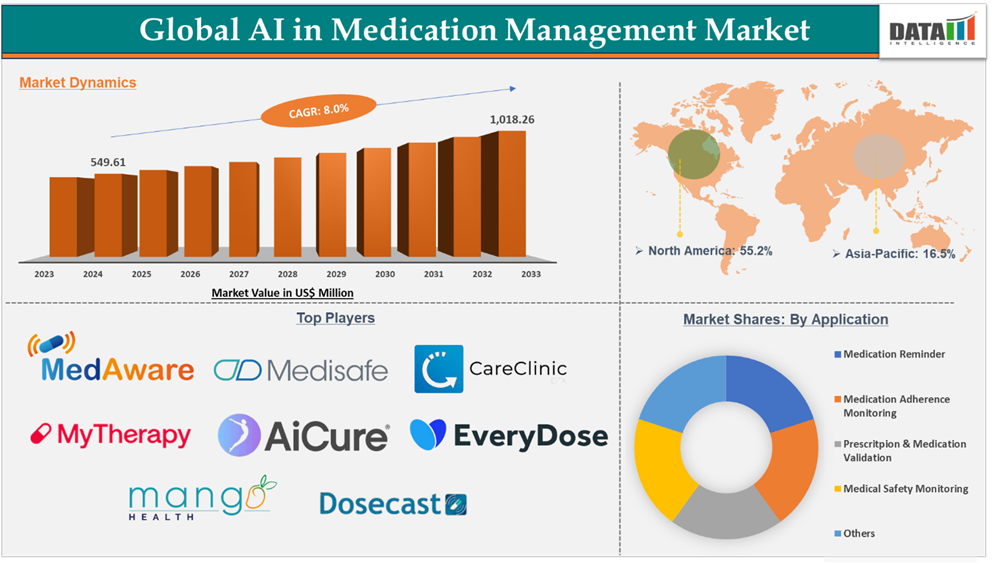
- The AI in medication management market growth is supported by an 8.0% CAGR, indicating consistent and sustained adoption across healthcare systems.
- Medication reminder applications account for 40.5% of market share, positioning adherence tools as the primary revenue generator.
- North America holds 55.2% of the market share, driven by strong digital health infrastructure and early AI adoption.
- The USD 42 billion annual cost of medication errors is pushing healthcare providers to invest in automation and decision-support tools.
- Patients on multiple medications face a 30% higher risk of errors, increasing demand for AI-based drug interaction and dosage optimization platforms.
- The growing elderly population, particularly those aged 65 and above, is significantly increasing demand for medication adherence technologies.
- Expansion of home healthcare and remote patient monitoring is widening the market beyond traditional hospital settings.
- Integration of AI with electronic health records and clinical systems is improving workflow efficiency and real-time decision-making.
- Increasing investments in digital health infrastructure and mobile health applications are accelerating global adoption of AI-powered medication management solutions.
Executive Summary
Market Dynamics: From Adherence Tools to Clinical Intelligence Platforms
Rising Medication Errors Are Driving System-Level Adoption
The increasing prevalence of chronic diseases has led to widespread polypharmacy, significantly raising the risk of medication errors. These errors occur across prescribing, dispensing, and administration stages, often leading to hospital readmissions and adverse outcomes.
AI technologies are being deployed to analyze patient data, detect drug interactions, and provide real-time clinical recommendations. Hospitals and healthcare providers are integrating these tools into electronic health records and care management systems to reduce errors and improve patient safety.
Digital Health Expansion is Accelerating Market Penetration
The widespread adoption of smartphones and health applications is expanding the reach of AI-based medication management solutions. Patients are increasingly using mobile apps for medication reminders, adherence tracking, and health monitoring.
This trend is particularly strong in home healthcare settings, where AI tools help bridge the gap between clinical care and patient self-management.
Data Privacy Concerns Are Influencing Adoption Decisions
Despite strong growth potential, concerns related to patient data security and privacy remain a key restraint. AI systems require access to large volumes of sensitive health data, raising concerns about breaches and misuse.
Healthcare providers are therefore prioritizing solutions that offer robust data protection, compliance with regulatory standards, and secure integration with existing systems.
Segment Analysis: Adherence Applications Lead, Clinical Tools Expanding
Segmented by technology (Machine Learning, Natural Language Processing, Predictive Analytics), application (Medication Reminder, Adherence Monitoring, Prescription Validation, Safety Monitoring), end user (Healthcare Providers, Pharmaceutical Companies, Home Healthcare), and by Region - Share, Trends, and Forecast to 2035.
Medication Reminder Segment: Dominant Entry Point for AI Adoption
The medication reminder segment accounts for 40.5% of the AI in medication management market share, driven by widespread adoption in mobile health applications. These tools use AI algorithms to provide personalized reminders and improve adherence, particularly among elderly patients and those with chronic conditions.
Advanced Clinical Applications: Emerging Growth Drivers
Applications such as prescription validation, drug interaction analysis, and safety monitoring are gaining traction in clinical settings. These solutions provide higher value by directly impacting treatment outcomes and reducing healthcare costs.
Healthcare providers are increasingly investing in integrated platforms that combine multiple functionalities, moving beyond standalone applications.
Regional Analysis: North America Leads, Asia-Pacific Expands Rapidly
North America: Mature Market with High Adoption Rates
North America dominates the AI in medication management market with 55.2% share, driven by advanced healthcare infrastructure and strong presence of digital health companies.
The U.S. market is characterized by rapid adoption of AI tools in hospitals and clinics, supported by high healthcare spending and regulatory support for digital health innovation.
Asia-Pacific: Expanding Digital Health Ecosystem
Asia-Pacific is expected to witness the fastest growth, supported by increasing smartphone penetration, rising healthcare awareness, and government initiatives promoting digital health.
Countries such as India and China are seeing strong adoption of mobile health applications, particularly in urban populations.
Europe: Focus on Patient Safety and Compliance
Europe’s market is driven by patient safety initiatives and regulatory frameworks aimed at reducing medication errors. Adoption is supported by integration of AI tools into healthcare systems and emphasis on data protection.
Competitive Landscape: Innovation Focused on Integration and Usability
The AI in medication management market is fragmented, with a mix of digital health startups and established players focusing on user-centric and clinically integrated solutions.
Key players include MedAware, Medisafe, CareClinic, MyTherapy, AiCure, EveryDose, Dosecast, and Mango Health.
Competitive strategies include:
- Integration with healthcare systems and EHR platforms
- Development of user-friendly mobile applications
- Expansion of AI capabilities for clinical decision support
- Partnerships with healthcare providers and pharmaceutical companies
Recent Developments
In June 2026, Oracle Corporation expanded its AI-driven medication management solutions with advanced analytics for prescription optimization and patient adherence tracking. The innovation focuses on real-time insights and safety. This supports improved clinical outcomes.
In May 2026, IBM Corporation introduced AI-powered medication management platforms with predictive analytics for drug interactions and personalized treatment plans. The development enhances patient safety and decision-making. This benefits healthcare providers.
In April 2026, Cerner Corporation (Oracle Health) launched AI-enabled tools for automated medication reconciliation and clinical workflow optimization. The development improves accuracy and efficiency. This supports hospital operations.
In March 2026, McKesson Corporation strengthened its AI capabilities in medication management with solutions for inventory optimization and prescription accuracy. The innovation focuses on reducing errors and improving supply chain efficiency. This supports pharmacies and healthcare systems.
In February 2026, Omnicell, Inc. introduced AI-based medication adherence solutions with smart dispensing systems and real-time monitoring. The development enhances patient compliance. This benefits long-term care and hospital settings.
In January 2026, Change Healthcare (Optum) expanded its AI-driven medication management solutions with advanced data analytics for cost optimization and clinical decision support. The focus is on efficiency and patient safety. This supports value-based care.
Regulatory and Policy Environment
Regulatory frameworks are evolving to support the integration of AI in healthcare while ensuring patient safety and data privacy. Governments are promoting digital health adoption through funding and policy initiatives, particularly in developed markets.
At the same time, strict data protection regulations are influencing system design and deployment, requiring companies to ensure compliance with healthcare data standards and cybersecurity protocols.
Strategic Insights and Analyst Perspective
The AI in medication management market is entering a phase of clinical integration, where solutions are becoming part of core healthcare workflows rather than standalone tools. Companies that can combine usability with clinical accuracy and data security will be best positioned for growth.
Investment opportunities lie in platforms that:
- Integrate with healthcare systems
- Offer predictive and real-time analytics
- Address both patient and provider needs
Report Benefits
This AI in medication management market report supports:
- Healthcare providers in reducing medication errors and improving patient outcomes through AI-driven tools
- Investors in identifying scalable digital health solutions and long-term growth opportunities
- Technology companies in aligning product development with clinical and patient needs
- Pharmaceutical companies in improving medication adherence and treatment effectiveness
- Strategy teams in planning digital transformation and AI adoption
Target Audience
- Hospitals and healthcare providers
- Digital health companies
- Pharmaceutical companies
- Health insurers and payers
- Investors and venture capital firms
- Research and consulting firms




























































