


AI in Clinical Trials Market Overview
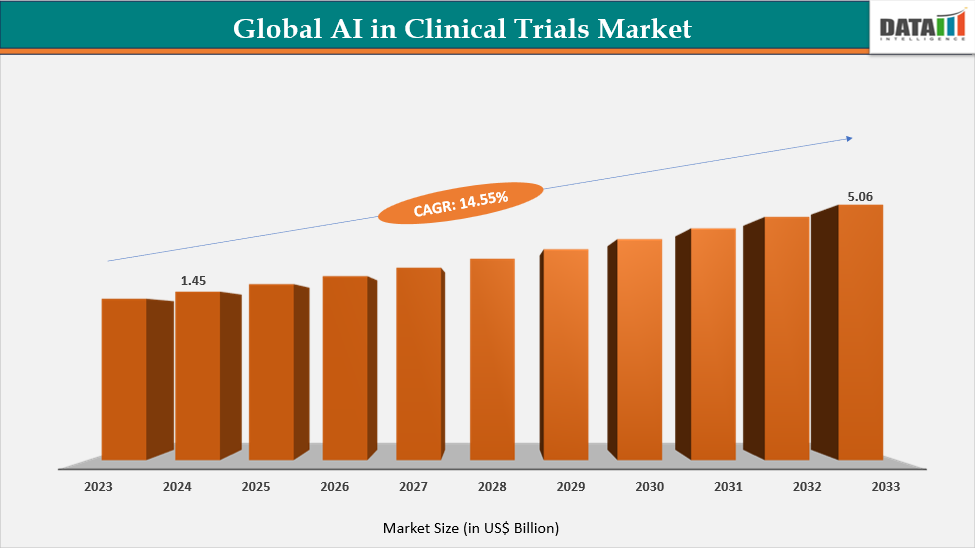
The market’s rapid expansion is primarily driven by the rising adoption of artificial intelligence technologies to enhance clinical trials efficiency, reduce costs, and accelerate drug development timelines. Increasing data availability from electronic health records (EHRs), genomics, and real-world evidence is enabling AI algorithms to optimize patient recruitment, predict trial outcomes, and improve protocol design.
Moreover, the growing prevalence of complex diseases such as cancer and neurological disorders has prompted pharmaceutical and biotechnology companies to leverage AI-powered analytics for precision trial management and adaptive study designs. Additionally, the growing collaboration between AI technology providers, contract research organizations (CROs), and life science companies is further fueling innovation in this space. As regulatory bodies continue to embrace digital and data-driven methodologies, the global AI in Clinical Trials market is expected to witness sustained growth, offering transformative potential for accelerating medical breakthroughs and improving patient outcomes.
AI in Clinical Trials Market Key Takeaways
- North America dominates the AI in Clinical Trials market with the largest revenue share of 43.04% in 2024.
- North America is the fastest-growing region and is expected to grow at the fastest CAGR of 17.18% over the forecast period.
- Based on the offering type, the software segment led the market with the largest revenue share of 67.43% in 2024.
- The major market players in the AI in Clinical Trials market are Medidata, IQVIA, Saama Technologies, Phesi, Euretos, Median Technologies, Innoplexus, Deep6.ai, AiCure, Antidote Technologies, Mendel AI, among others.
AI in Clinical Trials Market Dynamics
Drivers: The Rising R&D Costs and Long Trial Timelines are significantly driving the AI in Clinical Trials market growth
The rising R&D costs and extended timelines associated with traditional clinical trials are among the most significant drivers of the AI in Clinical Trials market. Pharmaceutical and biotechnology companies are increasingly seeking solutions that can accelerate patient recruitment, streamline data analysis, and enhance trial efficiency. AI technologies fit this demand perfectly, offering benefits such as predictive patient enrollment, automated monitoring, adaptive trial design, and real-time data analytics, which help reduce costs and shorten timelines.
According to the U.S. Food and Drug Administration (FDA), it takes, on average, 10 to 15 years and approximately $2.6 billion to bring a new medicine to market. This lengthy and costly process underscores the need for innovative solutions to expedite drug development and reduce expenses.
In addition, the European Medicines Agency (EMA) has recognized the potential of AI in clinical trials. The agency's human medicines committee (CHMP) has accepted clinical trial evidence generated by an AI tool supervised by a human pathologist, marking a significant step in integrating AI into clinical research.
Furthermore, the FDA has highlighted the role of AI in mitigating existing challenges in conducting post-market surveillance for generic drugs, including insufficient data on bioequivalence and high costs associated with large-scale studies. AI and machine learning (ML) have the potential to address these challenges by improving data analysis and decision-making processes.
Leading technology providers and Contract Research Organizations (CROs), including IBM Watson Health, Medidata, and IQVIA, are expanding AI-powered offerings to optimize trial design and patient outcomes. The adoption of AI-driven predictive analytics and real-world data integration is making clinical trials more efficient and precise, paving the way for faster drug development and improved patient access to innovative therapies.
Restraints: Shortage of Skilled Professionals is hampering the growth of the market
The shortage of skilled professionals in clinical research is a significant restraint on the growth of the AI in Clinical Trials market. Pharmaceutical companies and Contract Research Organizations (CROs) are increasingly adopting AI technologies to enhance trial efficiency and data analysis. However, the rapid pace of AI integration has outstripped the availability of professionals with the requisite expertise in both AI and clinical development. This talent gap hampers the effective implementation and scaling of AI solutions in clinical trials.
A 2025 report by Intuition Labs highlights that 49% of surveyed industry professionals identified a shortage of specific skills and talent as the primary barrier to their company's digital transformation. This shortage is particularly pronounced in roles requiring proficiency in machine learning, data science, and regulatory compliance within the context of clinical research.
This talent shortage not only affects the deployment of AI technologies but also poses risks to the quality and compliance of clinical trials, potentially leading to increased operational costs and delayed time-to-market for new therapies.
AI in Clinical Trials Market, Segment Analysis
The global AI in Clinical Trials market is segmented based on offering, trial phase, indication, end user, and region.
Offering: The software segment is dominating the AI in Clinical Trials market with a 67.43% share in 2024
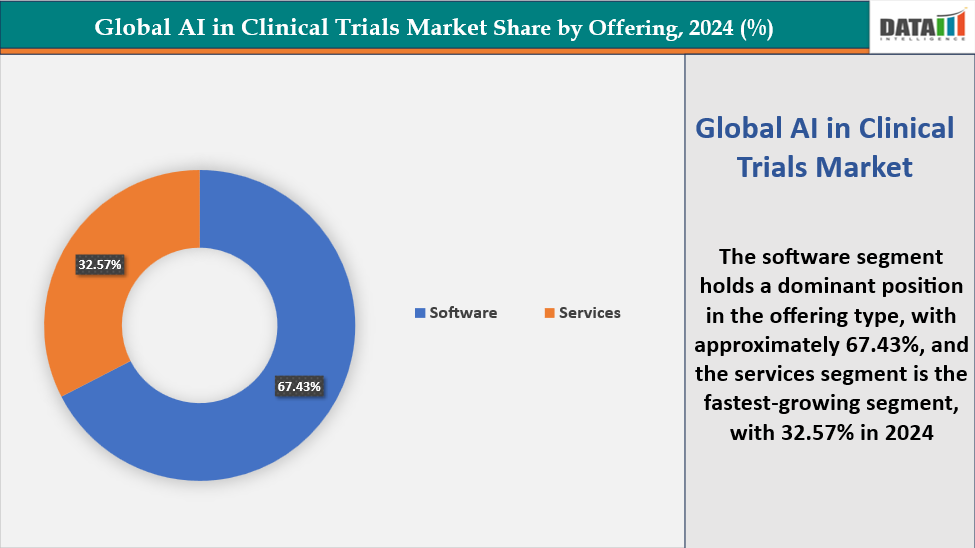
The software segment is dominating the AI in Clinical Trials market, accounting for a 67.43% share in 2024. Software solutions, including clinical trial management systems (CTMS), electronic data capture (EDC) platforms, and AI-driven analytics tools, are at the forefront of digitizing and optimizing clinical trials. These platforms enable streamlined protocol design, real-time patient monitoring, predictive enrollment, and automated data analysis, significantly reducing trial costs and timelines.
Pharmaceutical companies and Contract Research Organizations (CROs) increasingly rely on AI software to handle the growing complexity of clinical trial data, particularly with the rise of multi-center and global trials. For example, Medidata Solutions’ AI-enabled Rave platform has been widely adopted to manage large-scale clinical trials, providing predictive insights and real-time reporting that enhance decision-making. Similarly, IBM Watson Health offers AI-driven clinical trial matching and analytics software that accelerates patient recruitment and optimizes trial outcomes.
The dominance of the software segment is further reinforced by the scalability and flexibility of cloud-based solutions, which allow seamless integration with existing trial workflows and support remote or decentralized trials. As clinical trials become more data-intensive and adaptive, AI software continues to be the key driver for improving efficiency, reducing human errors, and enabling faster, more precise drug development.
Why AI in Clinical Trials Market Matters in 2026
The global pharmaceutical and healthcare industry is undergoing a major transformation driven by digitalization, data-driven decision-making, and precision medicine.
Artificial intelligence is increasingly reshaping clinical trials by improving patient recruitment, reducing trial timelines, optimizing protocol design, and enhancing real-time data monitoring. This is helping pharmaceutical companies accelerate drug development while improving trial accuracy and efficiency.
Several macroeconomic and technological factors are driving market growth:
- Increasing complexity of clinical trial designs
- Growing adoption of decentralized and hybrid clinical trials
- Expansion of real-world data and real-time analytics usage
- Advancements in machine learning and predictive modeling
- Improved patient recruitment and retention technologies
- Increasing regulatory acceptance of digital trial tools
- Growth in precision medicine and targeted therapies
- Expansion of wearable health monitoring devices
- Strong investment from pharma and biotech companies in AI platforms
AI in Clinical Trials Market Geographical Analysis
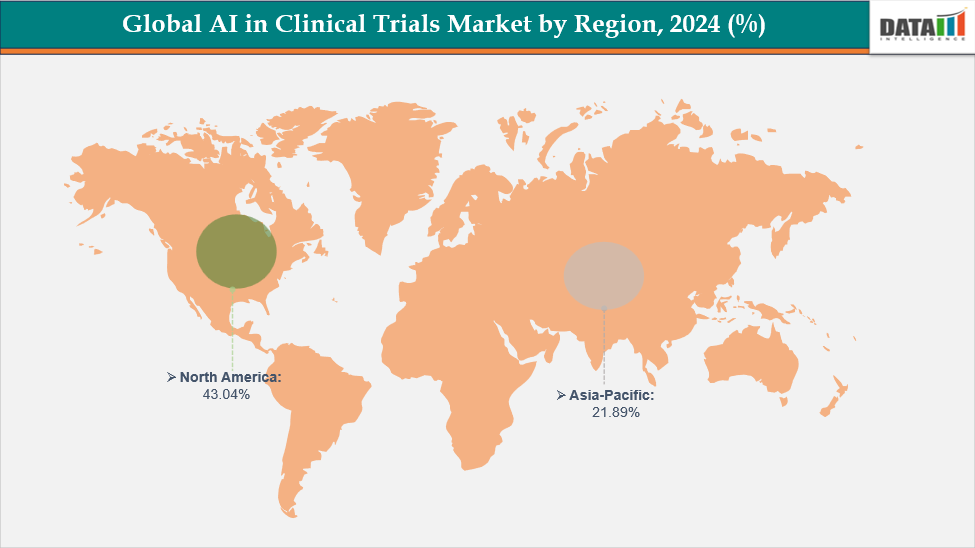
North America dominates the global AI in Clinical Trials market with a 43.04% in 2024
North America dominates the global AI in Clinical Trials market, accounting for 43.04% of the market share in 2024. The region’s leadership is driven by the presence of a robust pharmaceutical and biotechnology industry, advanced healthcare infrastructure, and early adoption of AI technologies in clinical research. The U.S., in particular, is home to major AI technology providers, Contract Research Organizations (CROs), and leading pharmaceutical companies that are actively implementing AI-driven solutions for patient recruitment, trial monitoring, and data analytics.
Government support and regulatory frameworks also play a key role in accelerating AI adoption. Agencies such as the U.S. Food and Drug Administration (FDA) have issued guidance and pilot programs for the integration of AI and machine learning in clinical trials, enabling companies to safely leverage AI for trial design and real-world data analysis. Additionally, the widespread availability of electronic health records (EHRs), large patient databases, and real-world data in the region facilitates AI-driven insights and predictive modeling, further strengthening North America’s position.
Leading players, such as IBM Watson Health, Medidata Solutions, and IQVIA, are headquartered or heavily active in North America, contributing significantly to technological innovation and service offerings. The region’s strong focus on precision medicine, digital health initiatives, and decentralized clinical trials continues to reinforce its dominance in the global AI in Clinical Trials market.
Europe AI in Clinical Trials Market Trends
In the European region, the AI in Clinical Trials market is witnessing steady growth, driven by several key factors. The European Union has launched a €1.1 billion initiative, the "Apply AI" strategy, to accelerate AI deployment across critical industries, including healthcare. This initiative aims to reduce dependence on non-EU technologies while fostering innovation within the region. Regulatory support is further strengthened by the European Medicines Agency (EMA), which has approved AI tools such as AIM-NASH for assessing liver disease severity, reflecting growing confidence in AI’s application in clinical trials. Additionally, AI-driven platforms are being increasingly adopted to optimize trial design, streamline patient recruitment, and enable real-time monitoring, significantly enhancing trial efficiency and data accuracy.
With strong regulatory backing, technological advancements, and strategic investments, Europe is poised to continue leading the integration of AI in clinical trials, improving the speed, precision, and cost-effectiveness of drug development across the region.
Asia Pacific AI in Clinical Trials Market Trends
In the Asia Pacific region, the AI in Clinical Trials market is experiencing rapid growth, driven by several key factors. Increasing R&D investments in countries like China and India are creating a conducive environment for clinical trials and AI adoption. The region’s high burden of chronic diseases, including diabetes, cardiovascular conditions, and cancer, is fueling the need for efficient and innovative trial solutions. Additionally, the large and diverse patient population in the Asia Pacific provides a rich pool for inclusive and representative clinical studies. Cost-effectiveness is another critical driver, as conducting trials in this region is more economical compared to Western countries.
Government support through favorable policies and investment in healthcare infrastructure is further promoting the integration of AI technologies. Technological advancements, such as cloud computing and sophisticated AI platforms, are enabling more efficient data management, real-time monitoring, and predictive analytics. Strategic collaborations between pharmaceutical companies, technology providers, and research institutions are accelerating the development and application of AI in clinical trials. Together, these factors position the Asia Pacific region as a rapidly expanding hub for AI-driven clinical research, enhancing trial efficiency, reducing costs, and improving patient outcomes.
AI in Clinical Trials Market Competitive Landscape
Top companies in the AI in Clinical Trials market include Medidata, IQVIA, Saama Technologies, Phesi, Euretos, Median Technologies, Innoplexus, Deep6.ai, AiCure, Antidote Technologies, Mendel AI, among others.
AI in Clinical Trials Market Recent Developments
- May 2026 – Merck, a leading global pharmaceutical company, partnered with Mayo Clinic to advance AI-driven drug discovery and clinical research, integrating advanced machine learning models with large-scale clinical datasets to accelerate early-stage trial decision-making and improve pipeline development efficiency.
- April 2026 – The U.S. FDA launched real-time clinical trial initiatives supported by AI and data science tools, including pilot programs designed to monitor trial outcomes and safety signals in real time, aiming to shorten traditional drug development timelines and enhance regulatory decision-making efficiency.
- April 2026 – Worldwide Clinical Trials and Medidata expanded their strategic partnership to integrate Medidata AI across the full clinical trial lifecycle, enabling enhanced study execution, automated insights, and improved operational precision through AI-powered platforms.
- January 2026 – The AI-based clinical trials market continued strong growth momentum, driven by increasing adoption of AI in protocol design, patient recruitment, and safety monitoring, with rising investments from biopharma sponsors and CROs supporting market expansion.
- January 2026 – Industry focus shifted toward platformization and AI fluency in clinical research, with growing collaboration between pharma companies, CROs, and technology providers to streamline data-driven trial execution and improve efficiency across the value chain.
AI in Clinical Trials Market Scope
| Metrics | Details | |
| CAGR | 14.55% | |
| Market Size Available for Years | 2022-2033 | |
| Estimation Forecast Period | 2025-2033 | |
| Revenue Units | Value (US$ Bn) | |
| Segments Covered | Offering | Software and Services |
| Trial Phase | Phase I, Phase II, and Phase III | |
| Indication | Oncology, Central Nervous System (CNS) Disorders, Cardiovascular (CVS) Diseases, and Other Indications | |
| End-user | Pharmaceutical and Biotechnology Companies, Contract Research Organizations (CROs), Other End Users | |
| Regions Covered | North America, Europe, Asia-Pacific, South America, and the Middle East & Africa | |
AI in Clinical Trials Market Investment & Growth Analysis
Global investment in AI-powered healthcare and life sciences technologies is accelerating as pharmaceutical companies, CROs, and biotech firms seek faster, more efficient, and cost-effective clinical development processes.
Artificial intelligence is transforming clinical trials by improving patient recruitment, optimizing trial design, enhancing data analysis, and reducing drug development timelines.
Major Investment Areas Include:
- AI-driven patient recruitment and matching platforms
- Predictive analytics for trial outcomes
- Digital biomarkers and real-world data integration
- Clinical trial automation and workflow optimization tools
- Natural language processing for medical data analysis
- Decentralized and hybrid clinical trial platforms
- AI-enabled drug discovery and protocol design
- Cloud-based clinical data management systems
- Pharmacovigilance and safety monitoring solutions
- Virtual trial and remote monitoring technologies
Strategic Recommendations
For Pharmaceutical Companies
- Integrate AI across clinical trial design and execution
- Invest in real-world data and digital health ecosystems
- Strengthen partnerships with AI technology providers
For Investors
✔ Focus on scalable AI healthcare platforms
✔ Monitor regulatory frameworks for AI in medicine
✔ Evaluate long-term value of digital clinical transformation
For Governments & Regulators
- Develop clear guidelines for AI-driven clinical research
- Support digital health infrastructure development
- Promote ethical and transparent AI usage in healthcare
Why Buy This AI in Clinical Trials Market Report?
This report helps organizations:
- Understand future healthcare innovation trends
- Identify high-growth investment opportunities
- Benchmark leading AI healthcare companies
- Analyze regulatory and compliance environments
- Optimize clinical development strategies
- Evaluate digital transformation in drug development
- Assess regional adoption of AI in healthcare
- Track emerging technologies in clinical research
What’s Included in the AI in Clinical Trials Market Report?
The report provides:
- Market size & forecast analysis
- Regional growth outlook
- Competitive intelligence
- Technology benchmarking
- Pricing analysis
- Regulatory assessment
- Data integration insights
- Market share analysis
- Investment landscape analysis
- Strategic recommendations
- Emerging trends analysis
- Company profiling
Who Should Buy This Report?
This AI in Clinical Trials Market report is ideal for:
- Pharmaceutical companies
- Biotechnology firms
- Clinical research organizations (CROs)
- AI healthcare technology providers
- Medical device companies
- Venture capital firms
- Institutional investors
- Healthcare regulators
- Digital health startups
- Academic research institutions
- Market intelligence teams
Key Benefits for Stakeholders
Gain actionable market intelligence to:
- Understand future clinical trial transformation
- Analyze global AI adoption in healthcare
- Evaluate innovation and digitalization trends
- Identify strategic growth opportunities
- Benchmark competitors in AI healthcare space
- Improve investment and R&D decision-making
- Track regulatory evolution in digital clinical trials
The global AI in Clinical Trials market report delivers a detailed analysis with 73 key tables, more than 63 visually impactful figures, and 159 pages of expert insights, providing a complete view of the market landscape.
Suggestions for Related Report
For more healthcare IT-related reports, please click here




























































