


AI in Aviation Market Size & Growth
Aviation operators are under pressure to improve safety, reduce downtime, manage rising air traffic, optimize fuel use and modernize defense readiness. Artificial intelligence is becoming a strategic technology layer across airlines, aerospace manufacturing, airports, defense aviation and maintenance operations because it can process operational data faster than traditional systems and support better decisions across mission-critical workflows.
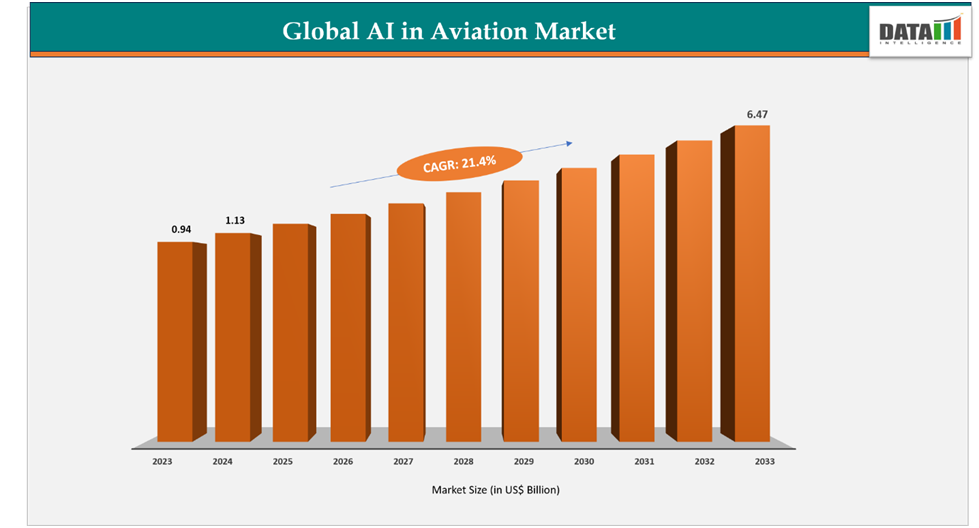
AI in Aviation Market is valued at US$ 1.37 billion in 2025 and is projected to reach US$ 9.53 billion by 2035, growing at a CAGR of 21.4% during 2026–2035.
The AI in Aviation Market 2025 is shaped by adoption in predictive maintenance, air traffic management, autonomous flight support, defense surveillance, aircraft manufacturing, passenger experience and airport automation. Investment timing is important because airlines and defense agencies are moving from isolated AI pilots toward embedded operational systems. GE Aerospace’s AI-enabled Blade Inspection Tool, deployed in 2025, reflects this shift by using AI-guided image analysis to help technicians detect turbine blade issues earlier while reducing inspection time nearly by half.
AI in Aviation Market: Key Takeaways
- The AI in Aviation Market Forecast indicates growth from US$1.37 billion in 2025 to US$9.53 billion by 2035, supported by a 21.4% CAGR.
- North America held 41.7% of the global AI in Aviation Market Share in 2024, supported by defense programs, aerospace research depth and early AI adoption by airlines and OEMs.
- Asia-Pacific accounted for 30.8% share in 2024 and is expected to record the fastest growth due to airline modernization, safety system adoption and government-backed AI investment.
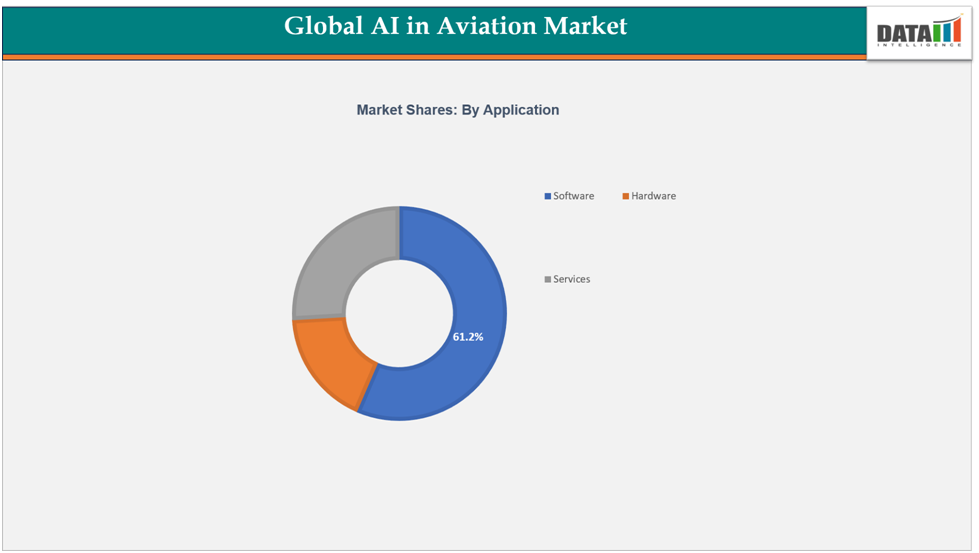
- Software represented an estimated 61.2% market share, making it the largest offering segment because AI adoption in aviation is primarily delivered through analytics platforms, maintenance algorithms, flight optimization tools and operational decision systems.
- Defense modernization is a major demand signal as AI supports surveillance, mission planning, fleet maintenance, radar warning systems and situational awareness.
- Cybersecurity and data privacy remain high-impact adoption barriers because AI aviation systems use sensitive passenger, flight operations and defense intelligence data.
- Companies with aviation domain expertise, cloud capability, AI model performance and system integration experience are better positioned than vendors offering standalone AI tools.
AI in Aviation Market Scope
| Report Attribute | Details |
| Market Size in 2025 | US$1.37 billion |
| Market Size by 2035 | US$9.53 billion |
| CAGR | 21.4% during 2026 to 2035 |
| Historic Years | 2023 to 2024 |
| Base Year | 2025 |
| Forecast Period | 2026 to 2035 |
| Segments Covered | Offering, Technology, Application and Region |
| Leading Region | North America |
| Fastest Growing Region | Asia-Pacific |
AI in Aviation Market Trends and Commercial Demand Signals
Predictive Maintenance Is Becoming the First Enterprise-Scale Use Case
Predictive maintenance is one of the most commercially mature AI applications in aviation. Airlines, lessors and MRO teams are using AI to reduce aircraft downtime, improve inspection accuracy and support faster turnaround. Maintenance teams need systems that can interpret records, component images, sensor data and service history to identify risk earlier.
GE Aerospace’s Blade Inspection Tool is a strong example of this trend. By applying AI-guided image analysis to turbine blade inspection, the solution supports earlier issue detection and faster inspection workflows. GE Aerospace’s partnership with Microsoft and Accenture on generative AI-powered maintenance solutions also shows how aviation maintenance is becoming a key adoption area for enterprise AI platforms.
Defense Modernization Is Expanding AI Procurement
Defense aviation is a major driver of AI in Aviation Market Growth. Governments are investing in AI systems that improve mission planning, surveillance, aircraft readiness, fleet maintenance and combat support. AI can help defense operators process large volumes of sensor and operational data, improving situational awareness and mission responsiveness.
Raytheon, an RTX business, completed flight testing of an AI and machine learning powered Radar Warning Receiver system for a fourth-generation aircraft. This development highlights how AI is being used to improve threat detection and defense readiness. Defense agencies are likely to remain high-value buyers because AI directly supports mission performance, operational security and fleet availability.
Airport and Airline Operations Are Moving Toward Intelligent Automation
AI adoption is also increasing in airport operations and commercial airline workflows. Passenger processing, biometric security, automated baggage handling, smart check-in, crew management, flight disruption management and fuel optimization are becoming important deployment areas.
Qatar Airways’ partnership with Accenture to launch “AI Skyways” reflects how airlines are using AI to improve customer engagement, streamline operations and support digital transformation. All Nippon Airways’ operational implementation of BlueWX’s AI-based turbulence prediction system demonstrates a safety-oriented commercial aviation use case, with AI analyzing long-term atmospheric data to improve passenger safety and flight efficiency.
AI in Aviation Market Dynamics
Growth Driver: AI Is Improving Safety, Efficiency and Fleet Availability
Aviation operators need measurable operational improvement. AI helps address this requirement by reducing inspection time, improving maintenance planning, supporting route and flight optimization, enhancing air traffic decision-making and improving safety monitoring. As aircraft systems, airline networks and airport operations generate large datasets, AI platforms can help operators move from reactive decision-making toward predictive and automated workflows.
Machine learning, computer vision, generative AI and edge AI are expanding the range of aviation use cases. Computer vision supports inspection and surveillance. Machine learning enables predictive maintenance and operational optimization. Generative AI supports maintenance record search, workflow guidance and operational knowledge assistance. Edge AI can support low-latency aviation systems where data needs to be processed close to the aircraft, airport asset or defense platform.
Demand Driver: Aerospace Manufacturing Needs Workforce Productivity Tools
AI is also entering aircraft manufacturing and assembly. Airbus is testing GenAIR Assistant, a smartphone-based AI program that generates tailored assembly instructions based on worker expertise. A beginner, intermediate or expert user can receive step-by-step guidance suited to their skill level. This type of AI tool can improve workforce productivity, reduce training friction and support more consistent manufacturing execution.
For aerospace manufacturers, AI adoption is connected to quality control, production efficiency, workforce support, fuel efficiency optimization and predictive maintenance. These use cases are commercially relevant because aircraft manufacturing is complex, safety-sensitive and cost-intensive.
Restraint: Cybersecurity and Data Privacy Limit Full-Scale Adoption
Data security and privacy concerns remain a major barrier in the AI in Aviation Market Analysis. AI-enabled aviation systems rely on passenger data, flight operations records, maintenance data, air traffic information and defense intelligence. A breach in these systems can create safety, operational and national security risks.
Predictive maintenance systems and air traffic management platforms need large volumes of operational data to function effectively. If this data is compromised or manipulated, the impact can extend beyond financial loss to safety hazards and regulatory non-compliance. The absence of standardized cybersecurity safeguards and consistent governance frameworks can slow AI implementation, especially in defense and safety-critical aviation environments.
AI in Aviation Market Opportunities
Airlines can use AI to reduce downtime, improve schedule reliability, personalize passenger services and optimize fuel efficiency. The most immediate opportunities are in predictive maintenance, disruption management, crew planning, turbulence forecasting and customer engagement automation.
Aerospace OEMs can use AI for manufacturing guidance, inspection automation, digital twin development and lifecycle support. AI-enabled assembly tools such as Airbus’ GenAIR Assistant indicate how manufacturing productivity and workforce training can become meaningful opportunity areas.
Defense contractors and government buyers represent a high-value opportunity because AI can enhance surveillance, radar warning, mission planning and aircraft readiness. The procurement cycle may be longer, but defense applications can support larger-scale and higher-specification deployments.
Technology companies and cloud providers can capture demand through AI infrastructure, secure data platforms, analytics software, computer vision models, generative AI assistants and aviation-specific integration services. The commercial requirement is not only model performance. Buyers need secure deployment, aviation workflow knowledge, regulatory alignment and clear ROI.
Economic and Investment Analysis
The AI in aviation market is influenced by airline profitability, defense budgets, aerospace R&D expenditure, digital infrastructure investment and airport modernization programs. Airlines are likely to invest when AI can reduce delays, maintenance costs and fuel inefficiency. Defense buyers invest when AI improves readiness, situational awareness and mission outcomes.
Capital expenditure is moving toward software platforms, cloud infrastructure, AI model integration, sensors, data governance and operational analytics. Vendors that can convert capex-heavy AI adoption into scalable software or recurring platform revenue are likely to benefit from stronger customer retention.
ROI is clearest where AI reduces inspection time, improves aircraft utilization, lowers downtime and supports better fuel or route efficiency. However, profitability can be affected by integration cost, cybersecurity requirements, certification processes, workforce training and the need to connect AI platforms with legacy aviation systems.
Economic risks include airline budget pressure, delayed technology procurement, cybersecurity incidents, defense approval cycles and uncertainty around the pace of autonomous aviation adoption. Scenario planning should account for faster adoption in predictive maintenance and slower adoption in fully autonomous flight systems.
AI in Aviation Market Segmentation Analysis
The AI in Aviation Market is segmented by Offering, by Technology, by Application, and by Region - Share, Trends, and Forecast to 2035.
Software Leads the Market Because AI Value Is Delivered Through Platforms
The software segment accounted for an estimated 61.2% of the global AI in aviation market. Applied to the 2025 market size, this represents approximately US$0.84 billion. Software dominates because aviation AI depends on algorithms, analytics engines, decision-support platforms, predictive models and operational workflow tools.
Software is central to predictive maintenance, air traffic management, flight optimization, crew management, passenger services and defense intelligence systems. The segment is expected to maintain its leadership as generative AI, natural language processing and advanced predictive algorithms become more useful in operational aviation environments.
Technology Adoption Is Concentrated Around Machine Learning, Computer Vision and Generative AI
Machine learning supports predictive maintenance, flight optimization and risk modeling. Computer vision is important for inspection, surveillance, safety monitoring and airport automation. Generative AI is emerging in maintenance record search, assembly guidance, operational documentation and customer service.
Edge AI has long-term relevance where aviation systems require local processing, lower latency and reduced dependency on centralized infrastructure. The pace of adoption will depend on safety validation, computing reliability, cybersecurity and integration with aircraft and airport systems.
Applications Are Expanding from Maintenance to Passenger and Defense Workflows
Predictive maintenance remains one of the clearest commercial applications because it has a direct link to downtime reduction and cost control. Air traffic management and flight operations optimization are gaining traction as airlines and airports manage higher traffic intensity. Passenger experience applications include biometric security, smart check-in, automated baggage handling and AI-assisted service personalization.
Defense applications are strategically important because AI supports surveillance, mission planning, radar warning, fleet readiness and situational awareness. These use cases are likely to shape high-performance AI requirements across the aviation ecosystem.
AI in Aviation Market Regional Analysis

North America AI in Aviation Market
North America held 41.7% of the global AI in aviation market in 2024, making it the leading region. The region benefits from advanced defense programs, major aerospace OEMs, high technology investment and strong airline adoption of AI-enabled operational systems.
The United States is the key demand center. GE Aerospace, Microsoft, Accenture, RTX, Boeing, Lockheed Martin and other major aviation technology stakeholders support regional leadership. Defense modernization and commercial airline efficiency programs continue to provide a strong base for AI deployment. GE Aerospace’s generative AI maintenance solutions and Raytheon’s AI-enabled Radar Warning Receiver testing reflect North America’s role in both commercial and defense aviation AI.
Canada contributes through aviation technology, aerospace manufacturing and airline modernization, although country-level market values are not disclosed. Procurement priorities in North America are expected to focus on safety validation, cybersecurity, maintenance efficiency and measurable operational ROI.
Europe AI in Aviation Market
Europe has a strong aviation AI opportunity due to Airbus, Thales, major airlines, defense modernization programs and advanced airport infrastructure. The region’s adoption pattern is expected to be shaped by safety, data protection, operational reliability and manufacturing productivity.
Airbus is positioned as a key European player because of its AI initiatives across aircraft manufacturing, predictive maintenance, flight safety and fuel efficiency optimization. Thales also strengthens the regional ecosystem through aviation, defense and digital systems capability. European buyers are likely to place strong emphasis on certification, data governance, cybersecurity and safe integration into aviation workflows.
Investment opportunities in Europe are strongest in aerospace manufacturing AI, airline efficiency tools, defense aviation systems, airport automation and safety-focused analytics.
Asia-Pacific AI in Aviation Market
Asia-Pacific accounted for 30.8% of the global AI in aviation market in 2024 and is projected to be the fastest-growing region. Growth is supported by rising air traffic, expanding airline fleets, airport modernization, defense spending and government-backed technology investment.
Japan is becoming an important AI aviation contributor. In August 2025, Prime Minister Shigeru Ishiba announced a planned US$68 billion investment in India over the next decade to strengthen bilateral ties and innovation across strategic sectors including AI, mobility, environment, healthcare and semiconductors. This initiative supports broader AI collaboration and can influence aviation modernization, security systems and technology ecosystem development.
All Nippon Airways’ implementation of BlueWX’s AI-based turbulence prediction system is a strong commercial aviation example from the region. China, India, Japan and South Korea are expected to support regional market expansion through air traffic growth, airline fleet expansion and AI-enabled automation.
Country-Level Market Analysis
Country-level revenue values are not disclosed, so the country outlook is interpreted through adoption indicators, investments and company activity.
The United States remains the most influential country market because of defense spending, aerospace technology depth and early commercial AI deployment. Key growth drivers include predictive maintenance, defense AI systems, aircraft inspection, air traffic modernization and airline operational efficiency. The main barriers are cybersecurity, certification complexity and legacy system integration.
Japan is gaining relevance through airline safety applications, government-backed innovation investment and aviation modernization. ANA’s AI-based turbulence prediction deployment shows that Japanese aviation companies are willing to operationalize AI where safety and efficiency benefits are clear.
China, India and South Korea are positioned for faster adoption due to rising air traffic, expanding airline fleets and automation needs. India also benefits from Japan’s planned investment framework covering AI and mobility-related innovation. The key barriers in these markets include infrastructure readiness, regulatory alignment, cybersecurity capability and integration with existing airline systems.
European countries with major aerospace and defense activity are expected to focus on AI for manufacturing productivity, defense readiness, passenger processing and flight safety. Airbus’ activities strengthen the region’s aviation AI ecosystem.
Regulatory and Policy Analysis
AI in aviation is governed by safety-critical operating requirements, cybersecurity expectations, passenger data protection, defense information security and aviation certification standards. The regulatory burden is higher than in many software markets because failures can affect aircraft safety, airport operations and national security.
Data privacy is a central issue because AI systems process passenger information, operational records and sensitive defense data. Cybersecurity standards are expected to become more important as AI platforms connect with predictive maintenance systems, air traffic tools, airport operations and defense aviation infrastructure.
Government initiatives and defense procurement programs support adoption, but they also increase scrutiny. AI systems must prove reliability, explainability, secure deployment and operational safety before broad use in aircraft or mission-critical systems. Regulatory change through 2035 is likely to favor vendors that build compliance, auditability and cybersecurity into platform design from the beginning.
Competitive Landscape and Vendor Positioning
The major players in the AI in Aviation Market include Airbus, Boeing, Lockheed Martin Corporation, Thales, RTX, TAV Technologies, General Electric Company, Amazon Web Services, SITA and Dedalian.
Competition is developing across aerospace OEMs, defense contractors, aviation software companies, airport technology providers and cloud infrastructure firms. Airbus and Boeing are positioned through aircraft platforms, manufacturing expertise and airline relationships. Lockheed Martin and RTX are strong in defense aviation and mission-critical systems. GE Aerospace is positioned around engine analytics, predictive maintenance and inspection intelligence.
Amazon Web Services supports aviation AI through scalable cloud infrastructure and enterprise AI deployment. SITA and TAV Technologies are relevant to airport operations, passenger processing and aviation IT systems. Dedalian adds capability in autonomous flight and AI-based aviation safety systems.
Company strategy is increasingly centered on partnerships. GE Aerospace’s collaboration with Microsoft and Accenture, Qatar Airways’ partnership with Accenture, and ANA’s adoption of BlueWX technology show that aviation AI adoption often requires a combination of domain expertise, AI engineering, data integration and operational implementation.
Recent Developments in AI in Aviation Market
- June 2026 – Airbus expands AI-powered aircraft design and flight operations
Airbus strengthened its AI strategy by expanding the use of artificial intelligence for aircraft engineering, predictive maintenance, operational optimization, and digital aviation services, improving aircraft performance and airline efficiency. - June 2026 – SITA enhances AI solutions for airport and airline operations
SITA expanded its AI portfolio through new intelligent automation capabilities designed to reduce operational disruptions, optimize passenger processing, and improve airport and airline operational efficiency. - May 2026 – Boeing advances AI-enabled predictive maintenance and autonomous systems
Boeing continued expanding artificial intelligence across aircraft health monitoring, predictive maintenance, autonomous flight technologies, and operational analytics to improve safety, fleet reliability, and maintenance efficiency. - May 2026 – Amazon Web Services strengthens cloud AI for aviation
Amazon Web Services (AWS) enhanced its cloud-based AI and machine learning services for airlines, airports, and aerospace organizations, enabling predictive analytics, digital twins, operational optimization, and intelligent aviation applications. - April 2026 – Thales expands AI-powered aerospace and air traffic management solutions
Thales strengthened its AI-enabled aviation portfolio by enhancing intelligent avionics, air traffic management systems, cybersecurity, and decision-support technologies to improve flight safety and operational performance. - March 2026 – RTX advances AI-enabled aerospace technologies
RTX expanded the application of AI across aerospace systems, predictive maintenance, intelligent sensing, and defense aviation platforms, supporting improved mission readiness and aircraft performance. - February 2026 – General Electric strengthens AI-driven aircraft engine analytics
General Electric expanded AI-powered predictive maintenance and digital engine health monitoring capabilities, enabling airlines to improve fleet availability, optimize maintenance scheduling, and reduce operational costs.
Impact Analysis
Supply Chain and Operations Impact
AI can reduce operational disruptions by improving maintenance planning, inspection speed, spare part readiness and aircraft turnaround. Predictive maintenance systems can help airlines identify issues before they create grounded aircraft events. Airport AI systems can also improve passenger throughput, baggage handling and security processing.
However, aviation AI implementation depends on reliable data infrastructure, system interoperability and skilled teams. Legacy systems, fragmented records and poor data quality can limit the operational value of AI platforms.
Policy and Security Impact
Policy and cybersecurity risks have direct commercial impact. Airlines, airports, defense agencies and OEMs must ensure AI systems are secure, compliant and operationally reliable. Data breaches or model failures could delay procurement decisions, increase compliance costs and reduce buyer confidence.
Strategic Insights and Analyst Perspective
The AI in Aviation Market Analysis points to a technology market where adoption will be led by practical operational use cases rather than speculative autonomy alone. Predictive maintenance, inspection automation, air traffic support, turbulence forecasting, airport automation and defense readiness offer clearer near-term value.
Aviation companies should prioritize AI projects with measurable ROI, such as downtime reduction, faster maintenance record access, fuel optimization and improved passenger processing. Investors should track companies with aviation-specific AI platforms, cybersecurity capability, defense exposure, cloud partnerships and integration experience. Procurement teams should evaluate vendor credibility in aviation environments, not only AI model sophistication.
The next phase of competition will favor companies that combine AI capability with aviation certification discipline, secure data architecture, system integration and customer-specific deployment support.
Report Benefits
This AI in Aviation Market Report helps aerospace OEMs understand adoption patterns across commercial and defense aviation. Airlines can use the report to assess AI opportunities in maintenance, operations, passenger services and safety. Investors can evaluate market growth, regional demand, competitive positioning and technology themes. Technology companies can identify opportunities in AI software, cloud platforms, computer vision, generative AI and airport automation. Procurement and strategy teams can benchmark market size, competitive direction, regulatory risk and investment timing.
For more AI in aviation-related reports, please click here
Target Audience
- Precision livestock farming companies
- AI platform providers
- Livestock equipment manufacturers
- Dairy technology companies
- Poultry and swine producers
- Cattle ranch operators
- Farm management software vendors
- Sensor manufacturers
- Drone and GPS tracking solution providers
- Animal health companies
- Agri-tech investors
- Private equity firms
- Venture capital firms
- Procurement heads
- Farm operations leaders
- Product managers
- Corporate strategy teams





























































