


The global Battery Energy Storage System Testing, Inspection, and Certification market is segmented based on service type, battery type, system component, deployment type, end user, and region.
FOR IMMEDIATE RELEASE
Battery Energy Storage Safety Testing Market Gains Momentum as Global BESS Deployment and Regulatory Compliance Requirements Increase
LEANDER, Texas: Rising Deployment of Battery Energy Storage Systems, Increasing Safety Compliance Requirements, and Growing Demand for Reliable Energy Storage Validation Accelerate the Global Battery Energy Storage System Testing, Inspection, and Certification Market
Global Battery Energy Storage System Testing Inspection Certification Market is experiencing strong traction owing to fast adoption of utility-scale battery storage projects, growing battery safety norms, and rising demand for independent third-party validation of the grid-tied energy storage systems. UL Solutions, TÜV SÜD, Intertek, SGS, Bureau Veritas, and DEKRA continue to be major vendors that expand battery testing and certification portfolios to help renewable energy companies, utilities, and battery makers. Rising deployment of utility-scale battery projects together with stricter international shipping and safety guidelines like IMDG Code Amendment 42-24 (mandated from January 1, 2026), and new GB 38031-2025 standards for thermal propagation safety in China will increase demand for advanced testing and certification solutions. Moreover, emerging new laws, like CEA 2026 BESS Safety Rules in India that call for mandatory battery monitoring, fire detection and suppression system, two-fault tolerance system design, and independent third-party fire safety audit for BESS higher than 650 volts, will drive demand for lifecycle testing, inspection, and certification services.
Unlock Key Insights from the BESS TIC Market Report
Explore critical market intelligence covering industry trends, technology developments, regional opportunities, and competitive strategies shaping the future of battery energy storage testing, inspection, and certification. Request a Sample Report Today!
As the reliance on BESS is increasing for utilities and project developers in order to balance out the grid, integrate renewable energy, and ensure energy security, the need for certification of systems with an assured performance record in terms of safety is becoming crucial by the day. However, the issue of huge capital investment required for establishing such testing facilities and the constantly changing dynamics of international safety standards for battery technologies is another major problem faced by market players. The emergence of new generation batteries like lithium-ion, sodium-ion, and flow batteries will add to this problem.
Key Takeaways
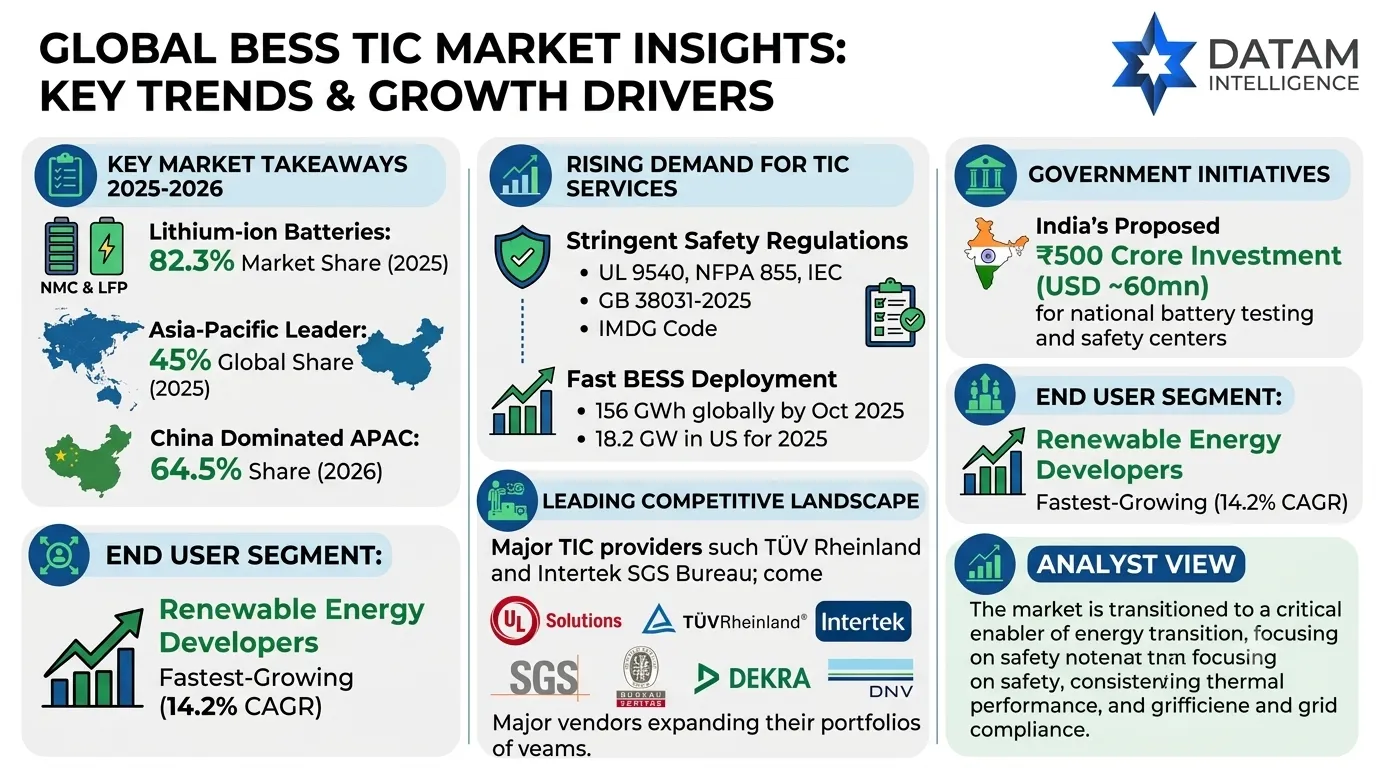
- Lithium-ion batteries dominated the service demand within the industry during 2025. The chemistry accounted for a substantial 82.3% of the total global BESS TIC market share.
- The Asia-Pacific region held a leading position with a 45% share of the global market in 2025. China alone accounted for approximately 64.5% of the total Asia-Pacific market revenue in 2026.
- The United States set plans to deploy a record 18.2 GW of battery storage capacity in 2025. This target represents a massive 77% increase over the 10.3 GW capacity deployed in 2024.
- Global BESS grid deployments successfully accumulated a total of 156 GWh through October 2025. This volume highlights an impressive 38% rate of growth compared to the previous year's metric.
Government Investment in Battery Testing Infrastructure Creating Wide-Scale Opportunities Across the BESS TIC Ecosystem
In January 2026, the Government of India evaluated a potential allocation of approximately ₹500 crore (around USD 60 million) to establish dedicated battery testing, certification, and research & development (R&D) infrastructure amid rising concerns over EV battery fires, safety risks, and dependence on imported battery technologies. The proposed investment is expected to focus primarily on developing National Battery Testing and Safety Centres, strengthening domestic capabilities for battery cell validation, battery pack testing, safety certification, thermal performance assessment, and advanced battery technology evaluation. The largest share of funding is expected to be directed toward testing laboratories, safety validation facilities, and certification infrastructure, including equipment for thermal runaway analysis, abuse testing, battery performance evaluation, and compliance testing under Indian operating conditions. Additional investment areas include battery R&D facilities, indigenous cell technology development, recycling research, and supply chain localization initiatives to reduce reliance on overseas testing centres and imported battery components.
The initiative is expected to create significant opportunities across the Battery Energy Storage System (BESS) Testing, Inspection, and Certification (TIC) value chain, particularly for companies providing battery safety testing, regulatory certification, engineering validation, and laboratory services. TIC providers such as UL Solutions, Intertek, TÜV Rheinland, DNV, SGS, Bureau Veritas, and CSA Group are well-positioned to benefit from increasing demand for BESS compliance testing, certification against standards such as UL 9540, UL 9540A, IEC standards, and Indian regulatory requirements. Battery manufacturers and energy storage companies, including CATL, LG Energy Solution, Panasonic Energy, Samsung SDI, Reliance New Energy, and Ola Electric, may benefit from access to domestic testing facilities that can accelerate product approval, localization, and commercialization of advanced battery systems. In addition, specialized equipment suppliers, battery research institutes, and engineering service providers are expected to gain opportunities through the development of testing infrastructure, prototype validation, safety assessment, and next-generation battery technology programs. The investment is likely to strengthen India’s domestic BESS ecosystem by reducing dependence on foreign certification facilities and improving confidence among utilities, renewable energy developers, and industrial users adopting large-scale energy storage systems.
Stringent Battery Safety Regulations and Mandatory Compliance Requirements Drive Demand for Independent BESS Testing and Certification
Rapid development of battery energy storage systems (BESS), along with the introduction of more stringent laws on battery safety, has been playing a big role in raising the need for third-party testing, inspection, and certification (TIC) services. Increasingly more stakeholders have started to impose compliance with various standards, including UL 9540/9540A, NFPA 855, IEC 62933, GB 38031-2025, and IMDG Code Amendment 42-24, so third-party verification has become necessary before moving on to installing and commissioning battery systems. The accelerating deployment pipeline is substantially expanding opportunities for TIC providers. According to the U.S. Energy Information Administration (EIA), the United States planned to deploy a record 18.2 GW of battery storage capacity in 2025, representing a 77% increase over the 10.3 GW deployed in 2024, making battery energy storage one of the fastest-growing utility assets requiring independent safety certification. Globally, Rho Motion reported that grid-scale BESS deployments reached 156 GWh through October 2025, reflecting 38% year-over-year growth, while BloombergNEF estimated total installations of 112 GW (307 GWh) during 2025, marking the first year that annual deployments exceeded 100 GW.
In October 2025, Sive, Paget & Riesel (SPR Law) reported that the New York City Department of Buildings (NYCDOB) adopted two new Energy Storage System (ESS) rules requiring compliance with UL 9540, UL 9540A, and NFPA 855 standards. The rules mandate system commissioning, testing, inspections, peer reviews by licensed engineers, and final regulatory approval before operation, while reducing the minimum battery capacity threshold for certain lithium-ion ESS installations to 1 kWh to strengthen safety oversight.
Adoption of Lithium-Ion Battery Energy Storage Systems Driving the Largest Demand for Testing, Inspection, and Certification Services
Lithium-ion battery energy storage systems have become the largest and most influential segment in the global BESS Testing Inspection Certification (TIC) market, due to their high penetration levels in the utility, commercial and industrial (C&I), and residential energy storage segments. The lithium-ion batteries account for about 82.3% of the overall BESS TIC market in 2025 because of the significant usage of lithium-ion batteries, specifically Lithium Iron Phosphate (LFP) and Nickel Manganese Cobalt (NMC). As the number of deployments increases further, there is a lot of investment in testing from third parties to ensure thermal safety, electrical performance, transportation compliance, fire propagation resistance, environmental performance, BMS functionality, and grid compatibility.
The segment's leadership is reinforced by continued growth in global battery deployment during 2025–2026. The rapid expansion of lithium-ion-based energy storage systems, combined with increasingly stringent safety regulations such as UL 9540A, IEC 62933, and NFPA 855, continues to strengthen demand for specialized testing, inspection, and certification services, reinforcing lithium-ion batteries as the dominant segment in the global BESS TIC market.
Renewable Energy Developers Drive the Fastest Growth in BESS Testing, Inspection, and Certification Through Large-Scale Energy Storage Deployment
Renewable energy developers are emerging as the fastest-growing end-user segment in the global Battery Energy Storage System (BESS) Testing, Inspection, and Certification (TIC) market, experiencing an annual growth rate of 14.2% in the forecast period. The fast-paced development of utility-scale solar and wind projects will see a significant increase in the use of BESS, as the aim of such technology is to increase the flexibility of power grids, energy shifting, and the integration of renewable resources. As the projects increase in size and complexity, developers need the services of third-party testing, inspection, and certification.
This combination of accelerating renewable energy investments and tightening safety regulations is strengthening renewable energy developers as the fastest-growing end-user segment in the global BESS Testing, Inspection, and Certification market.
Asia-Pacific Dominance Driven by Battery Manufacturing Leadership, Energy Storage Deployment, and Expanding TIC Infrastructure
Asia-Pacific continues to dominate the global Battery Energy Storage System (BESS) Testing, Inspection, and Certification (TIC) market, accounting for approximately 45% of the global market in 2025, supported by its strong battery manufacturing ecosystem, rapid deployment of grid-scale energy storage projects, and expanding testing and certification infrastructure. The region produces more than 70% of the world's lithium-ion battery cells, with China, South Korea, and Japan serving as global hubs for battery manufacturing, energy storage technologies, and battery innovation. Rising investments in renewable energy integration and utility-scale battery storage across China, India, Japan, and South Korea are significantly increasing the need for independent testing, safety validation, and certification services to meet evolving domestic and international regulatory requirements.
The new facility significantly enhances Asia-Pacific's capacity for large-scale BESS safety, performance, and grid integration testing, supporting faster product validation and regulatory compliance. In June 2026, Contemporary Amperex Technology Co., Limited (CATL), a China-based battery manufacturer, launched the world's largest Xiamen Energy Storage Validation Research Institute (ESVL) in Xiamen, China. Backed by an investment of approximately RMB 3 billion (US$440 million) and spanning 10 hectares, the facility features five specialized laboratories, including a 35 kV/100 MVA grid integration laboratory, a 1–500 kV high-voltage safety laboratory, and a 20 MW thermal safety and combustion laboratory.
China Leads the Battery Energy Storage System Testing, Inspection, and Certification Market Through Battery Manufacturing Leadership and Advanced Testing Infrastructure
China continues to hold a dominant position in the Asia-Pacific Battery Energy Storage System (BESS) TIC market, thanks to the country's established battery manufacturing landscape, high adoption rate of grid-scale energy storage solutions, and strict focus on battery testing and validation. In 2026, China's share in the Asia-Pacific BESS TIC market was around 64.5%, owing to the country's domination in lithium-ion battery manufacturing, large battery energy storage capacity, and availability of leading battery manufacturers like CATL and BYD. With an already strict regulatory landscape of China, including the country's GB 38031-2025 battery safety standards and further investments in testing facilities, demand for TIC services is set to gain momentum in the battery industry.
In September 2025, Beijing CGC Certification Center and Xiamen Empirical Energy Storage Technology Research Institute Co., Ltd., two China-based third-party technical service, testing, and energy storage standard R&D institutions, signed a strategic cooperation agreement witnessed by an executive from Contemporary Amperex Technology Co., Limited (CATL), a China-based battery manufacturer.
Competitive Landscape and Strategic Developments
The global Battery Energy Storage System (BESS) Testing, Inspection, and Certification (TIC) market is moderately concentrated, with competition driven by technical expertise, laboratory capabilities, international accreditation, regulatory compliance expertise, and the ability to provide end-to-end testing and certification services across the battery lifecycle. Market participants are increasingly investing in advanced battery testing laboratories, thermal runaway testing capabilities, grid integration validation, transportation certification, and cybersecurity assessment to support the rapidly expanding energy storage industry. The competitive landscape is led by global TIC service providers and specialized battery testing organizations, including UL Solutions, Intertek Group plc, TÜV Rheinland, DNV, SGS, Bureau Veritas, DEKRA, CSA Group, Element Materials Technology, Applus+ Laboratories, Kiwa, and the VDE Testing and Certification Institute. These organizations support battery manufacturers, BESS integrators, renewable energy developers, and utilities by providing testing and certification services in accordance with international standards such as UL 9540/9540A, IEC 62619, IEC 63056, UN 38.3, ISO/IEC 17025, and NFPA 855. As battery technologies continue to evolve beyond conventional lithium-ion chemistries, competition is increasingly centered on expanding laboratory capacity, reducing certification timelines, and strengthening expertise in next-generation battery safety and grid compliance testing.
In June 2026, SGS, a Switzerland-based independent testing, inspection, and certification (TIC) company, provided advanced battery and energy storage system testing services through its China operations to support the safe and reliable deployment of Battery Energy Storage Systems (BESS).
Key Developments:
- In March 2025, Powin LLC, a U.S.-based global energy storage integrator, expanded its strategic partnership with TÜV Rheinland, a German-based independent testing, inspection, and certification (TIC) company, to enhance safety, compliance, and innovation in energy storage systems.
- In July 2026, Havells India Limited, an India-based electrical equipment and consumer durables company, entered into a strategic collaboration with Pixii AS, a Norway-based energy storage technology company, to develop and introduce modular Battery Energy Storage System (BESS) solutions for the Indian market.
- In July 2026, AmpereHour Energy, an India-based full-stack Battery Energy Storage System (BESS) solutions provider and energy technology company, launched an intelligent energy storage manufacturing platform to enable digital-first BESS integration in India.
Leading Company Profiles and Strategic Developments
UL Solutions (U.S.)
UL Solutions is one of the leading companies in the global Battery Energy Storage System Testing, Inspection, and Certification Market. This company's competitive advantage is represented by a wide range of services related to battery safety testing, energy storage system certification, and regulatory compliance. In particular, UL Solutions is known for its independent testing and certification of battery cells, modules, packs, battery energy storage systems, and their electrical components in accordance with international standards such as UL 9540, UL 9540A, UL 1973, UL 991, UL 1998, and UN 38.3. UL Solutions' extensive network of labs and experts in the field allows the company to work with battery producers, BESS integrators, utility companies, renewable energy generators, and equipment producers through all stages of development, transportation, installation, commissioning, and operation. With the constantly increasing demand for grid-scale energy storage, UL Solutions is ready to benefit from it.
In April 2026, UL Solutions (U.S.), a global testing, inspection, and certification (TIC) company, announced an agreement to acquire Eurofins Scientific's Electrical & Electronics business for approximately €575 million (around USD 670 million).
Analyst Opinion
The Battery Energy Storage System (BESS) Testing, Inspection, and Certification (TIC) market is transitioning from a compliance-driven industry into a critical enabler of the global energy transition. As battery energy storage systems become larger, more complex, and increasingly integrated into national electricity grids, developers can no longer rely solely on product specifications or internal validation. Independent verification of battery safety, thermal performance, grid compatibility, and operational reliability is becoming a prerequisite for project financing, insurance approval, grid interconnection, and long-term asset performance. This shift is positioning TIC providers much closer to the center of the BESS value chain than in previous years.
The companies that are likely to lead this market will not be those with the largest number of laboratories alone, but those capable of delivering faster certification timelines, advanced thermal runaway analysis, cybersecurity validation, digital monitoring verification, and testing expertise across multiple battery chemistries. As annual global BESS deployments continue to expand beyond 100 GW, testing, inspection, and certification will increasingly become a strategic differentiator that supports project bankability, reduces operational risk, and accelerates the commercialization of next-generation energy storage technologies. The market's long-term opportunity, therefore, extends well beyond regulatory compliance—it lies in becoming an indispensable pillar of safe, reliable, and scalable energy storage deployment worldwide.
Media Contact
Company Name: DataM Intelligence 4Market Research
Contact Team: Media Relations and Analyst Inquiries
Email: [email protected]
Corporate Address: 2243 Rocoso TRL, Leander, TX 78641, USA
Official Website: https://www.datamintelligence.com
Topic: Battery Energy Storage System Testing Inspection Certification Market
Download Sample Report: https://www.datamintelligence.com/download-sample/battery-energy-storage-system-testing-inspection-and-certification-market
Related Reports links
- Battery TIC Market
- Battery Energy Storage System Market
- Battery Management System Market
- Battery Management Integrated Circuit IC Market