


Battery Energy Storage System Testing, Inspection, Certification Market Definition and Overview
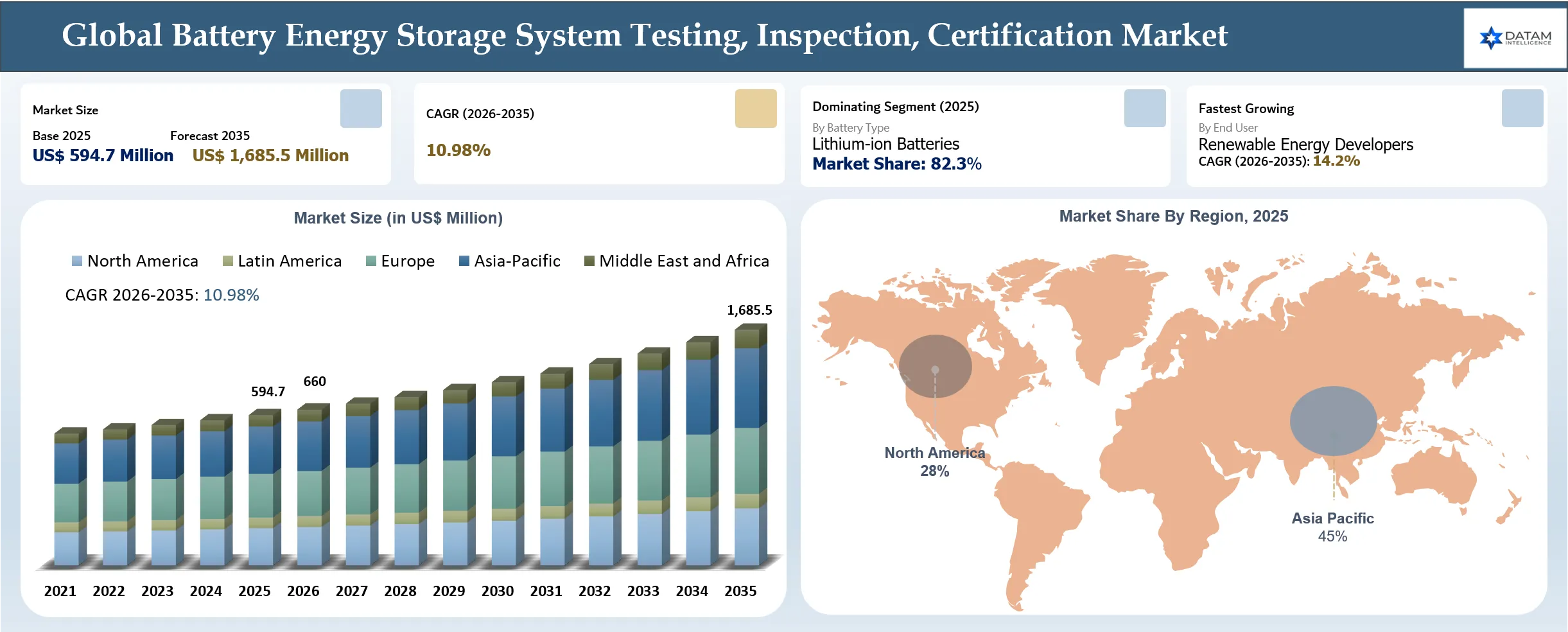
The global Battery Energy Storage System Testing Inspection Certification market reached USD 594.7 million in 2025 and is expected to reach USD 1,685.5 million by 2035, growing with a CAGR of 10.98% during the forecast period 2026-2035. Market expansion is being driven by the rapid deployment of utility-scale battery storage projects, battery safety standards, and third-party certification of grid-connected energy storage systems. According to the International Energy Agency (IEA), electricity demand will grow by 3.3% in 2025 and 3.7% in 2026; thus, investments in upgrading the energy grid and battery storage system are going to be accelerated. Moreover, IMDG Code Amendment 42-24 became mandatory on 1 January 2026 and changed international transport conditions for lithium batteries, whereas GB 38031-2025 increased safety and thermal propagation test standards for battery safety in China. Companies like UL Solutions, TÜV SÜD, Intertek, SGS, Bureau Veritas, and DEKRA are opening new battery test labs and certification services in order to satisfy their customers' demands coming from the renewable energy sector, utility companies, and battery manufacturers. Nevertheless, high capital costs for test labs and constant updating of international safety standards pose challenges for market players.
The required safety audits and increased performance obligations are anticipated to result in higher demand for testing, inspection, and certification during the entire lifecycle of the BESS. In June 2026, Energetica India, the 2026 BESS Safety Rules were notified by the Central Electricity Authority (CEA), and the regulation would come into effect from April 1, 2027. The regulation mandates two faults tolerance design, continuous monitoring of the batteries, installation of an automated fire detection and suppression system, and a third-party independent fire safety audit within three months of commissioning. These rules are applicable to Battery Energy Storage Systems having a voltage greater than 650 volts.
Battery Energy Storage System Testing, Inspection, Certification Market Key Takeaways
- Lithium-ion batteries dominated the service demand within the industry during 2025. The chemistry accounted for a substantial 82.3% of the total global BESS TIC market share.
- The Asia-Pacific region held a leading position with a 45% share of the global market in 2025. China alone accounted for approximately 64.5% of the total Asia-Pacific market revenue in 2026.
- The United States set plans to deploy a record 18.2 GW of battery storage capacity in 2025. This target represents a massive 77% increase over the 10.3 GW capacity deployed in 2024.
- Global BESS grid deployments successfully accumulated a total of 156 GWh through October 2025. This volume highlights an impressive 38% rate of growth compared to the previous year's metric.
- Evolving grid integration guidelines require safety rules for systems operating above 650 volts. These advancements support India's goal to satisfy a domestic storage demand of 175 GWh by 2032.
Battery Energy Storage System Testing, Inspection Certification Market Industry Trends and Strategic Insight
- Transition from product-level certification to system-level safety validation. Battery storage developers are increasingly requiring testing beyond individual battery cells to include integrated BESS architecture, covering battery management systems (BMS), power conversion systems (PCS), energy management systems (EMS), thermal management, and fire protection systems.
- Regulatory authorities are placing greater emphasis on full-scale thermal runaway and fire propagation testing rather than laboratory cell-level evaluations. The latest revisions to UL 9540A and the 2026 edition of NFPA 855 require more comprehensive large-scale fire assessments, driving demand for specialized testing facilities and advanced fire simulation capabilities.
- Expansion of certification requirements for next-generation battery chemistries. As sodium-ion, lithium iron phosphate (LFP), and emerging battery technologies enter commercial deployment, TIC providers are expanding testing methodologies beyond conventional lithium-ion systems.
- Digital engineering and simulation are reducing certification timelines. Leading TIC organizations are integrating computational fire modeling, explosion simulations, digital twins, and predictive risk analysis into the certification process.
- Growing deployment of utility-scale storage is increasing demand for verification of grid support functions such as frequency regulation, voltage control, fault ride-through, black-start capability, and inverter interoperability.
Battery Energy Storage System Testing, Inspection, and Certification Market Scope
| Metrics | Details | |
| 2025 Market Size | USD 594.7 Million | |
| 2035 Projected Market Size | USD 1,685.5 Million | |
| CAGR (2026-2035) | 10.98% | |
| Largest Market | Asia-Pacific | |
| Fastest Growing Market | North America | |
| By Service Type | Testing, Inspection, Certification | |
| By Battery Type | Lithium-ion Batteries, Sodium-ion Batteries, Flow Batteries, Lead-acid Batteries, Other Battery Types | |
| By System Component | Battery Cells, Battery Modules, Battery Packs, Battery Management System (BMS), Power Conversion System (PCS), Energy Management System (EMS), Others | |
| By Deployment Type | Utility-scale BESS, Commercial & Industrial (C&I) BESS, Residential BESS, Others | |
| By End User | BESS Manufacturers, Utilities & Grid Operators, EPC Contractors, Renewable Energy Developers, Government & Public Sector, Commercial & Industrial (C&I) Energy Storage Owners, Independent Power Producers (IPPs), Data Centers & Critical Infrastructure Operators, Residential Energy Storage Providers, Others | |
| By Region | North America | U.S., Canada, Mexico |
| Europe | Germany, UK, France, Spain, Italy, Poland | |
| Asia-Pacific | China, India, Japan, Australia, South Korea, Indonesia, Malaysia | |
| Latin America | Brazil, Argentina | |
| Middle East and Africa | UAE, Saudi Arabia, South Africa, Israel, Türkiye | |
| Report Insights Covered | Competitive Landscape Analysis, Company Profile Analysis, Market Size, Share, Growth | |
Battery Energy Storage System Testing Inspection Certification Market Disruption Analysis
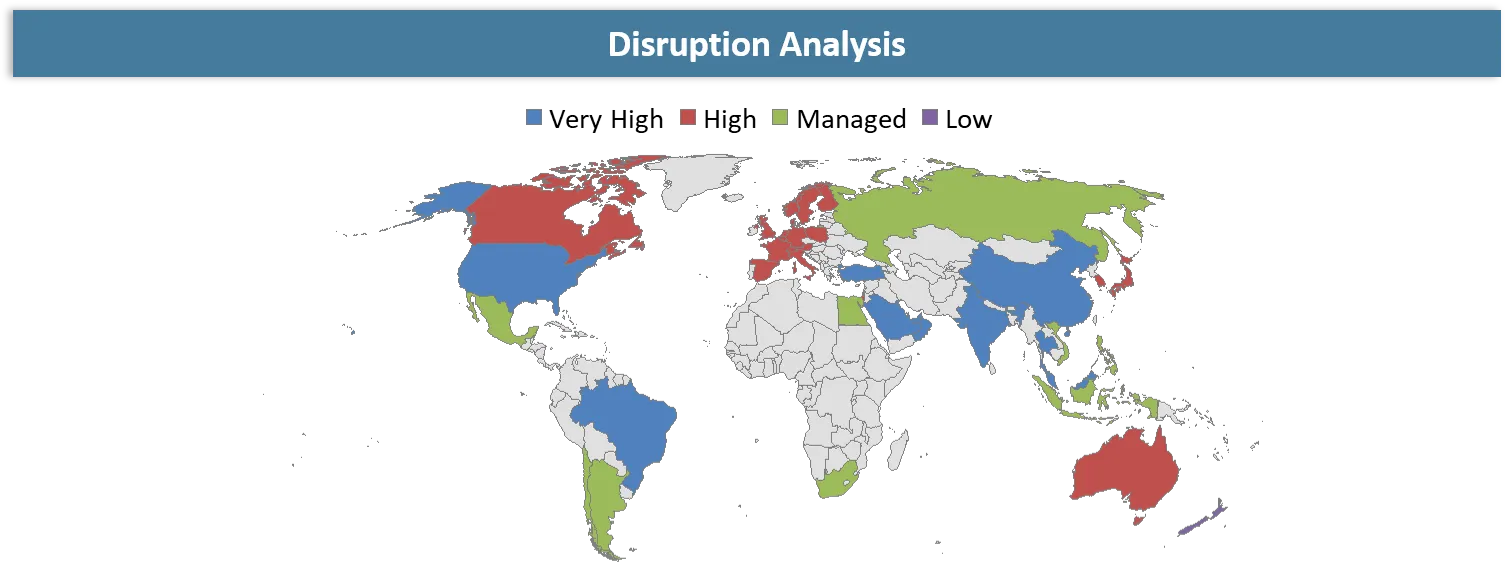
Commercialization of Next-Generation Battery Chemistries Reshaping Battery Energy Storage System Testing, Inspection, and Certification Landscape
The disruption in the BESS TIC market is becoming more prominent due to the commercialization of innovative battery chemistries, including sodium-ion, LMFP, and LFP. Since battery makers have started to go beyond traditional battery chemistries such as lithium-ion that utilize nickel content, traditional testing and certification methods are inadequate for assessing the new batteries in terms of thermal behavior, electrical properties, degradation behavior, and failure modes. Thus, the need for developing novel testing and validation approaches, abuse testing, fire safety assessment, and performance evaluation for every battery chemistry arises. The commercialization of these chemistries accelerated during 2025. As reported by the IEA Global EV Outlook 2026 (based on 2025 market statistics), LFP batteries were used in more than 55% of all EV batteries that have been employed worldwide in 2025, proving how quickly the industry has shifted towards cost-effective and safe chemistries.
Also, it has been noted that more than 50 GWh worth of battery manufacturing capacity in the USA has been redirected towards LFP battery manufacturing in 2025, showing how companies pay attention to the development of LFP chemistries, especially when it comes to stationary energy storage. On the other hand, companies were developing new sodium-ion chemistries for energy storage systems in order to meet the needs of the commercial sector, and thus, there arose a need for new certification approaches that would go beyond standard Li-Ion testing procedures.
Battery Energy Storage System Testing, Inspection, Certification Market BCG Matrix: Company Evaluation
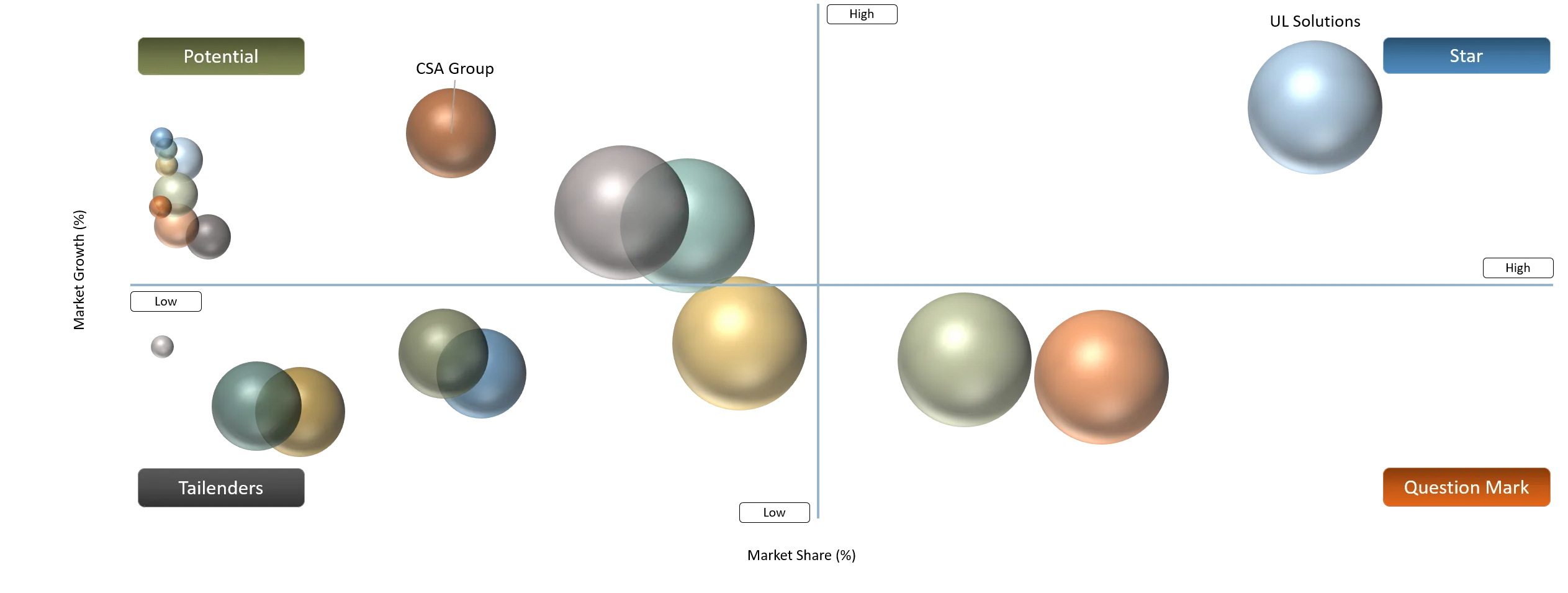
Stars include UL Solutions, Intertek Group plc, and TÜV Rheinland because they possess extensive global laboratory networks, broad accreditation across international battery safety standards (including UL, IEC, and NFPA), and comprehensive Battery Energy Storage System (BESS) testing capabilities spanning thermal runaway evaluation, fire safety, grid compliance, cybersecurity, and complete system certification. Question Marks companies such as DNV, SGS, and Bureau Veritas are categorized because they have established positions in renewable energy assurance, inspection, and certification while rapidly expanding dedicated BESS testing capabilities.
The Potential category includes CSA Group, DEKRA, and Applus+ Laboratories, which continue to strengthen their presence through investments in battery safety testing, transportation compliance, functional safety, and certification services. Tailenders category companies are Element Materials Technology, Kiwa, and VDE Testing and Certification Institute. These organizations provide specialized battery testing, electrical safety validation, and regulatory compliance services, but their participation in the global BESS TIC market is comparatively niche.
Battery Energy Storage System Testing, Inspection, and Certification Market Dynamics
Driver Impact Analysis
| Driver | Market Growth Impact (%) | Demand Concentration | Impacted Use Case | Strategic Impact |
Stringent Battery Safety Regulations and Mandatory Compliance Requirements such as UL 9540/9540A, NFPA 855, IEC 62933, GB 38031-2025, and the 2026 IMDG Code Amendment 42-24-is significantly increasing demand for independent testing, inspection, and certification services. | 37% | Battery manufacturers, BESS system integrators, utilities, EPC contractors, project developers | Product certification, thermal runaway testing, fire safety validation, commissioning approval, grid interconnection | Very High – Expands mandatory third-party TIC services, increases recurring compliance testing, and raises barriers to market entry through stricter certification requirements. |
Rapid Deployment of Utility-Scale Battery Energy Storage Systems to support renewable energy integration is increasing the need for testing, inspection, and certification services. | 31% | Utility-scale BESS projects, renewable energy developers, independent power producers (IPPs), transmission operators | Factory Acceptance Testing (FAT), Site Acceptance Testing (SAT), commissioning inspection, operational verification | Larger and more complex BESS installations increase demand for end-to-end testing, inspection, commissioning, and lifecycle assurance services. |
Expansion of Grid Code Compliance and Interconnection Testing is creating sustained demand for accredited testing and certification. | 21% | Utilities, transmission system operators (TSOs), distribution network operators (DNOs), grid operators | Grid compliance testing, inverter validation, frequency response testing, power quality verification | Increasing grid-support requirements make independent verification essential before commercial operation, creating recurring opportunities for specialized TIC providers. |
Expansion of Battery Manufacturing and Gigafactory Investments is increasing demand for factory audits, production quality inspections, product certification, transportation testing, and compliance assessments before batteries enter the energy storage market. | 18% | Battery cell manufacturers, module and pack manufacturers, OEMs, contract manufacturers | Factory audits, production quality inspection, product qualification, transport compliance testing | New battery manufacturing facilities require continuous quality assurance, supplier audits, production certification, and compliance testing throughout the manufacturing lifecycle. |
Stringent Battery Safety Regulations and Mandatory Compliance Requirements such as UL 9540/9540A, NFPA 855, IEC 62933, GB 38031-2025, and the 2026 IMDG Code Amendment 42-24—is significantly increasing demand for independent testing, inspection, and certification services
The increased adoption of standard regulations for battery safety is driving the BESS TIC market. Third-party testing and certification of battery energy storage systems have started being mandated by governments, regulatory agencies, utilities, insurance companies, and project developers prior to transportation, installation, connection to the grid, and commissioning of such systems. Expansion in the deployment pipeline is significantly broadening the potential for TIC companies. As stated by the U.S. Energy Information Administration (EIA), the United States planned to deploy an unprecedentedly high level of 18.2 GW battery storage capacity in 2025, which is 77% higher compared to the 10.3 GW deployed in 2024, making the battery storage one of the most rapidly increasing utility asset that should receive independent certification before being connected to the grid. Also, as stated by Rho Motion, global BESS grid deployments totaled 156 GWh through October 2025, marking an impressive 38% growth from last year, while BloombergNEF estimates the number of installations at 112 GW (307 GWh) for 2025, which was the first year of installations exceeding 100 GW per annum.
The adoption of new rules is expected to increase demand for accredited testing, inspection, and certification providers to verify compliance with recognized battery safety standards before system deployment. In October 2025, Sive, Paget & Riesel (SPR Law) reported that the New York City Department of Buildings (NYCDOB) adopted two new Energy Storage System (ESS) rules requiring compliance with UL 9540, UL 9540A, and NFPA 855 standards. The rules mandate system commissioning, testing, inspections, peer reviews by licensed engineers, and final regulatory approval before operation, while reducing the minimum battery capacity threshold for certain lithium-ion ESS installations to 1 kWh to strengthen safety oversight.
Restraint Impact Analysis
| Restraint | Drag on Market Growth (%) | Primary Impact Area | Impacted Use Case | Strategic Impact |
Lengthy Testing and Certification Timelines delay product commercialization and utility-scale BESS project commissioning. | 27% | Product commercialization & project commissioning
| Utility-scale BESS deployment, grid interconnection approval, product launch | Extends time-to-market, delays project revenue generation, and increases development costs. |
Frequent Revisions to Global Battery Safety Standards increase compliance complexity and certification costs for manufacturers. | 25% | Regulatory compliance & certification | Product redesign, re-certification, multi-market product approvals | Requires repeated testing, increases compliance expenditure, and prolongs certification cycles across multiple jurisdictions. |
Limited Availability of High-Capacity Thermal Runaway and Fire Testing Facilities creates bottlenecks for large-scale BESS certification. | 23% | Testing infrastructure capacity | Thermal runaway testing, fire propagation testing, system-level safety validation | Creates laboratory backlogs, extends certification lead times, and limits the speed of utility-scale project deployment. |
Lack of Global Harmonization Across Battery Safety Standards requires multiple certifications for different regional markets, increasing time and cost. | 19% | International market access | Global product certification, export compliance, and regional regulatory approvals | Increases duplicate testing requirements, raises certification costs, and complicates global commercialization strategies. |
Limited Availability of High-Capacity Thermal Runaway and Fire Testing Facilities creates bottlenecks for large-scale BESS certification
One of the key restrictions faced by the Battery Energy Storage System (BESS) Testing, Inspection, and Certification (TIC) Market is the lack of accredited laboratories that have the capability of performing the thermal runaway test, fire propagation test, explosion test, and other system-level safety tests required for utility-scale battery energy storage systems. With the growing size of BESS installations, regulatory compliance to standards such as UL 9540A, NFPA 855, and IEC 62933 needs a complete fire safety validation to be performed before project commissioning. However, there are very few laboratories that have the facilities to perform high-energy battery testing, explosion testing, and large-scale fire testing, leading to increased time and cost for testing and certification of products.
The shortage of dedicated high-capacity BESS testing facilities is extending certification timelines and increasing reliance on overseas laboratories for safety validation. In January 2026, Mint reported that the Indian government is considering a ₹500 crore allocation in the FY2027 Budget to establish National BESS Testing and Safety Centers, battery certification infrastructure, and R&D facilities. The report highlighted that India currently lacks dedicated BESS testing and prototype centers, with only a handful of battery testing facilities available, forcing many manufacturers to send battery systems to China for testing and contributing to certification delays as domestic energy storage demand grows toward 175 GWh by 2032.
Battery Energy Storage System Testing, Inspection, Certification Market Segment Analysis
The global Battery Energy Storage System Testing, Inspection, and Certification market is segmented based on service type, battery type, system component, deployment type, end user, and region.
Adoption of Lithium-Ion Battery Energy Storage Systems Driving the Largest Demand for Testing, Inspection, and Certification Services
The lithium-ion batteries segment dominates the Battery Energy Storage System (BESS) Testing, Inspection, and Certification (TIC) market, accounting for an 82.3% of the market share by 2025. The dominance is attributed to the widespread deployment of lithium-ion batteries, which are used extensively in energy storage systems for utility-scale, C&I (Commercial and Industrial), and residential applications. In such cases, rigorous safety and performance standards, along with regulatory compliance, result in the need for extensive third-party TIC services. For Li-ion batteries, especially LFP and NMC chemistries, thorough testing of various factors is essential, including thermal runaway potential, fire propagation, electrical safety, environmental durability, transportation requirements, and system integration, before commercialization of the battery products.
The segment's leadership is reinforced by continued growth in global battery deployment during 2025–2026. The rapid expansion of lithium-ion-based energy storage systems, combined with increasingly stringent safety regulations such as UL 9540A, IEC 62933, and NFPA 855, continues to strengthen demand for specialized testing, inspection, and certification services, reinforcing lithium-ion batteries as the dominant segment in the global BESS TIC market.
Battery Energy Storage System Testing, Inspection, Certification Market Geographical Penetration
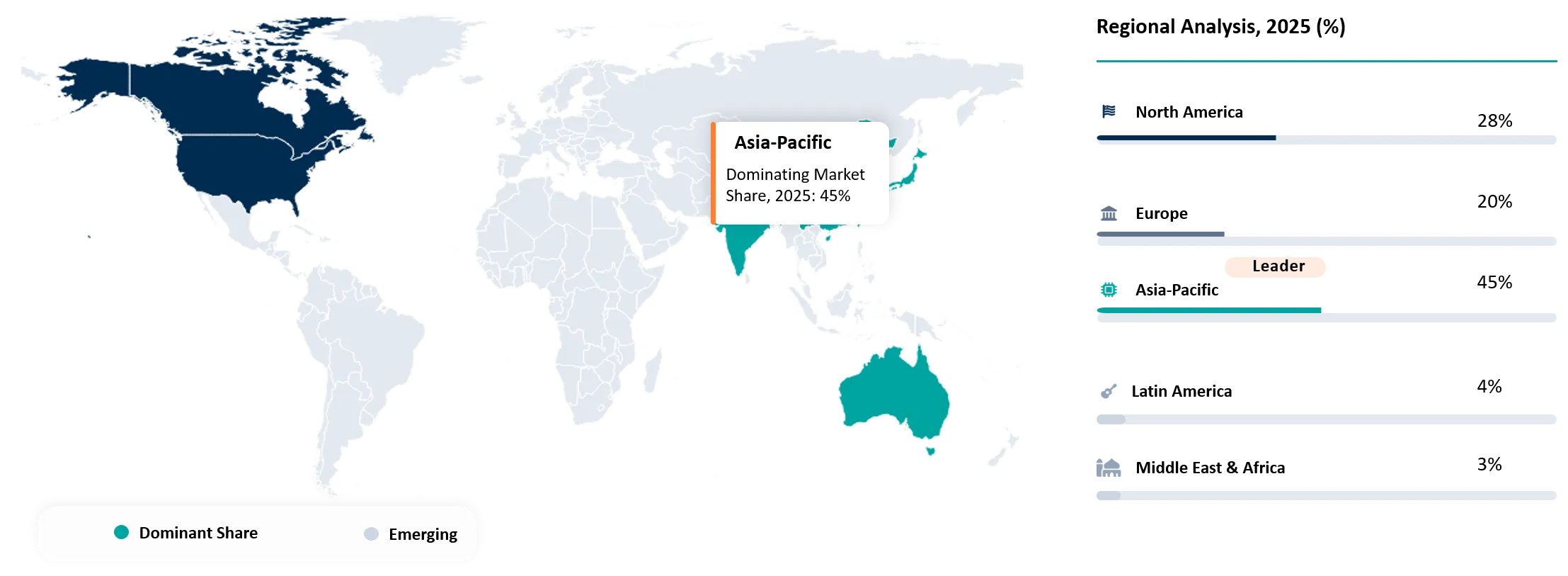
Asia-Pacific Dominance Driven by Battery Manufacturing Leadership, Energy Storage Deployment, and Expanding TIC Infrastructure
The Asia Pacific region dominates the Battery Energy Storage Systems Testing, Inspection, and Certification (BESS TIC) Market, having a market share of about 45% in the global market in 2025 due to its strong battery manufacturing industry, growth of renewable energy generation capacity, and rising penetration of utility scale energy storage systems. This region accounts for more than 70% of the world’s lithium-ion battery cell manufacturing capacity, where China, South Korea, and Japan are considered the centers of battery manufacturing, energy storage systems, and battery technology innovation. Growing deployment of grid-scale BESS projects, especially in China and India, coupled with growing safety testing needs, is driving the demand for BESS TIC services.
The new facility significantly enhances Asia-Pacific's capacity for large-scale BESS safety, performance, and grid integration testing, supporting faster product validation and regulatory compliance. In June 2026, Contemporary Amperex Technology Co., Limited (CATL), a China-based battery manufacturer, launched the world's largest Xiamen Energy Storage Validation Research Institute (ESVL) in Xiamen, China. Backed by an investment of approximately RMB 3 billion (US$440 million) and spanning 10 hectares, the facility features five specialized laboratories, including a 35 kV/100 MVA grid integration laboratory, a 1–500 kV high-voltage safety laboratory, and a 20 MW thermal safety and combustion laboratory.
China Battery Energy Storage System Testing, Inspection, and Certification Market Trends
China holds a dominant position in the Asia-Pacific Battery Energy Storage System (BESS) Testing, Inspection, and Certification (TIC) Market owing to its extensive battery manufacturing ecosystem, rapid expansion of grid-scale energy storage projects, and strong regulatory focus on battery safety and performance validation. China accounts for approximately 64.5% of the Asia-Pacific BESS TIC market revenue in 2026, supported by its leadership in lithium-ion battery production, large-scale energy storage deployment, and presence of major battery manufacturers such as CATL and BYD.
The collaboration strengthens China's BESS testing, inspection, and certification ecosystem by integrating technical validation, standard development, and system-level certification capabilities. In September 2025, Beijing CGC Certification Center and Xiamen Empirical Energy Storage Technology Research Institute Co., Ltd., two China-based third-party technical service, testing, and energy storage standard R&D institutions, signed a strategic cooperation agreement witnessed by an executive from Contemporary Amperex Technology Co., Limited (CATL), a China-based battery manufacturer.
India Battery Energy Storage System Testing, Inspection, and Certification Market Outlook
India is emerging as the fastest-growing country in the Asia-Pacific Battery Energy Storage System (BESS) Testing, Inspection, and Certification (TIC) Market due to its expanding renewable energy capacity, increasing deployment of utility-scale battery storage projects, and government initiatives supporting domestic battery manufacturing. The country’s growing requirement for grid stability solutions, renewable energy integration, and reliable power infrastructure is driving demand for advanced BESS testing, safety validation, and certification services.
The partnership demonstrates the growing investment in domestic BESS testing infrastructure in India, as manufacturers increasingly integrate advanced testing capabilities to ensure safety, reliability, and regulatory compliance. In September 2025, Invergy India, a subsidiary of GP Eco Solutions India Ltd., an India-based renewable energy solutions provider, signed an MoU and supply contract with Shenzhen Sinexcel RE Equipment Co., Ltd., a China-based BESS power electronics and testing equipment manufacturer, for the supply of advanced battery testing equipment for its upcoming 3 GWh Battery Energy Storage System (BESS) factory in Uttar Pradesh, India.
Battery Energy Storage System Testing, Inspection, Certification Market Competitive Landscape
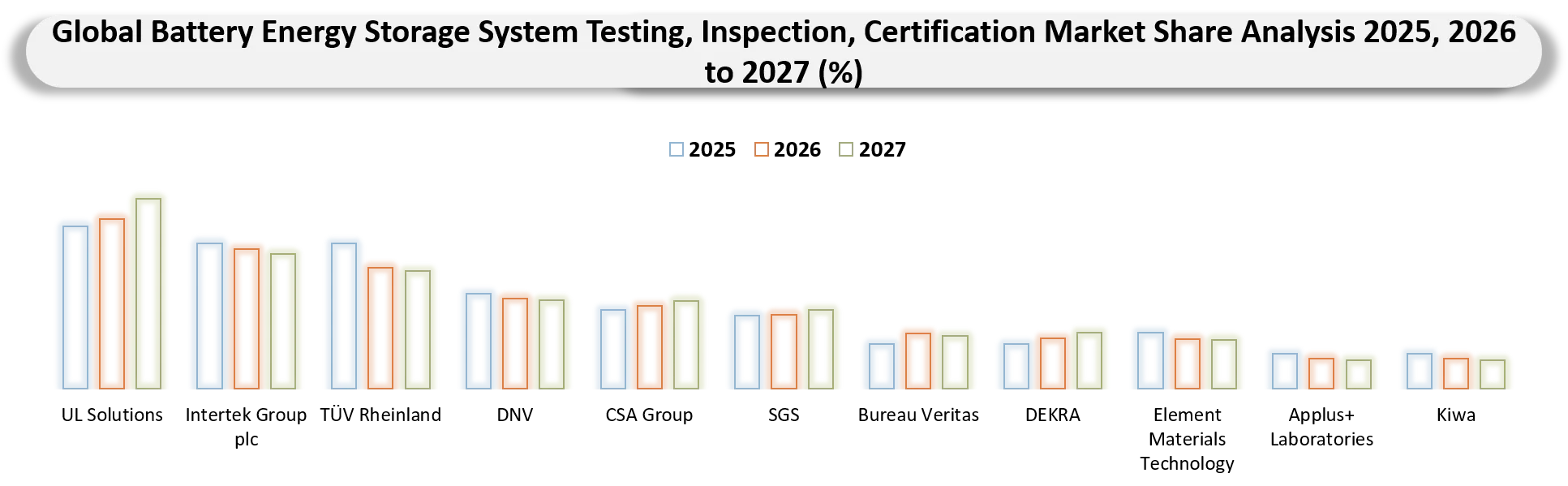
- The Battery Energy Storage System (BESS) Testing, Inspection, and Certification (TIC) market is characterized by three major participant groups – global TIC service providers, battery testing labs, and certification bodies that have proficiency in energy, electrical safety, and transportation certification. Some of the major players in the industry include UL Solutions, Intertek Group plc, TÜV Rheinland, DNV, SGS, Bureau Veritas, DEKRA, and Element Materials Technology, among others. Such companies act as facilitators to the manufacturers of battery energy storage systems, battery cell manufacturers, and energy storage system integration providers by offering testing services in accordance with standards like UL 9540A, IEC 62619, IEC 63056, UN 38.3, and ISO/IEC 17025. Organizations that specialize in this sector, such as CSA Group, VDE Testing and Certification Institute, Kiwa, and Applus+ Laboratories, enhance the competition in the market with their expertise in battery validation testing, grid compliance testing, environment testing, and certification services for new energy storage technologies.
- Key players in the Battery Energy Storage System Testing, Inspection, and Certification Market include UL Solutions, Intertek Group plc, TÜV Rheinland, DNV, CSA Group, SGS, Bureau Veritas, DEKRA, Element Materials Technology, Applus+ Laboratories, Kiwa, and VDE Testing and Certification Institute.
Battery Energy Storage System Testing, Inspection, Certification Market Key Developments
- In June 2026: SGS, a Switzerland-based independent testing, inspection, and certification (TIC) company, provided advanced battery and energy storage system testing services through its China operations to support the safe and reliable deployment of Battery Energy Storage Systems (BESS).
- In March 2025: Powin LLC, a U.S.-based global energy storage integrator, expanded its strategic partnership with TÜV Rheinland, a German-based independent testing, inspection, and certification (TIC) company, to enhance safety, compliance, and innovation in energy storage systems.
- In July 2026: Havells India Limited, an India-based electrical equipment and consumer durables company, entered into a strategic collaboration with Pixii AS, a Norway-based energy storage technology company, to develop and introduce modular Battery Energy Storage System (BESS) solutions for the Indian market.
- In July 2026: AmpereHour Energy, an India-based full-stack Battery Energy Storage System (BESS) solutions provider and energy technology company, launched an intelligent energy storage manufacturing platform to enable digital-first BESS integration in India.
- In September 2025: Jupiter Electric Mobility (JEM), an India-based electric mobility and energy storage solutions company and subsidiary of Jupiter Wagons Limited, launched modular Battery Energy Storage System (BESS) units designed for grid-scale and commercial energy storage applications.
- In November 2025: Edisson India Nextgen Pvt. Ltd., an India-based energy storage solutions and BESS technology company, signed a strategic MoU with Shenzhen Bluesea Intelligent Manufacturing Technology Co., Ltd. and Jinying Energy Co., Ltd., both China-based energy storage technology and manufacturing companies, to establish local battery energy storage system (BESS) assembly capabilities in India.
Key Procurement Priorities and Buyer Evaluation Criteria
- Organizations investing in Battery Energy Storage System (BESS) Testing, Inspection, and Certification (TIC) services are increasingly selecting TIC providers based on their ability to deliver comprehensive battery safety testing, performance validation, and certification solutions that ensure reliability, regulatory compliance, and long-term operational stability of energy storage systems.
- The procurement decision-making process is increasingly influenced by the rapid expansion of utility-scale BESS projects, renewable energy integration, electric vehicle battery applications, and stricter global battery safety regulations. Buyers are prioritizing TIC partners that can support compliance with evolving standards such as UL 9540A, IEC 62619, IEC 63056, UN 38.3, and regional grid connection requirements.
- Buyers evaluate factors such as testing laboratory accreditation, global certification coverage, turnaround time, technical expertise, safety testing capabilities, and experience with lithium-ion battery chemistries, including LFP, NMC, and NCA, when selecting their TIC service providers. The ability to perform thermal runaway testing, environmental testing, battery lifecycle assessment, abuse testing, and system-level performance verification has become a critical procurement criterion.
Why Choose DataM?
- Technological Advancements: Explores the evolution of advanced battery testing, inspection, and certification technologies, including thermal runaway analysis, battery management system validation, lifecycle performance testing, environmental testing, and safety assessment methodologies that support reliable deployment of lithium-ion, LFP, NMC, and next-generation battery energy storage systems.
- Product Performance & Market Positioning: Evaluates how leading TIC providers differentiate their services based on testing accuracy, certification capabilities, laboratory infrastructure, turnaround time, global accreditation coverage, and expertise in validating battery safety, durability, efficiency, and compliance for utility-scale, commercial, industrial, and electric mobility energy storage applications.
- Real-World Evidence: Highlights the adoption of BESS TIC solutions across grid-scale energy storage projects, renewable energy integration systems, electric vehicle batteries, and industrial storage applications, demonstrating their role in improving battery safety, preventing thermal failures, enhancing operational reliability, and ensuring compliance with international performance standards.
- Market Updates & Industry Changes: Tracks key developments such as expansion of battery testing laboratories, establishment of advanced validation facilities, new battery safety regulations, certification standard updates, and investments in energy storage infrastructure across Asia-Pacific, North America, and Europe, supporting the transition toward safer and more reliable battery ecosystems.
- Competitive Strategies: Analyzes how leading TIC companies strengthen their market position through laboratory expansion, accreditation development, strategic partnerships with battery manufacturers, and integration of advanced testing capabilities to address increasing demand for large-scale BESS certification and safety validation.
- Pricing & Market Access: Explains variations in BESS TIC service pricing based on battery chemistry, testing complexity, system size, certification requirements, and scope of validation, along with access through global TIC organizations, specialized battery laboratories, and regional certification networks supporting worldwide energy storage deployment.
- Market Entry & Expansion: Identifies growth opportunities driven by renewable energy adoption, grid modernization, electric vehicle battery demand, and increasing regulatory requirements, while outlining strategies such as regional laboratory expansion, specialized testing capabilities, regulatory compliance expertise, and partnerships with battery manufacturers and energy storage developers to scale globally.
Target Audience
- Battery Manufacturers and Cell Producers
- Battery Energy Storage System Manufacturers and Integrators
- Testing, Inspection, and Certification (TIC) Service Providers
- Renewable Energy Developers and Utility Companies
- Automotive and Electric Vehicle Battery Companies
- Government Bodies, Regulatory Authorities, and Standard Organizations
- Energy Storage Investors, Venture Capital Firms, and Financial Institutions


























































