


Published Date: June 15th, 2026
SpaceX is rapidly evolving beyond its traditional aerospace operations, expanding into humanoid robotics, autonomous vehicles, artificial intelligence systems, and next-generation satellite infrastructure, according to recent industry insights and executive statements led by President and COO Gwynne Shotwell.
The company’s strategic direction reflects a broader convergence of AI, robotics, and autonomous mobility ecosystems, positioning SpaceX as a multi-domain technology leader rather than solely a space transportation provider.
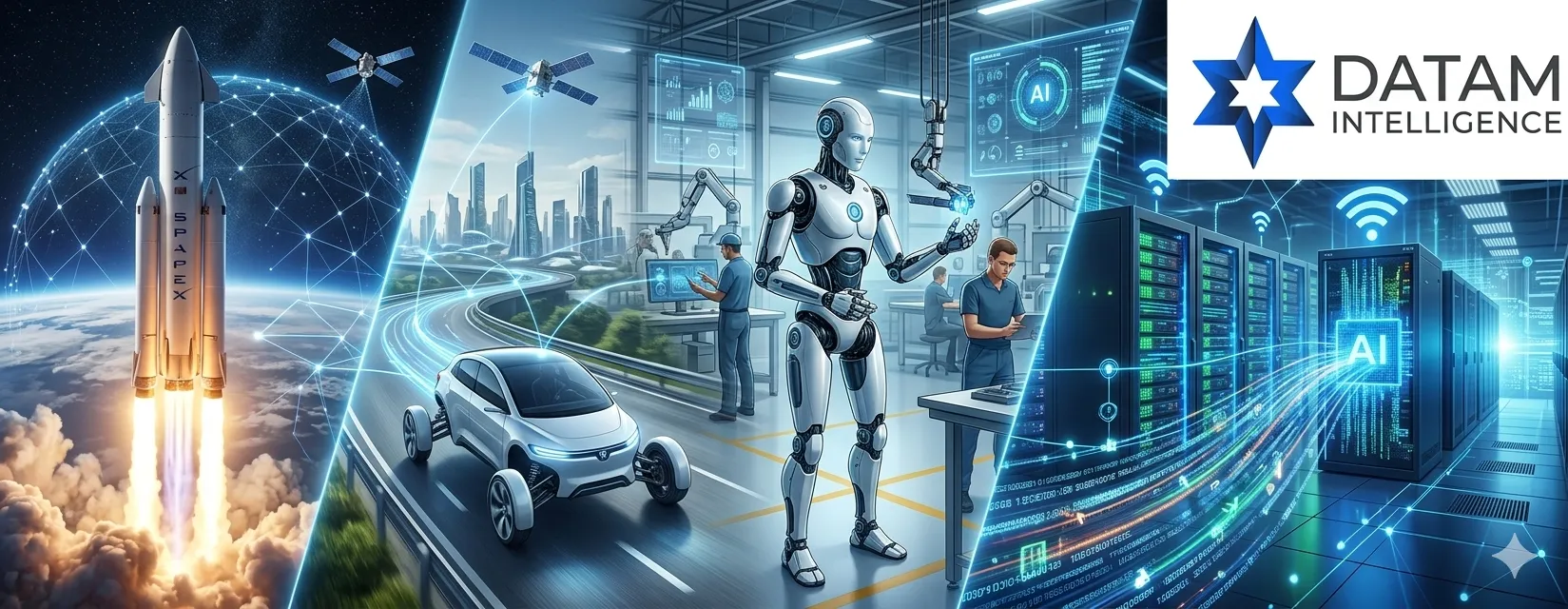
AI, Robotics, and Autonomous Mobility Convergence
Industry discussions indicate growing alignment between SpaceX’s infrastructure capabilities and emerging technologies such as:
- Humanoid robotics systems for industrial and logistics applications
- Autonomous driving platforms integrated with AI perception systems
- AI computing infrastructure deployed through satellite networks
- Edge intelligence powered by low-latency Starlink connectivity
This convergence suggests that SpaceX is building a multi-layered AI ecosystem, where satellites, robotics, and autonomous systems operate within a connected intelligence framework.
Starlink Driving Next-Gen AI Demand
A key growth driver behind this expansion is the increasing global demand for high-speed, low-latency connectivity, powered by the Starlink satellite network.
Starlink is increasingly positioned as a foundational infrastructure layer for:
- Autonomous vehicles requiring real-time data exchange
- Robotics systems operating in remote environments
- AI models deployed at the edge
- Global IoT and defense communication systems
As AI workloads grow, satellite-based connectivity is becoming critical for enabling real-time autonomous decision-making systems.
Humanoid Robotics: The Next Industrial Shift
The humanoid robotics segment is emerging as a strategic focus area within the broader AI automation ecosystem.
Key industry trends include:
- Labor automation in manufacturing and logistics
- AI-driven robotic assistance in industrial environments
- Integration of perception models with real-world mobility systems
- Increasing investment in general-purpose robotics platforms
Experts suggest humanoid robots could become a core extension of AI infrastructure, particularly when combined with satellite-enabled connectivity and edge computing systems.
Autonomous Cars and AI Mobility Ecosystem
The autonomous vehicle industry is also experiencing rapid convergence with SpaceX-related technologies, especially in:
- AI-based perception systems
- Vehicle-to-satellite communication (V2S)
- Real-time navigation in low-connectivity regions
- Data-driven mobility intelligence systems
This ecosystem could significantly accelerate the adoption of fully autonomous transportation networks, particularly in logistics, defense, and urban mobility sectors.
Explore robotaxi market report.
Investor Insight: Multi-Trillion Dollar AI Infrastructure Opportunity
From an investor perspective, the convergence of robotics, autonomous vehicles, and satellite AI infrastructure represents a multi-trillion-dollar opportunity space.
Key investment themes include:
- AI infrastructure expansion through satellite networks
- Robotics-as-a-service business models
- Autonomous mobility ecosystems
- Edge AI and distributed computing platforms
- Integrated hardware-software intelligence systems
Market analysts suggest this convergence could redefine multiple industries including transportation, defense, logistics, and telecommunications.
Gwynne Shotwell’s Strategic Role
SpaceX President Gwynne Shotwell continues to play a critical role in scaling operations across Starlink, launch systems, and emerging AI initiatives.
Recent developments highlight her focus on:
- Expanding global Starlink deployment
- Supporting AI infrastructure integration
- Strengthening aerospace and telecom convergence
- Driving operational scalability for future technologies
Her leadership is increasingly viewed as central to SpaceX’s transition into a multi-domain AI and infrastructure company.
Conclusion
The evolution of SpaceX into humanoid robotics, autonomous mobility, and AI-powered satellite infrastructure signals a major transformation in the global technology landscape.
As AI demand accelerates, the convergence of space systems, robotics, and autonomous vehicles is expected to become one of the most significant investment and innovation themes of the decade.
News sources: https://www.cnbctv18.com/technology/spacex-humanoid-robots-autonomous-cars-starlink-ai-demand-gwynne-shotwell-ws-l-19924868.htm