


Introduction
South Korea is rapidly emerging as a global testbed for AI-driven elderly care solutions, deploying intelligent companion dolls designed to support seniors living alone. These AI-powered devices are being integrated into public welfare systems to address growing concerns around loneliness, mental health decline, and healthcare accessibility in one of the world’s fastest-aging societies.
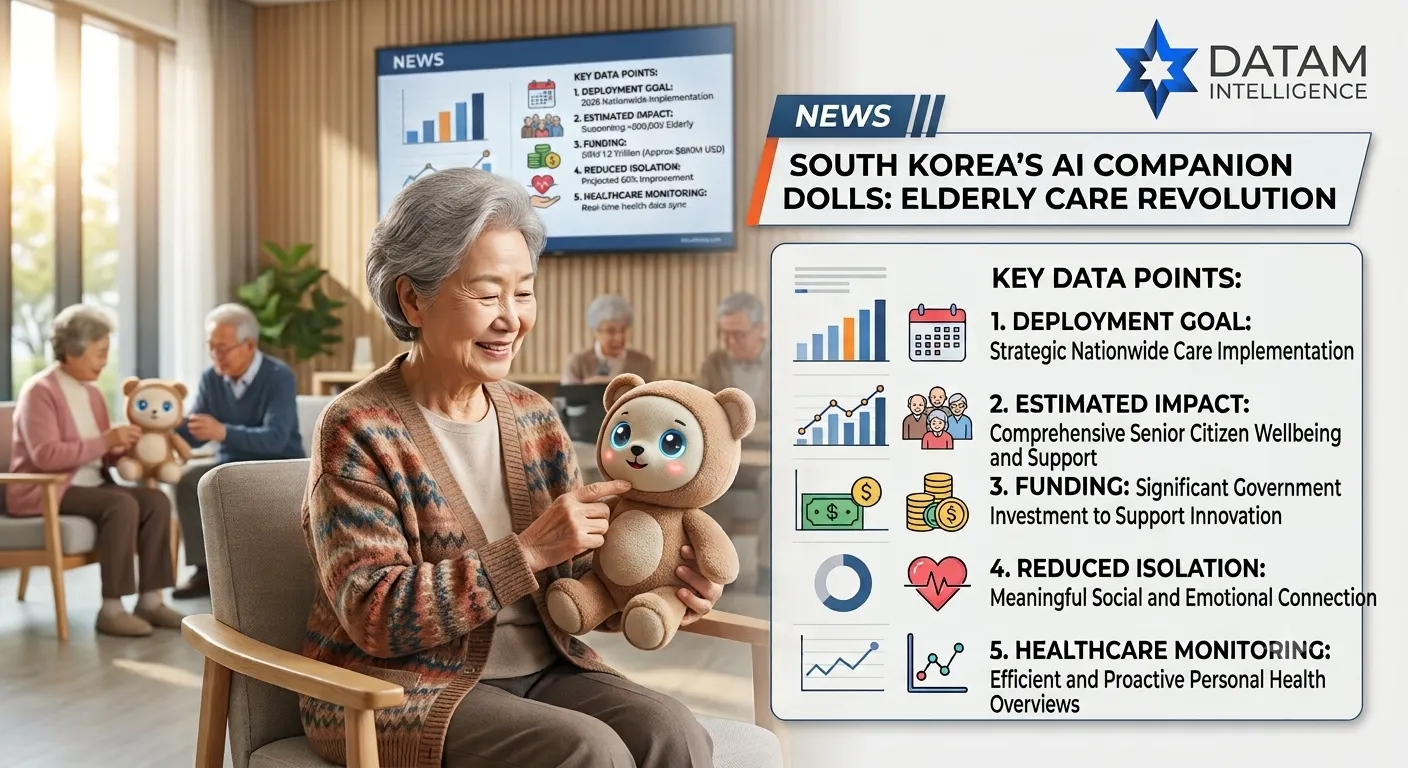
According to recent developments reported from Seoul and surrounding regions, local authorities have begun distributing AI companion dolls to elderly residents as part of a nationwide digital healthcare transformation initiative.
Explore AI in Elderly Care Market analysis report for mor information.
What Are AI Companion Dolls?
AI companion dolls are interactive robotic systems designed to simulate emotional companionship while providing essential health support functions. These devices combine:
- Conversational AI systems
- Health monitoring sensors
- Medication reminders
- Emergency alert systems
- Behavioral and emotional tracking algorithms
Unlike traditional assistive devices, these AI dolls are designed to build emotional engagement with users, especially elderly individuals living in isolation.
AI Companion Dolls Transform Elderly Care in South Korea
The newly deployed AI companion dolls are part of South Korea’s broader digital healthcare strategy. These devices are designed to interact with elderly users through natural conversation, emotional engagement, and health monitoring capabilities.
Unlike traditional assistive tools, these AI companions are built to simulate human-like interaction, offering seniors a sense of presence and emotional connection.
Authorities have introduced these systems primarily for elderly individuals living alone, where risks of isolation, depression, and medical emergencies are significantly higher.
Key Features of AI Elderly Care Dolls
The AI companion dolls are equipped with multiple intelligent functions, including:
- Conversational AI for daily interaction and companionship
- Medication reminders to ensure timely health management
- Emotional behavior analysis to detect loneliness or distress
- Health tracking sensors for monitoring daily activity patterns
- Emergency alert systems to notify caregivers or authorities when needed
These features allow the system to function as both a social companion and a basic healthcare assistant.
Why South Korea Is Investing in AI Elder Care
South Korea is facing one of the fastest aging populations in the world. Key challenges include:
- Increasing number of elderly people living alone
- Declining birth rate and shrinking workforce
- Rising healthcare and caregiving costs
- Growing mental health concerns among seniors
These demographic pressures have pushed policymakers to explore AI-based solutions for scalable elder care support.
The AI companion doll program is designed to fill gaps in human caregiving by providing continuous, low-cost monitoring and emotional interaction.
How AI Companion Dolls Support Elderly Wellbeing
AI companion dolls deployed in South Korea are designed as multi-functional assistive care systems, combining conversational artificial intelligence, behavioral analytics, and health monitoring tools. Their purpose goes beyond basic interaction they operate as continuous digital caregivers that support both the emotional and physical wellbeing of elderly users living alone.
1. Emotional Support and Social Companionship
One of the most critical roles of AI companion dolls is addressing social isolation, which is a growing concern among aging populations.
These systems use natural language processing (NLP) and voice recognition to simulate human-like conversations. They can:
- Engage in daily conversations with elderly users
- Respond to emotional cues such as sadness, confusion, or joy
- Provide reminders of daily routines and personal preferences
- Offer comfort through conversational interaction and responsive dialogue
By maintaining continuous interaction, the AI system helps reduce feelings of loneliness and psychological distress, which are strongly linked to depression and cognitive decline in elderly individuals.
2. Continuous Health and Behavior Monitoring
AI companion dolls function as passive health monitoring systems by analyzing behavioral and activity patterns over time.
Using embedded sensors and AI-driven analytics, they can:
- Track movement patterns and daily routines
- Monitor sleep and activity consistency
- Detect changes in mood through voice tone and interaction frequency
- Identify deviations from normal behavioral patterns
This continuous monitoring enables early identification of potential health issues such as fatigue, cognitive decline, or sudden behavioral changes that may indicate underlying medical conditions.
3. Medication Adherence and Routine Management
Medication non-adherence is a common challenge among elderly populations. AI companion dolls help address this issue through automated reminder systems.
They provide:
- Timely voice reminders for prescribed medications
- Alerts for hydration, meals, or scheduled medical routines
- Personalized schedules based on user health profiles
- Confirmation tracking to ensure medication intake compliance
This function significantly improves treatment effectiveness and reduces risks associated with missed or incorrect medication usage.
4. Emergency Detection and Alert Systems
A critical safety feature of AI companion dolls is their ability to function as early warning systems for emergencies.
The AI continuously evaluates user behavior and environmental signals to detect anomalies such as:
- Sudden inactivity or prolonged immobility
- Irregular breathing or distress signals (where sensor-equipped)
- Repeated non-response to interaction prompts
- Unusual behavioral deviations from normal routines
When such patterns are detected, the system automatically triggers alerts to:
- Family members or designated caregivers
- Healthcare providers or social welfare agencies
- Emergency response services (where integrated)
This rapid response mechanism helps reduce risks associated with unattended medical emergencies such as falls or sudden illness.
5. Data-Driven Elder Care and Predictive Health Insights
Beyond real-time interaction, AI companion dolls also contribute to a broader data-driven healthcare ecosystem.
They collect and analyze long-term behavioral and interaction data to support:
- Early detection of cognitive decline or mental health deterioration
- Identification of chronic disease risk patterns
- Personalized care recommendations for healthcare providers
- Predictive analytics for preventive medical intervention
This data is typically aggregated and analyzed under healthcare compliance frameworks to support clinical decision-making and public health planning.
In essence, these AI systems shift elderly care from a reactive model (treating illness after it occurs) to a predictive model (identifying risks before escalation).
Smart Healthcare Transformation in Asia
This initiative reflects a broader shift toward AI-powered smart healthcare ecosystems across Asia. Governments are increasingly integrating:
- AI-assisted home care systems
- Remote health monitoring platforms
- Predictive healthcare analytics
- Robotics in elder care facilities
South Korea’s model is now being closely watched by global healthcare investors and medtech startups exploring scalable AI caregiving solutions.
Impact on Healthcare and Social Wellbeing
Experts believe AI companion systems could significantly improve elderly wellbeing by:
- Reducing loneliness and social isolation
- Supporting mental health stability
- Providing early detection of health risks
- Enhancing independence for elderly citizens
- Reducing pressure on healthcare workers and caregivers
This approach represents a shift from traditional care models to AI-assisted preventive healthcare systems.
Growing Global Interest in AI Elder Care
South Korea’s initiative is gaining international attention as countries like Japan, China, and several European nations face similar aging population challenges.
Healthcare analysts suggest that AI companion systems could become a key part of future elder care infrastructure globally, especially as:
- Demand for caregivers increases
- Healthcare systems face staffing shortages
- AI technology becomes more emotionally adaptive
This positions AI elder care as a rapidly expanding sector in the global healthtech market.
Ethical and Social Considerations
While the technology offers clear benefits, it also raises important concerns:
- Dependence on artificial companionship
- Privacy risks from behavioral data collection
- Emotional substitution for human relationships
- Long-term psychological effects on users
Experts emphasize that AI should be used as a support tool, not a replacement for human care and interaction.
Market & Investment Outlook
The AI elderly care segment is expected to become a multi-billion-dollar market as:
- Aging populations increase globally
- Healthcare labor shortages intensify
- Governments invest in digital healthcare infrastructure
- AI models become more emotionally adaptive
For investors and startups, this sector represents a convergence of:
- Artificial Intelligence
- Robotics
- Healthcare technology
- Government-funded social innovation
Future Outlook
The development of AI companion dolls is expected to evolve into more advanced systems, including:
- Fully autonomous home care robots
- Emotionally intelligent AI assistants
- Integrated smart home healthcare ecosystems
- Predictive health monitoring platforms
South Korea’s early adoption may position it as a global leader in AI-driven elderly care innovation.
Analyst Insight
Industry analysts suggest South Korea’s AI companion doll program represents a pilot model for global aging economies, especially countries like Japan, China, and parts of Europe facing similar demographic pressures.
The success of these systems will depend on:
- User trust in AI caregiving
- Regulatory frameworks for health data
- Integration with public healthcare systems
- Cost scalability and accessibility
Conclusion
South Korea’s deployment of AI companion dolls marks a major milestone in the intersection of artificial intelligence and healthcare innovation. As the country continues to address the challenges of an aging society, AI-powered elder care solutions are emerging as a practical and scalable approach to improving quality of life for seniors.
This initiative not only highlights technological progress but also signals a broader global shift toward AI-supported social welfare systems.
News source: https://www.japantimes.co.jp/news/2026/06/11/asia-pacific/science-health/south-korea-ai-dolls-elderly/