


Why Sodium-Ion Batteries Could Reshape the Global Energy Storage Market in 2026
The global energy-storage industry is entering a new phase as sodium-ion batteries move rapidly from an emerging battery chemistry toward commercial deployment.
For years, lithium-ion batteries particularly lithium iron phosphate (LFP) systems have dominated stationary energy storage. But growing demand for grid flexibility, renewable-energy integration, energy security and alternative battery supply chains is creating opportunities for sodium-ion technology.
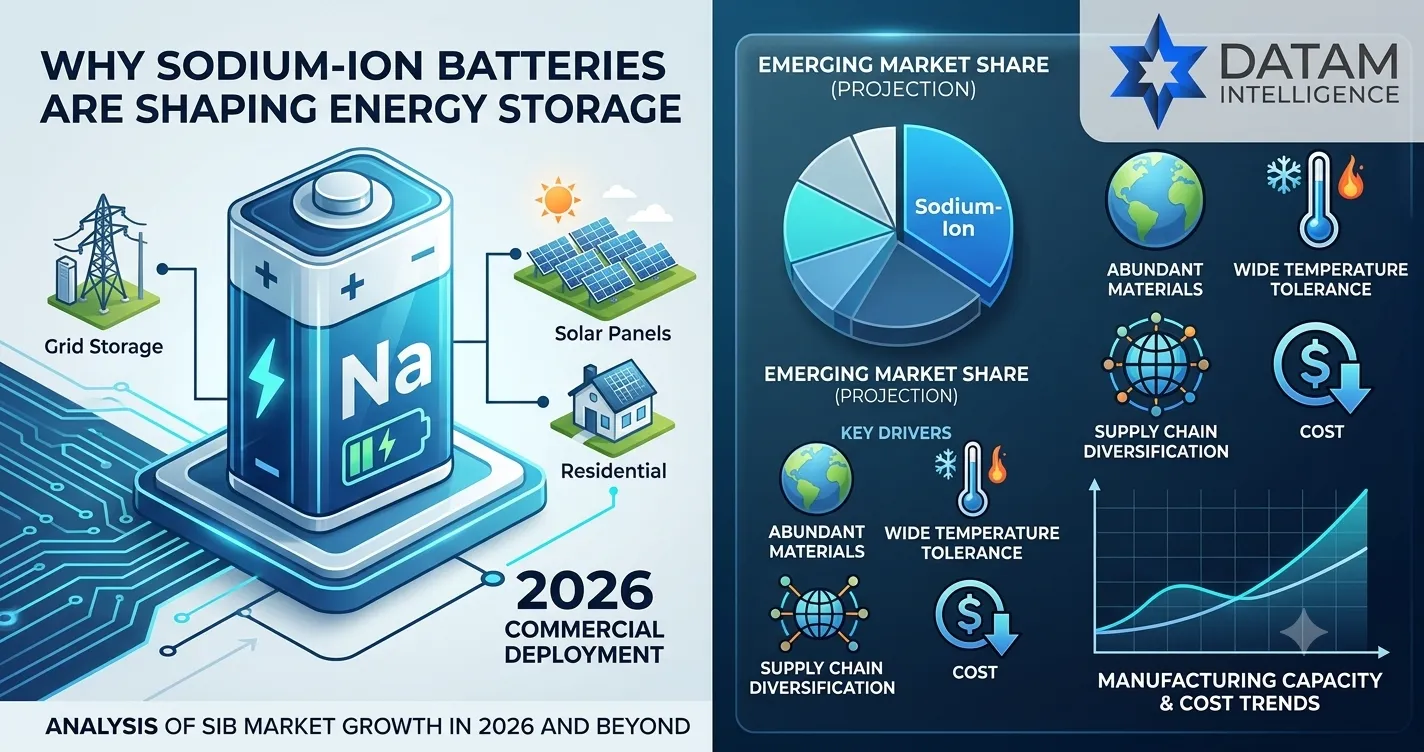
Sodium-ion batteries are now attracting manufacturers, energy-storage developers and technology companies because they can use abundant sodium-based materials while offering strong temperature tolerance and a potentially simpler thermal-management architecture.
The technology is therefore no longer just a laboratory alternative to lithium-ion. It is increasingly becoming a commercial option for applications where safety, temperature performance, supply-chain diversification and cost are more important than maximum energy density.
Why Sodium-Ion Batteries Are Gaining Momentum in 2026
The biggest change in the sodium-ion market is the transition from technology development to commercialization.
Recent industry activity shows companies are moving toward large-scale manufacturing, commercial energy-storage systems and customer deployments. CATL, for example, has announced commercial sodium-ion energy-storage systems and expects international deliveries to begin in 2027. The company has also expanded its sodium-ion manufacturing infrastructure.
At the same time, major energy-storage players are developing sodium-ion products specifically for grid applications.
Solar Power World reported that ESS plans to introduce its first grid-scale sodium-ion system in 2027 using NFPP cells, while Peak Energy is preparing to manufacture its GS1 sodium-ion storage system in Sacramento.
This shift is important because battery technologies generally need more than laboratory performance to become commercially relevant. They need manufacturing capacity, bankable products, supply chains, project deployments and long-term service capabilities.
Sodium-ion is beginning to develop these commercial foundations.
Sodium-Ion vs Lithium-Ion: The Competitive Equation Is Changing
Sodium-ion batteries are not simply a direct replacement for every lithium-ion battery.
Lithium-ion technology continues to benefit from enormous manufacturing capacity, established supply chains, high energy density and extensive deployment experience. According to the International Energy Agency, sodium-ion manufacturing capacity remains substantially smaller than lithium-ion capacity, while lower energy density continues to limit competitiveness in some applications.
The opportunity for sodium-ion is therefore more targeted.
Sodium-ion batteries can become particularlya attractive where extreme temperatures, thermal-management requirements, critical-mineral exposure or supply-chain diversification are major considerations.
Solar Power World highlighted sodium-ion's ability to operate across a broad temperature range, potentially reducing the need for the cooling infrastructure commonly associated with lithium-based battery energy-storage systems.
This creates a different value proposition: instead of winning solely through energy density, sodium-ion can compete through system-level economics, safety, operating conditions and supply-chain resilience.
Grid-Scale Energy Storage Could Become Sodium-Ion's Biggest Opportunity
Grid-scale battery storage represents one of the most important opportunities for sodium-ion technology.
Large stationary systems do not necessarily require the same energy-density characteristics as electric vehicles. Developers can place greater emphasis on lifecycle performance, safety, operating temperature, maintenance requirements and total system cost.
This makes sodium-ion particularly relevant to renewable-energy projects where batteries are used to shift electricity generated during periods of high solar or wind production.
The technology is already moving into this market.
Peak Energy is developing a 3.1-MWh NFPP-based storage system, while ESS plans a sodium-ion product for grid-scale applications. Meanwhile, CATL has moved sodium-ion energy storage toward commercial production and deployment.
A major commercial milestone came in 2026 when CATL and HyperStrong announced a 60-GWh sodium-ion energy-storage agreement covering technology development, applications and project deployment.
Such agreements indicate that sodium-ion is increasingly being evaluated as an industrial-scale storage platform rather than simply a future battery concept.
Solar Energy Storage Creates Another Growth Path
The relationship between sodium-ion batteries and solar power could become particularly significant.
Solar generation is inherently variable. Battery storage allows excess daytime generation to be shifted toward evening demand, while also providing backup and grid-support services.
Sodium-ion's temperature tolerance and potential reduction in auxiliary cooling requirements could provide advantages in certain solar-storage environments.
A notable 2026 development came from Moonwatt, which commissioned a 500-kWh passively cooled sodium-ion system directly coupled with a ground-mounted solar plant in the Netherlands. The company described the project as its first commercial-scale deployment and is targeting broader commercial deliveries from 2027.
This type of deployment is important because it demonstrates how sodium-ion technology can be integrated into actual renewable-energy infrastructure rather than being evaluated only as a standalone battery technology.
Residential Storage Could Become a Secondary Growth Market
Grid-scale storage is receiving much of the industry's attention, but residential energy storage could also benefit from sodium-ion batteries.
The residential market has traditionally relied heavily on lithium-ion systems because of their high energy density and established supply chains. However, homeowners and installers increasingly consider safety, operating temperature, lifecycle performance and total ownership cost.
Unigrid is developing NCO-based sodium-ion batteries for residential applications and has introduced its Na+Casa battery concept. Solar Power World reported that the system is designed around extreme-temperature performance and a long cycle life.
The opportunity is particularly interesting for regions where batteries must operate in challenging climates.
If sodium-ion manufacturing costs decline as production scales, residential storage could become another market where the chemistry competes on overall system economics rather than energy density alone.
China Remains Central to Sodium-Ion Manufacturing
China currently has a major advantage in sodium-ion battery manufacturing because established lithium-ion production infrastructure can be adapted for sodium-ion cell production.
The ability to leverage existing battery manufacturing knowledge and equipment can potentially accelerate commercialization.
However, companies outside China are also developing domestic sodium-ion supply chains.
In the United States, companies such as Peak Energy, ESS and Unigrid are developing domestic products and manufacturing capabilities. Peak Energy is planning a 4-GWh annual manufacturing facility in Sacramento, while Unigrid is developing U.S.-based NCO battery production.
This could make sodium-ion strategically important beyond its battery chemistry.
For policymakers and energy companies, the technology offers an opportunity to diversify battery supply chains and reduce dependence on specific critical minerals and geographically concentrated manufacturing.
What Could Limit Sodium-Ion Battery Adoption?
Despite the momentum, sodium-ion batteries still face important challenges.
The first is energy density. Lithium-ion batteries remain more competitive for applications where weight and physical footprint are critical, particularly many electric-vehicle applications. The IEA notes that sodium-ion's lower energy density remains a limitation compared with LFP at current lithium prices. The second challenge is manufacturing scale.
Sodium-ion production capacity remains far below lithium-ion capacity, and supply chains for materials such as hard carbon are still developing.
The third is cost competitiveness. Although sodium is abundant and raw-material costs can potentially be lower, sodium-ion batteries still need to achieve sufficient manufacturing scale to deliver competitive total system costs.
Finally, bankability and project experience remain important. Utilities, investors and large-scale energy developers typically require evidence of long-term performance before committing to new battery technologies at scale.
Sodium-Ion Is More Likely to Complement Lithium Than Immediately Replace It
The future energy-storage market is unlikely to become a simple lithium-versus-sodium contest.
Instead, different chemistries are likely to serve different applications.
Lithium-ion will continue to play a major role where energy density, established manufacturing capacity and proven supply chains provide strong advantages.
Sodium-ion can capture applications where temperature tolerance, safety, material availability, supply-chain diversification and stationary-storage economics become more important.
This means the key question is no longer whether sodium-ion batteries will completely replace lithium-ion.
The more important question is how much of the growing energy-storage market sodium-ion can capture.
Morgan Stanley Research has estimated that sodium-ion could increase its share of battery deployment from around 2% in 2027 to 20% in 2030 and 37% by 2035. These projections illustrate the scale of the potential opportunity, although actual adoption will depend on manufacturing expansion, economics and project performance.
Outlook: Sodium-Ion Moves From Promise to Proof
The sodium-ion battery industry has reached a critical point.
Manufacturers are building production capacity. Energy-storage developers are developing commercial systems. Solar projects are beginning to demonstrate sodium-ion integration, and major battery companies are committing resources to the technology.
The next stage will be proving performance at scale.
If sodium-ion manufacturers can combine competitive costs, long cycle life, reliable manufacturing and bankable project performance, the chemistry could become one of the most important additions to the global energy-storage technology mix.
The result may not be a post-lithium world.
Instead, the energy-storage industry could enter a multi-chemistry era in which sodium-ion becomes a mainstream complement to lithium-ion particularly across grid, solar and stationary-storage applications.
Related FAQs
1. Are sodium-ion batteries ready for mass adoption?
Sodium-ion batteries are entering the commercial scale-up phase, particularly for stationary and grid-scale energy storage. However, they have not yet reached the manufacturing scale or supply-chain maturity of lithium-ion batteries.
2. Are sodium-ion batteries better than lithium-ion batteries?
Neither technology is universally better. Sodium-ion can offer advantages in temperature tolerance, material availability and supply-chain diversification, while lithium-ion generally retains advantages in energy density, manufacturing scale and established supply chains.
3. Can sodium-ion batteries be used with solar panels?
Yes. Sodium-ion battery systems can be integrated with solar PV systems for energy shifting, backup power and grid-support applications. A 500-kWh passively cooled sodium-ion system was commissioned alongside a ground-mounted solar plant in the Netherlands in 2026.
4. Why are companies developing sodium-ion batteries?
Companies are developing sodium-ion batteries to diversify battery chemistry, reduce dependence on critical minerals, address specific safety and temperature requirements and create alternative supply chains for stationary energy storage.
5. What are the main advantages of sodium-ion batteries?
Key potential advantages include abundant sodium resources, broad operating-temperature capability, reduced dependence on certain critical minerals and compatibility with manufacturing processes similar to lithium-ion batteries.
6. What are the disadvantages of sodium-ion batteries?
The main challenges include lower energy density than leading lithium-ion chemistries, smaller manufacturing capacity, less mature supply chains and the need to establish long-term commercial performance.
7. Will sodium-ion batteries replace lithium-ion batteries?
Sodium-ion batteries are more likely to complement lithium-ion technology than completely replace it. Sodium-ion is particularly promising for stationary, grid-scale and some residential storage applications.
8. Which companies are developing sodium-ion batteries?
Companies involved in the emerging sodium-ion ecosystem include CATL, BYD, Peak Energy, ESS, Unigrid and other battery and energy-storage developers. CATL has already announced commercial sodium-ion energy-storage products and expanded manufacturing capacity.
9. What is the future of sodium-ion batteries?
The outlook is increasingly focused on grid-scale storage, renewable-energy integration and stationary applications. Market growth will depend on manufacturing scale, cost reductions, supply-chain development and successful commercial deployments.
10. Are sodium-ion batteries safe?
Sodium-ion designs can offer safety advantages, particularly in thermal-management requirements, but safety depends on the complete cell chemistry, battery system, controls and installation. They should not be considered automatically risk-free.