


The latest LoRaWAN roadmap marks a significant evolution in the global Internet of Things (IoT) ecosystem, shifting focus from traditional connectivity improvements toward ecosystem usability, interoperability, and deployment simplicity.
According to industry developments, the roadmap is designed to address one of the most persistent challenges in IoT adoption complex integration across devices, networks, and applications by enabling a more standardized and plug-and-play architecture for large-scale deployments.
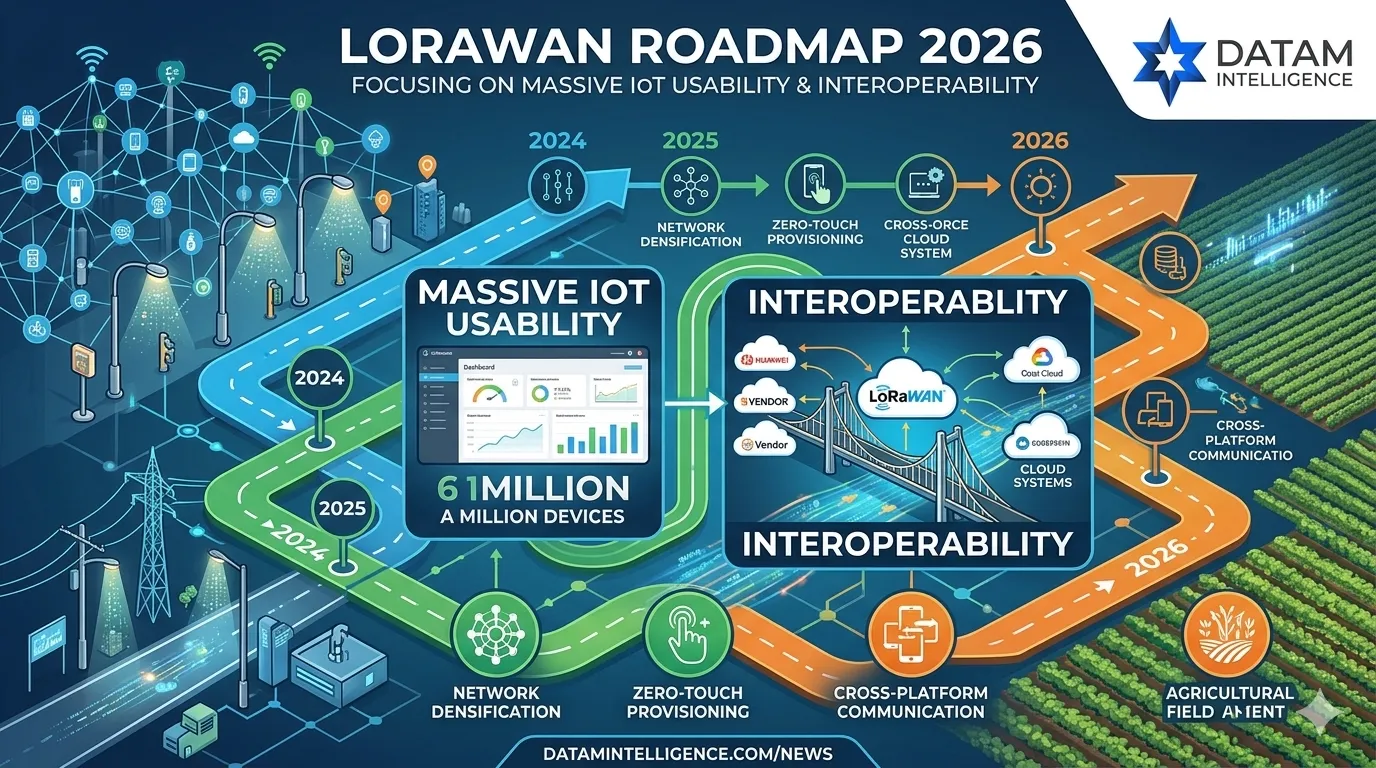
Shift from Connectivity to Usability-Driven IoT Growth
Instead of focusing on incremental improvements in low-power wide-area network (LPWAN) performance, the roadmap emphasizes real-world deployment barriers such as system fragmentation, manual provisioning, and integration complexity.
Key priorities include:
- Zero-touch device onboarding
- Standardized network-to-application APIs
- Unified data payload structures
- Simplified fleet migration between networks
These enhancements aim to significantly reduce deployment time and operational overhead for enterprises deploying IoT at scale.
Enabling Massive IoT Across Industries
The roadmap is strategically aligned with the growing demand for massive IoT applications, including:
- Smart city infrastructure (traffic, lighting, waste systems)
- Industrial automation and Industry 4.0 environments
- Utility monitoring (water, gas, electricity meters)
- Agriculture and environmental sensing
By improving interoperability, LoRaWAN aims to strengthen its position as a fourth pillar of wireless connectivity, alongside cellular networks, Wi-Fi, and Bluetooth ecosystems.
Interoperability and Industrial Integration
A major highlight of the roadmap is deeper integration with industrial protocols such as OPC UA, enabling seamless connectivity between IoT sensors and enterprise-grade industrial systems.
This interoperability layer is expected to:
- Improve data standardization across platforms
- Enable real-time industrial analytics
- Reduce custom integration efforts for enterprises
Additionally, support for utility-focused standards enhances LoRaWAN’s applicability in smart metering and infrastructure monitoring.
Expansion Through Satellite and Mobile Connectivity
The roadmap also expands LoRaWAN’s reach beyond traditional fixed gateways by introducing:
- Satellite-based IoT connectivity support
- Mobile gateways for vehicles and drones
- Infrastructure discovery via DNS-based systems
These capabilities are designed to extend IoT coverage to remote and hard-to-reach environments, improving global scalability.
Security, Analytics, and Network Evolution
Future enhancements include improved:
- Security frameworks with crypto-agility support
- Network analytics APIs for real-time monitoring
- Gateway certification programs
These additions aim to strengthen enterprise confidence in deploying LoRaWAN at scale while ensuring secure and manageable network operations.
Market Impact & Strategic Outlook
The evolution of LoRaWAN highlights a broader industry trend: IoT success is no longer defined by connectivity alone but by system-level usability and integration efficiency.
As enterprises move toward digital transformation, technologies that reduce operational complexity and accelerate deployment cycles are expected to gain competitive advantage in the global IoT landscape.
With competing technologies such as NB-IoT, LTE-M, private 5G, and Wi-Fi 6/7 also evolving rapidly, LoRaWAN’s focus on simplicity and ecosystem maturity positions it strongly in low-power, large-scale IoT deployments.
Strategic Takeaways
- IoT growth is shifting from hardware innovation to system integration efficiency
- Plug-and-play deployment is becoming a key enterprise requirement
- Interoperability is critical for industrial and utility IoT adoption
- Massive IoT demand is driving ecosystem-level standardization
- LoRaWAN is positioning itself as a global scalability enabler for IoT