


Japan Accelerates Strategic Shift Toward AI and Semiconductor Dominance
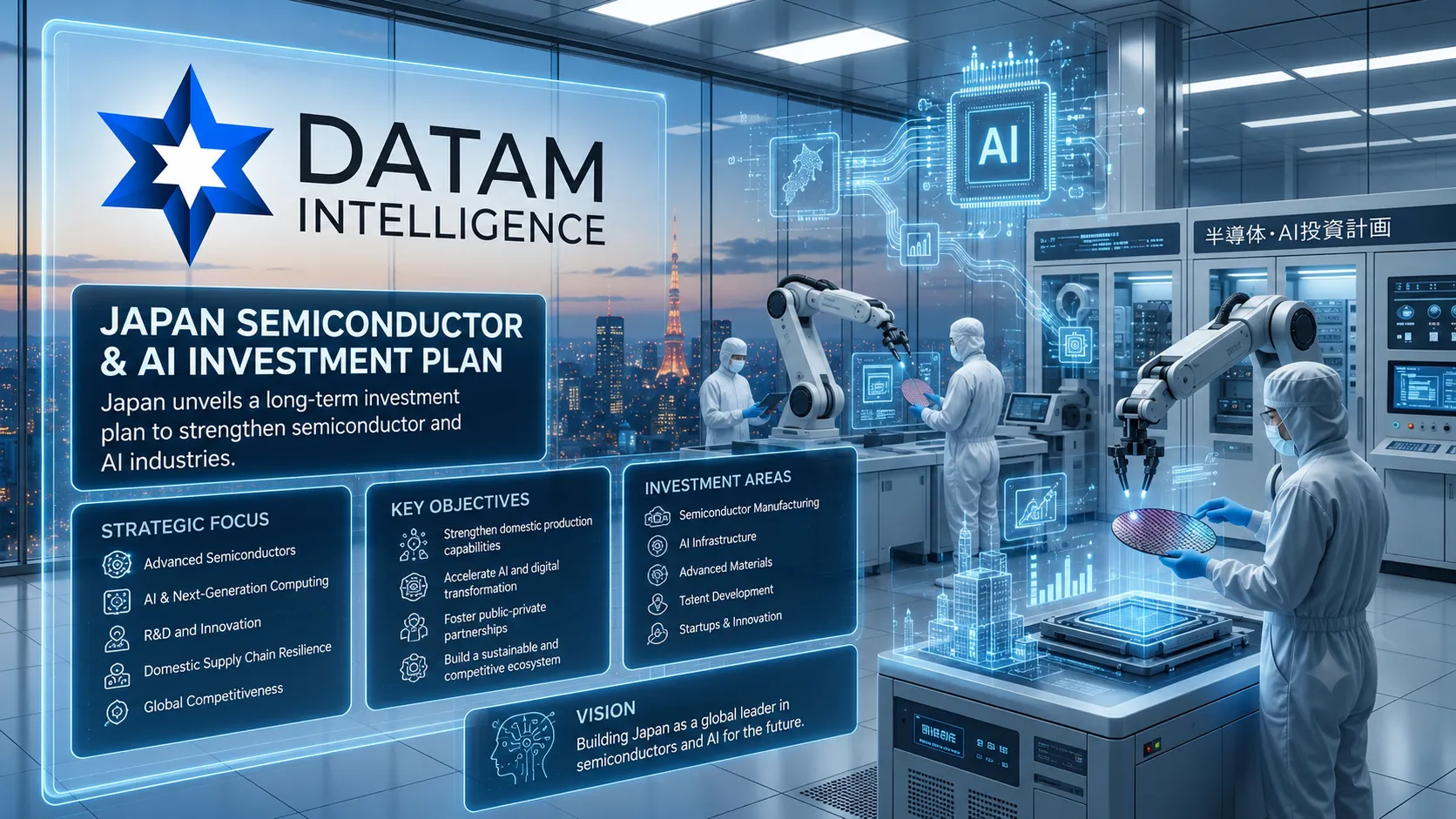
Japan has unveiled an unprecedented 14-year economic roadmap worth approximately $2.3 trillion, targeting structural transformation across 17 strategic industries, with semiconductor and artificial intelligence forming the core investment pillars.
According to the policy framework, more than $600 billion is allocated specifically toward AI systems, semiconductor manufacturing, and advanced digital infrastructure, reflecting Tokyo’s ambition to secure a stronger position in the global technology value chain.
This marks a decisive shift from short-term stimulus cycles to a long-horizon industrial strategy designed to stabilize supply chains, boost domestic chip production, and accelerate AI infrastructure deployment.
Get Your Free Market Intelligence Sample
Make informed decisions with curated insights on semiconductor market dynamics, competitive landscape, and growth projections.
Semiconductor Market Impact: Structural Demand Expansion
The semiconductor market sector is expected to experience multi-decade demand acceleration, driven by:
- AI data center expansion
- Advanced chip fabrication (2nm and below)
- Automotive semiconductor integration
- Defense and aerospace chip demand
- Cloud infrastructure scaling
- Edge AI and industrial automation systems
Industry analysts expect Japan’s policy to strengthen upstream semiconductor ecosystems, including equipment manufacturing, materials science, and advanced packaging technologies.
This aligns with global trends where semiconductor demand is increasingly tied to AI compute infrastructure rather than consumer electronics cycles.
Global Competitive Pressure Intensifies
Japan’s investment roadmap comes at a time when:
- The United States is scaling AI infrastructure investment programs
- South Korea is expanding semiconductor and battery manufacturing capacity
- Taiwan continues to dominate advanced foundry production
- China is accelerating domestic chip self-sufficiency initiatives
This creates a multi-polar semiconductor ecosystem, where regional governments are actively shaping supply chain resilience and technological sovereignty.
The result is expected to be a long-term structural supercycle in semiconductor capital expenditure (CapEx).
Market Forecast: Semiconductor Industry Outlook 2026–2040
From a market research perspective, the semiconductor industry is entering a phase characterized by:
Key Growth Drivers
- AI model scaling (large language models & multimodal systems)
- Hyperscale cloud infrastructure expansion
- Geopolitical supply chain localization
- Automotive electrification and autonomy
- Industrial digital transformation (Industry 4.0)
Strategic Technology Shifts
- Transition to sub-2nm process nodes
- Rise of chiplet-based architectures
- High-bandwidth memory (HBM) expansion
- Advanced semiconductor packaging dominance
- AI-specific accelerator chips (ASICs, GPUs, NPUs)
Business & Investment Implications (Expanded – Professional Analyst View)
For institutional investors, sovereign funds, and B2B stakeholders, Japan’s multi-decade semiconductor and AI investment roadmap represents a structural re-rating event for the entire semiconductor value chain, shifting the industry from cyclical manufacturing economics to a strategic infrastructure asset class anchored by state-level demand certainty.
1. Long-Term Upside in Semiconductor Equipment Suppliers
Semiconductor equipment manufacturers stand to benefit disproportionately as Japan and by extension other leading economies accelerate investment in advanced node fabrication capacity (7nm → 2nm and beyond).
This includes sustained demand across:
- Lithography systems (EUV/DUV scaling requirements)
- Deposition and etching equipment
- Metrology and inspection systems
- Advanced packaging and wafer-level integration tools
Unlike previous cycles driven by consumer electronics demand, the current wave is underpinned by government-backed capacity expansion programs, significantly reducing downside volatility for equipment suppliers.
From an investment standpoint, this creates a multi-year visibility cycle for capex-heavy OEMs, improving earnings predictability and strengthening valuation multiples.
2. Increased Demand for AI Infrastructure Providers
AI has emerged as the primary structural demand driver for semiconductor consumption. Japan’s roadmap accelerates this transition by prioritizing:
- National AI compute clusters
- Sovereign cloud infrastructure
- High-performance data center expansion
- AI-optimized chip deployment at scale
This directly benefits:
- GPU and AI accelerator providers
- Hyperscale cloud platforms
- Data center infrastructure firms
- High-bandwidth memory (HBM) ecosystem players
The implication is a shift in semiconductor demand elasticity, where growth is no longer tied to consumer cycles but to compute intensity expansion driven by AI model scaling laws.
3. Expansion Opportunities in Materials and Chemical Supply Chains
A critical but often underappreciated beneficiary segment is the semiconductor materials and specialty chemicals ecosystem.
Japan’s strong domestic positioning in this segment particularly in photoresists, silicon wafers, and electronic-grade chemicals creates a strategic advantage in:
- Ultra-pure chemical production
- Advanced substrate materials
- Lithography resist innovation
- Specialty gases and process inputs
As fabs migrate toward smaller nodes and higher complexity, material purity requirements increase exponentially, making supply chain resilience and localization a priority.
This creates a durable growth runway for materials suppliers, with higher margin stability compared to downstream chip fabrication cycles.
4. Growth in Fab Construction and Industrial Engineering Services
The scale of planned semiconductor investment will require an extensive buildout of:
- Semiconductor fabrication plants (fabs)
- AI data centers
- Cleanroom infrastructure
- Power and cooling systems
- High-precision industrial facilities
This directly benefits:
- Industrial engineering firms
- Construction conglomerates with high-tech capabilities
- HVAC and cleanroom system providers
- Electrical infrastructure and energy optimization companies
Given the capital intensity and technical specialization required, this segment is expected to experience a multi-year backlog-driven expansion cycle, with strong revenue visibility and recurring project pipelines.
5. Strategic Repricing of Semiconductors as National Infrastructure
Perhaps the most important structural shift is the reclassification of semiconductors from cyclical industrial goods to strategic national infrastructure assets.
Historically, semiconductor markets were characterized by:
- Demand volatility tied to consumer electronics cycles
- Price-driven competition
- Inventory-led boom-bust cycles
However, under current geopolitical and technological conditions:
- AI compute demand is persistent and non-discretionary
- Governments are directly financing capacity expansion
- Supply chain security is a national priority
- Chips are embedded into defense, energy, and industrial systems
This fundamentally changes valuation frameworks across the industry. Semiconductor assets increasingly exhibit characteristics similar to:
- Energy infrastructure
- Telecommunications backbone systems
- Critical national utilities
As a result, investors should expect:
- Lower cyclicality in core semiconductor segments
- Higher long-term capital intensity
- Premium valuations for strategic nodes in the supply chain
- Increased policy-linked upside and downside risk factors
Analyst Insight: Structural Supercycle Confirmed
The semiconductor industry is transitioning from a traditional demand cycle into a state-backed structural supercycle, where:
- Governments act as demand anchors
- AI becomes the primary consumption driver
- Supply chains are geopolitically redistributed
- Capital intensity continues to rise globally
Japan’s $2.3 trillion roadmap reinforces this global trend, positioning semiconductors as the backbone of the next industrial era.
Conclusion
Japan’s long-term semiconductor and AI investment roadmap signals a paradigm shift in global technology economics. The industry is transitioning from a historically cyclical manufacturing sector into a strategically governed, infrastructure-grade ecosystem, where capital allocation is increasingly driven by national security, AI compute demand, and supply chain sovereignty.
For institutional investors, this represents not just a growth opportunity, but a structural re-rating of risk, valuation, and long-term sector classification.
For market participants, the key message is clear:
Semiconductor market growth is no longer just cyclical it is structural, geopolitical, and AI-driven.
News source: https://www.japantimes.co.jp/business/2026/06/24/economy/investment-plan-unveiled-14-years/