


India’s EV Opportunity Could Be Much Bigger Than Investors Realize
India’s electric vehicle (EV) market is entering a transformative growth phase, creating opportunities that extend far beyond automobile manufacturing. As the country accelerates its transition toward cleaner transportation, industry experts believe India could emerge as one of the world’s fastest-growing EV markets over the next decade.
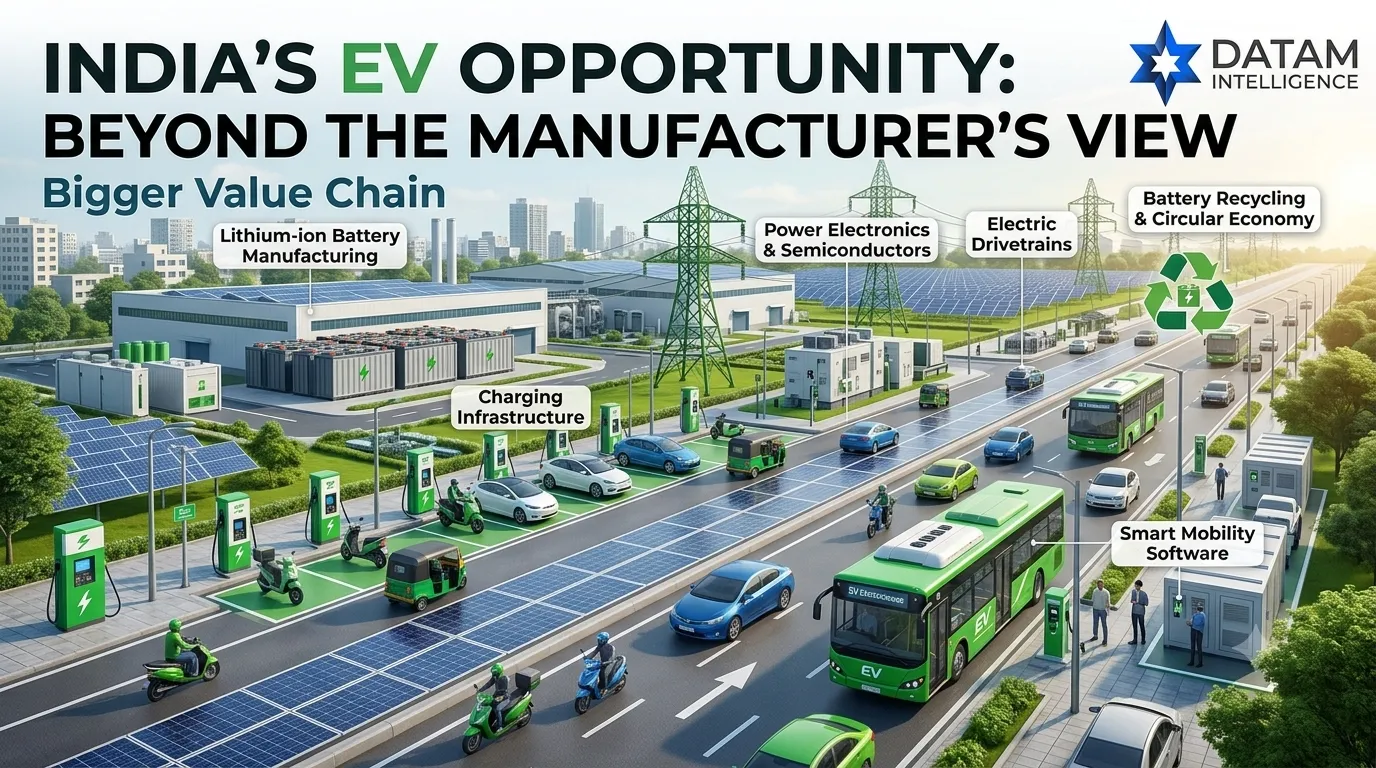
Rising fuel prices, supportive government policies, technological advancements, and increasing consumer awareness are driving unprecedented momentum across the EV ecosystem. While many investors focus primarily on EV manufacturers, the broader value chain including batteries, charging infrastructure, power electronics, software, semiconductors, and advanced materials may offer even larger growth opportunities.
Identify High-Growth Opportunities in India’s Electric Vehicle Market
Explore detailed analysis of India’s Electric Vehicle Market, adoption trends, battery ecosystem developments, charging infrastructure expansion, and key market opportunities shaping India’s future mobility landscape.
According to recent industry observations, India's EV adoption is expanding across multiple vehicle categories, including electric two-wheelers, three-wheelers, passenger vehicles, commercial fleets, and public transportation systems. Government-backed programs such as PM E-DRIVE, Production Linked Incentive (PLI) schemes, and state-level EV policies continue to strengthen domestic manufacturing and infrastructure development.
Three Key Reasons India's EV Market Has Massive Growth Potential
1. Government Policies Are Accelerating EV Adoption
India has established one of the most comprehensive policy frameworks supporting electric mobility among emerging economies. Successive initiatives have encouraged both demand creation and domestic manufacturing.
Programs such as FAME, PM E-DRIVE, and PLI schemes have helped stimulate EV demand while supporting investments in battery production, charging networks, and localization of critical components. Industry leaders believe these policies have laid the foundation for long-term ecosystem growth and increased global competitiveness.
Additionally, government efforts to strengthen domestic battery manufacturing and advanced chemistry cell production are expected to reduce import dependence while improving supply-chain resilience.
2. EV Growth Extends Beyond Vehicle Manufacturers
One of the most compelling aspects of India’s EV opportunity is the size of the surrounding ecosystem.
The transition to electric mobility is expected to generate demand across:
- Lithium-ion battery manufacturing
- Battery management systems
- Power electronics
- Charging infrastructure
- Auto components
- Semiconductor packaging
- Smart mobility software
- Energy storage solutions
- Grid management technologies
Industry experts note that the largest value creation may occur within ancillary sectors supporting EV deployment rather than among vehicle manufacturers alone. As localization increases, suppliers and technology providers are expected to benefit from rising investments and production volumes.
Recent investments in EV charging technology and manufacturing capacity further highlight the growing importance of infrastructure development within India's electric mobility ecosystem.
3. Rising Adoption Is Creating Long-Term Market Momentum
India’s EV adoption curve continues to strengthen across consumer and commercial segments.
Recent market data shows record EV registrations, supported by expanding product availability, improving battery performance, and growing charging networks. Electric two-wheelers remain a major growth driver, while commercial vehicles, electric buses, and urban mobility solutions are gaining traction.
Industry analysts also point to increasing fuel costs and energy security concerns as additional catalysts encouraging EV adoption. As India remains heavily dependent on imported crude oil, electrification offers economic and strategic advantages while supporting sustainability goals.
Recent reports indicate EV registrations reached record levels during 2026, demonstrating growing consumer acceptance and market maturity.
Investment Opportunities Across the EV Value Chain
Investors are increasingly evaluating opportunities across the entire EV ecosystem rather than focusing exclusively on automakers.
Key investment themes include:
- Advanced battery technologies
- EV charging infrastructure market
- Battery energy storage systems
- Power semiconductors
- Electric drivetrain components
- Smart mobility platforms
- Renewable energy integration
- Battery recycling and circular economy solutions
As EV penetration increases, companies providing enabling technologies and infrastructure could experience sustained growth supported by long-term electrification trends.
Challenges Remain, But Long-Term Fundamentals Are Strong
Despite rapid growth, challenges remain. Charging infrastructure expansion, battery supply chains, financing accessibility, after-sales service networks, and technology standardization continue to require investment.
Industry experts emphasize that addressing these challenges will be critical for sustaining adoption momentum and achieving ambitious electrification targets. However, ongoing public and private sector investments suggest these barriers are gradually being addressed.
Analyst Perspective
India’s EV market is evolving into a strategic industrial opportunity that combines clean energy, advanced manufacturing, digital technology, and transportation innovation. With strong policy support, growing consumer demand, and increasing investments across the value chain, the country is positioning itself as a future global electric mobility hub.
For investors, the most significant opportunities may lie not only in EV manufacturers but across the broader ecosystem enabling the transition. As electrification accelerates, companies involved in batteries, charging infrastructure, software, semiconductors, and energy management are expected to play a pivotal role in shaping the next phase of India's mobility transformation.