


U.S. FDA Grants Accelerated Approval to ZENBEXUS for Multiple Myeloma
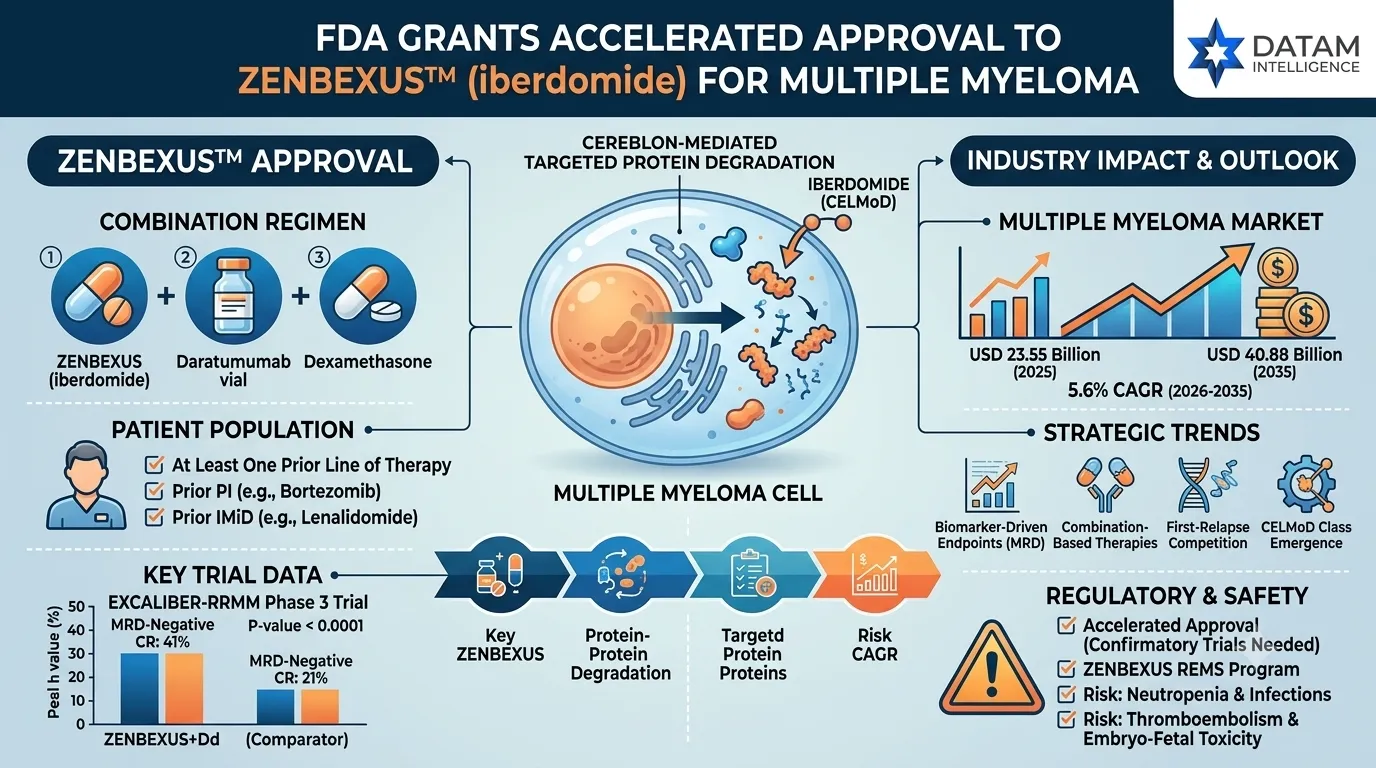
The U.S. Food and Drug Administration (FDA) has granted accelerated approval to ZENBEXUS™ (iberdomide), Bristol Myers Squibb’s first cereblon E3 ligase modulator (CELMoD), in combination with daratumumab and hyaluronidase-fihj and dexamethasone (ZDd) for adults with multiple myeloma who have received at least one prior line of therapy that included a proteasome inhibitor and an immunomodulatory agent.
The August 13, 2026 approval represents a significant development in the multiple myeloma treatment landscape, particularly for patients whose disease has returned following initial therapy. It also introduces the first FDA-approved CELMoD therapy for multiple myeloma, expanding the therapeutic approaches available in relapsed or refractory disease.
Explore the Targeted Protein Degradation Market Report
Gain actionable insights into the rapidly evolving targeted protein degradation landscape, including PROTACs, molecular glues, emerging degradation technologies, therapeutic applications, competitive strategies, regional opportunities, and market forecasts through 2033. Access the full report to support informed business, investment, and R&D decisions. Request a Sample Report Today!
ZENBEXUS Approval Is Based on EXCALIBER-RRMM Results
The FDA's accelerated approval was supported by results from the Phase 3 EXCALIBER-RRMM trial (NCT04975997), which evaluated iberdomide in combination with daratumumab and hyaluronidase-fihj and dexamethasone against daratumumab, bortezomib and dexamethasone in patients with relapsed or refractory multiple myeloma.
Among the primary efficacy population, 41% of patients receiving the ZD d regimen achieved a minimal residual disease (MRD)-negative complete response, compared with 21% for the comparator regimen. The difference was statistically significant, with a p-value below 0.0001.
The FDA identified MRD-negative complete response as the major efficacy outcome supporting the accelerated approval. However, the EXCALIBER-RRMM trial remains ongoing to evaluate progression-free survival, one of the study's dual primary endpoints. Continued approval may therefore depend on verification and description of clinical benefit through confirmatory trials.
Why the First FDA-Approved CELMoD Matters for Multiple Myeloma
CELMoDs represent a newer approach to targeted protein degradation. Iberdomide works through cereblon-mediated protein degradation and is designed to enhance the elimination of proteins involved in the survival and proliferation of myeloma cells.
The arrival of ZENBEXUS is strategically important because multiple myeloma treatment is increasingly moving toward combination-based and mechanism-driven therapies. CAR-T therapies, bispecific antibodies, monoclonal antibodies, proteasome inhibitors and other targeted approaches are reshaping treatment options across different stages of the disease.
For pharmaceutical companies, the approval also highlights the commercial potential of therapies capable of generating deep responses earlier in the treatment journey.
First-Relapse Multiple Myeloma Becomes an Increasingly Competitive Treatment Segment
Treatment selection at first relapse is becoming more complex as patients have already been exposed to multiple therapeutic classes during initial treatment. Recent clinical perspectives emphasize the need to consider disease characteristics, patient factors and the impact of subsequent treatment choices on future options such as CAR-T and T-cell-engaging therapies.
ZENBEXUS enters this evolving environment with an indication that can be used as early as the first relapse, provided patients meet the prior-treatment criteria. This could position CELMoD-based combinations as an increasingly important component of the evolving relapsed or refractory multiple myeloma treatment market.
MRD-Negativity Increasingly Influences Multiple Myeloma Drug Development
One of the most important elements of the ZENBEXUS approval is the use of MRD-negative complete response as the basis for accelerated approval.
MRD testing can detect very small numbers of remaining cancer cells that may not be identified through conventional diagnostic methods. The FDA notes that MRD assessment has become an important measure of treatment response in multiple myeloma, although MRD negativity does not necessarily mean that all cancer cells have been eliminated.
The increasing role of MRD is also influencing clinical development strategies. Drug developers are increasingly evaluating whether deeper responses can translate into improved progression-free survival and potentially longer-term disease control.
From an industry perspective, the ZENBEXUS approval reinforces the importance of biomarker-driven endpoints, measurable disease response and precision treatment strategies in next-generation oncology drug development.
Safety and Regulatory Considerations
ZENBEXUS carries boxed warnings for embryo-fetal toxicity and serious venous and arterial thromboembolism. The therapy is contraindicated during pregnancy and is distributed through the ZENBEXUS Risk Evaluation and Mitigation Strategy (REMS) because of embryo-fetal toxicity risks.
The FDA also identified neutropenia and infections among important safety considerations. In the EXCALIBER-RRMM study, neutropenia and infections were reported at high rates among patients receiving the ZDd regimen, emphasizing the need for appropriate monitoring and risk-management strategies.
Because this is an accelerated approval, the regulatory milestone should be viewed alongside the ongoing confirmatory evidence requirements rather than as the conclusion of the clinical development program.
Impact on the Multiple Myeloma Market
The ZENBEXUS approval arrives as the global multiple myeloma market continues to expand through increased treatment innovation, rising product approvals and the adoption of advanced therapies.
According to DataM Intelligence, the global multiple myeloma market was estimated at approximately USD 23.55 billion in 2025 and is projected to reach USD 40.88 billion by 2035, representing a 5.6% CAGR during 2026–2035. The market is being supported by new treatment combinations, immunotherapy adoption, advanced therapeutic platforms and increasing pharmaceutical R&D activity.
The approval of ZENBEXUS could further intensify competition among innovative therapies targeting relapsed and refractory multiple myeloma. It also strengthens the strategic importance of combination regimens that integrate established treatment mechanisms with newer targeted approaches.
For drug developers and investors, the CELMoD class may therefore become an important area to monitor as additional clinical data emerge and competing CELMoD programs progress through regulatory review.
Competitive Landscape: CELMoDs Add Another Layer to Multiple Myeloma Innovation
Bristol Myers Squibb is not the only company pursuing CELMoD-based strategies. The company has also submitted mezigdomide, another investigational CELMoD, in combination with carfilzomib and dexamethasone for regulatory review, with an FDA Prescription Drug User Fee Act target date of May 13, 2027.
Meanwhile, the broader multiple myeloma market includes established pharmaceutical companies developing CAR-T therapies, bispecific antibodies, monoclonal antibodies, immunomodulators and targeted treatments. DataM Intelligence identifies companies including Bristol-Myers Squibb, Johnson & Johnson, Amgen, Sanofi, Novartis, Pfizer, GSK and others among the major players in the global multiple myeloma market.
This competitive environment is likely to make clinical depth, durability of response, safety, treatment sequencing, administration convenience and market access increasingly important differentiators.
Analyst View
The FDA's accelerated approval of ZENBEXUS represents more than the launch of another multiple myeloma therapy. It signals the commercial and clinical emergence of CELMoDs as a new therapeutic class within an already rapidly evolving oncology market.
The key question for the industry now shifts from regulatory entry to long-term clinical validation and treatment positioning. Confirmation of progression-free survival benefit could strengthen the role of iberdomide-based therapy, while additional CELMoD programs could determine whether the mechanism develops into a broader treatment platform.
For pharmaceutical manufacturers, biotech companies and investors, the development highlights several areas to monitor: the adoption of CELMoDs in earlier treatment lines, competition with CAR-T and bispecific therapies, MRD-guided treatment strategies, combination-regimen development, regulatory acceptance of MRD endpoints and the commercial potential of targeted protein degradation.
What the ZENBEXUS Approval Means for the Industry
For patients: The approval provides an additional treatment option for eligible adults with multiple myeloma after prior therapy.
For pharmaceutical companies: It validates CELMoDs as a commercially relevant therapeutic class and creates opportunities for additional combination strategies.
For investors: The milestone strengthens the importance of targeted protein degradation and next-generation multiple myeloma therapies as areas for pipeline and competitive analysis.
For researchers: The EXCALIBER-RRMM results provide further evidence supporting the investigation of MRD-negative response as an important endpoint in multiple myeloma clinical development.
For the market: The approval adds another innovative therapy to an expanding multiple myeloma treatment ecosystem and may contribute to further competition across treatment classes.
Outlook
ZENBEXUS marks an important milestone in the evolution of multiple myeloma treatment, but its longer-term market impact will depend on confirmatory clinical results, treatment adoption, safety management, competitive launches and positioning within increasingly complex treatment sequences.
As CELMoDs, CAR-T therapies, bispecific antibodies and other next-generation modalities continue to advance, the multiple myeloma market is likely to become increasingly defined by deeper responses, earlier intervention, combination strategies and biomarker-informed treatment decisions.
For companies operating across oncology drug development, commercialization and market access, the ZENBEXUS approval provides another clear indication that innovation in multiple myeloma is shifting toward highly targeted and response-driven treatment platforms.
News source: https://news.bms.com/news/corporate-financial/2026/U-S--FDA-Grants-Accelerated-Approval-to-Bristol-Myers-Squibbs-First-CELMoD-Therapy-ZENBEXUS-in-Combination-with-Daratumumab-and-Hyaluronidase-fihj-and-Dexamethasone-ZDd-for-Patients-with-Multiple-Myeloma-as-Early-as-First-Relapse/default.aspx