


Nickel Market Company Research Insight
The nickel market is split in a way that makes it harder to read than many battery metals. Stainless steel still does much of the heavy lifting. Batteries create the excitement. Indonesia has changed the supply picture. China still shapes processing and downstream demand. Australia and Canada want to remain relevant, but cheaper Indonesian supply has made that difficult.
According to DataM Intelligence, the global Nickel Market reached US$ 39.51 billion in 2025 and is expected to reach US$ 57.94 billion by 2035, growing at a CAGR of 5.5% during 2026 to 2035. The market is segmented by source into pentlandite and laterite, by mining method into underground and surface, by class into Class I and Class II nickel, by application into stainless steel, alloys, plating, foundry, batteries and others, and by end user into metal goods, electric and electronics, engineering, building and construction, transportation and others. Asia Pacific is both the largest and fastest growing region.
The competitive landscape is being shaped by two different demand systems. Stainless steel needs large volumes of nickel, especially Class II products such as nickel pig iron and ferronickel. Battery makers need higher purity nickel units that can move into nickel sulfate and cathode precursor production. A company strong in stainless steel feedstock is not automatically strong in battery grade nickel. That distinction matters.
Indonesia is the biggest competitive force in the market. Its laterite resources, Chinese-backed processing investments and high-pressure acid leach projects have changed the cost curve. The impact has been uncomfortable for higher cost producers elsewhere. Several Australian nickel operations have been pressured by lower prices and supply growth from Indonesia, while some global producers have cut costs, reviewed assets or slowed investment.
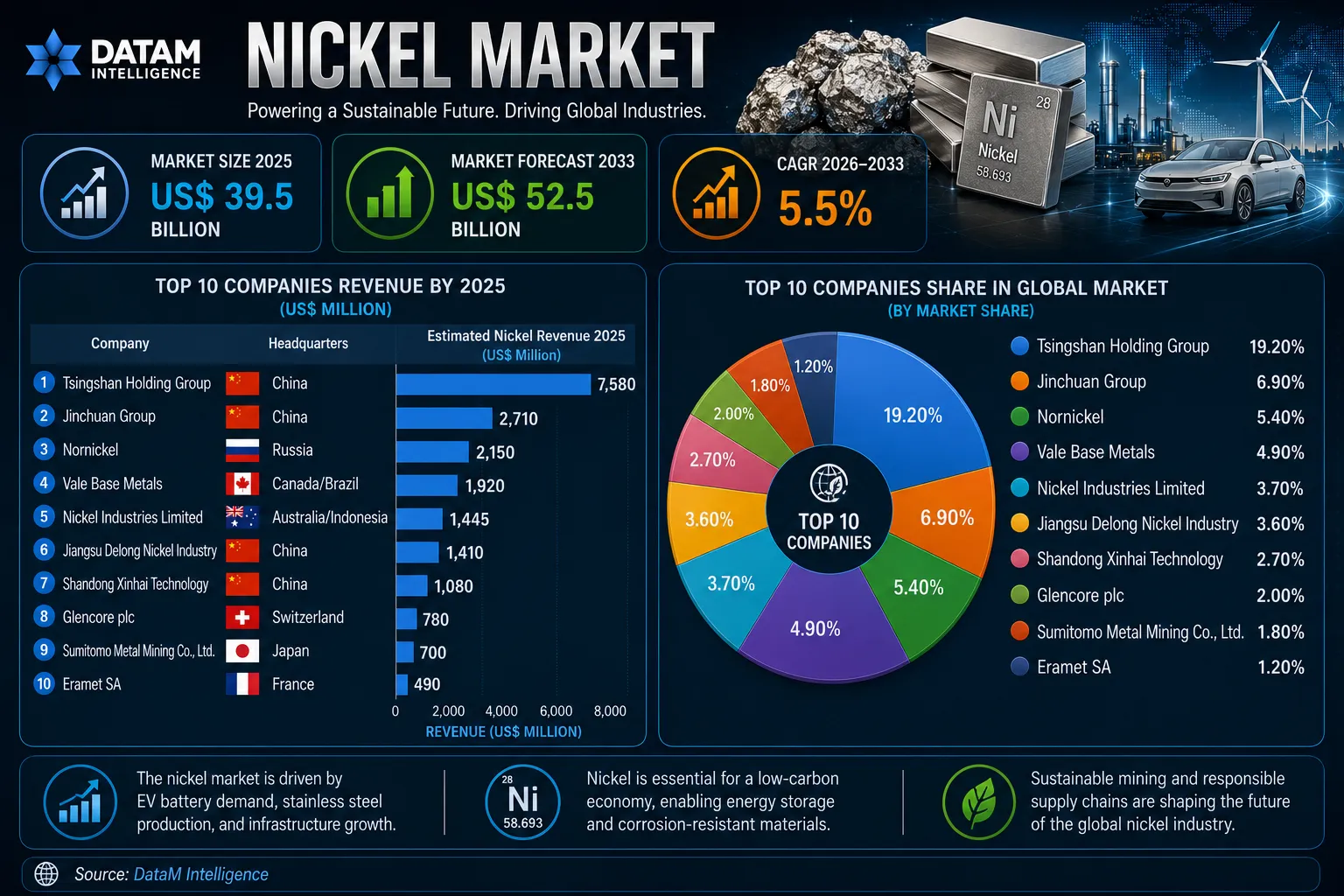
Request For Exclusive Sample: https://www.datamintelligence.com/download-sample/nickel-market
Top 10 Companies Analysis
Tsingshan Holding Group
Tsingshan is arguably the company that changed the modern nickel market. Its Indonesian investments helped scale nickel pig iron, stainless steel feedstock and later battery linked nickel intermediate production. It is difficult to discuss nickel competition without starting here.
The company’s strength is integration. It sits across stainless steel, nickel processing and Indonesian industrial park infrastructure. That gives it a cost and scale advantage many Western producers struggle to match. The downside is scrutiny. Indonesia’s nickel processing boom has faced questions around safety, labor practices, emissions and environmental impact. Scale can win markets, but it also attracts attention.
Vale
Vale remains one of the most important nickel producers globally, with operations linked to Canada, Indonesia and other mining regions. Its nickel position gives it exposure to stainless steel, alloys and battery materials.
Vale’s advantage is resource depth and operating experience. It also has exposure to Indonesia through PT Vale Indonesia, which matters because Indonesia is now central to the global nickel story. In 2025, PT Vale highlighted a year shaped by market volatility, regulatory changes and operational challenges while continuing to push its sustainable nickel strategy in Indonesia.
The company’s challenge is balancing growth with discipline. Nickel demand is attractive, but oversupply can hurt even strong producers.
Norilsk Nickel
Norilsk Nickel, or Nornickel, is one of the world’s largest producers of nickel and palladium. Its nickel production is tied to integrated operations in Russia, giving it a deep resource base and a strong role in Class I nickel supply.
The company matters because Class I nickel is important for batteries, alloys and high-performance applications. It also has a cost structure supported by product credits from copper, palladium and other metals. That helps.
The difficult part is geopolitics. Russian supply remains important, but sanctions exposure, buyer caution and compliance concerns can affect market access. Nornickel remains a major producer. It is also a complicated supplier for some Western customers.
BHP
BHP has long been a major nickel name through its Nickel West operations in Australia. Its position has been more exposed recently because Australian nickel has faced pressure from lower-cost Indonesian production.
This is a good example of how quickly nickel economics can change. A strategic battery metal can still become financially painful when supply growth overwhelms the market. BHP’s nickel business has gone through restructuring pressure, and the company has reviewed options in response to weak market conditions.
BHP’s strength is balance sheet and mining discipline. Its challenge is cost competitiveness. Battery demand alone does not protect high-cost production.
Glencore
Glencore is relevant in nickel through assets such as Murrin Murrin in Australia, as well as its broader metals trading and supply chain reach. It is not simply a nickel miner. It is also a market operator.
That matters when prices move. Glencore understands primary supply, refining, customer flows and trading. Its flexibility is useful in a market where stainless steel demand, battery demand and Indonesian supply can pull in different directions.
Still, even Glencore is not immune to margin pressure. Its Murrin Murrin operation faced job cuts in 2025 amid low output, high costs and nickel prices below US$15,000 per tonne. That says a lot about the current nickel environment.
Jinchuan Group
Jinchuan Group is one of China’s major nickel and cobalt producers and refiners. Its importance comes from China’s role in stainless steel, battery materials and industrial metals.
Jinchuan has refining scale and strong links to Chinese demand. That gives it a practical advantage because China remains one of the largest downstream users of nickel, both through stainless steel and battery supply chains.
The company’s position is less about global branding and more about industrial integration. In nickel, that often matters more.
Sumitomo Metal Mining
Sumitomo Metal Mining is an important Japanese nickel and battery materials company. It has long experience in nickel refining and supplies high-quality materials for battery and industrial applications.
Its advantage is technical discipline. Battery customers care about quality, purity and consistency, and Japanese suppliers have built strong reputations in this area. Sumitomo’s position is especially relevant where nickel materials need to meet demanding battery or electronics standards.
It is not the lowest cost player in the market. That is probably not its aim. Its value sits in reliability and customer trust.
Eramet
Eramet is important through its nickel operations in New Caledonia and Indonesia-linked exposure. The company sits at the intersection of traditional nickel mining and the new Indonesian-led supply chain.
Its strength is geographic exposure and technical experience. Its challenge is the pressure facing higher-cost operations, especially when nickel prices weaken. New Caledonia has long been important in nickel, but the global cost curve has shifted.
Eramet remains relevant because nickel supply is not only about Indonesia. Buyers still want diversified sources, but those sources need to be commercially resilient.
South32
South32 has nickel exposure through its Cerro Matoso operation in Colombia, which produces ferronickel. That makes the company more connected to stainless steel than battery grade nickel.
This is an important distinction. Not all nickel exposure is battery exposure. Ferronickel and Class II supply are essential for stainless steel, and stainless steel remains the largest demand base for nickel. South32’s position is useful because industrial demand still matters.
Its risk is that battery focused investors may overlook it. That may be unfair. The nickel market still needs stainless steel suppliers.
Nickel Industries
Nickel Industries has become more important because of its Indonesian nickel exposure and partnership links in the region. The company is tied to nickel pig iron, matte and battery material related growth through Indonesian processing projects.
Its appeal is direct exposure to the part of the market that has changed the global supply curve. Indonesia is where much of the new supply growth is happening, and Nickel Industries sits close to that shift.
The risk is concentration. Indonesia offers scale and cost advantages, but it also brings policy, environmental and ESG scrutiny. For investors and buyers, that trade off is becoming more visible.
Competitor Analysis: Top Nickel Market Players
| Company | Core Position | Strategic Focus | Main Demand Exposure | Competitive Strength |
Tsingshan Holding Group | Integrated stainless steel and nickel processing group | Indonesian nickel processing and stainless steel supply | Stainless steel, nickel pig iron, battery intermediates | Scale, cost position and Indonesia integration |
| Vale | Global nickel producer with Canada and Indonesia exposure | Battery metals, stainless steel feedstock and sustainable nickel | Batteries, stainless steel, alloys and industrial users | Resource depth and operating experience |
| Norilsk Nickel | Russian nickel and palladium producer | Class I nickel and integrated base metals supply | Batteries, alloys, stainless steel and industrial metals | Resource depth and by product economics |
| BHP | Australian nickel producer through Nickel West | Battery grade nickel and critical minerals exposure | Batteries, stainless steel and industrial users | Balance sheet strength and mining discipline |
| Glencore | Nickel producer, refiner and trader | Nickel supply, trading and multi metal exposure | Batteries, alloys, stainless steel and industrial users | Trading reach and flexible market access |
| Jinchuan Group | Chinese nickel and cobalt producer and refiner | Nickel refining and China industrial supply | Stainless steel, batteries and industrial metals | Refining scale and domestic demand integration |
Sumitomo Metal Mining | Japanese nickel refiner and battery materials supplier | High quality nickel materials and battery supply | Batteries, electronics and industrial applications | Technical reliability and customer trust |
| Eramet | Nickel producer with New Caledonia and Indonesia exposure | Ferronickel, nickel ore and battery linked growth | Stainless steel and battery materials | Geographic exposure and mining experience |
| South32 | Ferronickel producer through Cerro Matoso | Stainless steel linked nickel supply | Stainless steel and industrial applications | Ferronickel expertise and diversified mining base |
| Nickel Industries | Indonesia focused nickel producer | Nickel pig iron, matte and battery material intermediates | Stainless steel, batteries and downstream processing | Indonesia exposure and processing partnerships |
Request for Exclusive Sample: https://www.datamintelligence.com/download-sample/nickel-market
The table shows why nickel competition cannot be simplified into a battery ranking. Tsingshan, Nickel Industries and several Indonesia-linked players are reshaping the supply curve. Vale, Nornickel, BHP and Glencore carry older scale and technical depth. Jinchuan and Sumitomo sit closer to refining and downstream material quality. South32 and Eramet remind the market that stainless steel still matters.
Who Are Other Companies Influencing the Market?
Several other companies influence the nickel market even if they are not always in the top tier. Anglo American has been reducing exposure, including the sale of its nickel business for up to US$500 million to MMG Singapore Resources, a China-backed MMG unit, as part of a broader portfolio reshaping toward copper and iron ore.
Sherritt International remains relevant through laterite processing experience and mixed sulfide technology. Terrafame matters in Europe because it produces nickel and cobalt chemicals used in battery supply chains. IGO Limited and Wyloo Metals influence the Australian nickel story, especially as the country tries to maintain a place in battery metals despite price pressure. Wyloo’s FY25 reporting showed renewed interest in nickel and rare earth projects despite the market being pressured by Indonesian supply growth.
MMG is becoming more visible through acquisitions and a China-linked global mining strategy. PT Vale Indonesia, separately from Vale’s global profile, is important because Indonesia’s nickel policy and processing capacity are changing the entire industry. Battery and cathode companies such as CATL, BYD, LG Energy Solution, Samsung SDI, Huayou Cobalt and CNGR also influence the market because their chemistry choices and precursor demand shape nickel sulfate requirements.
What Is Driving Competition in the Market?
Indonesia’s laterite resources and processing investments have created large volumes of nickel products for stainless steel and, increasingly, battery-linked intermediates. This has lowered costs, increased supply and pressured producers in Australia, New Caledonia and other higher cost regions. It has also changed buyer expectations around price.
Stainless steel is the second force. It is less fashionable than batteries, but it still sets the demand floor. Class II nickel, nickel pig iron and ferronickel remain critical for stainless steel production.
Battery demand is the primary market driver, but it comes with caveats. High nickel cathodes can improve EV range and performance. Yet LFP batteries continue to gain share in cost-sensitive segments, which limits the idea that every EV automatically drives high nickel demand. Battery nickel is still attractive. It is just more selective than the early market hype suggested. Class I nickel, nickel sulfate and precursor materials are not the same as ferronickel or nickel pig iron. Battery makers need purity, consistency and qualification. This favors companies with refining capability and strong customer relationships.
ESG pressure is becoming harder to ignore. Indonesia offers cost and scale, but questions around emissions, tailings, safety and labor practices are rising. FT reporting on the Indonesia Morowali Industrial Park described serious safety and labor concerns at the world’s largest nickel processing site, showing the human and environmental scrutiny now attached to rapid nickel expansion.
The next phase of competition will favor companies that can manage cost without losing customer trust. Cheap supply matters. So does clean supply, reliable supply, and battery-qualified supply. Nickel looks like a growth market, but it is also one of the toughest critical minerals markets to navigate.
Read Complete Research Report: https://www.datamintelligence.com/research-report/nickel-market