

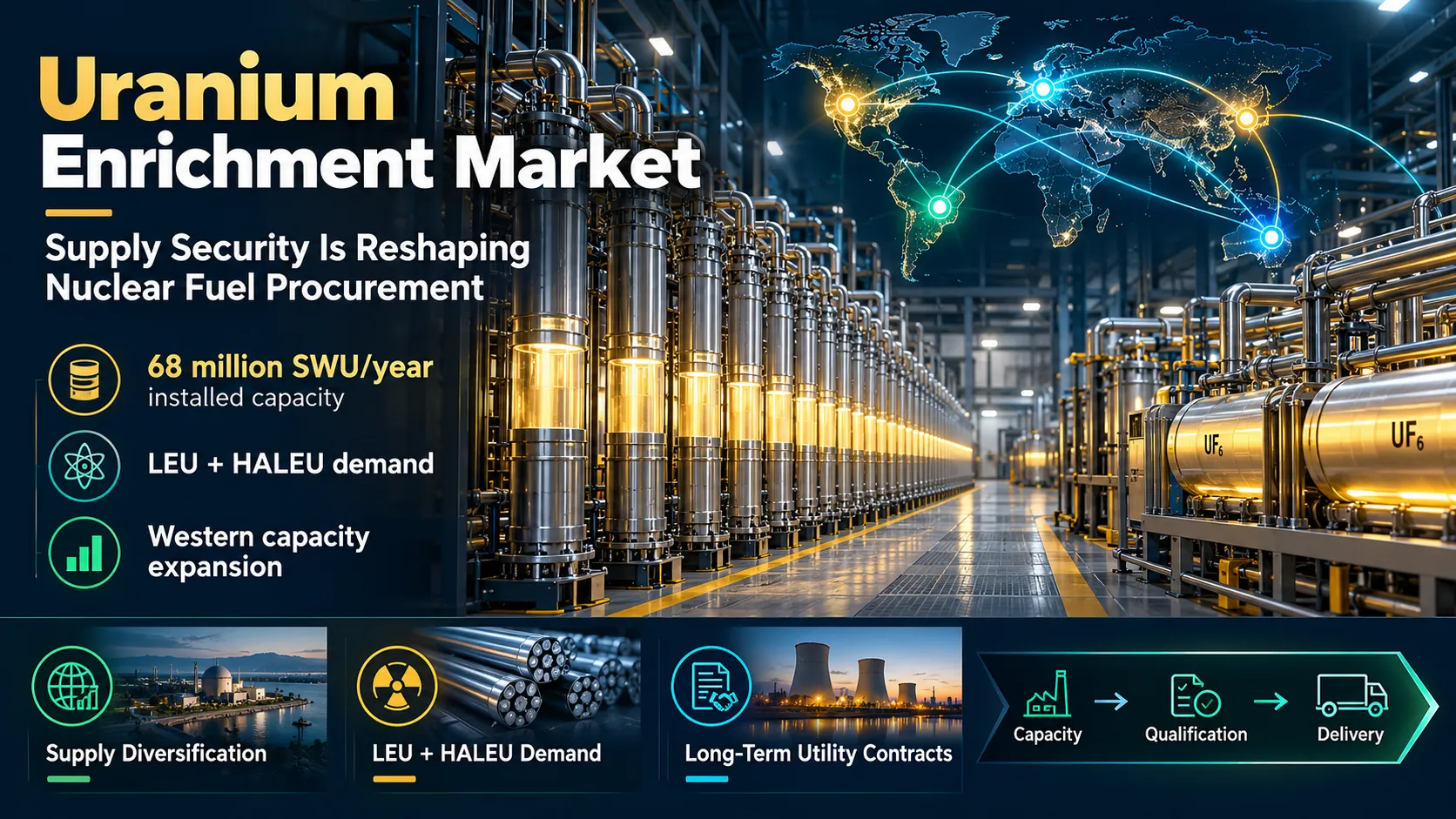
The uranium enrichment market is shifting from a concentrated nuclear-fuel service business toward a strategic supply-security industry. Utilities are reassessing origin of supply, delivery certainty, inventory requirements and long-term separative work unit (SWU) contracts. New nuclear construction, reactor life extensions and advanced-reactor fuel plans are increasing interest in Western enrichment capacity, although new facilities require years of investment, licensing and qualification.
The World Nuclear Association estimates global installed enrichment capacity at approximately 68 million SWU per year in 2025. Rosatom/TENEX, Urenco, Orano and China National Nuclear Corporation (CNNC) dominate existing industrial capacity. The market is more concentrated than the broader uranium mining or nuclear fuel services sector. Urenco reported an average enrichment spot-market price of approximately US$200 per SWU at the end of June 2026, an indicator of contracting conditions rather than a forecast of realized company pricing.
Industry leaders emphasize supply resilience. Announcing the June 2026 U.S. expansion, Urenco CEO Boris Schucht said the investment would reinforce “a resilient U.S. nuclear fuel supply chain.” Centrus President and CEO Amir Vexler described new advanced-reactor demand in September as “real and it is accelerating.” These statements illustrate why buyers increasingly value credible delivery schedules and qualified domestic production alongside nominal enrichment capacity.
Request Exclusive Sample: https://www.datamintelligence.com/download-sample/uranium-enrichment-market
Top 10 Companies Analysis
Rosatom / TENEX
Russia-based TENEX markets enrichment and other nuclear fuel-cycle services backed by Rosatom’s large industrial base. The company remains among the largest installed enrichment suppliers globally, but trade restrictions, sanctions exposure and utility diversification plans create uncertainty for future Western contracting. 2025 enrichment-specific revenue is not independently disclosed in a comparable public format.
Urenco Group
Urenco operates enrichment facilities in the United Kingdom, Germany, the Netherlands and United States. FY2025 revenue was approximately US$2.37 billion, converted from its published EUR2.096 billion. Its June 2026 U.S. capacity announcement plus October commissioning of a sixth expansion cascade position Urenco as a leading near-term source of Western supply. The competitive advantage is an established multi-country operating base.
Orano
France-based Orano operates the Georges Besse II enrichment complex and provides broader front-end and back-end nuclear services. Group FY2025 revenue was approximately US$5.81 billion, converted from EUR5.138 billion; the group-wide figure is not enrichment-only. Orano’s planned enlargement of its French enrichment assets is strategically important for European supply autonomy, but the ultimate value depends on delivery schedules and customer contracting.
China National Nuclear Corporation (CNNC)
CNNC supports China’s expanding reactor fleet with domestic fuel-cycle capacity and is developing a broader international supply position. China represents one of the largest areas of planned enrichment-capacity expansion. An independently comparable FY2025 enrichment revenue figure is unavailable; broader group revenues would not be an appropriate proxy for this market.
Centrus Energy
Centrus supplies low-enriched uranium and SWU through commercial transactions while pursuing U.S. domestic centrifuge manufacturing and high-assay low-enriched uranium (HALEU) capacity. Its FY2025 total revenue was US$448.7 million, including US$346.2 million from its LEU segment. The June 2026 DOE contract and subsequent customer agreements strengthen its pipeline, although new commercial-scale production remains a development effort.
Global Laser Enrichment (GLE)
GLE is a U.S.-based development venture owned by Silex Systems (51%) and Cameco (49%). It plans a laser-based enrichment facility at Paducah, Kentucky and had not begun commercial output by October 2026. Its September 2026 offtake arrangement with Cameco is an important future commercialization milestone; no standalone commercial enrichment revenue was reported for 2025.
Japan Nuclear Fuel Limited (JNFL)
JNFL operates Japan’s domestic enrichment activities at Rokkasho within its broader nuclear fuel-cycle role. Its strategic relevance lies in Japan’s effort to preserve national fuel-supply capability and reduce reliance on overseas suppliers. Japan’s enrichment scale is substantially below the leading global players and a directly comparable 2025 enrichment-only revenue figure is not available.
Indústrias Nucleares do Brasil (INB)
Brazilian state-controlled INB participates in the national nuclear fuel cycle and domestic uranium enrichment program serving Brazil’s reactor requirements. Its competitive relevance is national supply sovereignty rather than export-scale SWU competition. The public disclosure does not offer a comparable 2025 enrichment-only revenue measure.
Silex Systems
Silex is the technology developer and majority owner of GLE, rather than a current seller of commercial enrichment output. Its 2025 financial-year revenue from external customers was approximately US$4.8 million based on its Australian-dollar accounts and indicative currency conversion. Its strategic value lies in potential royalties and commercialization milestones rather than present SWU sales.
Cameco Corporation
Cameco supplies uranium and fuel services and owns 49% of GLE; it is included as a future enrichment commercialization partner, not as an independent operating enrichment plant. Its FY2025 consolidated revenue was approximately US$2.5 billion, converted from C$3.482 billion, and is not enrichment revenue. The September 2026 exclusive offtake agreement could position Cameco as a future distribution and marketing channel for GLE output.
Competitor Analysis: Leading Uranium Enrichment Market Participants
| Company | 2025 Revenue (USD) | Revenue scope | Strategic position |
| Rosatom / TENEX | Not separately disclosed | Operating enrichment supplier | Industrial scale; Russian supply exposure |
| Urenco | US$2.37bn approx. | Group; primarily enrichment and related activities | Four-country supply network |
| Orano | US$5.81bn approx. | Broader nuclear fuel-cycle group | French capacity expansion |
| CNNC | Not comparable publicly | State-owned nuclear group | Domestic Chinese expansion |
| Centrus | US$448.7m | Group; US$346.2m LEU segment | Domestic LEU/HALEU development |
| GLE | No commercial SWU revenue | Pre-commercial joint venture | Planned laser enrichment |
| JNFL | Not separately disclosed | Integrated Japanese fuel-cycle operator | Domestic fuel security |
| INB | Not separately disclosed | Brazilian state fuel-cycle entity | National fuel cycle |
| Silex Systems | US$4.8m approx. | Technology developer; FY to June 2025 | GLE licensing and IP |
| Cameco | US$2.5bn approx. | Uranium/fuel services group | GLE offtake partner |
Request Exclusive Sample: https://www.datamintelligence.com/download-sample/uranium-enrichment-market
2025 revenues are stated in USD. Translations from EUR, CAD and AUD are approximate using rounded 2025 exchange rates. Group figures and fuel-cycle segment figures must not be interpreted as enrichment-only sales or as a market-share ranking.
Who Are the Rising Companies Influencing the Market?
- Global Laser Enrichment - Strategic focus: advance its Paducah laser-enrichment project toward licensed, commercial production through a Cameco offtake structure.
- Centrus Energy - Strategic focus: scale U.S. centrifuge manufacturing and secure long-term HALEU/LEU contracts for existing and advanced reactors.
- Silex Systems - Strategic focus: commercialize licensed laser-enrichment intellectual property through GLE rather than compete as an operating fuel supplier.
- New Western nuclear-fuel entrants - Strategic focus: establish financing, licensing and qualified fuel-cycle partnerships before attempting industrial-scale enrichment supply.
Major Mergers, Acquisitions and Portfolio Restructuring - 2026
- 2 June 2026 - Urenco announced a multibillion-dollar U.S. expansion program that would increase the New Mexico facility’s enrichment capacity by nearly 50%. This is an organic capital investment, not an acquisition.
- 18 June 2026 - Centrus and Oklo announced a letter of intent for future HALEU supply supporting planned advanced-reactor deployments. The agreement is a prospective commercial supply arrangement.
- 30 June 2026 - Centrus subsidiary American Centrifuge Operating signed a US$900 million DOE contract for domestic HALEU enrichment capacity. This is a government procurement contract, not M&A.
- September 2026 - GLE and Cameco executed an exclusive offtake arrangement for expected future output from the proposed Paducah project. Their existing ownership interests remained unchanged.
No verified large-scale merger or completed acquisition among the four dominant enrichment operators was identified during the June–October 2026 period covered here. Expansion, offtake and long-term procurement contracts were the more significant publicly documented developments.
Recent Innovations and Their Potential Impact - June to October 2026
- 22 June 2026 - Urenco’s fifth U.S. expansion centrifuge cascade began production, announced 29 June. Impact: additional operational Western SWU supply can reduce near-term concentration risk and support contracted utility requirements.
- 5 August 2026 - Centrus reported progress toward a first newly manufactured centrifuge expected by the end of 2026. Impact: rebuilding domestic equipment production is a step toward future U.S. enrichment capacity, although the new expansion was not yet commercially operating.
- September 2026 - GLE and Cameco finalized future Paducah offtake terms while the laser-enrichment project remained in licensing and demonstration. Impact: commercial risk-sharing may support financing for a prospective alternative technology route.
- 8 October 2026 - Urenco USA started its sixth expansion cascade, lifting completion of its current installation program to roughly 75%. Impact: verified operational milestones add confidence to delivery timetables and utility contract execution.
What Is Driving Competition in the Market?
Supply diversification is becoming the central procurement issue. Russian-origin enrichment has historically accounted for substantial global capacity, but Western utilities increasingly seek alternative contracted supply. New procurement therefore prioritizes origin, regulatory eligibility, delivery performance and inventory risk alongside SWU pricing. Additional capacity will not eliminate tightness immediately because long engineering and licensing cycles separate announcements from commercial deliveries.
Advanced reactor fuel requirements create a second competitive layer. LEU remains the main market for operating reactors, while HALEU is emerging as a contracted niche tied to the commissioning plans of advanced nuclear developers. Producers that secure dependable orders and government-supported financing are better positioned to build facilities, but prospective project capacity should not be confused with currently available SWU output.
Through 2035, winning strategies will combine deliverable capacity, reliable operating history, multi-year utility contracts and geographically diverse supply. Established producers hold the advantage today, while GLE and expanding U.S. entrants could reshape the market only after meeting financing, licensing and commercialization milestones.