


Uranium Conversion Market Size and Overview
The global Uranium Conversion market reached USD 1.2 billion in 2025 and is expected to reach USD 2.1 billion by 2035, growing with a CAGR of 5.8% during the forecast period 2026-2035. The market is expanding steadily due to the increasing requirement of uranium feedstock by the growing number of nuclear reactors across the globe and due to investment in the nuclear fuel cycle infrastructure.
According to the World Nuclear Association, the total consumption of uranium feedstock by nuclear reactors across the globe was 68,920 tonnes in the year 2025, whereas, according to the International Atomic Energy Agency (IAEA), there were 420 operational nuclear reactors across the globe in the same year, leading to the continuous demand for uranium conversion. In 2025, Orano's Philippe Coste uranium conversion plant in France manufactured more than 12,000 metric tons of UF₆, thus strengthening Western uranium conversion capabilities, whereas ConverDyn restarted its operation in the Metropolis Works uranium conversion facility in the United States.
In September 2025, according to the U.S. Securities and Exchange Commission (SEC), Uranium Energy Corp. (UEC) announced the launch of its wholly owned subsidiary, United States Uranium Refining & Conversion Corp. (UR&C), which will create a cutting-edge uranium refining and UF₆ conversion plant in the U.S. The plant will be designed to operate with an initial capacity of about 10,000 metric tonnes of uranium (MtU) per year in UF₆, accounting for a considerable share of U.S. annual conversion demand, estimated at 18,000 MtU. At the same time, it should be mentioned that the **UF₆ conversion spot prices stood at around US$64–66/kgU, whereas the contract prices amounted to around US$52/kgU, due to limited conversion capacity worldwide.
White-Space Opportunities for the Uranium Conversion Market Through DOE Nuclear Fuel Cycle Investments
In July 2026, the DOE Nuclear Fuel Cycle Consortium, established under the U.S. Department of Energy's Defense Production Act program, is creating broad investment opportunities across the U.S. nuclear fuel cycle by enabling access to approximately US$17.5 billion in financing through the U.S. Department of Energy's Loan Programs Office (LPO). Rather than targeting a single segment, the initiative prioritizes investments in the front-end nuclear fuel cycle, with the highest funding focus on uranium enrichment and domestic fuel supply chain expansion, as these remain the most critical bottlenecks for supporting existing reactors and the deployment of advanced reactors and SMRs. Significant investment opportunities also extend to uranium conversion, uranium mining and milling, HALEU production, fuel fabrication, deconversion, recycling, transportation infrastructure, and nuclear component manufacturing. The availability of low-cost federal financing is expected to accelerate the construction of new fuel cycle facilities, the modernization of existing plants, the commercialization of advanced fuel technologies, and the expansion of domestic production capacity, thereby reducing U.S. dependence on foreign nuclear fuel suppliers and strengthening long-term energy security.
The consortium's financing framework is expected to benefit companies across multiple areas of the nuclear fuel value chain. Uranium enrichment developers such as Centrus Energy, Orano Federal Services, Urenco USA, and General Matter are well-positioned to secure funding to expand LEU and HALEU enrichment capacity. Uranium conversion companies, including ConverDyn and Orano Conversion, are expected to benefit from investments supporting new and expanded UF₆ conversion infrastructure required to supply enrichment facilities. Uranium mining and milling companies such as Uranium Energy Corp. (UEC), Energy Fuels, enCore Energy, and Cameco are likely to receive increased investment opportunities to strengthen domestic uranium feedstock availability. Nuclear fuel fabrication companies including Westinghouse Electric Company, Framatome, BWX Technologies, and Global Nuclear Fuel (GNF) are expected to benefit from expanded fuel manufacturing capacity for conventional and advanced reactors. In addition, advanced reactor developers such as TerraPower, X-energy, Kairos Power, and Oklo are positioned to benefit indirectly through improved access to domestically produced nuclear fuel, while engineering, construction, and infrastructure firms supporting nuclear fuel cycle projects are expected to experience increased demand as the US$17.5 billion financing initiative advances commercialization across the U.S. nuclear industry.
Uranium Conversion Market Key Takeaways
- Europe led the global uranium conversion market with a $37.8% market share in 2025. To enhance fuel supply security, the region approved the $€9.03 million EU-CONVERSION project, supported by $€7.64 million in EU funding.
- Global uranium hexafluoride () conversion spot prices reached approximately due to limited global capacity. In contrast, long-term contract prices for uranium conversion stood at around .
- The U.S. Department of Energy's Loan Programs Office is facilitating access to approximately in financing. This initiative prioritizes front-end nuclear fuel cycle investments, including enrichment, conversion, and domestic supply chain expansion.
- The annual U.S. uranium conversion demand is estimated at 18,000 metric tonnes of uranium (). To help meet this requirement, UR&C announced plans for a plant with an initial capacity of 10,000 per year.
Uranium Conversion Market Industry Trends and Strategic Insight
- Western countries are expanding domestic uranium conversion capacity to reduce geopolitical supply risks. Governments and nuclear fuel suppliers are prioritizing investments in domestic UF₆ conversion infrastructure following disruptions in Russian nuclear fuel trade.
- Capacity utilization at existing conversion facilities is increasing as utilities secure long-term conversion contracts. Major conversion providers are ramping up production to address tightening supply.
- The uranium conversion market is evolving from a commodity processing business into a strategic energy security asset. National governments increasingly classify conversion services as critical infrastructure because limited commercial conversion facilities represent a key bottleneck within the nuclear fuel cycle.
- Advanced reactor deployment is reshaping conversion service requirements. Growing commercialization of Small Modular Reactors (SMRs) and Generation IV reactors is increasing demand for conversion services that support LEU+ and HALEU fuel production.
- Supply chain diversification is creating opportunities for new conversion capacity outside traditional suppliers. The uranium conversion industry remains concentrated among a limited number of commercial facilities, prompting governments and private companies to evaluate additional conversion projects.
Uranium Conversion Market Scope
| Metrics | Details | |
| 2025 Market Size | USD 1.2 Billion | |
| 2035 Projected Market Size | USD 2.1 Billion | |
| CAGR (2026-2035) | 5.8% | |
| Largest Market | Europe | |
| Fastest Growing Market | Asia-Pacific | |
| By Product Type | Uranium Hexafluoride (UF₆), Uranium Dioxide (UO₂), Uranium Tetrafluoride (UF₄), Other Uranium Conversion Compounds | |
| By Conversion Process | Dry Conversion Process, Wet Conversion Process | |
| By Application | Uranium Enrichment Feedstock, Nuclear Fuel Fabrication, Research Reactor Fuel, Defense & Strategic Nuclear Programs, Radioisotope & Medical Isotope Production, Others | |
| By Region | North America | U.S., Canada, Mexico |
| Europe | Germany, UK, France, Spain, Italy, Poland | |
| Asia-Pacific | China, India, Japan, Australia, South Korea, Indonesia, Malaysia | |
| Latin America | Brazil, Argentina | |
| Middle East and Africa | UAE, Saudi Arabia, South Africa, Israel, Türkiye | |
| Report Insights Covered | Competitive Landscape Analysis, Company Profile Analysis, Market Size, Share, Growth | |
Uranium Conversion Market Disruption Analysis
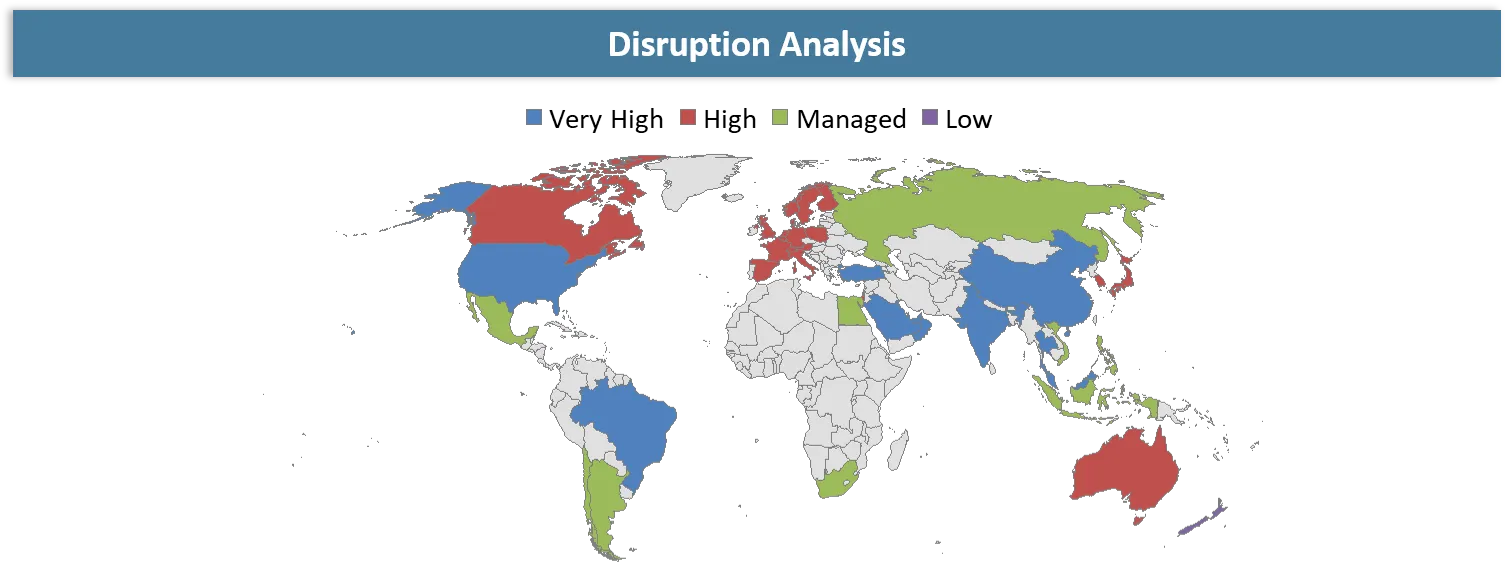
Geopolitical Realignment and Domestic Fuel Cycle Investments Reshaping the Uranium Conversion Landscape
The uranium conversion market is being reshaped by the strategic diversification of the global nuclear fuel supply chain as utility and government reliance on Russian conversion services declines. This trend will expedite capacity growth and long-term agreements and investments into Western conversion services. In 2026, the European Investment Bank (EIB) provided a loan of €400 million in support of the expansion of the uranium enrichment capacity at Orano's Georges Besse II facility, reinforcing the integration of the front end of the European nuclear fuel value chain and increasing the demand for upstream conversion services.
In 2026, ConverDyn revealed plans to assess another uranium conversion facility, "Metropolis 2.0," in addition to expansion of the current Metropolis Works facility to satisfy future conversion needs. The changes are leading to a strategic protection approach for uranium conversion, with region-specific capacity building, resilient supply chains, and fuel cycle investments being the main competitive forces.
Uranium Conversion Market BCG Matrix: Company Evaluation
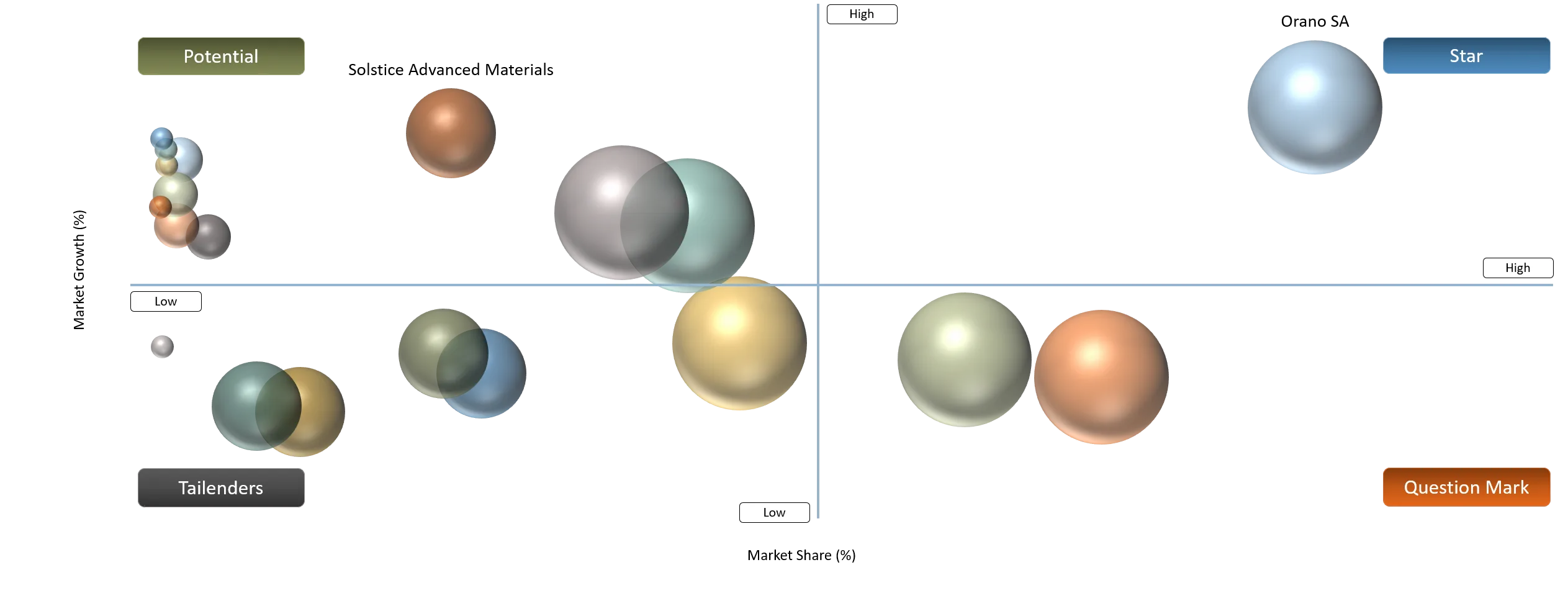
Stars include Orano SA and Rosatom because they possess large-scale commercial uranium conversion infrastructure integrated with uranium mining, enrichment, and nuclear fuel fabrication. Their established conversion capacities, long-term utility contracts, and strategic role in supplying the global nuclear fuel cycle position them as market leaders with strong competitive advantages. Question Marks include ConverDyn, China National Nuclear Corporation (CNNC), and Cameco Corporation. ConverDyn has strengthened its market position through the restart and expansion of the Metropolis Works uranium conversion facility, while CNNC continues to expand China's domestic nuclear fuel cycle alongside the country's growing reactor fleet.
The Potential category includes Solstice Advanced Materials, which owns and operates the Metropolis Works conversion facility and is expanding its role in the North American uranium conversion supply chain through infrastructure modernization and increased conversion capacity. The tailenders category includes Nuclear Fuel Complex (NFC) because its uranium conversion activities are primarily focused on supporting India's domestic nuclear power program rather than serving the international commercial conversion market.
Uranium Conversion Market Dynamics
Driver Impact Analysis
| Driver | Market Growth Impact (%) | Demand Concentration | Impacted Use Case | Strategic Impact |
Expansion of Global Nuclear Power Capacity Driving Demand for Uranium Conversion Services. | 32% | Commercial Nuclear Power Utilities | LEU fuel production for commercial reactors | High – Expands long-term demand for UF₆ conversion services and strengthens front-end nuclear fuel supply. |
Increasing Investments in Domestic Nuclear Fuel Cycle Infrastructure Strengthening Uranium Conversion Capacity. | 24% | North America & Europe | Domestic uranium conversion facilities | High – Improves regional fuel security, reduces import dependence, and increases conversion capacity. |
Rising Production Requirements for Low-Enriched Uranium (LEU) and High-Assay Low-Enriched Uranium (HALEU) Fuel. | 20% | Advanced Reactor & Enrichment Sector | LEU and HALEU feedstock production | High – Supports commercialization of SMRs and Generation IV reactor fuel supply chains. |
Geopolitical Diversification of Nuclear Fuel Supply Chains Accelerating Regional Conversion Capacity Expansion. | 16% | Western Nuclear Fuel Suppliers | Long-term conversion contracting | Medium to High – Encourages new conversion investments and regional supply chain resilience. |
Growing Deployment of Small Modular Reactors (SMRs) Increasing Demand for High-Purity Conversion Feedstock. | 12% | SMR Developers & Advanced Reactor Programs | HALEU-ready conversion services | Medium – Creates new demand for advanced fuel-cycle infrastructure and specialized conversion capabilities. |
Expansion of Global Nuclear Power Capacity Driving Demand for Uranium Conversion Services
Due to the growing need for nuclear power plants, there is an increasing demand for uranium conversion services since the uranium concentrate should be converted to uranium hexafluoride (UF₆) before enrichment and fuel manufacture. Due to the increasing demand for fuel, there has been major capacity building in the front end of the nuclear fuel cycle. In October 2025, the expansion of the Georges Besse II enrichment plant in France by Orano amounts to almost €1.7 billion, resulting in 2.5 million SWU/year of enrichment capacity, which is an increase in capacity of over 30% in the whole plant. This fuel cycle investment has led to an increasing demand for uranium conversion services.
With an increase in global reactors and new construction of nuclear power plants, there is going to be a greater need for uranium conversion services that can provide a safe and secure supply of UF₆ gas required for the front end of the nuclear fuel cycle. In July 2026, according to Axis Intelligence, the global nuclear industry operates approximately 440 commercial nuclear reactors, which have an installed capacity of roughly 400 GW and provide around 2,900 TWh of energy per year. It has been noted that there are currently over 60 nuclear reactors under construction in the world, and the installed nuclear capacity is supposed to reach 1,000 GW by 2050, owing to rising demand for energy, security measures, and decarbonization. Consequently, increased nuclear power capacity will result in a rise in the demand for uranium fuel cycle services such as uranium conversion due to the need for uranium conversion into UF₆.
Restraint Impact Analysis
| Restraint | Drag on Market Growth (%) | Primary Impact Area | Impacted Use Case | Strategic Impact |
Limited Global Uranium Conversion Capacity Creating Supply Bottlenecks Across the Nuclear Fuel Cycle. | 26% | Commercial Conversion Capacity | LEU & HALEU feedstock production | High – Limits conversion throughput, extends contract lead times, and constrains nuclear fuel supply expansion. |
Dependence on Fluorine-Based Chemical Processing Infrastructure Limiting Rapid Capacity Expansion. | 22% | Chemical Processing Infrastructure | UF₆ production and fluorination operations | High – Increases capital requirements, engineering complexity, and project development timelines for new conversion facilities. |
Concentrated Global Supply Base Increasing Vulnerability to Operational Disruptions and Geopolitical Risks. | 19% | Supply Chain & Trade Security | International uranium conversion services | Medium to High – Heightens supply risk, encourages regional diversification, and increases long-term contracting. |
Limited Availability of Commercial-Scale Conversion Facilities Outside Major Nuclear Fuel Cycle Countries. | 15% | Regional Conversion Infrastructure | Emerging nuclear energy programs | Medium – Restricts regional fuel-cycle development and increases reliance on imported conversion services. |
Dependence on Fluorine-Based Chemical Processing Infrastructure Limiting Rapid Capacity Expansion
One of the main restraints of the uranium conversion market is the high dependency on special chemical equipment based on fluorine for the conversion process of uranium concentrates into uranium hexafluoride (UF₆). This includes such systems as special fluorination systems, HF systems, corrosion-resistant equipment, equipment for containing radioactive materials, among others.
The expansion has shed light on the difficulties associated with the fast increase in conversion capacity, considering that the plants need to have fluorine processing facilities, regulatory compliance, and large amounts of investment to do so. In February 2026, according to World Nuclear News, Solstice Advanced Materials announced plans to expand the production process at its Metropolis Works plant, which is the only uranium conversion plant operating commercially in the United States. The company anticipates that the plant will generate more than 10,000 tonnes of uranium hexafluoride (UF₆) in 2026, indicating an estimated 20% rise from its projected production level for 2024. The expansion of production capacity is backed by a backlog of more than US$2 billion, attributed to orders from clients and increasing demand for uranium conversion.
Uranium Conversion Market Segment Analysis
The global Uranium Conversion market is segmented based on product type, conversion process, application, and region.
Uranium Hexafluoride (UF₆) Dominates the Product Type Segment Due to Its Essential Role in Uranium Enrichment
The Uranium Hexafluoride (UF₆) segment dominates the product type of the Uranium Conversion Market because it plays a vital role as the most important chemical element necessary for enrichment of uranium and production of nuclear fuel. UF₆ is a widely used material within the nuclear fuel cycle, which allows transforming into a gas form and to conduct the enrichment process via centrifuge, which helps produce low-enriched uranium (LEU) and high-assay low-enriched uranium (HALEU) needed for the operation of current nuclear reactors and future reactor designs. The growing interest in the expansion of nuclear energy, energy security, and the development of a domestic fuel chain has increased demand for UF₆ conversion capabilities in 2025-2026.
The increasing need for a dependable uranium conversion plant has led to increased investments in UF₆ production plants. In February 2026, Solstice Advanced Materials (US) made plans to expand its Metropolis Works uranium conversion plant in Illinois, which is the only existing uranium conversion plant in the US. The projections made were that the plant would be producing over 10 kilotonnes (10,000 tons) of uranium hexafluoride (UF₆) in 2026, which marked a rise of about 20% from its expected output in 2024. This has been due to debottlenecking investments made after the restart of the facility in 2023, coupled with high demand from customers in the nuclear fuel industry, whose backlog stood at over US$2 billion.
Uranium Conversion Market Geographical Penetration
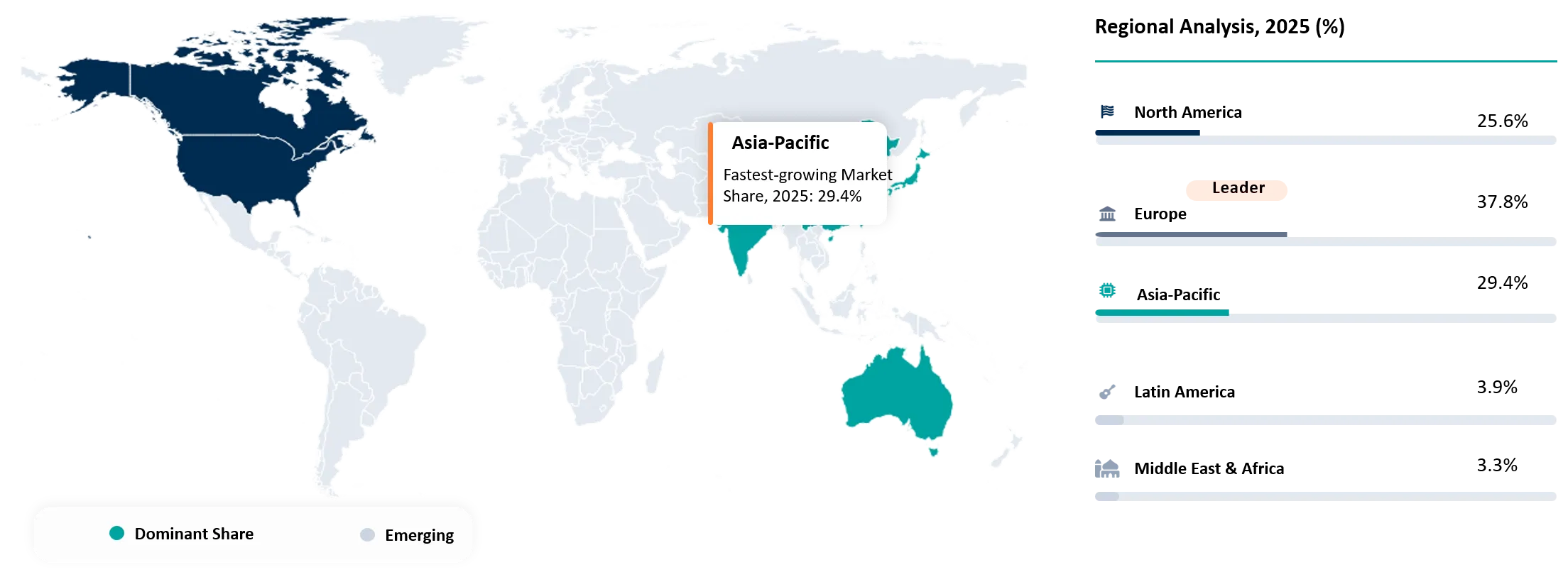
Strong Nuclear Fuel Security Initiatives and Expansion of Uranium Conversion Infrastructure Driving Europe’s Market Leadership
Europe dominates the Uranium Conversion Market with its significant market share of approximately 37.8% in 2025, because of its strong ecosystem of nuclear energy, high capability of uranium conversion, and government emphasis on domestic fuel cycle services to ensure nuclear energy supplies. The presence of leading players in uranium conversion and enrichment, such as Orano in France and Urenco in the UK, Netherlands, and Germany, has made Europe one of the major centers for uranium hexafluoride production and nuclear fuel cycle services. Increasing investments in nuclear energy growth, life extension of nuclear reactors, and advanced reactor technology developments have boosted the demand for uranium conversion in 2025-2026 in Europe.
The EU-CONVERSION program plays an instrumental role in promoting Europe's efforts by Europe to enhance its nuclear fuel self-sufficiency through development in fuel cycle technology and decreased dependence on fuel supply from outside sources. In January 2025, the EU-CONVERSION project was approved under the Euratom Research and Training Programme to increase the security of European fuel supply for safe low-enriched uranium (LEU) and conversion of European research reactors from highly enriched uranium (HEU) to LEU fuels. The project has a total investment of around €9.03 million, comprising an EU contribution of around €7.64 million, from October 2024 to September 2028. The project aims to qualify the fuel, conduct irradiation tests, safety analysis, and sustainable European fuel supply chain.
France Uranium Conversion Market Trends
France dominates the European Uranium Conversion Market owing to its well-established nuclear energy ecosystem, well-developed nuclear fuel cycle, and the presence of prominent nuclear fuel companies. The country's nuclear power plants, the government's nuclear energy policies, and uranium conversion capacity ensure a regular demand for UF₆, which is an essential intermediate good used in the processes of uranium enrichment and production of nuclear fuel. The presence of prominent nuclear fuel cycle facilities provided by firms like Orano helps France to have a strategic influence on the European uranium conversion supply chain.
The agreement helps to develop a more robust ecosystem in Europe when it comes to the fuel cycle process for nuclear power by filling the gap created by the lack of technical experts in the field of nuclear power. In November 2025, Orano, a French-based multinational corporation specializing in the nuclear fuel cycle, joined the Institut International de l'Energie Nucléaire (I2EN), intending to increase cooperation in developing future nuclear fuel cycle specialists and meeting labor force requirements in the field. Orano is one of the most significant corporations that deal with the mining of uranium, uranium conversion, enrichment, recycling, and nuclear fuel services. The collaboration will promote education and training of the future generation of nuclear experts in relation to various fuel cycle operations such as uranium conversion and others.
UK Uranium Conversion Market Outlook
The UK is emerging as a significant player in the Europe Uranium Conversion Market because of its renewed interest in expanding nuclear energy through advanced nuclear reactor technology developments and investments towards securing its nuclear fuel supply chain. The United Kingdom has decided to become less dependent on foreign sources of nuclear fuel through the expansion of facilities and capabilities throughout the entire nuclear fuel cycle process, which includes uranium enrichment, uranium conversion-related operations, and advanced nuclear fuels. The increasing need for low-enriched uranium (LEU) and high-assay low-enriched uranium (HALEU) for SMR and advanced reactors is increasing the importance of uranium conversion in the UK.
In terms of HALEU deconversion, the investments of the UK in such infrastructure support the advanced nuclear fuel chain and the establishment of fuel cycle facilities at home. In July 2024, UK Department for Energy Security and Net Zero (DESNZ) launched a competition with funding of up to GBP 70 million (approximately USD 90 million) to develop a commercial-scale High-Assay Low-Enriched Uranium (HALEU) deconversion facility in the United Kingdom. The initiative is part of the broader GBP 300 million UK HALEU Programme, which aims to establish a domestic HALEU supply chain by 2031. The planned facility will support the design and construction of an oxide HALEU deconversion plant with an initial processing capacity of at least 10,000 kgU per year, expandable up to 30,000 kgU per year, along with a future metal HALEU deconversion capability of at least 5,000 kgU per year.
Uranium Conversion Market Competitive Landscape
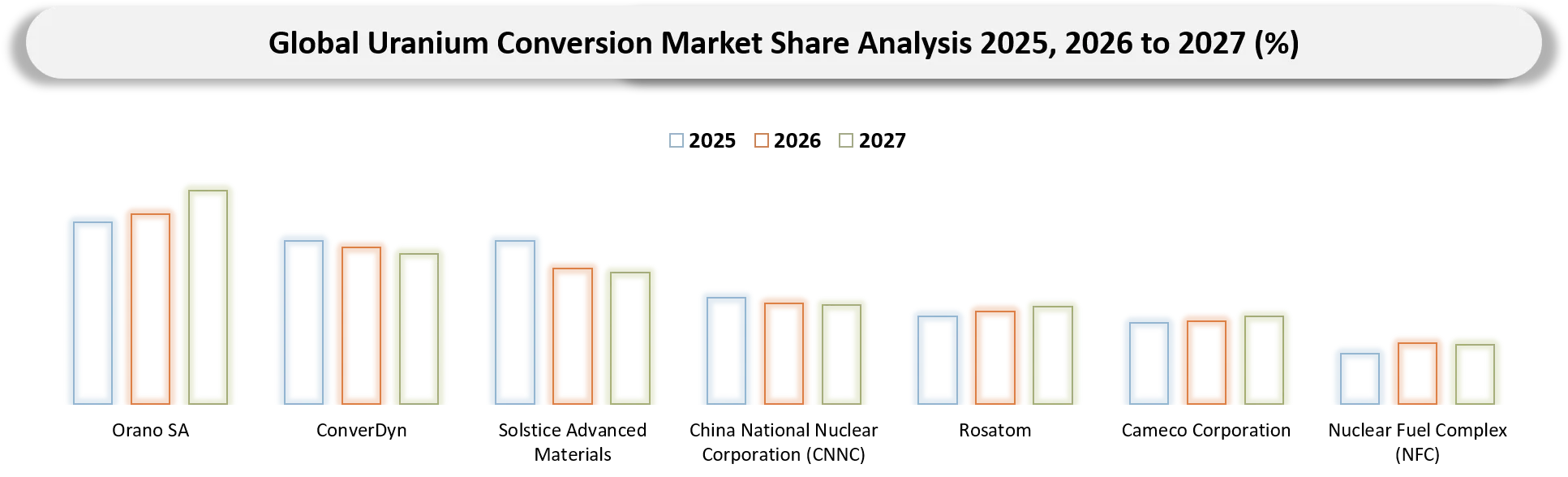
- The Uranium Conversion Market is characterized by three key participant groups: integrated nuclear fuel cycle companies, specialized uranium conversion operators, and state-owned nuclear organizations. Orano SA, Cameco Corporation, and Rosatom lead through integrated uranium processing, conversion, enrichment, and fuel supply capabilities; Solstice Advanced Materials and ConverDyn focus on uranium hexafluoride (UF₆) conversion capacity in North America; while China National Nuclear Corporation (CNNC) and Nuclear Fuel Complex (NFC) strengthen domestic nuclear fuel supply chains in China and India, respectively. This creates a highly strategic market environment where UF₆ production capacity, nuclear fuel cycle integration, government support, and long-term utility contracts define competitiveness. For example, in 2026, Solstice Advanced Materials announced expansion of its Metropolis Works uranium conversion facility in the United States, targeting more than 10,000 tonnes of UF₆ production annually, while Orano continued strengthening European conversion and enrichment capabilities through nuclear fuel infrastructure investments.
- Key players include Orano SA, Solstice Advanced Materials, ConverDyn, China National Nuclear Corporation (CNNC), Rosatom, Cameco Corporation, and Nuclear Fuel Complex (NFC).
Key Developments in the Uranium Conversion Market
- August 2026 - Global uranium production: Mid-year updates from major uranium producers showed stronger first-half production. Kazatomprom reported 13,291 tonnes of uranium on a 100% basis during H1 2026, up 9% year over year. Rising uranium production supports the longer-term availability of feedstock for conversion facilities
- July 2026 - Australia - India uranium supply agreement: Australia and India signed an administrative arrangement enabling Australian uranium exports to India for peaceful purposes. The agreement could support India's expanding nuclear program and, consequently, future demand for uranium processing and conversion services.
- July 2026 - Ukraine: Ukraine's Cabinet approved a UAH 555 million (approximately $12.4 million) loan to Eastern Mining and Processing Plant to increase uranium ore extraction and uranium oxide concentrate production. The plan targets production of up to 45 tonnes of uranium oxide concentrate per month, strengthening the upstream feedstock base for the nuclear fuel cycle.
- July 2026: ASP Isotopes Inc., a U.S.-based advanced isotope enrichment and critical materials technology company, its wholly owned subsidiary Quantum Leap Energy LLC (QLE), a U.S.-based applied engineering research organization, signed a research agreement with the Texas A&M Engineering Experiment Station (TEES) to advance the development of scalable domestic uranium conversion technology.
- June 2026 - Uranium Energy Corp. (UEC): UEC provided an update on its planned U.S. uranium refining and conversion facility. The company said it had received an NRC docket number, continued discussions with the U.S. Department of Energy regarding strategic nuclear fuel-cycle infrastructure, expanded its site-selection process, and narrowed the project to a final shortlist of candidate locations. UEC expects to submit a formal license application after completing engineering and design work with Fluor and selecting the site.
- June 2026 - Urenco USA: Urenco announced plans to expand its U.S. uranium-enrichment capacity by nearly 50%, supported by long-term customer contracts. Although the project is focused on enrichment rather than conversion, it is relevant to the uranium conversion market because increased enrichment capacity is expected to strengthen demand for upstream UF₆ feedstock and conversion services.
- June 2026 - Urenco: Urenco highlighted expansion plans driven by a record order book, including additional capacity to support growing demand for nuclear fuel and advanced reactor applications. The development reinforces the need for greater capacity across the upstream conversion-to-enrichment fuel-cycle chain.
- April 2026: FluxPoint, a U.S.-based nuclear fuel cycle technology company, announced plans to develop a new uranium conversion facility in the United States, expected to become the first new U.S. uranium conversion facility in more than 70 years. The company plans to convert uranium oxide (U₃O₈) into uranium hexafluoride (UF₆), a critical intermediate product required for uranium enrichment and nuclear fuel production.
- March 2026: Oklo Inc., a U.S.-based advanced nuclear technology company developing microreactors and clean energy systems, and Centrus Energy Corp., a U.S.-based uranium enrichment and nuclear fuel services company, announced plans to explore a joint venture focused on High-Assay Low-Enriched Uranium (HALEU) deconversion services and advanced nuclear fuel-cycle technologies at Centrus’ Piketon, Ohio facility. The collaboration aims to develop domestic fuel-cycle capabilities by integrating uranium enrichment and deconversion operations to support advanced reactors and small modular reactors (SMRs).
- August 2025: NANO Nuclear Energy Inc. (NNE), a U.S.-based advanced nuclear technology company developing microreactors and nuclear fuel solutions, announced a strategic partnership with Dioxitek S.A., an Argentina-based nuclear fuel cycle company, to explore opportunities in uranium conversion and enrichment technologies aimed at strengthening future High-Assay Low-Enriched Uranium (HALEU) fuel supply chains.
- September 2025: Uranium Energy Corp. (UEC), a U.S.-based uranium mining and nuclear fuel cycle company, launched a new subsidiary, United States Uranium Refining & Conversion Corp. (UR&C), to develop a domestic uranium refining and conversion facility in the United States.
Key Procurement Priorities and Buyer Evaluation Criteria
- Firms looking into the Uranium Conversion Market will base their supplier choices on how reliably a supplier can perform UF₆ conversions, maintain production capabilities, and adhere to strict nuclear safety regulations. On the other hand, buyers assess the conversion partner on operational reliability, access to conversion facilities, nuclear-grade quality of UF₆, and capability to enter into long-term uranium fuel supply contracts.
- The procurement decision-making process is becoming more and more affected due to the increasing emphasis that is being put on expanding nuclear energy, implementing policies related to energy security, using SMRs, and establishing HALEU chains. The utilities and the enrichment companies and the government-sponsored nuclear programs are looking for companies who can provide uranium conversion that will ensure stable supply of the raw materials.
- Considerations that buyers look at during the selection process of uranium conversion include UF₆ capacity, efficiency of conversion, quality requirements of the products, certifications, safety records of the facilities, and resiliency of the supply chain. Established conversion companies like Orano SA, Solstice Advanced Materials, ConverDyn, Rosatom, and CNNC are assessed based on their capability to provide secure and scalable uranium conversion for reactors.
Why Choose DataM?
- Technological Innovations: Explores advancements in the uranium conversion industry, including improvements in uranium hexafluoride (UF₆) production processes, conversion facility modernization, advanced nuclear fuel cycle technologies, and infrastructure upgrades supporting low-enriched uranium (LEU) and high-assay low-enriched uranium (HALEU) production. The analysis highlights how technological improvements enhance conversion efficiency, operational safety, and reliability across the global nuclear fuel supply chain.
- Product Performance & Market Positioning: Evaluates how leading uranium conversion companies differentiate their offerings through UF₆ production capacity, conversion reliability, nuclear-grade product quality, regulatory compliance, and integration with enrichment and fuel fabrication operations. The study highlights the competitive positioning of companies such as Orano SA, Solstice Advanced Materials, ConverDyn, Rosatom, CNNC, Cameco Corporation, and Nuclear Fuel Complex (NFC) based on their ability to support commercial reactors and next-generation nuclear technologies.
- Real-World Evidence: Highlights real-world adoption of uranium conversion capabilities across commercial nuclear power plants, enrichment facilities, and advanced reactor fuel programs, demonstrating the importance of secure UF₆ supply for reactor operations, uranium enrichment, and emerging applications such as small modular reactors (SMRs) and HALEU-based advanced reactors.
- Market Updates & Industry Changes: Tracks key developments such as uranium conversion facility expansions, nuclear fuel supply chain diversification initiatives, government-backed investments, and regional capacity developments across Europe, North America, and Asia. The analysis covers major industry updates, including Solstice Advanced Materials’ Metropolis Works UF₆ capacity expansion in the United States and Orano’s nuclear fuel cycle investments in France.
- Competitive Strategies: Analyzes how leading uranium conversion companies strengthen their market position through capacity expansion, strategic partnerships, vertical integration across the nuclear fuel cycle, modernization of conversion facilities, and investments in advanced nuclear fuel supply capabilities to address rising global demand for reliable uranium supply.
- Pricing & Market Access: Explains uranium conversion market dynamics based on UF₆ conversion capacity, uranium feedstock availability, enrichment demand, regulatory requirements, and long-term supply contracts. The report evaluates market access through integrated nuclear fuel companies, government-supported nuclear organizations, and specialized conversion operators supplying utilities and enrichment providers worldwide.
- Market Entry & Expansion: Identifies growth opportunities driven by global nuclear energy expansion, SMR commercialization, HALEU fuel development, energy security initiatives, and diversification of nuclear fuel supply chains. The analysis outlines expansion strategies including regional facility development, conversion capacity enhancement, strategic collaborations, and investment in secure nuclear fuel infrastructure.
Target Audience
- Uranium Conversion Companies & Nuclear Fuel Cycle Operators
- Nuclear Power Utilities & Reactor Operators
- Uranium Mining & Nuclear Fuel Suppliers
- Government Agencies & Nuclear Regulatory Authorities
- Enrichment Companies & Advanced Reactor Developers
- Nuclear Technology Investors & Financial Institutions
- Engineering, Procurement & Construction (EPC) Companies


























































