


Metabolic Disorder Therapeutics Market Company Research Insight
The metabolic disorder therapeutics market is becoming harder to define as a single treatment category. Diabetes and obesity are the largest commercial pools. Hypercholesterolemia and metabolic liver disease are pulling cardiovascular companies deeper into the space. At the same time, rare inherited metabolic disorders continue to support high-value enzyme replacement, substrate reduction, gene and other targeted therapies.
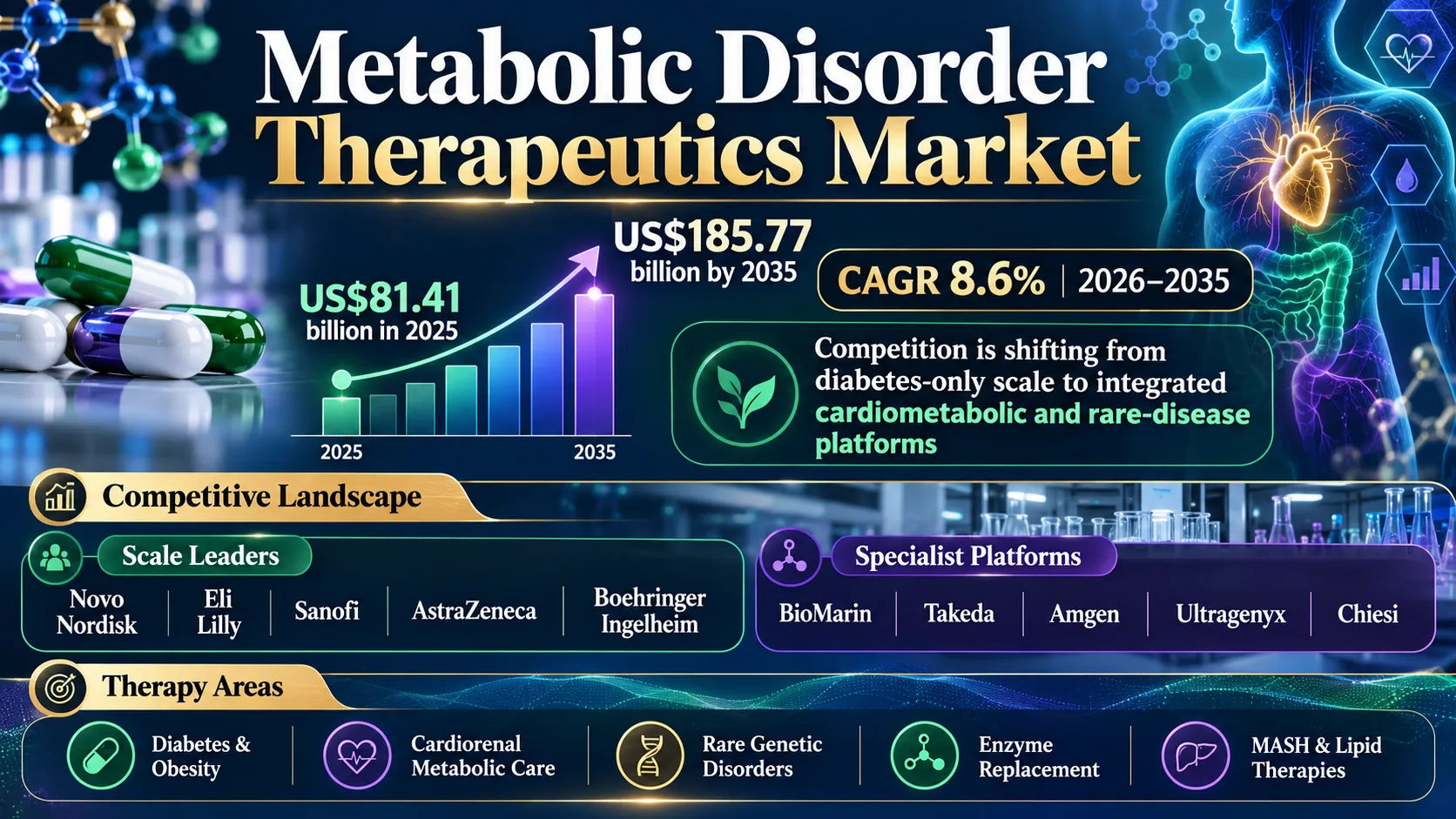
According to DataM Intelligence, the global Metabolic Disorder Therapeutics Market reached US$ 81.41 billion in 2025. Using the report's current 8.6% CAGR through a 2035 forecast horizon, the market would reach approximately US$ 185.77 billion by 2035. The market is segmented by therapy type into drug therapy, enzyme replacement therapy, cellular transplantation, small molecule-based therapy, substrate reduction therapy, gene therapy and other approaches. Diabetes is the largest disorder segment, while obesity, lysosomal storage diseases and hypercholesterolemia are also important commercial areas.
DataM currently lists Novo Nordisk, Sanofi, Takeda Pharmaceuticals, BioMarin Pharmaceutical, Esperion Therapeutics, Pfizer, Ultragenyx Pharmaceutical, Chiesi, Eli Lilly and Johnson & Johnson among the leading companies. That list needs updating for a 2025 base year. The market has shifted toward companies with large diabetes and obesity franchises, broader cardio-renal-metabolic portfolios and stronger late-stage pipelines. AstraZeneca, Boehringer Ingelheim and Amgen now have stronger claims to a top-ten position than Pfizer, Esperion Therapeutics and Johnson & Johnson in the overall market.
The competitive landscape is therefore split between scale and specialization. Novo Nordisk and Eli Lilly dominate the current obesity and incretin cycle. Sanofi, AstraZeneca and Boehringer Ingelheim bring large chronic-disease platforms. BioMarin, Takeda, Ultragenyx and Chiesi remain important because inherited metabolic diseases require specialist commercial capabilities. Amgen sits between the two groups with an established lipid franchise and a growing obesity pipeline.
Request for Exclusive Sample: https://www.datamintelligence.com/download-sample/metabolic-disorders-therapeutics-market
Top 10 Companies Analysis
Novo Nordisk
Novo Nordisk is the clearest incumbent in the global metabolic disorder therapeutics market because diabetes and obesity sit at the center of its commercial model. Ozempic, Rybelsus and Wegovy give the company exposure across type 2 diabetes and chronic weight management, while its insulin portfolio keeps it relevant across multiple stages of diabetes care.
The company's advantage is scale. It has manufacturing, physician access, payer relationships and clinical-development experience that smaller metabolic companies cannot easily reproduce. Novo Nordisk has also been extending beyond glucose and weight control into cardiovascular risk reduction, MASH and other cardiometabolic conditions.
The pressure is increasing. Eli Lilly has become a direct commercial threat, while oral incretins, amylin combinations and next-generation multi-agonists could reduce the durability of today's product leadership. Novo Nordisk remains a top-tier company, but the market is no longer a one-company GLP-1 story.
Eli Lilly and Company
Eli Lilly has become one of the two companies setting the pace of the metabolic therapeutics market. Mounjaro and Zepbound established tirzepatide as a major product across diabetes and obesity and changed expectations for weight loss, glucose control and the commercial value of incretin-based therapy.
Lilly's strength is the depth behind the current franchise. Orforglipron gives the company an oral GLP-1 strategy, while retatrutide extends development into triple-agonist therapy. That makes Lilly relevant not only to the current treatment cycle but also to the next wave of metabolic drug development.
The main competitive risk is execution at very large scale. Supply, reimbursement and pricing pressure will influence adoption. Even so, Lilly should rank near the top of any 2025 competitive analysis because its marketed products and pipeline are reshaping diabetes and obesity treatment simultaneously.
Sanofi
Sanofi remains important because its metabolic exposure spans both common and rare disease. The company retains a substantial diabetes presence through insulin and related products, while its rare-disease portfolio includes long-established enzyme replacement therapies for lysosomal storage disorders.
That combination matters. Many competitors are strong either in mass-market cardiometabolic disease or in rare metabolic disorders. Sanofi has capabilities in both. Its commercial infrastructure, biologics manufacturing and specialist rare-disease relationships give it a broader metabolic footprint than its current obesity exposure alone would suggest.
The challenge is growth concentration. Sanofi is less exposed than Novo Nordisk and Lilly to the fastest-growing branded obesity segment. Its position remains strong, but it depends more on portfolio breadth and rare-disease durability than on leadership in the current incretin market.
AstraZeneca
AstraZeneca should be added to the top-ten list because the metabolic market is increasingly connected to cardiovascular and renal disease. Farxiga has given the company a major presence across type 2 diabetes, chronic kidney disease and heart failure, making its relevance wider than a traditional diabetes classification would imply.
The company benefits from treating metabolic disease as part of an integrated cardiovascular, renal and metabolic continuum. That positioning fits the way clinical practice is changing. Therapy selection increasingly considers cardiovascular outcomes, kidney protection, weight, glucose control and long-term risk together.
AstraZeneca is less exposed to the commercial obesity boom than Novo Nordisk or Lilly, but its cardiorenal scale and global chronic-disease infrastructure make it more relevant to the overall metabolic disorder therapeutics market than several companies on the current DataM list.
Boehringer Ingelheim
Boehringer Ingelheim is another company that should be added. Its metabolic position is anchored by Jardiance and a long-standing diabetes collaboration with Eli Lilly. The SGLT2 class has moved well beyond glucose lowering and now sits at the intersection of diabetes, cardiovascular disease and kidney protection.
This gives Boehringer a durable place in the market even as GLP-1 therapies attract most of the attention. The company has deep expertise in chronic cardiometabolic disease and strong physician access in patient groups that frequently have overlapping diabetes, heart and renal conditions.
The limitation is that part of its metabolic commercial exposure is shared through partnerships, while it does not currently have the same obesity franchise as the two incretin leaders. Even so, its clinical and commercial relevance is too large to leave outside the top ten.
BioMarin Pharmaceutical
BioMarin is one of the strongest specialist companies in inherited metabolic disease. Its portfolio addresses disorders where enzyme deficiencies, genetic defects or abnormal metabolic pathways create severe lifelong disease. This makes the company especially relevant to the enzyme replacement and rare metabolic portions of the market.
Its advantage is specialization. BioMarin has built capabilities in identifying small patient populations, navigating orphan-drug development, supporting complex diagnostics and commercializing high-value therapies. The planned expansion through Amicus Therapeutics strengthens its exposure to Fabry and Pompe disease and deepens its lysosomal storage disease position.
The trade-off is scale. Rare metabolic therapies can generate high revenue per patient but depend on small populations, diagnosis rates and specialist treatment centers. BioMarin should remain in the top ten because those barriers also make its expertise difficult to replicate.
Takeda Pharmaceutical
Takeda remains relevant through its rare-disease portfolio and established presence in lysosomal storage disorders. Its role in the metabolic market is much more concentrated in inherited and specialist diseases than in mass-market diabetes or obesity.
The company benefits from global rare-disease infrastructure, long-term physician relationships and experience with enzyme replacement therapies. These capabilities matter because diagnosis, treatment initiation and patient support are central to commercial success in rare metabolic disorders.
Takeda does not have the same exposure to the fastest-growing obesity category as leading cardiometabolic companies. Its place in the top ten is instead based on the importance of lysosomal and inherited metabolic diseases within the broader market definition.
Amgen
Amgen should be added because it already has a major commercial position in lipid management and is building a more direct obesity strategy. Repatha gives the company established exposure to hypercholesterolemia and cardiovascular risk reduction, an important metabolic segment that overlaps with cardiology.
The second part of the story is MariTide. If its obesity program develops successfully, Amgen could become a more direct competitor to the current incretin leaders. The program is strategically important because it gives the company a path from a mature lipid franchise into one of the fastest-growing pharmaceutical markets.
The risk is that the obesity position is still pipeline-driven compared with Novo Nordisk and Lilly. Even so, Amgen has stronger current commercial scale and broader strategic relevance than Esperion Therapeutics in a market-wide top-ten ranking.
Ultragenyx Pharmaceutical
Ultragenyx is a focused rare-disease company with several products directly relevant to inherited metabolic disorders. Its portfolio includes therapies for X-linked hypophosphatemia, long-chain fatty acid oxidation disorders, mucopolysaccharidosis VII and homozygous familial hypercholesterolemia.
The company's strength is focus. It has built development and commercialization capabilities around ultra-rare genetic conditions where patient identification, natural-history understanding and specialist centers are essential. These are difficult markets for generalist pharmaceutical companies to enter without dedicated infrastructure.
The commercial base is much smaller than that of large pharmaceutical companies, but the relevance is high within rare metabolic disease. Ultragenyx therefore remains a logical top-ten company when the market definition includes genetic and enzyme-related disorders rather than only diabetes and obesity.
Chiesi Farmaceutici
Chiesi should remain in the top ten because of its growing rare-disease business and its exposure to inherited and lysosomal disorders. The company has deliberately built a specialist portfolio where small patient populations can support high-value therapies and long treatment durations.
Its advantage is commercial specialization. Rare metabolic disease requires patient finding, diagnostic support, specialist engagement and country-by-country reimbursement work. Chiesi has been investing in that infrastructure rather than trying to compete directly with the scale of Novo Nordisk or Lilly.
The company is smaller and less diversified across common metabolic diseases, so its ranking is more sensitive to how broadly the market is defined. For a report that includes enzyme replacement and lysosomal storage diseases, however, it remains more relevant than several large pharmaceutical companies with only peripheral metabolic exposure.
Competitor Analysis: Top Metabolic Disorder Therapeutics Market Players
| Sponsor | Intervention | Clinical Stage | MoA | RoA | Modality | |||
| Kodiak Sciences | Zenkuda (Tarcocimab Tedromer / KSI-301) | Phase 3 - Completed | VEGF-A inhibition using an antibody-biopolymer conjugate designed for prolonged VEGF suppression | Intravitreal | Antibody-Biopolymer Conjugate | |||
| Ocular Therapeutix | AXPAXLI (OTX-TKI / Axitinib Implant) | Phase 3 | Sustained VEGFR-1, VEGFR-2 and VEGFR-3 tyrosine kinase inhibition, suppressing VEGF-mediated retinal vascular pathology | Intravitreal | Small Molecule Sustained-Release Implant | |||
| AbbVie / REGENXBIO | Surabgene Lomparvovec (Sura-vec / ABBV-RGX-314) | Phase 2/3 | AAV8-mediated delivery of a gene encoding an anti-VEGF Fab for sustained intraocular VEGF inhibition | Suprachoroidal | AAV Gene Therapy | |||
Beletalent (Zhuhai) Pharmaceutical | Tangning Tongluo Tablets (TNTL) | Phase 3 | Multicomponent modulation of retinal microvascular dysfunction and inflammatory pathways | Oral | Multicomponent Botanical Therapy | |||
Jaeb Center for Health Research / DRCR Retina Network | Fenofibrate | Phase 3 | PPAR-伪 activation modulates lipid metabolism, inflammation and endothelial signaling associated with retinal microvascular injury | Oral | Small Molecule | |||
| Boehringer Ingelheim | BI 764524 | Phase 2 | Sema3A inhibition designed to reduce ischemia-associated retinal vascular dysfunction and support physiological revascularization | Intravitreal | Monoclonal Antibody | |||
| Vantage Biosciences | Oruvestat (VX-01) | Phase 2 | Selective AOC3/VAP-1 inhibition reduces leukocyte trafficking and vascular inflammatory signaling | Oral | Small Molecule | |||
Bayer / Perfuse Therapeutics | PER-001 | Phase 2 - Completed | Endothelin receptor antagonism designed to improve retinal perfusion and reduce ischemia-associated retinal injury | Intravitreal | Small Molecule Sustained-Release Implant | |||
Opus Genetics / Ocuphire Pharma | APX3330 | Phase 2 - Completed; Phase 3-Ready | APE1/Ref-1 redox inhibition suppresses inflammatory and angiogenic transcriptional signaling including HIF-1伪, NF-魏B and AP-1 | Oral | Small Molecule | |||
| Bayer | Runcaciguat (BAY 1101042) | Phase 2 - Completed | Soluble guanylate cyclase activation increases cGMP signaling and supports retinal microvascular function | Oral | Small Molecule | |||
Request for Exclusive Sample: https://www.datamintelligence.com/download-sample/metabolic-disorders-therapeutics-market
The table shows why the market is difficult to rank using one metric. Novo Nordisk and Lilly dominate the highest-growth mass-market categories. AstraZeneca and Boehringer Ingelheim are powerful because metabolic disease increasingly overlaps with cardiovascular and renal outcomes. BioMarin, Takeda, Ultragenyx and Chiesi matter because rare metabolic disorders reward specialist capabilities. Amgen links an established lipid franchise with a potentially larger obesity opportunity.
Who Are Other Companies Influencing the Market?
Several companies outside the top group are influencing where the market goes next. Roche is becoming particularly important through its expanding obesity and cardiometabolic pipeline, including incretin and amylin-based programs. It is not yet as commercially established in metabolic therapeutics as the top-ranked companies, but it is one of the most important emerging challengers to watch through the forecast period.
Esperion Therapeutics remains relevant in hypercholesterolemia through Nexletol and Nexlizet. The company is strategically important in oral LDL lowering, but its portfolio is too narrow to rank ahead of diversified metabolic companies across the entire market. Pfizer still has metabolic research capabilities, although the discontinuation of its oral GLP-1 danuglipron program reduced its near-term obesity position. Johnson & Johnson also has historical diabetes exposure but metabolic therapeutics are no longer central enough to justify a top-ten ranking.
Madrigal Pharmaceuticals is influencing metabolic liver disease through Rezdiffra in MASH. Alnylam, Ionis and Arrowhead are important in RNA-based lipid and genetic metabolic therapies. Zealand Pharma, Viking Therapeutics, Structure Therapeutics and other biotechnology companies are shaping next-generation obesity competition. Innovent Biologics is also important in China after the approval of mazdutide, reflecting the rise of locally developed incretin therapies in Asia.
Amicus Therapeutics has historically been important in Fabry and Pompe disease. Its strategic relevance increasingly sits within BioMarin because of the acquisition agreement. PTC Therapeutics is another company to watch after the approval of Sephience for phenylketonuria, showing that rare metabolic competition continues to produce new commercial entrants even while obesity receives most of the market attention.
What Is Driving Competition in the Market?
Competition is being driven first by the scale of diabetes and obesity. These are very large chronic populations, and the success of GLP-1 and dual-agonist therapies has moved metabolic disease to the center of pharmaceutical growth strategies. Companies with strong obesity products can now influence adjacent areas including cardiovascular disease, sleep apnea, kidney disease and metabolic liver disease.
The second driver is the move beyond first-generation GLP-1 therapy. Oral incretins, dual agonists, triple agonists, amylin combinations and products designed to improve body composition are creating new ways to compete. The market will increasingly be judged on efficacy, tolerability, convenience, persistence and manufacturing capacity rather than on weight loss alone.
Cardiometabolic boundaries are also disappearing. Diabetes, obesity, hypercholesterolemia, chronic kidney disease, cardiovascular risk and MASH frequently occur in the same patients. That favors companies that can build evidence across several outcomes and gives AstraZeneca, Boehringer Ingelheim and Amgen a stronger competitive position than a narrow diabetes-only view would suggest.
Rare metabolic disorders create a different competitive model. Patient populations are small, but unmet need is high and treatment can be lifelong. Success depends on diagnosis, specialist centers, reimbursement, genetic testing and patient support. BioMarin, Takeda, Ultragenyx, Sanofi and Chiesi benefit from infrastructure that takes years to build.
The next phase of competition will probably favor companies that can combine commercial scale with pipeline depth. Large companies will continue to license or acquire specialist assets, while biotechnology companies will remain important sources of innovation in obesity, genetic metabolic disease, MASH and lipid disorders. For the 2025 base-year competitive landscape, the strongest top-ten list is Novo Nordisk, Eli Lilly, Sanofi, AstraZeneca, Boehringer Ingelheim, BioMarin Pharmaceutical, Takeda Pharmaceutical, Amgen, Ultragenyx Pharmaceutical and Chiesi Farmaceutici.