


Market Overview
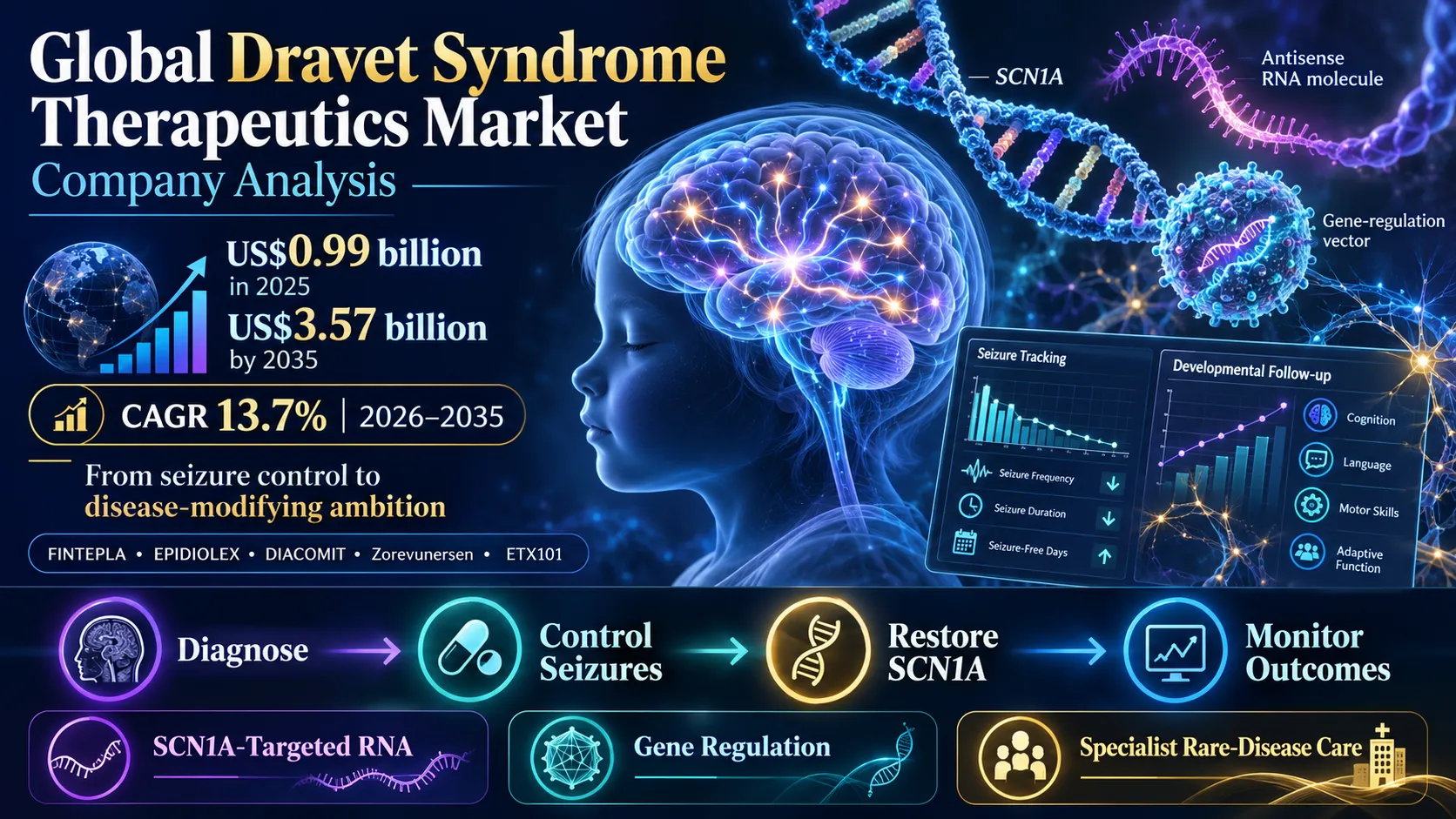
The global Dravet syndrome therapeutics market was valued at US$0.99 billion in 2025 and is projected by DataM Intelligence to reach US$3.57 billion by 2035. Dravet syndrome is a severe developmental and epileptic encephalopathy, commonly associated with pathogenic variants in SCN1A. Commercial treatment remains centered on reducing convulsive seizures and preventing seizure emergencies, but emerging genetic treatments could reshape long-term care.
UCB’s FINTEPLA (fenfluramine), Jazz Pharmaceuticals’ EPIDIOLEX/EPIDYOLEX (cannabidiol) and Biocodex’s DIACOMIT (stiripentol) anchor syndrome-specific treatment alongside valproate, clobazam and other established antiseizure medicines. DataM identifies North America as the largest market, accounting for 53.72% of 2025 spending, with Asia-Pacific presenting faster growth opportunities.
Industry commentary highlights the shift in clinical ambitions. In discussing zorevunersen’s longer-term follow-up, Stoke Therapeutics CEO Ian F. Smith said the emerging evidence suggests the investigational treatment “may change the course of Dravet syndrome.” His statement reflects the industry’s interest in outcomes extending beyond short-term seizure counts, while pivotal efficacy and safety evidence remains essential before approval.
Commercial leaders already generate substantial revenue in wider epilepsy or rare-disease portfolios. Jazz reported US$1.06 billion in 2025 EPIDIOLEX/EPIDYOLEX sales across approved indications, not exclusively Dravet syndrome. New entrants are judged primarily on clinical readiness, potential developmental benefits and the ability to reach patients through specialist networks rather than on current Dravet product sales.
Request Sample: https://www.datamintelligence.com/download-sample/dravet-syndrome-therapeutics-market
Key Companies and Competitive Positioning
The market has two distinct competitive groups. Approved-treatment companies defend penetration, reimbursement and treatment sequencing. Clinical-stage developers seek differentiated outcomes through SCN1A upregulation, gene regulation, serotonergic pathways and ion-channel mechanisms.
- UCB - FINTEPLA; rare-epilepsy commercialization.
- Jazz Pharmaceuticals - EPIDIOLEX / EPIDYOLEX; specialist distribution.
- Biocodex - DIACOMIT; established Dravet specialist treatment.
- Stoke Therapeutics - Zorevunersen; SCN1A RNA-targeted therapy.
- Biogen - Co-development and commercialization partner for zorevunersen.
- Encoded Therapeutics - ETX101; one-time gene regulation.
- Lundbeck - Bexicaserin; serotonin receptor targeting.
- Harmony Biosciences - EPX-100; late-stage serotonergic program.
- Ionis Pharmaceuticals - RNA therapeutics platform.
- Praxis Precision Medicines - Precision epilepsy and ion-channel development.
2025 Revenue Comparison (USD)
Figures below reflect consolidated company revenue where publicly reported. Commercial Dravet product sales and revenue from unrelated indications are not interchangeable. Pre-commercial biotechnology companies can recognize collaboration revenue without an approved Dravet product.
| Company | 2025 Revenue (USD) |
| UCB | $8.60 billion |
| Jazz Pharmaceuticals | $4.27 billion |
| Biocodex | $754.85 million |
| Stoke Therapeutics | $184.42 million |
| Biogen | $9.89 billion |
| Encoded Therapeutics | $54 million |
| H. Lundbeck | $3.55 billion |
| Harmony Biosciences | $868.45 million |
| Ionis Pharmaceuticals | $944.00 million |
| Praxis Precision Medicines | No commercial product sales |
| Bright Minds Biosciences | No commercial product sales |
| Bloom Science | $1.7 million |
| Xenon Pharmaceuticals | $7.50 million |
| Emugen Therapeutics | $4.5 million |
| Regel Therapeutics | $2.7 million |
Request Sample: https://www.datamintelligence.com/download-sample/dravet-syndrome-therapeutics-market
Rising Companies and Their Strategic Focus
- Stoke Therapeutics - SCN1A protein restoration using antisense oligonucleotides, with the Phase 3 EMPEROR program central to commercial readiness.
- Encoded Therapeutics - AAV-based gene regulation for SCN1A-positive patients; differentiation hinges on durability and developmental outcomes.
- Harmony Biosciences - Development of EPX-100 as a differentiated serotonin-based treatment for seizure control.
- Bright Minds Biosciences - Selective serotonergic compounds aimed at rare and treatment-resistant epilepsies.
- Regel Therapeutics - Genetic regulation platforms intended to address underlying neurological dysfunction.
- Bloom Science - Microbiome-directed neurological therapeutics with a longer development horizon.
Major Mergers, Acquisitions and Portfolio Restructuring
The most consequential developments in the 2026 review period have centered on program partnerships, commercial responsibility and pipeline investment rather than a verified series of completed Dravet-specific acquisitions.
- April 1, 2026 - Nippon Shinyaku assumed Japanese marketing-authorization responsibilities for FINTEPLA from UCB Japan. The portfolio handover reshapes local commercialization and physician engagement in Japan.
- June 2026 - Stoke Therapeutics completed Phase 3 EMPEROR enrollment, supporting its joint development strategy with Biogen and the planned regulatory submission pathway.
- August 3, 2026 - Stoke reported US$420 million of pro forma available liquidity, including a subsequent equity financing, to support development and launch preparations; this was financing rather than M&A.
- September 8, 2026 - Encoded Therapeutics advanced its ETX101 evidence package at the European Epilepsy Congress, reinforcing the strategic importance of gene-regulation programs.
Recent Innovations and Their Potential Impact
- June 2026 | Stoke Therapeutics - Enrollment of 162 patients completed in Phase 3 EMPEROR for zorevunersen. Potential impact: enables a decisive late-stage evaluation of SCN1A-targeted RNA therapy and possible regulatory filing in 2027.
- August 3, 2026 | Stoke Therapeutics - Updated the regulatory plan for zorevunersen, including a pre-NDA meeting and planned rolling submission. Potential impact: increased visibility on the commercial timetable for a candidate that may alter treatment sequencing.
- September 8, 2026 | Encoded Therapeutics - Presented updated Phase 1/2 POLARIS findings on ETX101, including seizure and adaptive-behavior follow-up. Potential impact: supports further examination of one-time gene regulation as a potentially disease-modifying modality.
- 2026 | Harmony Biosciences - Continued the Phase 3 ARGUS study of EPX-100 with a 2027 readout target. Potential impact: offers an additional potential prescription option if efficacy and safety are demonstrated.
Competitive Outlook
Dravet treatment is progressing toward a dual model: continued optimization of established antiseizure combinations and a possible new class of genetic therapies. In the near term, product differentiation will depend on real-world seizure outcomes, adverse-effect management, reimbursement, pediatric and adult labeling, and emergency-event reduction. The longer-term commercial prize lies in demonstrating sustained developmental and functional improvement without unacceptable treatment burden.
From a market-entry perspective, the largest opportunities are genotype-confirmed patient identification, specialist trial recruitment, longitudinal outcome measurement and reimbursement models that recognize reductions in hospitalization and caregiver burden. Companies with credible clinical results and scalable rare-disease distribution will be best positioned to convert scientific progress into commercial leadership.