


Published Date: June 2026
Category: Network Security | Cybersecurity | Artificial Intelligence
Author: DataM Intelligence Security Research Team
Introduction
Artificial intelligence is rapidly transforming the cybersecurity landscape. While enterprises are increasingly leveraging AI to improve threat detection, automate security operations, and strengthen cyber resilience, threat actors are adopting the same technologies to launch faster, more sophisticated attacks.
One of the most concerning developments is the rise of AI-powered lateral movement attacks.
Historically, cyberattacks focused on breaching network perimeters. Today, attackers understand that gaining initial access is only the first step. The real objective is moving across the enterprise environment, identifying valuable assets, escalating privileges, and expanding control over systems before security teams can respond.
As organizations embrace cloud computing, hybrid work environments, distributed applications, and interconnected digital infrastructures, the attack surface continues to expand. AI now enables threat actors to automate reconnaissance, identify attack pathways, and move laterally through networks at unprecedented speed.
For security leaders, defending against AI-powered lateral movement is becoming a critical component of modern network security strategies.
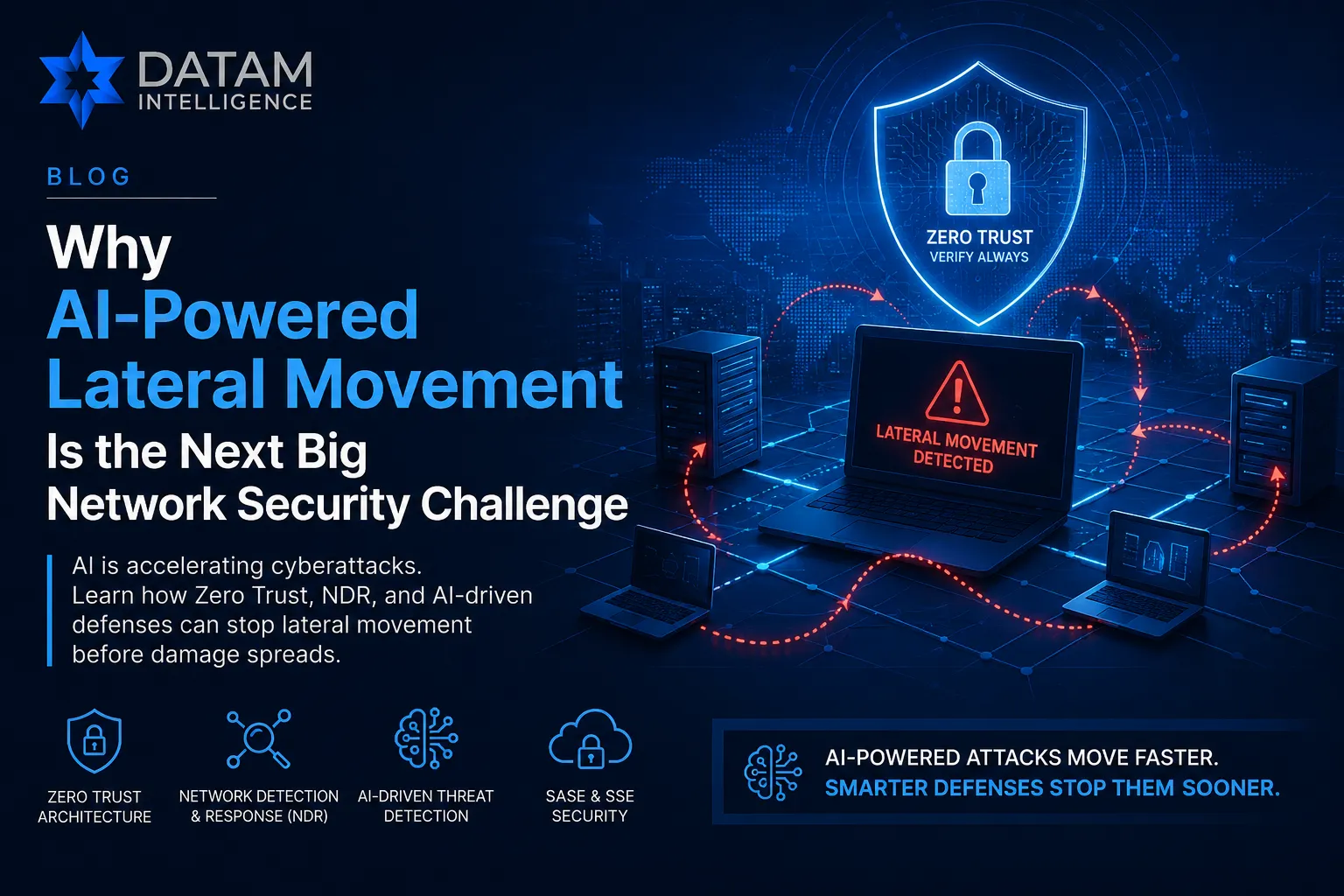
What Is Lateral Movement?
Lateral movement refers to the techniques cybercriminals use to move from an initially compromised system to other devices, servers, applications, and resources within an organization's environment.
Once attackers gain access through:
- Phishing attacks
- Stolen credentials
- Vulnerable applications
- Compromised endpoints
- Supply chain attacks
they rarely stop there.
Instead, they attempt to:
- Escalate privileges
- Access sensitive databases
- Compromise domain controllers
- Move between cloud environments
- Identify business-critical assets
- Deploy ransomware across multiple systems
The longer attackers remain undetected, the more damage they can cause.
Traditionally, lateral movement required manual reconnaissance and attacker expertise. Artificial intelligence is changing that dynamic dramatically.
Why AI Changes the Threat Landscape
Artificial intelligence provides attackers with capabilities that significantly increase attack speed and effectiveness.
Automated Reconnaissance
AI systems can rapidly analyze enterprise environments, map network structures, identify high-value assets, and discover vulnerable systems.
What once required days or weeks can now occur within minutes.
Intelligent Credential Abuse
Compromised credentials remain one of the most common attack vectors.
AI-powered tools can:
- Identify privileged accounts
- Analyze access patterns
- Test authentication pathways
- Prioritize high-value targets
This increases the likelihood of successful privilege escalation.
Adaptive Attack Strategies
Modern AI models can evaluate security controls in real time and dynamically adjust attack techniques to avoid detection.
Rather than following predefined attack paths, AI-assisted malware can adapt based on environmental conditions.
Evasion of Traditional Defenses
Signature-based security tools often struggle against AI-generated attack patterns because they continuously evolve and modify behavior.
This makes threat detection increasingly difficult for legacy security architectures.
The Growing Importance of East-West Traffic Security
For years, cybersecurity strategies focused primarily on securing north-south traffic communications entering and leaving the corporate network.
Today, attackers are increasingly targeting east-west traffic.
East-west traffic includes communications between:
- Servers
- Applications
- Containers
- Virtual machines
- Cloud workloads
- User devices
Once attackers gain access to a network, east-west movement becomes the primary pathway for expanding their reach.
This shift has made internal visibility one of the most important aspects of modern network security.
Organizations that lack visibility into east-west traffic often struggle to detect lateral movement until significant damage has already occurred.
Why Traditional Security Models Are Struggling
Legacy network security architectures were designed around perimeter protection.
These models assumed that:
- Internal users could be trusted
- Network boundaries were well defined
- Applications resided inside corporate data centers
- Remote access was limited
Those assumptions no longer reflect modern business environments.
Today, organizations operate across:
- Public clouds
- Private clouds
- Hybrid environments
- SaaS applications
- Remote workforces
- Edge infrastructure
Traditional security approaches frequently provide excessive access privileges once users authenticate.
This creates opportunities for attackers to move laterally after an initial compromise.
As AI-powered attacks become more adaptive, perimeter-based defenses alone are no longer sufficient.
How Zero Trust Helps Prevent AI-Powered Lateral Movement
Zero Trust Architecture (ZTA) has emerged as one of the most effective cybersecurity frameworks for defending against modern lateral movement attacks, particularly those enhanced by artificial intelligence. As cybercriminals increasingly leverage AI to automate reconnaissance, identify privileged accounts, map network relationships, and move rapidly across enterprise environments, traditional perimeter-based security controls are becoming less effective.
Unlike conventional security models that assume users and devices inside the network can be trusted, Zero Trust operates on a fundamentally different principle:
Never Trust. Always Verify.
Every user, device, application, and connection request must continuously prove its legitimacy before access is granted. This approach significantly limits an attacker's ability to move freely across the network after an initial compromise.
Why Traditional Security Models Struggle Against AI-Powered Threats
Modern AI-driven attacks can rapidly analyze enterprise environments, identify vulnerable pathways, and exploit excessive user permissions far faster than human attackers. Once inside a network, AI-assisted malware can automate lateral movement by targeting weak access controls, compromised credentials, and poorly segmented environments.
In traditional network architectures, a single compromised account may provide access to multiple applications, servers, and sensitive resources. AI-powered attackers exploit these trust relationships to expand their access and reach critical assets before security teams can respond.
Zero Trust eliminates this implicit trust model by continuously evaluating every interaction across the enterprise.
Continuous Verification at Every Access Point
Rather than granting broad access based solely on successful login credentials, Zero Trust evaluates multiple risk factors before authorizing access.
These factors include:
- User identity and authentication status
- Device security posture
- Geographic location
- Network context
- Behavioral patterns
- Session activity
- Risk scores generated by security analytics platforms
For example, if an employee typically accesses financial applications from a corporate laptop in New York but suddenly attempts to connect from an unmanaged device in another country, the Zero Trust system can trigger additional verification requirements, restrict access, or block the session entirely.
This dynamic security model makes it significantly harder for AI-powered attackers to exploit stolen credentials.
Zero Trust Network Access (ZTNA): Eliminating Broad Network Exposure
One of the most important Zero Trust technologies is Zero Trust Network Access (ZTNA).
Traditional VPNs often place authenticated users directly onto the corporate network, allowing visibility into multiple systems and creating opportunities for lateral movement.
ZTNA works differently.
Instead of granting network-level access, users receive access only to specific applications they are authorized to use. Applications remain hidden from unauthorized users, reducing the attack surface and limiting network discovery opportunities.
Key benefits of ZTNA include:
- Eliminating excessive network access
- Reducing lateral movement opportunities
- Hiding internal applications from attackers
- Improving visibility into user activity
- Supporting secure hybrid work environments
Even if an AI-powered attacker compromises a user account, their ability to move throughout the network is significantly restricted.
Least Privilege Access: Limiting the Blast Radius
The principle of least privilege is another core pillar of Zero Trust.
Users, devices, and applications receive only the minimum permissions required to perform their tasks.
This approach reduces risk by ensuring that:
- Administrative privileges are tightly controlled
- Sensitive systems remain isolated
- Access rights are continuously reviewed
- Unnecessary permissions are removed
For AI-powered attackers, limited privileges create barriers that slow movement and reduce opportunities for privilege escalation.
Even if an endpoint becomes compromised, the attacker cannot automatically access critical systems or sensitive databases.
Continuous Authentication and Session Monitoring
Traditional security systems often validate users once during login and then trust them throughout the session.
Zero Trust continuously evaluates trust throughout the entire user journey.
Modern Zero Trust platforms monitor:
- User behavior
- Device activity
- Access requests
- Application interactions
- Data movement patterns
If suspicious activity is detected, security controls can immediately:
- Revoke access
- Require additional authentication
- Restrict privileges
- Trigger incident response workflows
This real-time monitoring capability is especially valuable against AI-powered attacks that evolve dynamically during an intrusion.
Micro-Segmentation: Containing Threats Before They Spread
Micro-segmentation further strengthens Zero Trust by dividing networks into smaller, isolated security zones.
Instead of operating as one large trusted environment, the network is segmented based on:
- Applications
- Workloads
- Business units
- Data sensitivity
- User groups
If an attacker compromises one segment, built-in policies prevent unrestricted movement into other areas of the network.
For organizations concerned about ransomware and AI-driven lateral movement, micro-segmentation serves as a critical containment mechanism.
AI-Powered Security Enhances Zero Trust
Many organizations are now combining Zero Trust frameworks with AI-driven security analytics.
Artificial intelligence can help:
- Detect unusual user behavior
- Identify compromised accounts
- Analyze network anomalies
- Calculate dynamic risk scores
- Automate threat response
This creates a powerful defensive model where AI helps security teams identify and stop AI-powered attacks before they spread across enterprise environments.
The Strategic Advantage of Zero Trust
As enterprise infrastructures become increasingly distributed across cloud platforms, remote work environments, and hybrid networks, lateral movement remains one of the most dangerous stages of modern cyberattacks.
Zero Trust significantly reduces this risk by:
- Verifying every access request
- Limiting user permissions
- Restricting network visibility
- Continuously monitoring activity
- Containing threats through segmentation
- Enabling faster threat detection and response
For organizations preparing for the next generation of AI-driven cyber threats, Zero Trust is no longer simply a security best practice it is becoming a foundational requirement for modern network defense.
Network Detection and Response (NDR): The New Security Imperative
Network Detection and Response (NDR) has become one of the fastest-growing segments within the network security market.
Unlike traditional monitoring solutions, NDR platforms focus specifically on identifying suspicious behavior within network traffic.
Key capabilities include:
- Behavioral analytics
- Threat hunting
- East-west traffic visibility
- Anomaly detection
- AI-powered threat analysis
- Automated response workflows
NDR solutions help organizations identify:
- Ransomware activity
- Insider threats
- Credential misuse
- Unauthorized access attempts
- Advanced persistent threats (APTs)
As AI-driven attacks become more sophisticated, NDR provides the visibility needed to detect lateral movement before major damage occurs.
The Role of SASE and SSE in Modern Network Security
Secure Access Service Edge (SASE) and Security Service Edge (SSE) are reshaping enterprise security architectures.
These frameworks combine networking and security functions into cloud-delivered platforms designed for distributed environments.
Benefits include:
- Consistent security policy enforcement
- Improved cloud visibility
- Reduced infrastructure complexity
- Better protection for remote workers
- Enhanced threat detection capabilities
By moving security controls closer to users and applications, SASE helps reduce attack surfaces and improves protection against AI-powered threats.
As enterprises continue migrating workloads to the cloud, SASE adoption is expected to accelerate significantly.
AI Defending Against AI
Fortunately, organizations can leverage artificial intelligence to strengthen their defenses as well.
AI-powered security platforms help security teams:
- Detect abnormal behavior
- Identify compromised accounts
- Analyze network anomalies
- Prioritize security alerts
- Automate incident response
- Reduce false positives
Machine learning algorithms continuously analyze massive volumes of network activity to uncover patterns that human analysts might miss.
The future of cybersecurity will increasingly involve AI-powered defenses combating AI-powered threats.
Organizations that combine AI security analytics with Zero Trust, NDR, and SASE frameworks will be best positioned to defend against emerging attack techniques.
Industries Facing the Highest Risk
While AI-powered lateral movement attacks pose a threat to organizations across every sector, certain industries face significantly greater risk due to the sensitivity of their data, complexity of their infrastructure, regulatory requirements, and potential operational impact. As cybercriminals increasingly leverage artificial intelligence to automate reconnaissance, credential theft, privilege escalation, and network traversal, these industries are becoming primary targets for sophisticated cyber campaigns.
Banking and Financial Services (BFSI)
The Banking, Financial Services, and Insurance (BFSI) sector remains one of the most targeted industries globally due to the high value of financial assets, customer information, transaction records, and payment systems.
Modern financial institutions operate highly interconnected digital ecosystems that include online banking platforms, mobile applications, payment gateways, cloud environments, trading systems, and third-party service providers. This complexity creates multiple entry points that attackers can exploit.
AI-powered lateral movement attacks enable threat actors to rapidly identify privileged accounts, move between business-critical systems, and access sensitive financial data before detection occurs. Once inside a network, attackers may attempt to compromise customer databases, manipulate transactions, deploy ransomware, or disrupt financial operations.
To mitigate these risks, financial institutions are increasingly investing in:
- Zero Trust Architecture (ZTA)
- Multi-factor authentication (MFA)
- Identity and Access Management (IAM)
- Network Detection and Response (NDR)
- Security Analytics Platforms
- AI-powered fraud detection systems
As regulatory scrutiny continues to increase, financial organizations are prioritizing advanced network security frameworks to maintain customer trust and ensure operational resilience.
Healthcare
Healthcare organizations have become one of the fastest-growing targets for cybercriminals due to the immense value of patient information and the critical nature of healthcare services.
Hospitals, clinics, laboratories, and healthcare networks manage vast amounts of sensitive data, including:
- Electronic Health Records (EHRs)
- Patient medical histories
- Insurance information
- Prescription data
- Clinical research records
In addition to traditional IT systems, healthcare environments often contain thousands of connected medical devices such as infusion pumps, patient monitoring systems, imaging equipment, and diagnostic tools.
Many of these devices were not originally designed with modern cybersecurity protections, creating vulnerabilities that AI-powered attackers can exploit.
A successful lateral movement attack within a healthcare network can result in:
- Patient data breaches
- Service disruptions
- Delayed medical procedures
- Ransomware incidents
- Regulatory penalties
To address these challenges, healthcare providers are increasingly adopting micro-segmentation, Zero Trust security models, and continuous monitoring solutions to improve visibility across both IT and medical device networks.
Manufacturing
The manufacturing sector is undergoing rapid digital transformation through Industry 4.0 initiatives, smart factories, industrial IoT deployments, and connected production environments.
While these advancements improve operational efficiency, they also expand the attack surface available to cybercriminals.
Manufacturers rely heavily on Operational Technology (OT) systems, including:
- Industrial Control Systems (ICS)
- Supervisory Control and Data Acquisition (SCADA) platforms
- Robotics systems
- Production line automation
- Industrial sensors and connected machinery
Historically, many OT environments operated in isolation. Today, increasing integration between IT and OT networks has created new pathways for lateral movement attacks.
AI-powered attackers can leverage compromised endpoints to move between corporate networks and production environments, potentially causing:
- Production downtime
- Equipment failures
- Supply chain disruptions
- Intellectual property theft
- Safety incidents
As a result, manufacturers are investing in industrial network security, OT visibility platforms, network segmentation, and AI-powered threat detection technologies to secure critical operations.
Government and Public Sector
Government agencies manage some of the world's most sensitive information and critical infrastructure systems, making them attractive targets for nation-state actors, cybercriminal groups, and advanced persistent threat (APT) campaigns.
Public-sector organizations oversee:
- National security systems
- Citizen databases
- Tax records
- Law enforcement information
- Defense infrastructure
- Public utilities
- Election systems
Many government environments contain large, complex networks with legacy systems that can be difficult to secure and modernize.
AI-powered lateral movement attacks can enable adversaries to:
- Access classified information
- Disrupt public services
- Compromise critical infrastructure
- Conduct espionage activities
- Exfiltrate sensitive data
Governments worldwide are responding by implementing Zero Trust mandates, strengthening identity controls, expanding threat intelligence programs, and deploying advanced network monitoring technologies.
The increasing focus on cyber resilience is driving significant investments in next-generation network security frameworks across public-sector environments.
Technology and Telecommunications
Technology companies and telecommunications providers sit at the center of the modern digital economy, supporting cloud computing, software services, internet connectivity, and digital communications.
These organizations often manage highly distributed environments consisting of:
- Multi-cloud infrastructures
- Data centers
- SaaS platforms
- Edge computing resources
- 5G networks
- Global communications systems
The scale and complexity of these environments make them attractive targets for attackers seeking widespread impact.
AI-powered cyber threats can exploit interconnected systems to move laterally across cloud workloads, applications, virtual machines, and user environments at unprecedented speed.
A successful compromise within a technology or telecommunications environment can result in:
- Service outages
- Data breaches
- Customer account compromise
- Supply chain attacks
- Infrastructure disruption
To defend against these risks, technology providers are increasingly implementing:
- Secure Access Service Edge (SASE)
- Security Service Edge (SSE)
- Zero Trust Network Access (ZTNA)
- Cloud-native security platforms
- AI-driven threat detection
- Continuous risk assessment frameworks
As digital ecosystems continue expanding, maintaining visibility across complex network environments remains a critical challenge for security teams.
Why These Industries Require Advanced Network Security
Although every organization faces cybersecurity risks, industries handling sensitive data, critical infrastructure, financial assets, healthcare services, or large-scale digital operations face disproportionately higher consequences from successful attacks.
AI-powered lateral movement has amplified these risks by enabling attackers to move faster, adapt to security controls, and target valuable assets with greater precision.
For organizations operating within these sectors, investing in modern network security technologies such as Zero Trust Architecture, Network Detection and Response (NDR), AI-powered threat analytics, micro-segmentation, and SASE frameworks is no longer optional it is essential for maintaining business continuity, regulatory compliance, and long-term cyber resilience.
Strategic Recommendations for Security Leaders
To defend against AI-powered lateral movement attacks, organizations should prioritize:
Adopt Zero Trust Architecture
Implement continuous verification, least-privilege access, and Zero Trust Network Access (ZTNA).
Invest in Network Detection and Response
Deploy NDR platforms to improve visibility across east-west traffic and identify suspicious behavior.
Expand Network Segmentation
Reduce attack surfaces through micro-segmentation and workload isolation.
Leverage AI-Powered Security Analytics
Use machine learning and behavioral analytics to improve threat detection and response capabilities.
Modernize Security Infrastructure
Adopt cloud-native security frameworks such as SASE and SSE to support distributed environments.
Strengthen Identity Security
Implement multi-factor authentication (MFA), privileged access management, and identity governance controls.
Frequently Asked Questions
What is AI-powered lateral movement?
AI-powered lateral movement refers to the use of artificial intelligence to automate attacker activities such as reconnaissance, credential abuse, privilege escalation, and movement between systems after initial compromise.
Why is lateral movement dangerous?
Lateral movement enables attackers to access sensitive assets, escalate privileges, deploy ransomware, and increase the overall impact of cyberattacks.
How can organizations prevent lateral movement attacks?
Organizations can reduce risks through Zero Trust Architecture, Network Detection and Response (NDR), micro-segmentation, identity security controls, and continuous monitoring.
What role does AI play in network security?
AI improves threat detection, behavioral analytics, anomaly identification, incident response automation, and security operations efficiency.
What industries face the highest risk?
Banking, healthcare, manufacturing, government, technology, and telecommunications organizations are among the most targeted industries due to their valuable assets and complex infrastructures.
Analyst Perspective
The rise of AI-powered cyberattacks represents a fundamental shift in the threat landscape. While traditional security models focused on preventing unauthorized access, modern organizations must also address what happens after attackers gain entry.
Lateral movement remains one of the most dangerous stages of a cyberattack because it enables threat actors to expand control, access critical assets, and maximize operational disruption.
Organizations that combine Zero Trust Architecture, Network Detection and Response, AI-powered analytics, and cloud-native security frameworks will be significantly better positioned to defend against the next generation of cyber threats.
As enterprise environments continue to evolve, internal visibility and east-west traffic security will become defining factors in cybersecurity success.
Explore the Full Market Analysis
As organizations accelerate investments in Zero Trust, SASE, AI-powered threat detection, Network Detection and Response (NDR), and advanced cybersecurity architectures, understanding market dynamics becomes increasingly important.
For detailed market forecasts, competitive intelligence, technology adoption trends, vendor benchmarking, and regional spending analysis, explore DataM Intelligence's comprehensive Network Security Market Report.
Related Reports
Network security is increasingly interconnected with technologies such as Zero Trust, AI-driven threat detection, security analytics, and managed security services. As organizations modernize cybersecurity strategies to combat ransomware, AI-powered attacks, and evolving network threats, understanding adjacent security markets becomes essential for informed decision-making. Explore the following reports for deeper insights into the technologies, trends, and investment opportunities shaping the future of enterprise cybersecurity and network protection.
Zero Trust Security Market
Organizations are increasingly adopting Zero Trust frameworks to secure users, devices, and applications through continuous verification and least-privilege access controls.
Managed Security Services Market
Businesses are partnering with managed security providers to improve threat detection, incident response, and continuous security monitoring.
Security Analytics Market
Security analytics solutions leverage AI, machine learning, and behavioral monitoring to identify cyber threats and improve security operations.
Artificial Intelligence (AI) in Security Market
AI-powered cybersecurity platforms are transforming threat detection, risk assessment, and automated response capabilities across enterprise environments.