


The humanoid robot race has moved beyond robots dancing on stage or carrying boxes in carefully controlled demonstrations.
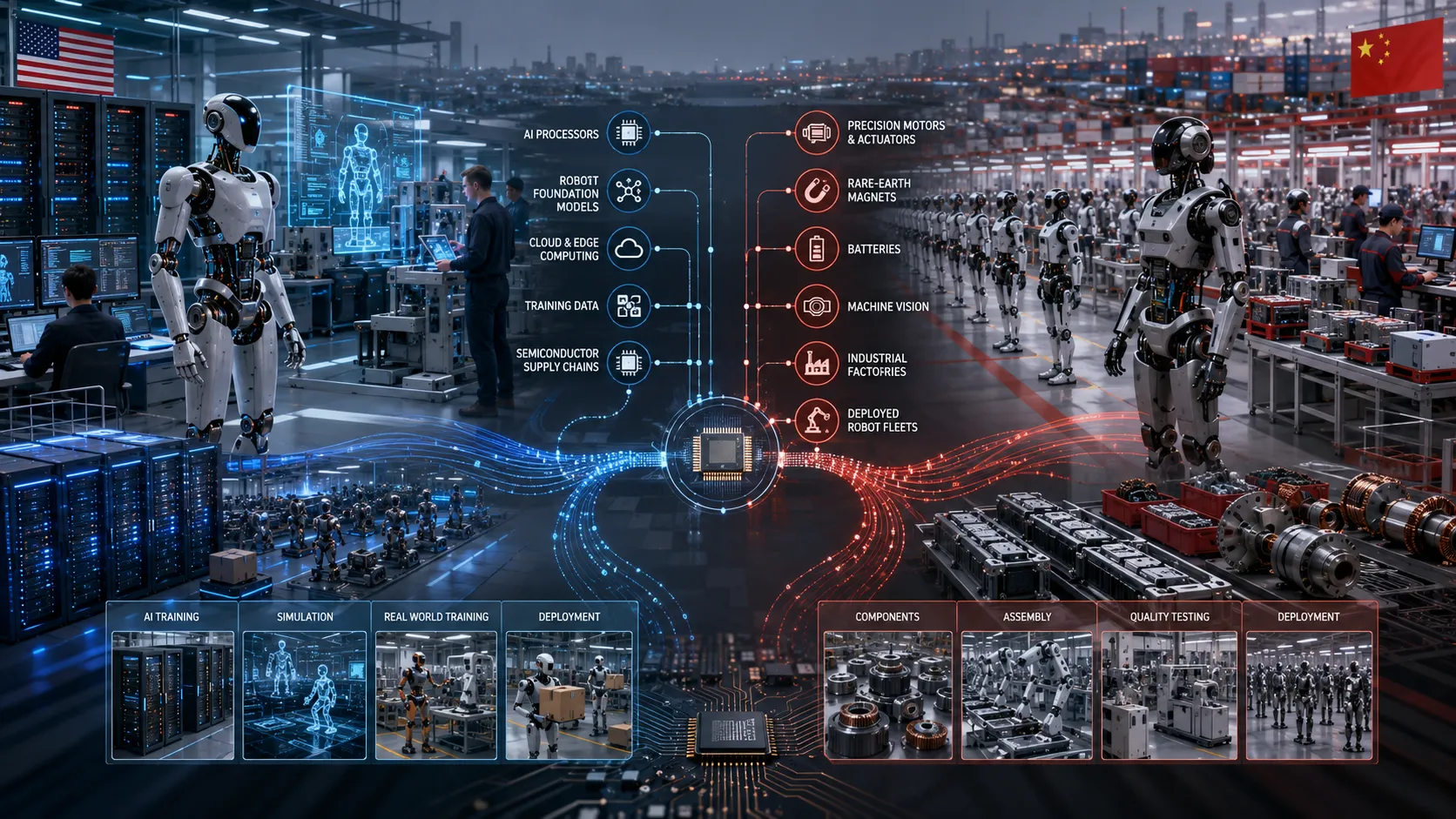
In 2026, the more important question is who can manufacture robots cheaply, train them with real-world data, secure the chips and components inside them, and deploy thousands of machines into factories where they can keep learning.
China expects its humanoid robot output to exceed 100,000 units in 2026, according to a Ministry of Industry and Information Technology official. Unitree alone says it shipped more than 5,500 humanoid robots in 2025 and produced more than 6,500. In the United States, Tesla is installing its first-generation Optimus production line in Fremont and said in July that production was expected to begin soon.
Those numbers are not directly comparable. Tesla has not disclosed commercial Optimus shipments comparable with Unitree's figure, and China's national production forecast covers multiple manufacturers.
But they reveal something important.
China has entered the volume-building phase earlier. The United States is placing a heavier bet on AI capability, software, compute, and vertically integrated robot intelligence.
That makes humanoid robotics a new technology-sovereignty contest.
Request for Exclusive Sample on Humanoid Robots Market
Why Humanoid Robots Are Becoming a National Technology Issue
A useful humanoid robot combines several industries that governments already consider strategic: artificial intelligence, advanced semiconductors, batteries, sensors, electric motors, precision manufacturing, machine vision and industrial software.
China has made that connection explicit.
Its national humanoid-robot policy called for breakthroughs in the robot's "brain," "cerebellum" and "limbs," while building secure supplies of core components. The 2026 government work agenda also identifies embodied AI among the industries China intends to develop as part of its next generation of economic activity.
The United States has approached the issue differently, with private companies playing the larger visible role. Yet robotics has already entered national-security policy. In September 2025, the U.S. Department of Commerce opened a Section 232 national-security investigation into imports of robotics and industrial machinery, including robots, computer-controlled mechanical systems, parts and components.
That is an important change in language.
Robots are no longer being treated only as factory equipment. They are increasingly connected to industrial resilience, AI leadership and national manufacturing capacity.
China's Advantage Is Starting to Look Like Manufacturing Economics
Unitree illustrates why China cannot be judged only by the intelligence of its latest robot.
The company currently lists its G1 humanoid from $13,500. Its newer R1 line starts at $4,900 before tax and shipping, although these products have different capabilities and should not be treated as substitutes for industrial humanoids. Unitree itself warns that the global humanoid industry remains at an early stage.
That price point matters because robotics improves when developers can put more machines into laboratories, universities, factories and training facilities.
More robots can mean more testing, more component orders, more failures identified and more physical data collected.
China is now trying to industrialize exactly that process.
A June 2026 program from MIIT and China's State-owned Assets Supervision and Administration Commission asks participating regions and state-owned enterprises to create real-world training environments covering manufacturing, inspection, maintenance, logistics, retail, healthcare, emergency response and other tasks. It targets more than 100 high-value application scenarios and aims to build the ability to support deployment at a scale of tens of thousands of units.
The same program encourages commercial models including robot-as-a-service, operating leases and payment based on actual use.
That deserves more attention than another video of a robot doing a backflip.
China is working on the mechanism that could convert an expensive capital purchase into an operating expense for factories. If that model succeeds, smaller manufacturers would not necessarily need to buy a humanoid robot outright. They could rent robotic labor or pay according to output.
Tesla Is Building a Very Different Robotics Machine
Tesla's advantage is not that Optimus is already being shipped in Unitree-like numbers. It is that Tesla is trying to connect robot manufacturing with its existing capabilities in AI, batteries, electronics and large-scale production.
Its latest update shows that this transition is becoming physical.
Tesla said in July that it had decommissioned the Model S and Model X manufacturing lines at Fremont and was installing first-generation Optimus lines in their place. Initial robots from the line are intended for an "Optimus Academy," where Tesla plans to collect training data and develop additional functionality. Construction related to Optimus is also under way in Texas.
Earlier in 2026, Tesla said its first Fremont line was being designed around eventual capacity of one million robots per year, while a later-generation Texas line was being designed for long-term annual capacity of 10 million. These are design ambitions rather than current production numbers, and actual manufacturing at those levels has not been demonstrated.
Tesla is also putting substantial compute behind physical AI. Its Q2 update says Cortex 2 in Texas supports development of both vehicle and humanoid autonomy software.
This is where the Tesla strategy becomes interesting.
A car factory gives Tesla a place to manufacture a robot, but it also gives the robot somewhere to work. Internal deployment can create a loop:
build the robot → place it in a Tesla facility → collect failure and task data → retrain the software → update the fleet → redesign the hardware.
The company does not need to wait for a large outside customer before gathering useful industrial experience.
But the U.S. Robotics Race Is Bigger Than Tesla
Tesla receives the most consumer attention, but the U.S. humanoid ecosystem is becoming much broader.
Figure says its BotQ facility increased Figure 03 production from roughly one robot per day to one per hour in less than 120 days and had delivered more than 350 third-generation humanoids by late April 2026. Figure previously said the first BotQ line was designed for capacity of up to 12,000 humanoids annually.
Apptronik announced in February that its Series A funding had grown to more than $935 million, with investors and strategic backers including Google, Mercedes-Benz and others. In June it expanded Robot Park in Austin, where Apollo 2 fleets collect physical-world data for training robot AI in cooperation with Google DeepMind.
Agility Robotics, meanwhile, has moved Digit into commercial industrial deployments and announced a 2026 agreement with Toyota Motor Manufacturing Canada following a pilot.
The U.S. strategy therefore looks increasingly like a competition between several well-funded AI and robotics platforms rather than one national champion.
Request for Customized Sample As Per Your Business Requirements on Humanoid Robots Market
The Most Interesting Twist: The U.S. and China Robot Stacks Are Still Connected
The idea of a clean U.S.-versus-China technology split breaks down when the robot itself is opened up.
In June 2026, NVIDIA announced an Isaac GR00T reference humanoid built around Unitree's H2 Plus body, Sharpa hands, NVIDIA Jetson Thor compute, and NVIDIA's GR00T robotics software.
Unitree's own H2 Plus specifications list Jetson Thor-based computing with as much as 2,070 FP4 TFLOPS for onboard inference and robot control.
A Chinese humanoid body running an American AI computing and software platform is not a minor detail.
It shows that today's physical-AI supply chain remains interconnected even while both governments place more emphasis on technology sovereignty.
Semiconductors are already subject to this tension. In January 2026, the U.S. Bureau of Industry and Security moved exports of NVIDIA H200, AMD MI325X and similar advanced AI processors to China to case-by-case license review under specified requirements. That rule does not establish that Jetson Thor is subject to the same treatment, but it shows how access to computing technology has already become a geopolitical lever.
The Next Strategic Asset May Be Robot Data
There is another resource neither country can simply import by the container load: high-quality physical-world training data.
Tesla's Optimus Academy is being created to gather it. Apptronik's Robot Parks are collecting it through fleets of Apollo machines. China's June 2026 program specifically calls for high-quality datasets containing whole-body trajectories, force-control information, action sequences, spatial information and abnormal operating conditions.
That makes factories something more than customers.
They are becoming training grounds for embodied AI.
A robot that spends thousands of hours handling irregular parts, recovering from mistakes and working around humans can create data that is difficult to reproduce through simulation alone.
Data sovereignty could therefore become as important to robotics as semiconductor sovereignty.
Components Could Become the Quiet Battleground
The intelligence inside the robot gets the headlines, but a humanoid cannot walk without motors, gearboxes, bearings, encoders, batteries and sensors.
Unitree's G1, for example, uses permanent-magnet synchronous joint motors and industrial crossed-roller bearings. Its newer G1-D platform says Unitree uses proprietary actuators, gearboxes, encoders and sensors.
China also introduced export licensing requirements in 2025 covering several rare-earth-related items. The exact magnet composition used by Unitree is not disclosed, so it would be wrong to claim those controls directly affect a particular Unitree motor. But permanent-magnet supply illustrates why robotics policy increasingly reaches deep into raw materials and components rather than stopping at the finished machine.
The U.S. Section 232 robotics investigation similarly includes parts and components, reinforcing the same point from the American side.
So, Who Is Winning the U.S.-China Humanoid Robot Race?
DataM Intelligence assesses China as having the stronger current position in low-cost hardware availability, manufacturing depth and early volume production.
Unitree's disclosed shipments, aggressive product pricing and China's national deployment program support that conclusion. China also expects national humanoid output to cross 100,000 units this year.
The United States has a different advantage: AI compute, robot foundation-model infrastructure, private capital and several companies pursuing vertically integrated physical AI.
Tesla's Optimus factories, NVIDIA's GR00T platform, Figure's BotQ ramp and Apptronik's AI-training infrastructure show that the U.S. effort is moving from prototypes toward industrial systems.
Neither side has won.
The deciding metric will not be which robot can dance better or run faster at a product launch.
Watch hours of useful autonomous work, intervention rates, task success, robot cost, component localization, fleet learning speed and annual manufacturing output.
Those numbers will tell us when humanoid robotics stops being a technology demonstration and starts becoming industrial infrastructure.
What Investors Should Watch Next
For investors, the humanoid story is wider than the robot manufacturer.
The companies that control robot AI chips, simulation software, motors, actuators, precision components, batteries, sensors and training infrastructure may capture value before general-purpose humanoids reach very large commercial fleets.
There is also an unusual geopolitical complication: suppliers may participate in both ecosystems. NVIDIA's collaboration with Unitree shows how an American computing platform can accelerate development of a Chinese humanoid at the same time that Washington is tightening controls around other categories of advanced computing.
That tension is likely to become one of the defining business questions of physical AI.
The first phase of the humanoid race was about who could build a robot.
The next phase is about who can build the industrial system around millions of robots.
That is why humanoids are becoming the next U.S.-China technology-sovereignty battleground.
Frequently Asked Questions
Is China ahead of the United States in humanoid robots?
China currently has a clear advantage in disclosed production volume and low-cost commercial hardware. Unitree shipped more than 5,500 humanoids in 2025, while China expects total national output to exceed 100,000 units in 2026. The United States remains highly competitive in AI software, computing platforms, investment and advanced robotics development.
Is Tesla Optimus already in mass production?
Not yet according to Tesla's latest published update. In July 2026, Tesla said it was installing its first-generation Optimus manufacturing lines in Fremont and expected production to start soon. The first builds are intended for training-data collection and development through the Optimus Academy.
How much does a Unitree humanoid robot cost?
Unitree currently advertises its R1 AIR from $4,900, the standard R1 from $5,900 and its G1 from $13,500 before taxes and shipping. Capabilities differ considerably between models, so price alone does not indicate suitability for industrial work.
Why are humanoid robots important to national security?
Humanoid robots combine AI, advanced computing, precision machinery, sensors and industrial automation. The U.S. Department of Commerce has already opened a national-security investigation covering imports of robotics and industrial machinery, while China has made secure humanoid-robot supply chains part of its industrial policy.
Will humanoid robots be made entirely in either the U.S. or China?
Not necessarily. Current supply chains remain international. NVIDIA and Unitree's H2 Plus collaboration is a clear example: the reference platform combines a Chinese robot body with NVIDIA's U.S.-developed Jetson Thor computing platform and Isaac GR00T software.
What is the most important humanoid robot trend to watch?
DataM Intelligence considers real-world deployment data one of the most important indicators. China, Tesla, and U.S. robotics startups are all building environments specifically to collect physical task data and improve robot models. The company or ecosystem that can turn the largest quantity of high-quality operating experience into reliable autonomous behavior could develop an advantage that hardware specifications alone do not capture.
Read Complete Research Report: Humanoid Robots Market