


The nuclear industry is entering a different investment cycle. Reactor restarts, operating-life extensions and interest in advanced reactors are increasing scrutiny of an often-overlooked link in the fuel chain: uranium enrichment. While uranium mining draws headlines, utilities cannot load mined uranium directly into most commercial reactors. Enrichment is the specialized service that makes much of that fuel usable.
What Is Uranium Enrichment?
Natural uranium contains mainly uranium-238 and approximately 0.7% uranium-235, the isotope that sustains the chain reaction in most commercial nuclear power plants. Enrichment increases the share of uranium-235. Most conventional reactors use low-enriched uranium (LEU), typically around 3-5% uranium-235. Some advanced designs are expected to use higher-assay low-enriched uranium (HALEU), generally above 5% but below 20%.
Think of the process as concentrating a small but essential ingredient within a much larger mixture. Industrial enrichment plants typically use gas centrifuges to separate uranium isotopes. Their output is measured in separative work units (SWU), which reflect the effort needed for the separation. A utility buys uranium material and enrichment services before fuel is fabricated into reactor-ready assemblies.
Three terms matter commercially: uranium feedstock is the raw material; conversion makes a chemical form suitable for enrichment; SWU is the enrichment service. A shortage at any one stage can delay fuel availability even when uranium ore is abundant.
Request Sample: https://www.datamintelligence.com/download-sample/uranium-enrichment-market
Why the Market Is Changing
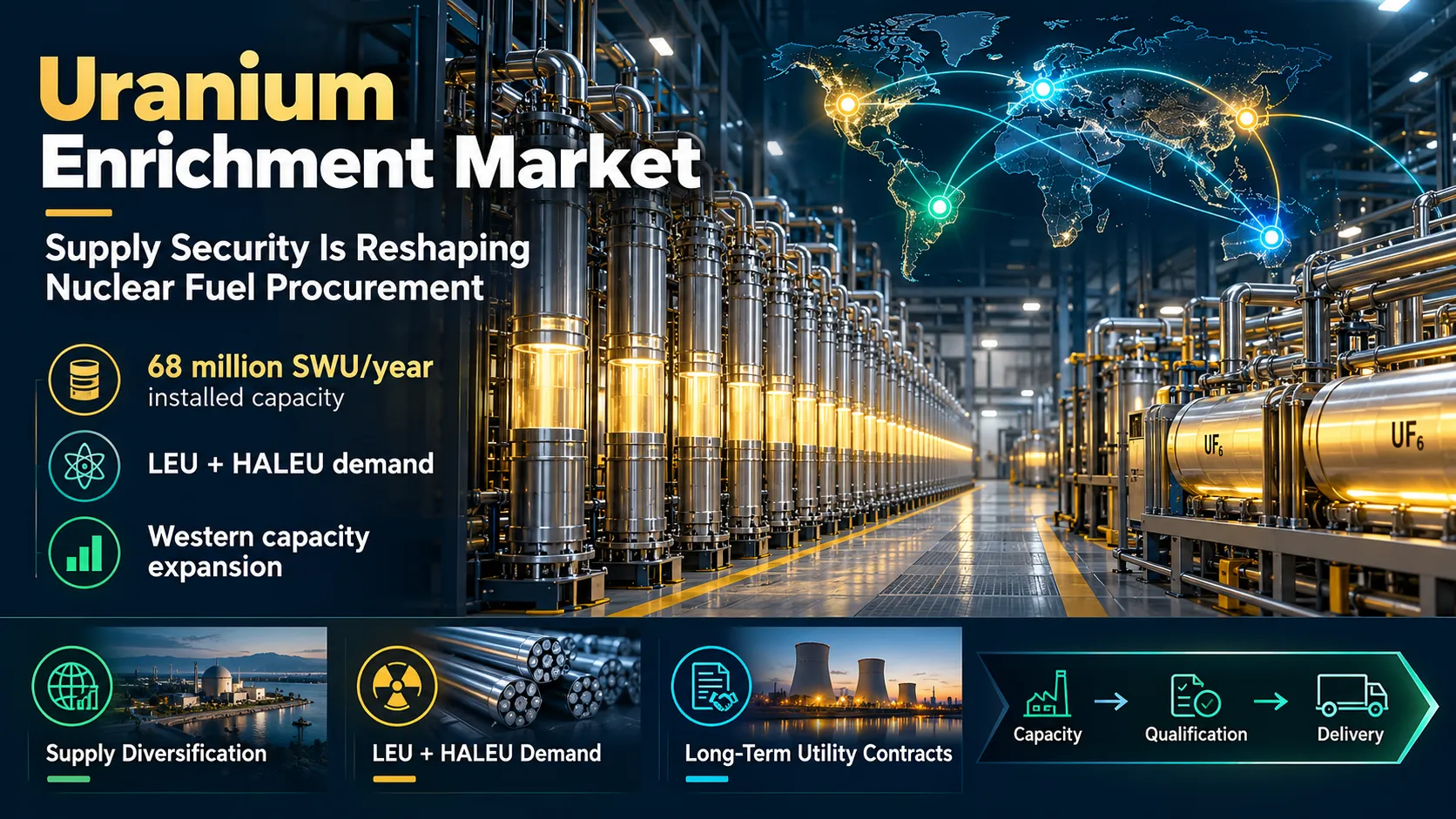
The World Nuclear Association estimates global enrichment capacity at approximately 68.1 million SWU per year in 2025, rising to approximately 77.8 million SWU by 2030. Capacity is highly concentrated: Rosatom, Urenco, Orano and China’s CNNC dominate the installed base. These are capacity estimates, not a dollar-value forecast.
Geopolitics has become a major procurement driver. U.S. restrictions on Russian uranium products began in 2024, with limited waivers permitted only through January 1, 2028. That timetable is encouraging utilities and policymakers to diversify contracted supply and accelerate new non-Russian capacity.
Major Growth Opportunities
1. Western Enrichment Capacity Expansion
Urenco announced in June 2026 plans for a further 2.1 million SWU of U.S. capacity, with initial production targeted for 2032. Orano is expanding its Georges Besse II site in France while pursuing a U.S. facility. These projects create demand for equipment, construction, specialized services and multiyear customer contracts.
2. HALEU for Advanced Reactors
Many proposed small modular and advanced reactors require fuel with higher enrichment than conventional LEU. In January 2026, the U.S. Department of Energy awarded $900 million each to American Centrifuge Operating, a Centrus subsidiary, and General Matter for HALEU capacity. The opportunity remains tied to actual reactor deployment, licensing and fuel qualification timelines.
3. Long-Term Fuel Supply Security
Utilities are increasingly evaluating counterparty risk, origin restrictions and delivery schedules alongside SWU prices. Suppliers with dependable licensed capacity and transparent supply chains may benefit from longer-duration agreements. This creates strategic value beyond the lowest quoted enrichment price.
4. Capacity Upgrades and Industrial Localization
Repowering existing plants, adding centrifuge capacity and establishing domestic manufacturing ecosystems may offer more predictable expansion routes than entirely new facilities. Government support is particularly important because enrichment projects require large upfront investment and long permitting cycles.
5. Advanced Fuel and Flexible Product Grades
The market is gradually moving beyond standard LEU toward LEU+ grades and HALEU. That expands the need for fuel qualification, regulatory oversight, specialized logistics and coordination with conversion and fuel-fabrication providers.
Where Is the Market Headed Through 2035?
The next decade is likely to produce two overlapping markets: large-volume enrichment for existing reactors and a smaller, strategically important market for advanced-reactor fuel. The pace of the second market depends on whether demonstration projects translate into operating fleets.
Three changes will shape competitive advantage: new supply capacity outside Russia, tighter integration of enrichment with conversion and fabrication, and more sophisticated procurement strategies prioritizing resilience. Global capacity can expand while particular regions still face constrained access because not all suppliers are commercially interchangeable under sanctions, licensing rules and national policy.
The core challenge through 2035 will be matching capital-intensive enrichment expansion to nuclear projects whose construction schedules may change. A durable competitive advantage will depend on execution certainty, licensing, delivered cost and the ability to secure long-term customers.
Key Companies in the Uranium Enrichment Market
The supplier landscape is unusually concentrated. The following ten organizations include established commercial enrichers, national operators and emerging developers; they should not be interpreted as ten peers with comparable operating capacity.
- Rosatom / TENEX - Major Russian enrichment supplier with extensive established centrifuge capacity and international nuclear-fuel exposure.
- Urenco - Leading Western enrichment provider operating in Europe and the United States with ongoing capacity expansions.
- Orano - French nuclear fuel-cycle group expanding enrichment in France and advancing a U.S. facility.
- China National Nuclear Corporation (CNNC) - Major Chinese state-owned nuclear fuel-cycle operator supporting domestic reactor growth.
- Centrus Energy / American Centrifuge Operating - U.S. enrichment developer transitioning HALEU demonstration activity toward commercial expansion.
- Japan Nuclear Fuel Limited (JNFL) - Japan-based national fuel-cycle operator developing domestic enrichment capability.
- Indústrias Nucleares do Brasil (INB) - Brazilian state-controlled fuel-cycle company building domestic enrichment capability.
- General Matter - Emerging U.S. enrichment developer selected for a 2026 DOE HALEU capacity award.
- Global Laser Enrichment (GLE) - Developer pursuing laser-based uranium enrichment technology in the United States.
- Laser Isotope Separation Technologies (LIS Technologies) - Emerging U.S. laser-enrichment technology developer participating in domestic supply-chain initiatives.
Other participants include Silex Systems, Cameco, Kazatomprom, Framatome, Westinghouse, Global Nuclear Fuel, X-energy and BWX Technologies. Several operate in adjacent fuel-cycle, technology or end-user segments rather than selling commercial enrichment SWU directly.
Competition increasingly centers on licensed production capacity, supply-chain independence, delivery reliability, HALEU readiness, government support and the ability to integrate with conversion and fuel fabrication. For buyers, credible delivery dates may matter as much as announced plant capacity.
Request Sample: https://www.datamintelligence.com/download-sample/uranium-enrichment-market
The Bigger Opportunity
Uranium enrichment is moving from a relatively stable outsourced service toward a strategic energy-security infrastructure market. Through 2035, the most valuable opportunities will emerge where nuclear-fuel demand, public funding and executable enrichment projects intersect.