


The U.S. Drone Market Has Entered a Supply-Chain Reset
The United States is treating foreign drone dependence as an industrial, cybersecurity, and national-security risk-not simply a trade imbalance.
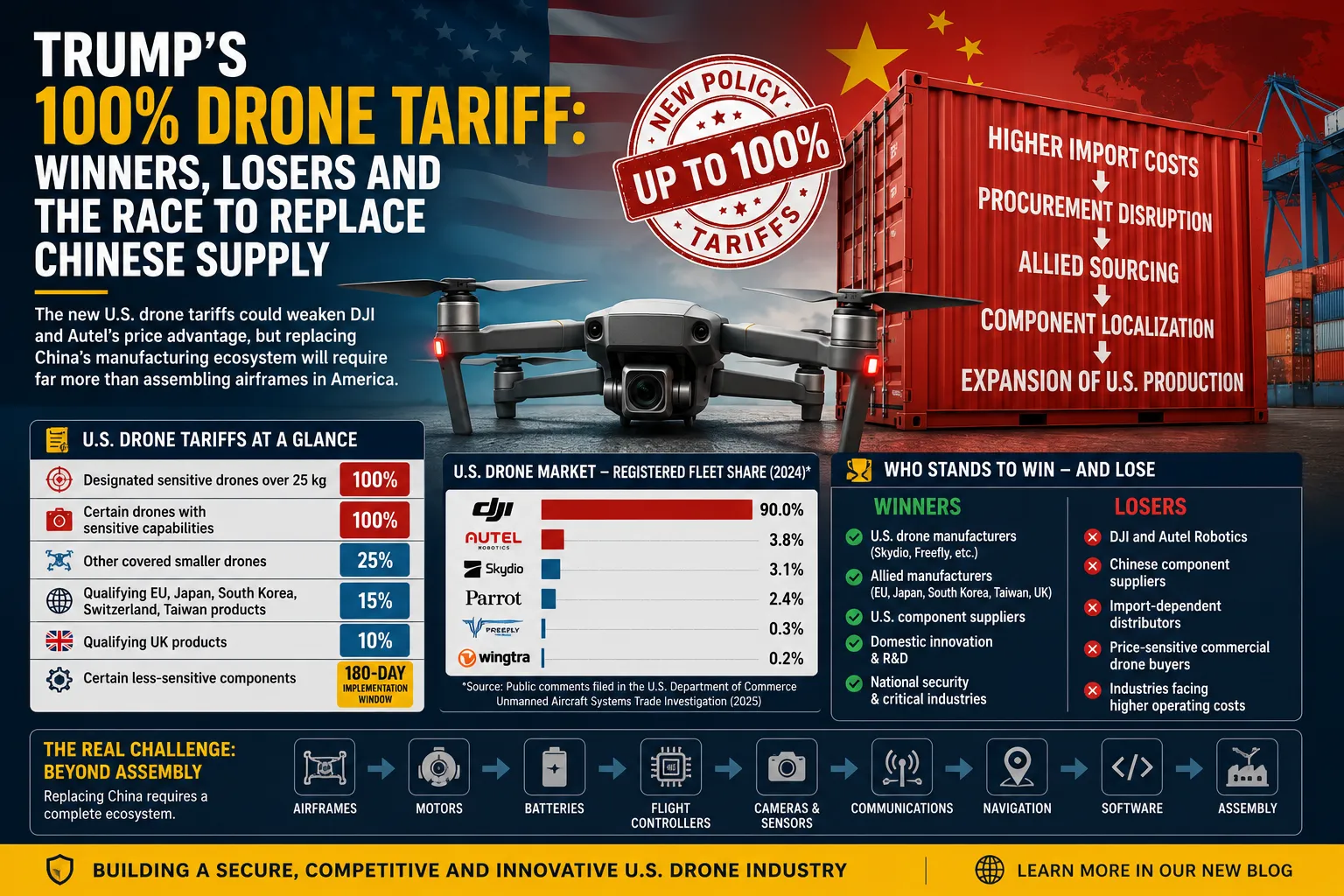
On August 13, 2026, President Donald Trump announced tariffs of up to 100% on designated sensitive imported drones. The highest rate covers certain drones weighing more than 25 kilograms and systems with specified capabilities, including some thermal-imaging equipment. Other covered smaller drones face a 25% tariff, while qualifying products from selected allies receive lower rates.
This is not a universal 100% tariff on every Chinese drone. The applicable rate depends on the product, country of origin, and implementing rules. China is nevertheless at the center of the disruption because DJI, Autel Robotics, and Chinese component suppliers occupy critical positions across the U.S. drone ecosystem.
The likely transition is:
Higher import costs → procurement disruption → allied sourcing → component localization → gradual expansion of U.S. production
The policy creates an opening for American manufacturers. It does not guarantee that they can immediately match China’s price, volume, component availability, or product range.
Request for Exclusive Sample: https://www.datamintelligence.com/research-report/unmanned-aerial-vehicle-market
What Trump’s Drone Tariffs Actually Cover
| Product or qualifying origin | Tariff treatment |
| Designated sensitive drones over 25 kg | 100% |
| Certain drones with sensitive capabilities | 100% |
| Other covered smaller drones | 25% |
| Qualifying EU, Japanese, South Korean, | 15% |
| Swiss and Taiwanese products | |
| Qualifying UK products | 10% |
| Certain less-sensitive components | 180-day implementation window |
The new measures build on the White House’s June 2025 “Unleashing American Drone Dominance” executive order, which directed federal agencies to strengthen domestic UAS manufacturing and expand exports of trusted American systems.
The policy also covers critical components and certain docking stations. Its commercial impact therefore extends below the finished aircraft.
Why the Tariff Is Bigger Than DJI
DJI is the most visible target, but China’s competitive strength comes from an integrated supply chain:
Airframes → motors → batteries → flight controllers → cameras → sensors → communications → navigation → software → assembly
An American company may assemble a drone domestically while still relying on Chinese battery cells, magnets, motors, circuit boards, or imaging modules. Final assembly in the United States does not necessarily create an independent U.S. supply chain.
The tariff is therefore attempting to address two separate issues:
- Chinese dominance of finished-drone sales
- U.S. dependence on Chinese components and manufacturing
Replacing imported aircraft can happen faster than rebuilding the component ecosystem supporting them.
How Dependent Is the U.S. on Chinese Drones?
A submission during the U.S. Department of Commerce’s 2025 unmanned-aircraft investigation cited 2024 Part 107 registration data showing substantial market concentration.
| Manufacturer | Associated country | Share of cited registrations |
| DJI | China | 90.00% |
| Autel Robotics | China | 3.80% |
| Skydio | United States | 3.10% |
| Parrot | France | 2.40% |
| Freefly Systems | United States | 0.30% |
| Wingtra | Switzerland | 0.20% |
Registration share is not the same as current annual sales or import value. It does, however, illustrate the installed-base challenge facing domestic replacements.
Company-level exposure should be measured using registration data, verified shipment records or corporate disclosures. Country-level imports can be analyzed through HS 8806 customs data. National trade figures should not be presented as audited export shares for individual private companies.
Foreign Drone Companies Facing the Greatest Exposure
| Company | Country | Principal exposure |
| DJI | China | Large U.S. commercial installed base and regulatory scrutiny |
| Autel Robotics | China | Enterprise and consumer exposure similar to DJI |
| Parrot | France | Lower allied-country tariff may improve relative competitiveness |
| Wingtra | Switzerland | Potential opportunity in surveying and mapping |
| Potensic | China | Price-sensitive consumer products |
| Holy Stone | China | Entry-level and recreational drones |
| Hubsan | China | Consumer and prosumer systems |
| HOVERAir | China | Autonomous personal-camera drones |
| Yuneec | China | Consumer and professional systems |
| FIMI | China | Value-oriented camera drones |
DJI and Autel face the greatest strategic pressure. Other Chinese consumer brands are especially vulnerable because tariffs can weaken the low-price positioning on which they compete.
Allied manufacturers may gain a relative advantage, but they still face tariffs, origin requirements, and production-capacity constraints.
Why Replacing DJI Will Be Difficult
DJI’s competitive position goes beyond airframe pricing. Its products are embedded in the workflows of construction teams, surveyors, farmers, emergency responders, energy companies and infrastructure inspectors.
Changing platforms may require replacing:
- Batteries, chargers and spare parts
- Cameras and sensor payloads
- Flight-planning software
- Mapping and data-processing workflows
- Docking systems
- Pilot training
- Maintenance procedures
- Fleet-management tools
American manufacturers must therefore deliver more than a compliant aircraft. They need a complete, reliable and supportable operating ecosystem.
Can Chinese Production Move Through Malaysia?
The new tariff puts greater emphasis on the distinction between brand nationality, assembly location and legal country of origin.
A drone assembled in Malaysia could still contain Chinese batteries, motors, sensors and flight-control electronics. Shipping a product through another country does not change its origin.
Importers may face greater scrutiny of:
- Bills of materials
- Manufacturing steps
- Component suppliers
- Battery and motor origin
- Software provenance
- Contract-manufacturing arrangements
- Supplier declarations
- Transshipment patterns
Malaysia, Vietnam, and other Asian manufacturing centers could attract new investment. However, supply-chain diversification will remain incomplete unless component manufacturing moves with final assembly.
China’s Export Controls Create a Second Supply Shock
U.S. import tariffs are only one side of the disruption. On August 5, 2026, China announced tighter controls on U.S.-bound drones and related technologies, including case-by-case scrutiny.
China had already placed several American aerospace and drone businesses-including Red Cat Holdings and Teal Drones-on its export-control list in June 2026. Chinese exporters were prohibited from supplying covered dual-use goods to those companies, including indirectly through third countries.
This creates a potential contradiction for U.S. industrial policy: tariffs increase demand for American-made drones while Chinese restrictions may reduce access to components needed to manufacture them.
The most exposed inputs include:
- Battery cells
- Rare-earth magnets
- Electric motors
- Camera and thermal modules
- Power electronics
- Circuit assemblies
- Radio-frequency equipment
- Manufacturing tools
A tariff raises cost. An export restriction can prevent delivery altogether.
Can American Manufacturers Fill the Gap?
The United States has credible drone manufacturers, but it cannot immediately replace Chinese supply at the same scale, price and product breadth.
| U.S. company | Main opportunity |
| Skydio | Enterprise, public safety and defense |
| Freefly Systems | Heavy-lift, industrial and cinematography |
| AeroVironment | Defense UAS and loitering systems |
| Anduril Industries | Autonomous defense systems |
| Shield AI | AI-enabled flight and tactical autonomy |
| Red Cat Holdings | Small tactical drones |
| AgEagle Aerial Systems | Surveying, mapping and commercial UAS |
| Ondas Holdings | Autonomous drone infrastructure |
| Unusual Machines | U.S.-controlled drone components |
| BRINC | Public-safety and emergency-response drones |
Skydio is the strongest direct replacement candidate
Skydio combines U.S. manufacturing with enterprise, public-safety and defense products. In 2025, it received a two-year State Department IDIQ contract valued at up to US$74 million for aircraft, software, training and support. The contract ceiling is not guaranteed revenue, but it demonstrates procurement access.
Its challenge is scale. Capturing a meaningful portion of the installed Chinese fleet will require competitive prices, more production, reliable payloads, and extensive customer support.
AeroVironment benefits primarily from defense demand
AeroVironment is not a direct substitute for low-cost consumer camera drones. Its opportunity is in tactical UAS and precision-strike systems.
The company generated US$820.6 million in fiscal 2025 revenue, up 14% year over year. Its SEC filing attributed US$164.7 million of product-revenue growth to Switchblade production, supported by global demand and U.S. Department of Defense resupply.
The component opportunity may be even larger
Companies such as Unusual Machines could benefit from demand for U.S.-controlled parts across multiple drone platforms. A qualified motor, flight controller, or communications module can serve several manufacturers instead of depending on the success of one aircraft.
Where the Biggest Component Opportunities Are Emerging
Batteries
Battery localization is one of the hardest challenges. Drone packs need high energy density, low weight, fast discharge and reliable control electronics. Domestic pack assembly does not remove dependence if the cells are imported from China.
Motors and propulsion
Motors require magnets, copper, precision production and consistent performance. Defense and public-safety systems also need higher reliability than entry-level recreational products.
Flight controllers
Flight controllers manage stabilization, navigation and mission logic. Their software and hardware provenance make them strategically sensitive for government users.
Cameras and thermal sensors
Thermal imaging supports firefighting, security, search and rescue, energy maintenance and building inspection. Because certain thermal capabilities influence tariff and regulatory treatment, buyers must verify the status of each system.
Secure communications
Encrypted data links, anti-jamming capabilities and approved radio equipment are essential for defense and critical-infrastructure operations.
AI and autonomy
U.S. manufacturers may compete more effectively through autonomous navigation, automated inspection, obstacle avoidance and operation in GPS-denied environments rather than attempting to win solely on hardware price.
How Much Could Drone Prices Increase?
The following calculation is illustrative and does not represent a retail-price forecast.
| Tariff applied to a US$1,000 customs value | Cost after tariff* |
| 10% | US$1,100 |
| 15% | US$1,150 |
| 25% | US$1,250 |
| 100% | US$2,000 |
*Excludes freight, taxes, other duties, distributor margins and compliance costs.
Actual prices will depend on importer margins, pre-tariff inventory, currency movements, exemptions, origin decisions and the availability of competing products.
Operators must also calculate the cost of new batteries, payloads, training, software migration and maintenance. The airframe price alone understates the cost of changing platforms.
Who Wins, Who Loses and Who Remains Uncertain?
| Likely winners | Likely losers | Uncertain |
| U.S. drone manufacturers | Chinese drone exporters | European and Japanese suppliers |
| Domestic component producers | Import-dependent distributors | Third-country assembly centers |
| Defense UAS companies | Low-margin consumer brands | U.S. firms using Chinese parts |
| AI and autonomy developers | Price-sensitive commercial operators | Domestic consumer-drone start-ups |
| Secure communications suppliers | Businesses dependent on DJI fleets | Allied suppliers facing 10%–15% tariffs |
| U.S. contract manufacturers | Resellers holding affected products | Malaysian and Vietnamese producers |
The tariff does not automatically make every American manufacturer a winner. Companies must still prove that they can deliver reliable products, secure components, competitive pricing and lifecycle support.
Five Market Effects That Could Matter More Than the Tariff
1. Assembly may relocate without eliminating Chinese dependence
Moving assembly to another Asian country will not solve the underlying problem if batteries, motors, sensors and electronics remain Chinese.
2. Component producers could capture more durable value
A qualified component can serve multiple aircraft programs, potentially creating a broader opportunity than manufacturing one complete drone.
3. Prices may rise before U.S. production catches up
Trade policy can change demand immediately. Factories, skilled workforces, and qualified component suppliers take considerably longer to develop.
4. Allied suppliers could form a new middle market
A 10% or 15% tariff is materially different from a 100% rate. European, British, Japanese, and other allied manufacturers could gain share if they meet origin rules and expand production.
5. Chinese export controls may cause deeper disruption
Tariffs make products more expensive. Export restrictions can make components unavailable. This could slow the domestic production expansion that U.S. policy is trying to encourage.
What Drone Buyers Should Do Now
Procurement teams should take seven immediate steps:
- Map every aircraft, component, battery, payload and software platform in the existing fleet.
- Determine whether each product is prohibited, tariff-exposed or only ineligible for a particular government program.
- Identify single-source dependencies in batteries, thermal sensors, radios and replacement parts.
- Test alternative aircraft under actual wind, range, payload and data-quality conditions.
- Calculate the complete switching cost, including training and software migration.
- Request country-of-origin and component documentation from suppliers.
- Qualify more than one replacement vendor to avoid creating another concentrated dependency.
Frequently Asked Questions
Did Trump impose a 100% tariff on every drone?
No. The 100% rate applies to designated sensitive imported drones. Other covered smaller drones face a 25% tariff, while qualifying products from certain allies receive lower rates.
Will existing DJI drones stop working?
No. The tariff does not disable existing drones. Owners may, however, face higher costs or reduced availability for replacement aircraft, batteries, and components.
Can Skydio replace DJI?
Skydio can replace DJI in some enterprise, defense, and public-safety applications, but no American company can immediately replace DJI across every market. Consumer pricing and production volume remain major gaps.
Could European drone manufacturers benefit?
Yes. Qualifying European products may face a 15% tariff rather than the highest rate. Market-share gains will depend on origin compliance, pricing, production capacity, and product performance.
Why are components so important?
A drone cannot be manufactured without qualified batteries, motors, controllers, sensors, and communications equipment. Continuing dependence on Chinese inputs can limit U.S. production even if final assembly moves domestically.
Outlook: Who Will Replace China’s Grip?
Trump’s drone tariff creates an opening for American manufacturers, but replacing China’s position will be a multiyear industrial challenge.
The fastest gains are likely to occur in defense, public safety and critical-infrastructure applications, where security and supply-chain assurance justify higher prices. Allied suppliers could gain in surveying, mapping and industrial inspection. Consumer users may face the longest period of higher prices and limited domestic alternatives.
The companies best positioned to benefit will prove six things:
Product performance + secure components + manufacturing capacity + competitive economics + regulatory eligibility + lifecycle support
The tariff begins the supply-chain reset. Factories, components, customer adoption, and execution will decide who ultimately wins.