


Natural Gas Engine Market Size and Overview
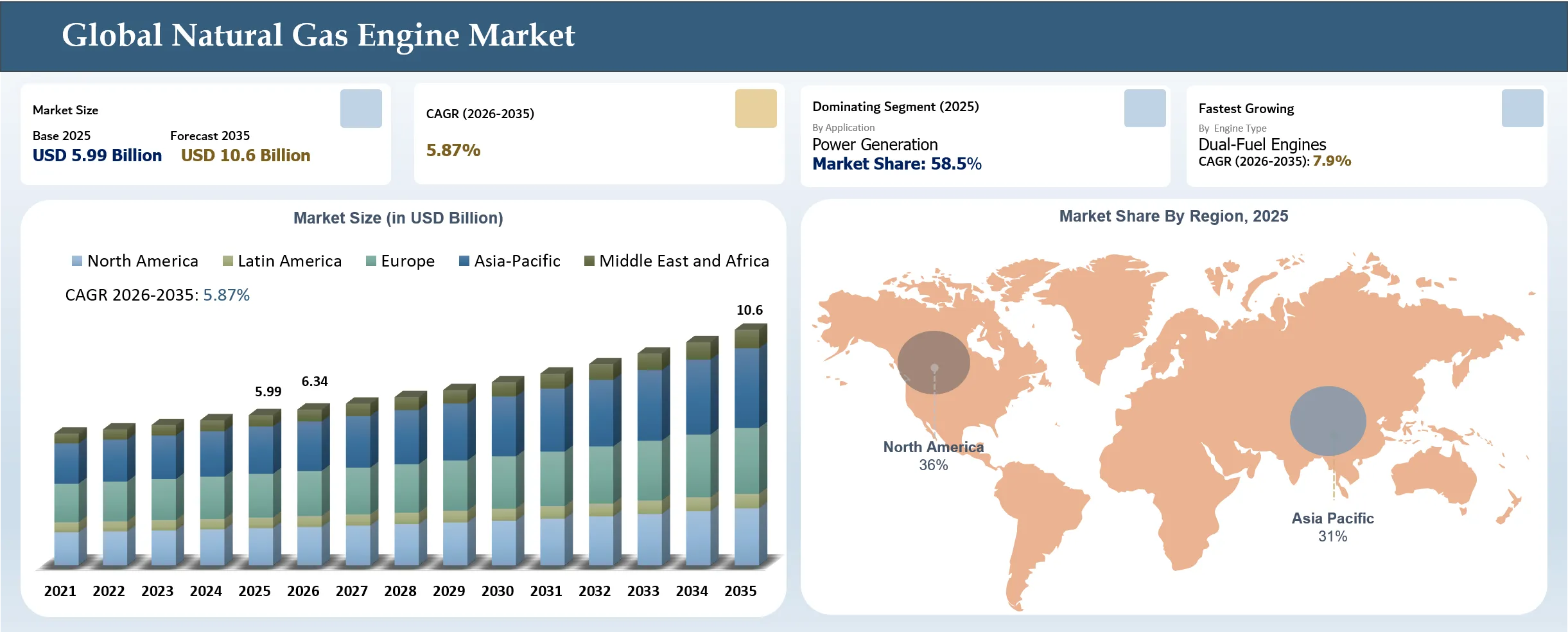
The global natural gas engine market reached USD 5.99 billion in 2025 and is expected to reach USD 10.6 billion by 2035, growing with a CAGR of 5.87% during the forecast period 2026-2035. The market is witnessing steady expansion due to rising electricity requirements, data centers, and the need for efficient and reliable gas-based power generation systems. In November 2025, Wärtsilä received an order of 507 MW in the U.S., which includes 27 natural gas-fired 50SG engines to deliver continuous primary power to the new data center, and the engines are expected to be delivered by 2027; the company also claimed that its total power plant installed base worldwide amounts to 79 GW, of which 6 GW comes from around 80 U.S. power plants.
By improving the high-horsepower natural gas engines, Cummins is making its presence felt in the industry. In December 2025, Cummins announced that it has rolled out its 16N high-horsepower natural gas engine after four years of research and development work, backed up by more than 40,000 hours of bench testing and 5 million km of road testing. The engine can operate at maximum outputs of 720 hp and 3,600 Nm of torque, with features enhancing the acceleration and hill-climbing efficiency by 20%, improving the maximum thermal efficiency by 2%, lower fuel consumption by 4% when used cyclically, and offering 6% overall fuel savings in vehicles.
White-Space Opportunities for Natural Gas-Powered School Buses and Alternative-Fuel Fleet Transportation
In February 2026, the U.S. Environmental Protection Agency (EPA) identified a significant opportunity in natural-gas-powered school buses and alternative-fuel fleet transportation by considering a greater share of the approximately USD 2 billion remaining under the Clean School Bus Program for buses powered by natural gas, biofuels, or hydrogen.
The largest investment opportunity is therefore in school-bus replacement and procurement, where the Bipartisan Infrastructure Law established a USD 5 billion five-year Clean School Bus Program, of which EPA had already allocated about USD 3 billion for 8,500 buses, with roughly 90% of those buses being battery electric. The remaining USD 2 billion could provide greater opportunities for compressed natural gas (CNG) and liquefied natural gas (LNG) buses, while other investment areas include natural-gas powertrains, CNG/LNG fueling infrastructure, vehicle conversion and fleet maintenance.
The potential funding shift is expected to create opportunities for companies across the natural-gas school-bus and fueling value chain, with Cummins positioned to benefit through the supply of CNG/LNG engines for medium- and heavy-duty buses, while Blue Bird Corporation and Thomas Built Buses can benefit through the manufacturing and deployment of alternative-fuel school-bus platforms.
Hexagon Agility can benefit from increased demand for CNG/LNG onboard fuel-storage and delivery systems, while Clean Energy Fuels can benefit from additional demand for natural-gas and renewable-natural-gas fueling infrastructure and fleet fueling services. Love's Travel Stops, through its Clean Energy Fuels-related natural-gas fueling network, can also benefit as school and commercial fleets require additional CNG/RNG fueling access.
Natural Gas Engine Market Key Takeaways
- North America dominated the regional landscape in 2025, accounting for a 36% market share due to its robust natural gas infrastructure. Asia-Pacific stands out as the fastest-growing market region, holding a 31% share in 2025 as power demands expand.
- Power generation represents the single largest application segment, capturing 58.5% of the market share in 2025. Growth in this segment is primarily driven by rising demand for reliable, dispatchable, and lower-emission electricity assets.
- Natural gas accounted for 17% of the total growth in global energy supply in 2025, with overall gas demand rising by 1%. The IEA projects that gas-to-power generation will represent 30% of global incremental gas demand in 2026.
- The EPA's USD 5 billion Clean School Bus Program has USD 2 billion in remaining funds, following an initial USD 3 billion allocation for 8,500 buses. Around 90% of initial allocations were battery electric, opening the remaining USD 2 billion to CNG and LNG vehicles.
Natural Gas Engine Market Industry Trends and Strategic Insight
- Data-center power demand is repositioning natural gas engines from conventional generation equipment toward rapid-deployment primary power assets, as hyperscale and AI facilities increasingly require dedicated generation where grid interconnection cannot keep pace with load growth.
- Modular engine power is gaining strategic importance for capacity-constrained grids, enabling developers to deploy generation in expandable blocks rather than waiting for large centralized generation or transmission upgrades. This favors engine platforms that can be installed incrementally and synchronized with evolving industrial and data-center loads.
- Engine manufacturers are moving beyond fuel efficiency toward application-specific operating optimization, combining combustion-system improvements, intelligent controls, turbocharging, monitoring, and predictive maintenance to improve performance under variable loads and demanding duty cycles.
- Manufacturers should prioritize flexible, modular engine platforms rather than application-specific designs, allowing the same architecture to serve data centers, distributed generation, industrial facilities, and heavy-duty applications while reducing development and servicing complexity.
- Fuel flexibility should become a core product strategy, particularly through compatibility with natural gas, biomethane/RNG, and hydrogen blends, because it enables customers to decarbonize existing assets progressively instead of replacing generation equipment prematurely.
Natural Gas Engine Market Scope
| Metrics | Details | |
| 2025 Market Size | USD 5.99 Billion | |
| 2035 Projected Market Size | USD 10.6 Billion | |
| CAGR (2026-2035) | 5.87% | |
| Largest Market | North America | |
| Fastest Growing Market | Asia-Pacific | |
| By Engine Type | Spark-Ignition Engines, Dual-Fuel Engines, Internal Combustion Engines, Microturbines, Others | |
| By Power Output | Below 100 kW, 100–500 kW, 500 kW–1,500 kW, 1.5 MW–5 MW, above 5 MW | |
| By Horsepower Range | Up to 1000 HP, 1001 HP – 2000 HP, Above 2000 HP | |
| By Engine Configuration | 2-Stroke Gas Engines, 4-Stroke Gas Engines, Turbocharged Engines, Naturally Aspirated Engines | |
| By Application | Power Generation, Industrial Mechanical Drive, Natural Gas Gensets, Decentralized Energy Generation, Others | |
| By End-User | Industrial, Commercial, Utilities & Independent Power Producers (IPPs), Residential, Agriculture, Others | |
| By Region | North America | U.S., Canada, Mexico |
| Europe | Germany, UK, France, Spain, Italy, Poland, Netherlands, Switzerland | |
| Asia-Pacific | China, India, Japan, Australia, South Korea, Indonesia, Malaysia | |
| Latin America | Brazil, Argentina | |
| Middle East and Africa | UAE, Saudi Arabia, South Africa, Israel, Türkiye | |
| Report Insights Covered | Competitive Landscape Analysis, Company Profile Analysis, Market Size, Share, Growth | |
Natural Gas Engine Market Disruption Analysis
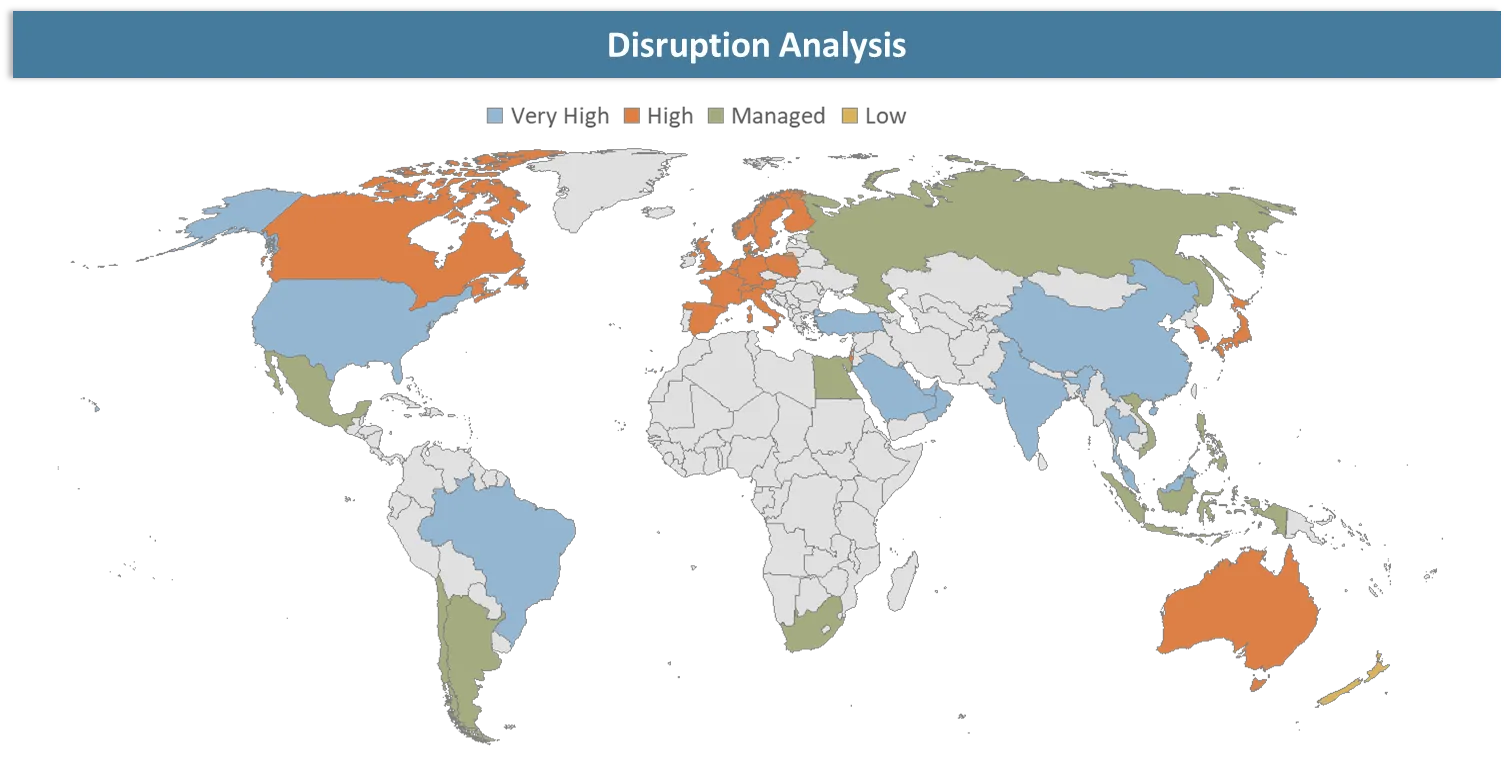
AI Data-Center Expansion and Grid Constraints Reshaping Natural Gas Engine Applications
The disruption in the natural gas engine market is increasingly associated with the rapid expansion of AI-driven data centers and the constraints of the current grid network. The growth in electricity needs due to high-performance computing is transforming natural gas engines from backup power generation systems into continuously running power generators in behind-the-meter, off-grid, and primary applications. It is especially crucial when one considers that the need for electricity in data centers continues to put pressure on current power systems.
As stated in the Global Energy Review 2026 of the International Energy Agency (IEA), there was an increase of 3% in the demand for electricity across the world in 2025, almost twice that of the energy demand overall, while data centers provided half of the increase in electricity use in the U.S. in 2025. As reported by the International Energy Agency (IEA), there was a 17% share of global energy-supply growth of natural gas in 2025, while there was an increase in global gas demand of about 1%. The changes have caused a disruption in the typical applications of natural gas engines, as engine-based electricity production has now become closely associated with fast-growing digital infrastructure and power systems.
Natural Gas Engine Market BCG Matrix: Company Evaluation
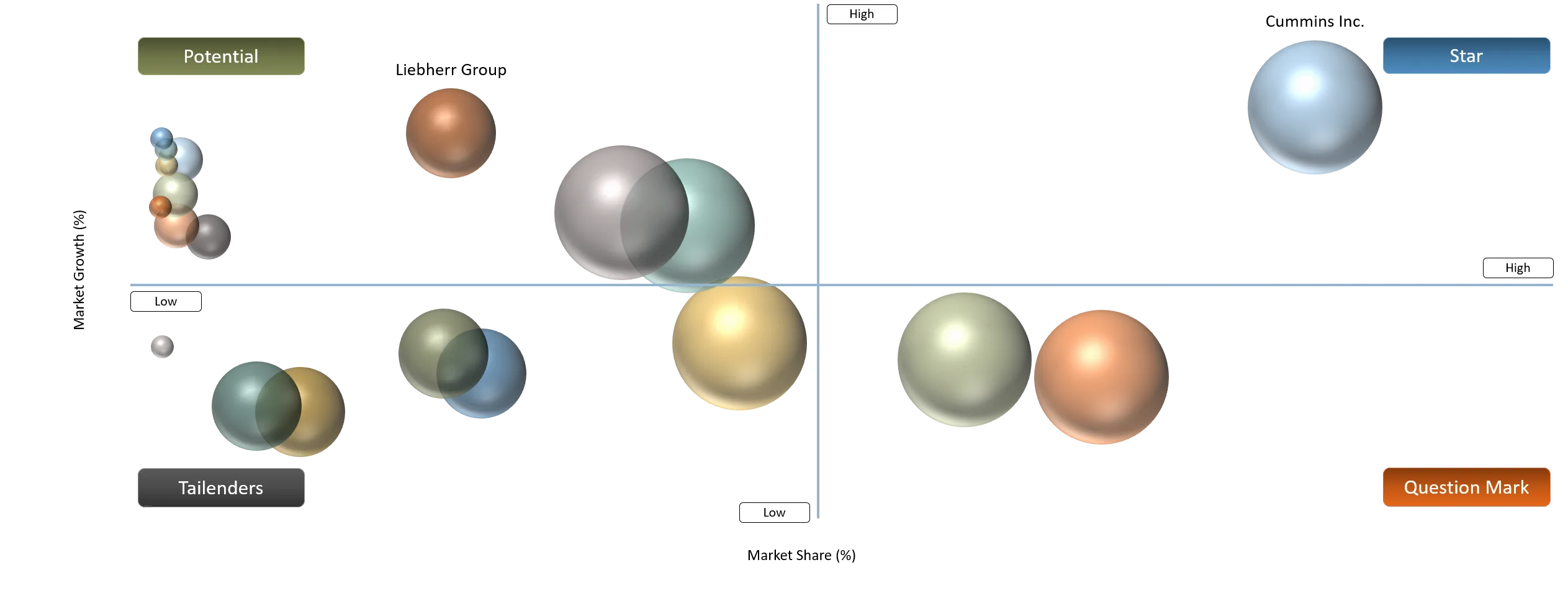
Stars include Cummins Inc., Wärtsilä, INNIO (Jenbacher), and Rolls-Royce plc, which have strong positions in natural-gas power generation and are benefiting from the rapid expansion of data-center, distributed-generation, and flexible-power applications. Question Marks include Caterpillar, Mitsubishi Heavy Industries Ltd., Siemens Energy, and Kawasaki Heavy Industries Ltd.
The Potential category includes Liebherr Group and Ningbo C.S.I Power & Machinery Group Co., Ltd. The companies have capabilities that can benefit from increasing demand for gas-based power and engine applications, but their competitive presence in the global natural gas engine market remains more specialized compared with the leading manufacturers. Tailenders would normally consist of companies with limited participation in the target market or a highly specialized gas-engine portfolio.
Natural Gas Engine Market Dynamics
Driver Impact Analysis
| Driver | Market Growth Impact (%) | Demand Concentration | Impacted Use Case | Strategic Impact |
Growing demand for lower-emission power solutions is driving the adoption of natural gas engines as an alternative to conventional diesel engines. | 32% | High concentration in North America, Europe, and developed industrial markets where emission reduction and fuel-efficiency requirements are accelerating replacement of conventional diesel systems. | Heavy-duty transportation, distributed power generation, backup/prime power, industrial facilities, CHP, and commercial power systems. | Encourages manufacturers to develop low-NOx, high-efficiency, low-methane-slip engines and fuel-flexible platforms compatible with renewable natural gas and other lower-carbon fuels. |
Expansion of natural-gas-powered heavy-duty vehicles and commercial fleets is increasing demand for high-efficiency natural gas engines. | 26% | Concentrated in North America, China, and selected European and Asian commercial-transport corridors with established CNG/LNG infrastructure and fleet-refueling networks. | Heavy-duty trucks, buses, refuse collection, regional haulage, vocational vehicles, and long-haul transportation. | Drives development of higher-horsepower engines, improved torque characteristics, advanced combustion systems, and integrated fuel-management technologies. |
Rising demand for reliable distributed and backup power is supporting the deployment of natural gas engine generator sets. | 27% | Strongest in North America and other markets experiencing grid-capacity constraints, data-center expansion, industrial electrification, and increasing requirements for resilient onsite generation. | Data centers, hospitals, manufacturing facilities, commercial buildings, utilities, microgrids, prime power, and emergency backup generation. | Shifts natural gas engines from conventional backup equipment toward continuous and behind-the-meter power assets, increasing demand for modular systems, rapid deployment, high availability, remote monitoring, and hybrid integration. |
Stricter vehicle and industrial emission standards are encouraging manufacturers and fleet operators to adopt cleaner natural gas engine technologies. | 15% | Concentrated in North America, Europe, China, and other jurisdictions implementing tighter emissions requirements for heavy-duty vehicles and stationary power equipment. | Commercial transportation, industrial engines, power generation, municipal fleets, and regulated stationary installations. | Accelerates investment in combustion optimization, exhaust after-treatment, methane-slip reduction, emissions monitoring, and regulatory-compliant engine architectures while increasing the value of natural-gas engines as a transition technology. |
Growing demand for lower-emission power solutions is driving the adoption of natural gas engines as an alternative to conventional diesel engines
The increasing focus on reducing emissions from conventional diesel-powered power generation has led to increased interest in natural gas engines in transportation, distributed energy, industrial power, and backup power applications. Natural gas engines have a lower emission profile compared to diesel engines, and the dispatchable nature of natural gas engines is essential in applications where intermittent renewables cannot produce uninterrupted power.
In parallel, the International Energy Agency (IEA) reported that there was 1% growth in the world’s natural gas demand compared to the previous year in the first six months of 2025, and for the full year, there is an estimated 1.3% growth. Natural gas demand in Europe grew by 6.5% in the first six months of 2025 due to reduced wind and hydro generation, leading to higher use of natural gas plants in producing electricity. The IEA predicted that in 2026, gas-to-power would represent 30% of incremental gas demand in the world, indicating the continuous relevance of gas-based power production in ensuring electricity security in addition to variable renewables.
Restraint Impact Analysis
| Restraint | Drag on Market Growth (%) | Primary Impact Area | Impacted Use Case | Strategic Impact |
Volatility in natural gas and LNG prices is increasing fuel-cost uncertainty and reducing the economic attractiveness of natural gas engines. | 32% | Fuel economics and operating expenditure | Power generation, LNG-fueled transportation, industrial power, distributed generation, and CHP | Encourages operators to secure long-term gas contracts, diversify fuel sourcing, and adopt engines compatible with RNG, biomethane, or alternative fuels to reduce exposure to gas-price fluctuations. |
Growing competition from renewable power, battery storage, and electrification is limiting new investments in natural gas engine-based power systems. | 28% | Technology substitution and new-capacity investment | Backup power, distributed generation, microgrids, commercial power, and vehicle propulsion | Pressures manufacturers to differentiate through faster response, higher efficiency, hybridization, and integration with batteries and renewable generation rather than competing as standalone gas systems. |
Stricter decarbonization policies are creating long-term uncertainty for natural gas engines because they remain dependent on fossil-based fuel. | 22% | Regulatory compliance and asset longevity | Stationary power generation, industrial facilities, commercial buildings, and utility-scale generation | Accelerates development of low-NOx and low-methane-slip engines and increases the strategic importance of hydrogen-, RNG-, and biomethane-compatible platforms to extend asset life under tightening emissions policies. |
Geopolitical disruptions and LNG supply constraints can increase natural gas costs and create fuel-supply uncertainty for engine operators. | 18% | Fuel security and supply-chain resilience | LNG-powered fleets, remote power generation, utility generation, industrial facilities, and backup power | Increases the value of localized gas supply, diversified procurement, strategic fuel storage, and engines capable of operating across multiple gas qualities or alternative fuels. |
Volatility in natural gas and LNG prices is increasing fuel-cost uncertainty and reducing the economic attractiveness of natural gas engines
Volatility in prices of natural gas and LNG is causing uncertainties with respect to the operating economics of natural gas engines, especially for power producers, industries, and commercial fleets which compete with diesel, electricity, or any other fuel technologies. As the cost of fuel is a regular cost element within the total cost of operation, any sudden changes in natural gas prices may cause an erosion in the economic benefit that may favor changing from diesel to natural gas engines. It is especially true with respect to LNG-based economies due to the volatility in spot prices and supply chain interruptions.
The increasing volatility of gas markets is creating greater uncertainties regarding the cost of fuel for natural gas engines and the economics of gas-fired power generation. In September 2026, according to Reuters, the prices of benchmark natural gas in Europe reached approximately €75 (USD 86.96)/MWh, rising more than twice as high as one year ago and reaching the highest point since late 2022. Reuters also stated that gas reserves in Europe were only at 66%, which is 12 percentage points lower than one year before, while exports of LNG from the Gulf declined by more than 85% in March through August 2026 relative to the same period one year before. Despite an increase in production of LNG in regions outside the Gulf by 18%, or approximately 27 billion cubic meters, during the year to June 2026, it compensated only around 75% of the lost supply from the Middle East.
Natural Gas Engine Market Segment Analysis
The global natural gas engine market is segmented based on engine type, power output, horsepower range, engine configuration, application, end-user, and region.
Power Generation Dominating the Application Segment of the Natural Gas Engine Market
The power generation segment dominated the natural gas engine market, accounting for 58.5% of the market in 2025, supported by the growing requirement for reliable, dispatchable, and lower-emission electricity generation. Natural gas engines are increasingly being deployed across distributed generation, prime power, standby generation, combined heat and power (CHP), and microgrid applications because they can provide continuous electricity while offering greater operational flexibility than intermittent renewable sources.
The accelerating growth in global electricity demand is strengthening the need for reliable and flexible power-generation technologies. In April 2026, according to the International Energy Agency (IEA), global energy demand increased by 1.3% in 2025, while electricity demand grew by around 3%, driven by expanding electrification across buildings and industry as well as increasing demand from electric vehicles and data centers. The IEA also reported that natural gas accounted for 17% of the increase in global energy supply, making it the second-largest contributor after solar PV. In addition, global solar PV generation increased by 600 TWh in 2025, while approximately 110 GW of new battery-storage capacity was added, increasing the need for flexible generation technologies that can complement variable renewable output.
Natural Gas Engine Market Geographical Penetration
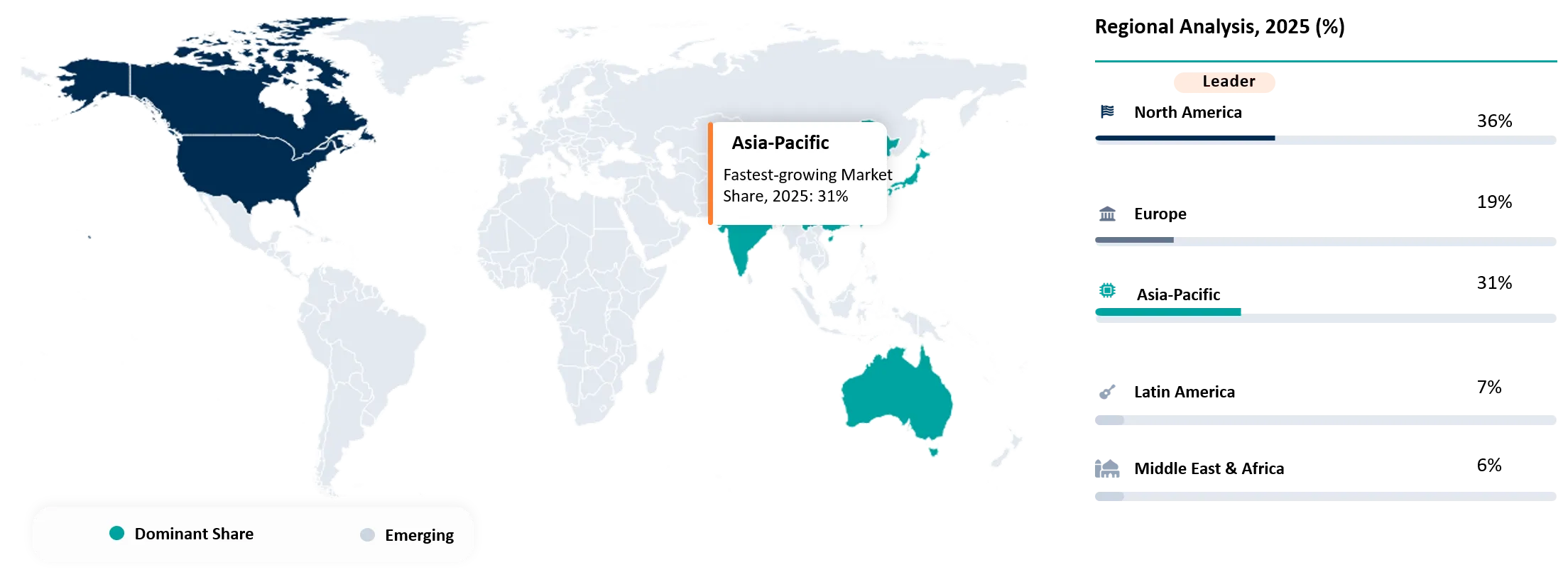
North America’s Strong Gas-Fired Power Base and Expanding Distributed Generation Capacity
North America is the dominant region in the natural gas engine market, accounting for 36% of the market in 2025. The region benefits from an established natural gas supply network, widespread gas-fired electricity generation, and growing requirements for reliable onsite and distributed power. The combination of natural gas availability, industrial power demand, data-center expansion, and the need for flexible generation capacity supports continued deployment of natural gas engines across utility, commercial, industrial, and backup-power applications.
The launch strengthens Volvo Penta’s position in natural-gas-based power generation and expands lower-emission engine solutions for critical infrastructure. In January 2026, Volvo Penta, a Sweden-based industrial engine and power-system manufacturer and part of Volvo Group, launched its first natural gas engine, the G17. The 17-liter, six-cylinder spark-ignited engine operates on both pipeline-quality natural gas and renewable natural gas and delivers approximately 450 kWe at 1,800 rpm. It incorporates advanced combustion management, low-pressure EGR, and a three-way catalyst to target lower NOx and particulate emissions while meeting U.S. EPA stationary-power standards.
U.S. Natural Gas Engine Market Trends
The U.S. holds a dominant position in the North American natural gas engine market due to its extensive natural gas production base, established power-generation infrastructure, and growing deployment of gas engines for distributed and onsite electricity generation. The availability of domestic gas resources supports fuel security for engine operators, while increasing electricity requirements from data centers, manufacturing facilities, and other large-load customers are creating new opportunities for natural gas engine-based prime and behind-the-meter power systems.
The production launch marks a significant step in the commercialization of natural-gas powertrains for North American heavy-duty transportation. In April 2025, Daimler Truck North America (DTNA), a U.S.-based commercial vehicle manufacturer, announced the start of production of the fifth-generation Freightliner Cascadia equipped with Cummins Inc., a U.S.-based engine and power technology manufacturer, X15N natural gas engine. The X15N is the industry’s first 15-liter natural gas engine specifically designed for heavy-duty truck applications, offering up to 500 hp and 1,850 lb-ft of torque. The Freightliner Cascadia became available for orders with the X15N, expanding natural-gas powertrain options for North American heavy-duty fleets.
Canada Natural Gas Engine Market Outlook
Canada is an important country in the North American natural gas engine market, supported by its large natural gas resource base, expanding gas infrastructure, and growing demand for reliable power across industrial and energy-intensive applications. The country’s natural gas ecosystem is particularly concentrated in Alberta and British Columbia, providing a strong domestic fuel base for natural gas-powered equipment.
The deployment demonstrates growing adoption of natural gas engines in Canada’s heavy-duty freight transportation sector. In October 2025, Nortrans Freight Management, a Canada-based trucking and logistics company, launched one of Canada’s first commercially deployed Kenworth T880 natural gas trucks powered by Cummins Inc.’s X15N, a U.S.-based engine and power technology manufacturer headquartered in Columbus, Indiana. The truck operates daily on the Revelstoke, British Columbia–Oroville, Washington route while carrying full-weight loads comparable to diesel trucks. The X15N natural gas engine is paired with an Eaton 18-speed Endurant transmission, while Nortrans has grown to approximately 65 trucks.
Expanding Gas Demand and Power-Generation Infrastructure Supporting Asia-Pacific Natural Gas Engine Adoption
The Asia-Pacific is the fastest-growing region in the natural gas engines market, accounting for 31% of the global market in 2025. The region benefits from expanding electricity demand, increasing industrialization, growing natural gas infrastructure, and the need for reliable and flexible power generation. Countries including China, Japan, India, South Korea, and Southeast Asian economies are investing in gas-based power capacity to support industrial facilities, commercial operations, and increasingly electricity-intensive infrastructure.
The launch strengthens the adoption of natural gas powertrains within India’s heavy-duty commercial vehicle sector. In January 2025, Cummins Group in India, the Indian operations of Cummins Inc., a U.S.-based power technology and engine manufacturer headquartered in Columbus, Indiana, launched its HELM (Higher Efficiency, Lower Emissions, Multiple Fuels) engine platforms at the Bharat Mobility Global Expo 2025 in New Delhi. The portfolio included the B6.7N natural gas engine, designed to support the transition of heavy-duty commercial vehicles to CNG and LNG, alongside the L10 engine and hydrogen fuel-delivery technologies.
Japan Natural Gas Engine Market Trends
Japan is one of the major countries in the Asia-Pacific natural gas engine market owing to its established LNG infrastructure, extensive gas-fired power-generation base, and continued requirement for reliable and flexible electricity supply. The country's natural gas ecosystem supports applications across utility power generation, industrial facilities, distributed generation, and combined heat and power systems.
The launch highlights Japan’s growing focus on hydrogen-natural gas co-firing technology to decarbonize large-scale gas-fired power generation. In October 2025, Kawasaki Heavy Industries, Ltd. (KHI), a Japan-based diversified industrial manufacturer, commercially launched the world’s first large gas engine system capable of co-firing up to 30% hydrogen by volume with natural gas or city gas. The 8 MW-class system was verified at Kawasaki’s Kobe Works and builds on the company’s Kawasaki Green Gas Engine, which has received more than 240 orders since 2011 for 5-8 MW-class natural-gas engines.
Natural Gas Engine Market Competitive Landscape
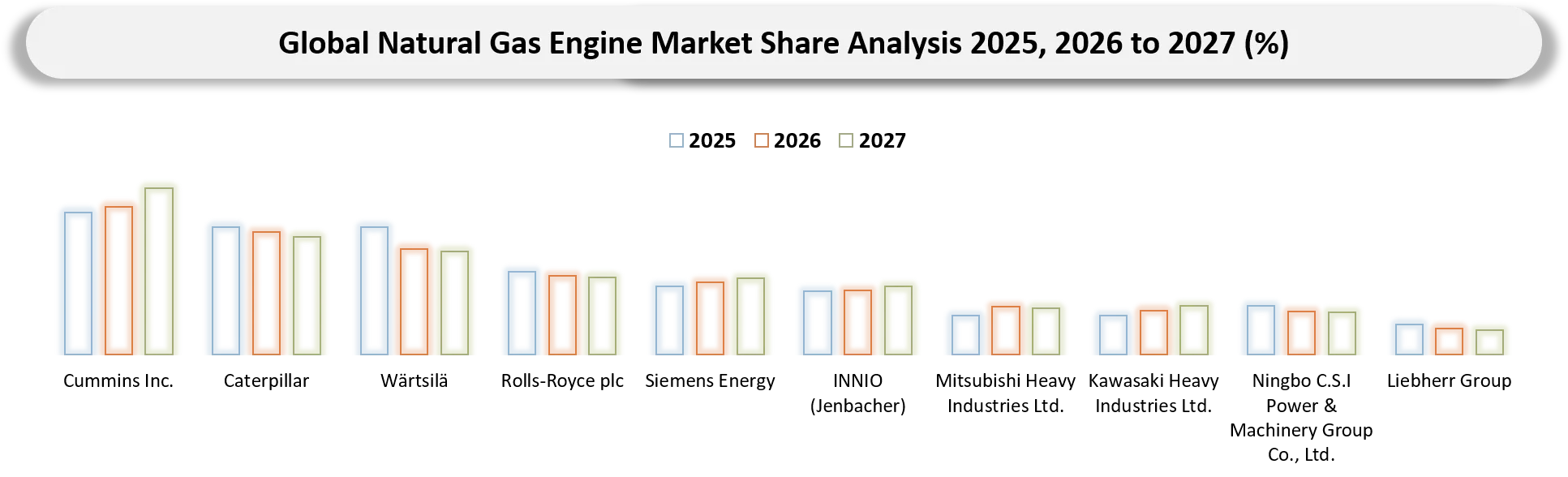
- The market is characterized by three key participant groups: leading gas engine and power-generation manufacturers, specialized gas engine and distributed-power providers, and diversified industrial companies with natural gas engine technologies. Cummins Inc., Caterpillar, and Wärtsilä lead across large-scale gas engines, power generation, distributed generation, and industrial applications; Rolls-Royce plc and INNIO (Jenbacher) focus on gas gensets, distributed power, data-center power, and flexible generation; while Siemens Energy, Mitsubishi Heavy Industries Ltd., Kawasaki Heavy Industries Ltd., Ningbo C.S.I Power & Machinery Group Co., Ltd., and Liebherr Group provide gas-engine, power-generation, industrial, and specialized engine solutions. Creating a technology- and application-driven competitive landscape where engine efficiency, reliability, fuel flexibility, emissions performance, scalability, and customer-specific power solutions define competitiveness.
- Key players include: Cummins Inc. (U.S.), Caterpillar (U.S.), Wärtsilä (Finland), Rolls-Royce plc (U.K.), Siemens Energy (Germany), INNIO (Jenbacher) (Austria), Mitsubishi Heavy Industries Ltd. (Japan), Kawasaki Heavy Industries Ltd. (Japan), Ningbo C.S.I Power & Machinery Group Co., Ltd. (China), and Liebherr Group (Switzerland).
Key Developments
- January 2025: Daphne Technology SA, a Switzerland-based industrial decarbonization and methane-abatement technology company, and Williams, a U.S.-based publicly traded natural gas infrastructure company, received an approximately $6 million U.S. Department of Energy (DOE) Methane Emissions Reduction Program grant to develop and scale Daphne’s SlipPure plasma-catalyst technology for reducing methane emissions from natural gas engines.
- January 2025: IES Holdings, Inc., a U.S.-based infrastructure products and services company, acquired Arrow Engine Company, a U.S.-based manufacturer and supplier of engines, generator sets, and compressors.
- December 2025: Cooper Machinery Services, a U.S.-based provider of natural gas engines, compressors, and aftermarket engine services, announced a strategic partnership with Altronic, LLC, a U.S.-based manufacturer of advanced ignition, engine-control, and instrumentation systems.
- August 2026: Clean Energy Fuels Corp., a U.S.-based renewable natural gas (RNG) transportation-fuel and fueling-infrastructure company, expanded its fueling and maintenance network across Western Canada through new agreements with trucking, logistics, refuse and oilfield fleets.
- March 2025: OPAL Fuels Inc., a U.S.-based renewable natural gas (RNG) and renewable-energy company, expanded its fuel-station services business in Canada by signing agreements covering five new fueling stations.
- May 2025: Enterprise Group, Inc., a Canada-based energy-services and infrastructure company, signed an agreement to acquire Flex Leasing Power and Service ULC (FlexEnergy Canada) from FlexEnergy Solutions, a U.S.-based clean-energy technology company specializing in natural-gas-powered microturbine systems.
Key Procurement Priorities and Buyer Evaluation Criteria
- Organizations investing in the natural gas engine market increasingly select suppliers based on their ability to provide high-efficiency, reliable, and scalable engine systems capable of supporting continuous, prime, standby, and distributed power-generation requirements.
- The procurement decision-making process is increasingly influenced by the need for flexible power generation, rising electricity demand, grid constraints, data-center expansion, and integration with renewable energy systems, encouraging buyers to prioritize engines that can respond efficiently to changing load requirements.
- Buyers consider factors such as fuel efficiency, power output, operational reliability, emissions performance, maintenance requirements, lifecycle operating costs, load-following capability, and engine durability when evaluating natural gas engine suppliers.
Why Choose DataM?
- Technological Innovations: Explores advancements in natural gas engine technologies, including high-efficiency combustion systems, fast-start engines, hydrogen co-firing, RNG/biomethane compatibility, digital controls, and low-emission technologies, enabling improved fuel efficiency, operational flexibility, and reduced environmental impact across power and industrial applications.
- Product Performance & Market Positioning: Evaluates how different players differentiate natural gas engine solutions based on power output, thermal efficiency, fuel consumption, load-following capability, reliability, emissions performance, maintenance requirements, and scalability across power generation, distributed energy, CHP, industrial, and commercial applications.
- Real-World Evidence: Highlights the deployment of natural gas engines in data centers, utilities, manufacturing facilities, microgrids, commercial buildings, transportation, and critical infrastructure, demonstrating benefits such as reliable prime power, rapid response, operational flexibility, and reduced dependence on constrained electrical grids.
- Market Updates & Industry Changes: Tracks key developments such as new gas engine launches, data-center power projects, manufacturing expansions, hydrogen co-firing demonstrations, LNG infrastructure development, and investments in flexible generation across North America, Europe, and Asia-Pacific.
- Competitive Strategies: Analyzes how leading companies expand through engine innovation, capacity expansion, strategic partnerships, large-scale power projects, fuel-flexibility development, and integration of digital monitoring and controls to address increasing demand for reliable and flexible natural gas-based power.
- Pricing & Market Access: Examines variations in natural gas engine economics based on engine capacity, fuel efficiency, configuration, application, installation requirements, maintenance needs, and fuel availability, alongside supplier networks, EPC partnerships, distributors, and aftermarket service capabilities.
- Market Entry & Expansion: Identifies growth opportunities driven by data-center electricity demand, distributed generation, grid constraints, industrial electrification, CHP, renewable integration, and emerging low-carbon fuels, while outlining strategies such as localized manufacturing, modular deployment, technology differentiation, fuel flexibility, and regional partnerships.
Target Audience
- Natural Gas Engine Manufacturers
- Power Generation Companies & Utilities
- Data Center Operators
- Industrial & Commercial End Users
- Energy & Gas Companies
- Engine Component & Technology Suppliers
- EPC Contractors & System Integrators



























































