


Introduction
Manufacturing is entering a new era where intelligence is moving closer to the factory floor. Traditional cloud-based AI solutions often struggle with latency, bandwidth limitations, and data privacy concerns. Edge AI solves these challenges by processing data directly on machines, sensors, cameras, and industrial devices in real time.
As manufacturers embrace Industry 4.0 initiatives, Edge AI is becoming a strategic technology for improving operational efficiency, reducing downtime, enhancing product quality, and enabling autonomous decision-making. Real-time analytics at the edge allows factories to react instantly without relying on remote cloud infrastructure. This capability is accelerating the adoption of smart manufacturing worldwide.
According to DataM Intelligence's Edge AI Market analysis, the convergence of AI, Industrial IoT, machine vision, robotics, and edge computing is creating significant growth opportunities across manufacturing sectors.
In this article, we explore the top 15 Edge AI use cases transforming manufacturing operations in 2026 and beyond.
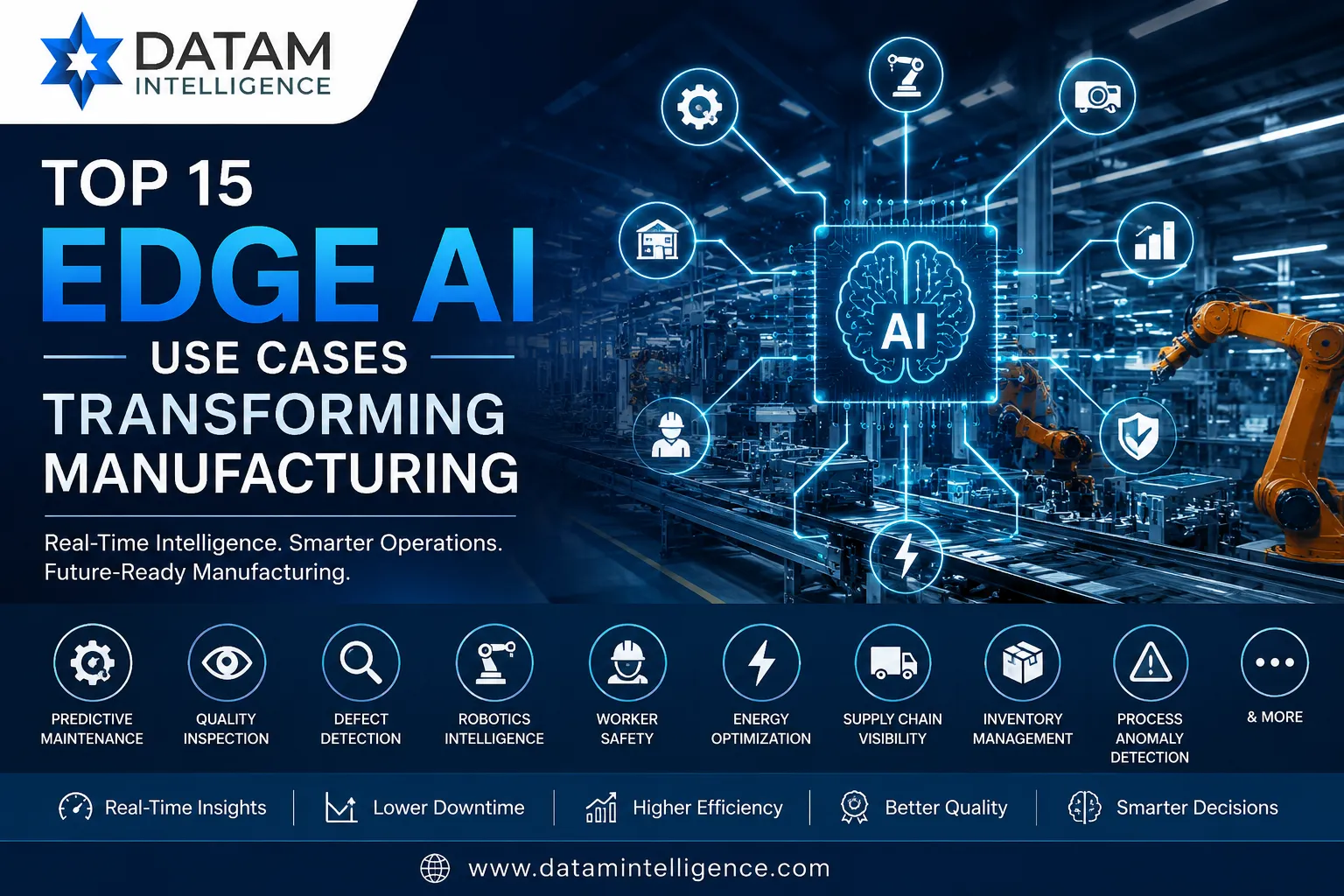
What is Edge AI in Manufacturing?
Edge AI refers to deploying artificial intelligence models directly on edge devices such as industrial cameras, PLCs, sensors, gateways, robots, and production equipment. Instead of sending data to centralized cloud servers, AI algorithms process information locally and deliver instant insights.
For manufacturers, this means:
- Millisecond-level decision making
- Reduced network dependency
- Improved data privacy
- Lower bandwidth costs
- Enhanced operational reliability
- Continuous production intelligence
These advantages make Edge AI particularly valuable for mission-critical manufacturing environments where delays can impact productivity and product quality.
Top 15 Edge AI Use Cases in Manufacturing
Edge AI is fundamentally reshaping modern manufacturing by enabling real-time intelligence directly on the factory floor. Unlike traditional cloud-based systems, Edge AI processes data locally on machines, sensors, and industrial devices, allowing manufacturers to respond instantly to operational changes, reduce downtime, and optimize production performance. Below are the top 15 high-impact Edge AI use cases transforming the manufacturing industry.
1. Predictive Maintenance
Predictive maintenance is one of the most widely adopted and commercially impactful applications of Edge AI in manufacturing.
By continuously analyzing real-time machine data such as vibration patterns, temperature fluctuations, pressure levels, acoustic signals, and operational load, Edge AI systems can detect early warning signs of equipment degradation. This enables maintenance teams to address issues before they escalate into costly failures or production stoppages.
Key Benefits:
- Significant reduction in unplanned downtime
- Lower maintenance and repair costs
- Increased overall equipment effectiveness (OEE)
- Extended machinery and asset lifespan
Predictive maintenance is increasingly prioritized due to its strong return on investment (ROI), improved asset reliability, and ability to minimize production disruptions in high-value manufacturing environments.
2. Real-Time Quality Inspection
Traditional manual inspection processes are often slow, inconsistent, and highly dependent on human accuracy.
Edge AI-powered computer vision systems enable automated inspection of products directly on the production line, identifying defects in real time with millisecond-level latency. This ensures that quality issues are detected immediately, preventing defective products from advancing further in the manufacturing process.
Key Applications:
- Surface defect detection in metals and materials
- PCB and electronic component inspection
- Weld integrity verification
- Packaging accuracy and labeling validation
- Semiconductor wafer inspection
By enabling continuous and automated inspection, manufacturers can significantly reduce scrap rates, improve yield, and maintain consistent product quality standards.
3. Automated Defect Detection
Advanced machine vision models deployed at the edge are capable of detecting micro-level defects that are often invisible to human inspectors.
These AI systems use deep learning algorithms to analyze high-resolution imagery and identify anomalies such as cracks, misalignments, scratches, or structural inconsistencies in real time.
Key Industries:
- Automotive manufacturing
- Electronics and consumer devices
- Aerospace engineering
- Metal fabrication
- Semiconductor production
This capability directly enhances first-pass yield rates, reduces rework costs, and minimizes the risk of product recalls, thereby improving overall manufacturing efficiency and reliability.
4. Autonomous Production Line Optimization
Edge AI enables continuous, real-time optimization of production lines by analyzing operational data and dynamically adjusting machine behavior.
Instead of relying on manual intervention or delayed analytics, AI systems can autonomously identify inefficiencies and implement corrective adjustments instantly.
Key Examples:
- Dynamic machine parameter tuning
- Production throughput optimization
- Bottleneck identification and resolution
- Cycle time reduction strategies
This results in significantly improved production efficiency, reduced operational delays, and higher overall manufacturing output.
5. Industrial Robotics Intelligence
Modern industrial robots are increasingly powered by Edge AI, enabling them to operate with greater autonomy, precision, and adaptability.
Edge-enabled robotics systems can process environmental inputs in real time and adjust their actions accordingly, making them suitable for complex and dynamic manufacturing environments.
Core Capabilities:
- Adaptive motion control for precision tasks
- Real-time object detection and recognition
- High-accuracy assembly operations
- Safe human-robot collaboration in shared workspaces
These advancements are enhancing manufacturing flexibility, increasing production speed, and enabling more complex automation use cases across industries.
6. Worker Safety Monitoring
Ensuring workplace safety is a critical priority in manufacturing environments, particularly in heavy industries and high-risk operations.
Edge AI-powered surveillance and monitoring systems continuously analyze video feeds and sensor data to detect unsafe conditions and behaviors.
Key Monitoring Functions:
- Detection of missing personal protective equipment (PPE)
- Identification of unsafe movements or practices
- Alerts for restricted zone violations
- Fatigue and abnormal behavior recognition
These systems generate real-time alerts that help prevent workplace accidents and ensure compliance with safety regulations.
7. Energy Consumption Optimization
With rising energy costs and increasing sustainability mandates, manufacturers are prioritizing energy efficiency more than ever.
Edge AI analyzes energy consumption patterns at the machine and process level to identify inefficiencies and optimize power usage in real time.
Key Benefits:
- Reduced operational energy costs
- Lower carbon emissions
- Improved environmental sustainability performance
- Enhanced energy efficiency across production systems
Energy optimization through Edge AI is becoming a strategic initiative for manufacturers aiming to achieve both cost savings and ESG compliance goals.
8. Supply Chain Visibility
Modern manufacturing supply chains generate vast volumes of real-time operational data that require efficient processing and interpretation.
Edge AI enhances supply chain visibility by enabling real-time monitoring and analysis of materials, inventory, and logistics operations.
Core Capabilities:
- Real-time inventory tracking
- Demand forecasting and demand sensing
- Material flow optimization
- Logistics and transportation monitoring
This improved visibility allows manufacturers to respond quickly to disruptions and build more resilient supply chain networks.
9. Process Anomaly Detection
Manufacturing processes are highly sensitive to even minor deviations, which can result in quality degradation or operational inefficiencies.
Edge AI systems continuously monitor process parameters and detect anomalies as soon as they occur.
Key Monitoring Areas:
- Temperature fluctuations
- Pressure irregularities
- Equipment performance deviations
- Production process inconsistencies
Early detection of anomalies enables rapid corrective actions, reducing waste, downtime, and quality risks.
10. Digital Twin Enhancement
Digital twin technologies become significantly more powerful when integrated with real-time Edge AI insights.
By feeding live operational data into virtual models, manufacturers can simulate, analyze, and optimize production environments with high accuracy.
Key Capabilities:
- Simulation of production scenarios in real time
- Predictive modeling of equipment behavior
- Workflow optimization through virtual testing
This enables more informed decision-making and supports proactive operational planning.
11. AI-Powered Inventory Management
Inventory inefficiencies often lead to production delays, overstocking, or material shortages.
Edge AI improves inventory management by providing real-time visibility into stock levels and material movement across warehouses and production facilities.
Core Functions:
- Real-time stock monitoring
- Automated replenishment triggers
- Material flow tracking and optimization
These capabilities help manufacturers maintain optimal inventory levels while reducing storage and holding costs.
12. Smart Machine Health Monitoring
Beyond traditional predictive maintenance, Edge AI enables continuous, real-time monitoring of machine health throughout the entire lifecycle of equipment.
Key Monitoring Metrics:
- Motor performance and efficiency
- Bearing wear and degradation
- Lubrication conditions
- Acoustic and vibration anomalies
This supports condition-based maintenance strategies, ensuring that machines operate at peak efficiency and reliability.
13. Semiconductor Manufacturing Inspection
Semiconductor manufacturing requires extreme precision, where even nanometer-level defects can impact performance and yield.
Edge AI plays a critical role in detecting defects and ensuring quality control in highly sensitive production environments.
Key Applications:
- Wafer-level defect inspection
- Lithography process monitoring
- Yield optimization analysis
- Cleanroom environment monitoring
Edge-based processing ensures faster detection and higher accuracy, which is essential for advanced semiconductor production.
14. Autonomous Material Handling
Edge AI is powering the next generation of autonomous logistics systems within smart factories and warehouses.
AI-enabled forklifts, automated guided vehicles (AGVs), and robotic systems operate independently while making real-time navigation and operational decisions.
Key Benefits:
- Faster and more efficient material movement
- Reduced dependency on manual labor
- Enhanced warehouse productivity
- Improved workplace safety
This is transforming internal logistics into a fully automated and intelligent system.
15. AI-Driven Production Forecasting
Edge AI enables manufacturers to combine real-time operational data with historical trends to improve forecasting accuracy.
By analyzing production rates, equipment performance, and demand signals, AI systems can generate highly accurate production forecasts.
Key Outcomes:
- Improved production planning accuracy
- Reduced material and resource waste
- Optimized capacity utilization
- Enhanced customer delivery performance
This shifts manufacturing from reactive operations to a predictive and intelligent production model.
Why Manufacturers Are Investing in Edge AI
The rapid adoption of Edge AI in manufacturing is being driven by a combination of operational, technological, and strategic factors. As factories become increasingly connected and data-intensive, manufacturers are recognizing that traditional cloud-centric architectures alone cannot deliver the speed, reliability, and intelligence required for modern production environments. Edge AI addresses these challenges by bringing artificial intelligence closer to machines, sensors, cameras, and production systems, enabling real-time decision-making directly on the factory floor.
1. Need for Real-Time Decision Making
Modern manufacturing operations generate continuous streams of data from production equipment, machine vision systems, robotics, and Industrial IoT devices. In many scenarios, even a few seconds of delay can result in production defects, equipment damage, safety incidents, or costly downtime.
Edge AI enables data processing and AI inference at or near the source of data generation, eliminating the latency associated with transmitting information to distant cloud servers. This allows manufacturers to make immediate decisions related to quality control, predictive maintenance, process optimization, and worker safety. Real-time responsiveness is particularly critical in high-speed production lines where instant action can prevent defects from propagating throughout an entire batch of products.
2. Growing Industrial IoT Deployments
The rise of Industry 4.0 has led to a dramatic increase in the deployment of connected sensors, cameras, programmable logic controllers (PLCs), and smart machines across manufacturing facilities. These Industrial IoT (IIoT) devices generate massive volumes of operational data every second.
Transmitting all of this data to centralized cloud platforms is often impractical due to bandwidth limitations, network costs, and processing delays. Edge AI allows manufacturers to analyze and filter data locally, extracting actionable insights before sending only the most relevant information to centralized systems. This approach reduces network congestion, improves operational efficiency, and enables scalable AI adoption across large industrial environments.
3. Rising Demand for Automation and Smart Manufacturing
Manufacturers worldwide face increasing pressure to improve productivity, reduce operational costs, address labor shortages, and remain competitive in rapidly evolving markets. As a result, organizations are accelerating investments in automation, robotics, and intelligent manufacturing technologies.
Edge AI serves as a foundational technology for smart factories by enabling machines and systems to analyze data, recognize patterns, and make autonomous decisions without constant human intervention. Applications such as predictive maintenance, automated quality inspection, autonomous robotics, and production optimization help manufacturers increase throughput, improve product quality, and build more resilient operations. Industry leaders increasingly view Edge AI as a critical enabler of next-generation autonomous manufacturing environments.
4. Data Privacy, Security, and Regulatory Compliance
Manufacturers often handle highly sensitive operational data, including proprietary production processes, intellectual property, equipment performance metrics, and supply chain information. Transferring this data to external cloud environments can introduce security risks and compliance challenges.
By processing data locally, Edge AI minimizes the need to move sensitive information outside the facility. This localized approach reduces exposure to cyber threats, supports data sovereignty requirements, and helps manufacturers comply with industry-specific regulations and corporate governance standards. For organizations operating in regulated industries such as aerospace, defense, electronics, and pharmaceuticals, maintaining control over critical production data is a significant driver of Edge AI adoption.
5. Reducing Downtime and Improving Operational Resilience
Unplanned downtime remains one of the most expensive challenges in manufacturing, often resulting in substantial financial losses and production disruptions. Edge AI continuously monitors equipment health and operational conditions to detect anomalies before failures occur.
Unlike cloud-dependent systems, Edge AI solutions can continue functioning even when network connectivity is limited or unavailable. This ensures uninterrupted monitoring, analysis, and decision-making, improving operational resilience and enabling manufacturers to maintain production continuity in mission-critical environments.
6. Accelerating ROI from AI Investments
Manufacturers are increasingly focused on AI initiatives that deliver measurable business outcomes. Edge AI provides tangible value through reduced maintenance costs, improved product quality, optimized energy consumption, enhanced worker safety, and increased production efficiency.
As organizations move beyond experimentation and pilot projects, Edge AI is emerging as a practical pathway to achieving scalable and sustainable AI-driven transformation. Industry surveys indicate that manufacturers are moving from evaluating AI opportunities to actively deploying intelligent systems that generate operational and financial returns.
The Strategic Imperative
The convergence of Artificial Intelligence, Industrial IoT, robotics, machine vision, and edge computing is reshaping the manufacturing landscape. Manufacturers are no longer investing in Edge AI solely as a technology upgrade; they are adopting it as a strategic capability that enables real-time intelligence, autonomous operations, and competitive differentiation. Organizations that successfully integrate Edge AI into their manufacturing ecosystems will be better positioned to improve efficiency, strengthen resilience, and lead the next generation of Industry 4.0 innovation.
You’re using a less powerful model until 10:47 PM. Upgrade for better answers now.Get Business
Challenges of Edge AI Adoption
Despite its advantages, manufacturers should consider:
- Legacy system integration complexity
- Initial deployment costs
- Cybersecurity risks
- AI talent shortages
- Model management and maintenance
Organizations that establish strong AI governance frameworks are more likely to achieve scalable success.
Future Outlook: The Rise of Autonomous Factories
The next phase of manufacturing transformation will combine:
- Edge AI
- Industrial IoT
- 5G connectivity
- Digital twins
- Autonomous robotics
- Generative AI
Together, these technologies will create self-optimizing factories capable of making intelligent operational decisions with minimal human intervention. Industry analysts increasingly view Edge AI as a foundational technology powering the future of autonomous manufacturing.
Conclusion
Edge AI is rapidly becoming a competitive necessity for manufacturers pursuing Industry 4.0 transformation. From predictive maintenance and quality inspection to autonomous robotics and production optimization, Edge AI delivers real-time intelligence where it matters most on the factory floor.
As manufacturing environments become increasingly connected and data-driven, organizations that invest in Edge AI today will be better positioned to improve operational efficiency, reduce costs, enhance product quality, and gain a sustainable competitive advantage.
For deeper insights into market growth, technology trends, competitive landscape analysis, and investment opportunities, explore DataM Intelligence's Edge AI Market report.