


Knowledge Graph Market Size 2026 and Forecast 2035
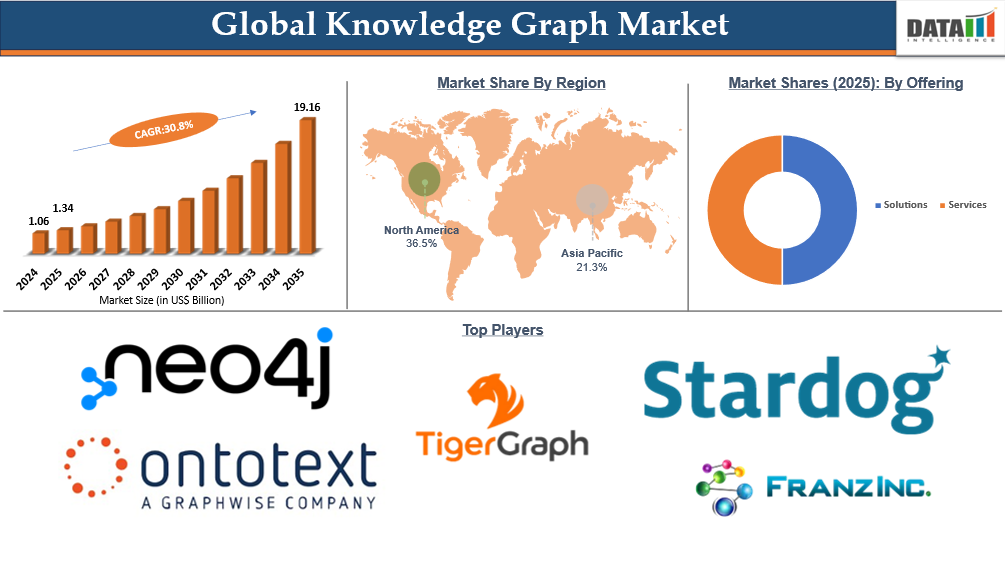
The global Knowledge Graph Market was valued at USD 1.34 billion in 2025 and is expected to reach USD 19.16 billion by 2035, growing at a Knowledge Graph market CAGR of 30.8% during the forecast period from 2026 to 2035.
The market is expanding because enterprises are realizing that AI systems need more than data storage and vector search. They need context, relationships, lineage, metadata, business definitions, and governed meaning. Knowledge graphs provide this connected intelligence layer by linking structured, unstructured, semi-structured, and streaming data into a semantic network that both humans and AI systems can query.
The investment case is especially strong because knowledge graphs now sit at the intersection of enterprise search, data governance, compliance, AI assistants, GraphRAG, semantic layers, fraud detection, customer intelligence and data lake modernization. The market is no longer limited to graph databases. It is evolving into an AI infrastructure category.
Key Takeaways
The market is projected to grow from USD 1.34 billion in 2025 to USD 19.16 billion by 2035. This reflects rapid adoption across AI, enterprise search, data governance and decision intelligence use cases.
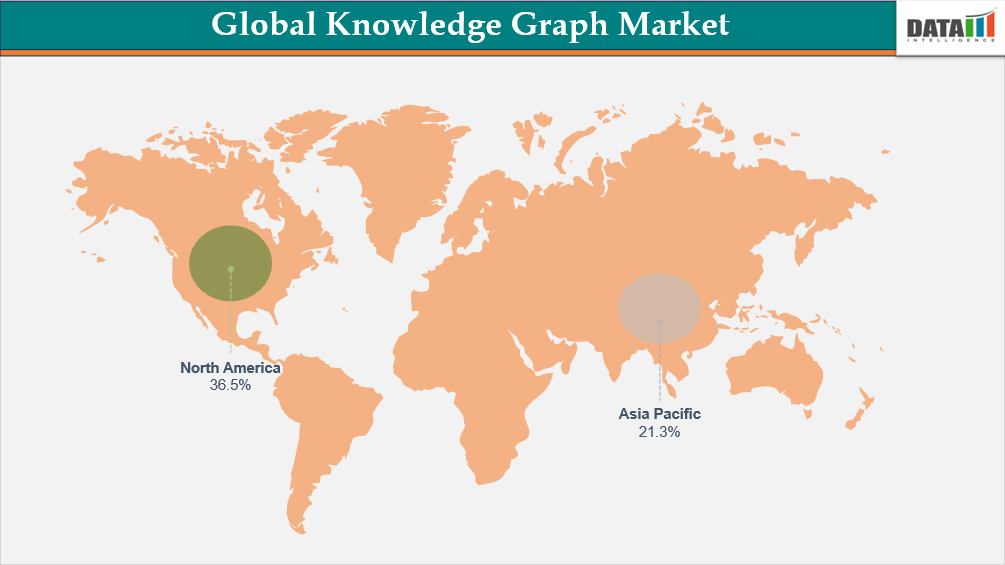
North America leads the market with more than 36% share. Strong cloud adoption, AI investment, hyperscaler platforms and early enterprise data infrastructure maturity support regional leadership.
Asia-Pacific is the fastest-growing region. China, India, Japan, South Korea and Southeast Asia are accelerating AI, cloud and data platform modernization.
Solutions lead the offering segment with about 30% share in 2025. Enterprises are investing in graph platforms, semantic search tools, relationship analytics and graph database solutions.
GraphRAG is changing the buyer conversation. Knowledge graphs are increasingly used to improve retrieval-augmented generation by adding relationships, entity context and explainability.
Data governance is becoming a high-value use case. Knowledge graphs help connect data assets, owners, policies, lineage, definitions and compliance rules.
Implementation complexity remains the biggest adoption barrier. Ontology design, entity resolution, data integration, RDF, SPARQL, LPG models and governance workflows require specialized skills.
Market Scope
| Metric | Details |
| Market Size in 2025 | USD 1.34 billion |
| Market Forecast 2035 | USD 19.16 billion |
| Market CAGR 202 | 30.80% |
| Historic Years | 2023-2024 |
| Base Year | 2025 |
| Forecast Years | 2026-2035 |
| Largest Market | North America, 36% share |
| Fastest Growing Region | Asia-Pacific |
| Leading Offering Segment | Solutions, with 30% by 2025 |
| Key Graph Types | Enterprise Knowledge Graph, Domain Knowledge Graph, Industry Knowledge Graph, Web-Scale Knowledge Graph and Others |
| Key Data Models | RDF Triple Store, LPG, Hybrid Graph Model and Virtual Knowledge Graph |
| Key Platform Layers | Data Layer, Graph Layer, Semantic Layer, AI Layer and Application Layer |
| Key AI Use Cases | GraphRAG, LLM Grounding, AI Agents with Knowledge Graph, Semantic Search and Context Engineering |
| Key Applications | Enterprise Search, Data Governance, Master Data Management, Fraud Detection, Customer Intelligence, Cybersecurity, Drug Discovery, Supply Chain Intelligence and AI Assistants |
| Target Buyers | Chief Data Officers, Chief AI Officers, Heads of Data Engineering, Heads of Analytics, Product Teams, Risk and Compliance Teams and Innovation Leaders |
Why Knowledge Graphs Are Becoming the Context Layer for Enterprise AI
The next phase of enterprise AI is not only about larger models. It is about better context. Large language models can generate fluent answers, but enterprises need answers that are grounded in governed data, linked business definitions, source lineage, access rules and domain relationships.
Knowledge graphs solve this problem by turning fragmented enterprise data into connected knowledge. A customer is linked to transactions, contracts, support tickets, risk scores, products, regions, policies and consent records. A supplier is linked to parts, facilities, emissions data, sanctions screening, purchase orders and logistics risk. A drug compound is linked to targets, studies, adverse events, patents and publications.
This makes knowledge graphs useful for AI because they provide structured relationships that models can use to retrieve context, reduce hallucination risk and support explainable reasoning. The rise of GraphRAG, semantic search and AI agents is turning knowledge graphs from a specialist data technology into a broader enterprise AI layer.
Investment timing is strong because many enterprises have already built data lakes, cloud warehouses and AI pilots, but still struggle to connect meaning across systems. Knowledge graphs can sit above existing infrastructure as a governed semantic layer rather than replacing databases, lakes or warehouses.
Enterprise Search Is Moving From Keyword Matching to Semantic Discovery
Enterprise search has historically failed because company knowledge is fragmented. Documents sit in SharePoint. Customer data sits in CRM. Policies sit in PDFs. Product data sits in PIM systems. Logs sit in data lakes. Data definitions sit in catalogs. Traditional search can retrieve documents, but it often cannot explain relationships between entities.
Knowledge graphs improve enterprise search by linking entities, concepts, documents, people, policies and business rules. Instead of searching only for keywords, users can ask relationship-based questions: which suppliers are linked to high-risk regions, which customers are affected by a product defect, which contracts reference a changed regulation, or which datasets support a specific AI model.
This is why semantic search adoption trends are strengthening. Enterprises want search experiences that understand intent, synonyms, business context, hierarchy and relationships. A knowledge graph can connect “client,” “account,” “customer,” “policyholder” and “member” depending on industry context, making search more accurate and useful.
For AI assistants and copilots, this matters even more. Without a graph, an assistant may retrieve a similar document. With a knowledge graph, it can retrieve relevant entities, relationships, definitions and evidence paths. This improves explainability and makes AI more useful for regulated and complex enterprise environments.
Data Governance Knowledge Graph and Compliance Use Cases
Data governance is one of the strongest enterprise knowledge graph use cases because governance is fundamentally about relationships. A data field is related to a business term, a data owner, a system, a policy, a privacy rule, a retention period, a downstream report and an AI model.
A data governance knowledge graph can connect these relationships into a single semantic layer. This allows enterprises to answer practical questions such as:
Which dashboards use customer personally identifiable information?
Which AI models depend on unapproved datasets?
Which data products are affected by a policy change?
Who owns a data asset and what approvals are required?
Which datasets contain regulated fields?
How does a metric flow from source system to executive dashboard?
For risk and compliance teams, this is valuable because it improves traceability. For data teams, it reduces manual reconciliation. For AI teams, it improves model governance by showing lineage, approved sources and policy constraints.
Knowledge graphs are especially useful in regulated sectors such as BFSI, healthcare, life sciences, government, defense, telecom and energy. These sectors need explainability, auditability and controlled access, not only faster analytics.
Semantic Layer and Integration With Data Lakes, Warehouses and SaaS Systems
Knowledge graphs are increasingly being used as a semantic layer above existing enterprise systems. They do not need to replace a data lake, data warehouse, CRM, ERP or document store. Instead, they connect business meaning across those systems.
The integration layer is becoming more important because enterprises already have large technology estates. A knowledge graph must connect with:
Data lakes
Data warehouses
Cloud platforms
Streaming data pipelines
APIs
SaaS applications
Master data systems
Data catalogs
Document repositories
ML platforms
LLM applications
Data lake integration is particularly important. Many organizations have stored large volumes of structured and unstructured data but still struggle to make that data discoverable and usable. A knowledge graph can map entities, metadata, relationships and semantic definitions on top of data lake assets, improving data discovery and governance.
Data warehouse integration is equally important because business metrics often live in warehouses. A knowledge graph can connect those metrics to definitions, owners, dashboards, source systems and compliance policies.
The value of the semantic layer is that it creates consistency. It helps business users, applications and AI systems interpret data the same way.
Enterprise Knowledge Graph Use Cases by Function
| Use Case | Business Problem | Knowledge Graph Role | ROI Signal |
| Enterprise Search | Employees cannot find trusted information across systems | Connects documents, entities, people, policies and definitions | Faster knowledge discovery and fewer duplicate research efforts |
| Data Governance | Data assets, ownership and policies are fragmented | Links data lineage, definitions, owners, policies and compliance rules | Lower governance workload and better audit readiness |
| Master Data Management | Customer, product or supplier records are duplicated | Supports entity resolution and relationship mapping | Better data quality and fewer operational errors |
| Fraud Detection | Risk signals are hidden across networks | Reveals relationships between accounts, transactions, devices and entities | Better detection of complex fraud patterns |
| Customer Intelligence | Customer data is siloed across channels | Links purchases, interactions, preferences and support history | Improved personalization and cross-sell relevance |
| Cybersecurity | Threat relationships are difficult to trace | Connects users, assets, vulnerabilities, logs and attack paths | Faster investigation and better threat prioritization |
| Supply Chain Intelligence | Supplier risk is hard to see across tiers | Maps suppliers, materials, plants, logistics routes and geopolitical risk | Better resilience and risk planning |
| Drug Discovery | Scientific knowledge is fragmented | Links compounds, targets, pathways, studies and publications | Faster hypothesis generation |
| AI Assistants and Copilots | LLMs lack enterprise context | Grounds responses in governed facts and relationships | More accurate, explainable and trusted AI outputs |
The strongest ROI usually appears where relationship complexity is high. Fraud networks, supplier dependencies, customer journeys, clinical research, cybersecurity events and compliance obligations are difficult to solve with tables alone. Knowledge graphs make those relationships explicit.
Knowledge Graph ROI Framework
Knowledge graph ROI should not be measured only by software license cost. The business case depends on the value of faster answers, better data quality, improved AI grounding and reduced compliance risk.
A practical ROI framework includes five layers.
1. Search and Knowledge Productivity
Enterprise teams spend time looking for documents, definitions, prior analyses, policies and subject-matter experts. A knowledge graph can reduce search time by connecting content and entities. ROI comes from improved employee productivity and faster decision cycles.
2. Data Governance Efficiency
Manual governance processes are slow because data owners, policies, assets and lineage are often tracked separately. A governance graph can automate relationship mapping and reduce manual reconciliation. ROI comes from lower governance workload and better audit preparedness.
3. AI Grounding and Hallucination Reduction
Generative AI projects often fail because they retrieve incomplete or weak context. GraphRAG can improve retrieval by combining vector similarity with entity and relationship structure. ROI comes from more accurate AI assistants, lower review burden and higher adoption by business users.
4. Risk and Compliance Reduction
In regulated industries, poor data lineage and inconsistent definitions increase compliance risk. Knowledge graphs improve traceability, evidence paths and policy enforcement. ROI comes from lower audit friction and fewer data misuse incidents.
5. Revenue and Decision Intelligence
In customer intelligence, supply chain and product recommendation use cases, knowledge graphs can reveal hidden relationships. ROI comes from better personalization, improved fraud prevention, higher conversion and better operational decisions.
Adoption Barriers: Ontology, Skills, Integration and Change Management
The Knowledge Graph Market is growing quickly, but adoption is not simple. The biggest barrier is implementation complexity.
Ontology design is often the first challenge. Enterprises need to define entities, relationships, rules, taxonomies and business meanings. If the ontology is too rigid, the project becomes slow. If it is too loose, the graph becomes hard to govern.
Skills are another constraint. RDF, SPARQL, LPG models, graph query languages, semantic modeling, entity resolution and graph embeddings are not always available in traditional data teams. This can slow enterprise adoption.
Data integration is also difficult. Knowledge graphs must connect multiple systems, and those systems often contain inconsistent identifiers, incomplete metadata and poor-quality data. Entity resolution becomes critical because the same customer, supplier, product or policy may appear differently across systems.
Change management can be underestimated. Business teams must trust the graph, contribute definitions and use graph-powered tools in daily workflows. Without adoption by business users, a graph can become another technical asset rather than an enterprise intelligence layer.
Cost can also be a concern. Enterprises must consider platform license, cloud consumption, data engineering, ontology work, governance operations, model integration and ongoing maintenance.
Knowledge Graph Vendor Landscape
The knowledge graph vendor landscape includes pure-play graph vendors, semantic technology specialists, hyperscalers, enterprise software providers, visualization companies, open-source players and regional cloud providers.
| Vendor Category | Strategy Role | Examples |
| Pure-Play Graph Platforms | Graph databases, graph analytics, enterprise graph applications and relationship intelligence | Neo4j, TigerGraph, Stardog, Ontotext, Franz Inc., ArangoDB, NebulaGraph |
| Hyperscalers | Cloud-native graph services, AI integration, GraphRAG and data platform connectivity | Amazon Web Services, Microsoft, Google, Alibaba Cloud, Tencent, Huawei |
| Enterprise Software Vendors | Integration with ERP, analytics, data platforms and enterprise applications | SAP, IBM, Oracle, Progress Software, Altair |
| Semantic Technology Specialists | RDF, ontology, reasoning, semantic querying and governed knowledge models | Ontotext, Stardog, Franz Inc., OpenLink Software, Oxford Semantic Technologies |
| Graph Visualization and Investigation Tools | Visual relationship exploration for analysts and investigators | Cambridge Intelligence, Linkurious, GraphAware |
| AI and Data Infrastructure Providers | Vector search, LLM integration, graph embeddings and data fabric use cases | DataStax, RelationalAI, Neo4j, TigerGraph |
| Asia-Based Technology Vendors | Regional cloud, enterprise AI and graph capabilities | Baidu, Fujitsu, Hitachi, Samsung SDS, Alibaba Cloud, Tencent, Huawei |
Top Companies
| Company | Strategic Position | Commercial Relevance |
| Neo4j | Graph database and graph intelligence platform | Strong fit for enterprise AI, knowledge layer, GraphRAG, fraud, recommendations and agentic systems |
| TigerGraph | Scalable graph analytics and vector-graph integration | Relevant to advanced RAG, large-scale relationship analytics and enterprise search |
| Stardog | Enterprise knowledge graph and semantic layer platform | Strong in data virtualization, governance and semantic modeling |
| Ontotext | Semantic technology and RDF graph platform | Relevant in publishing, life sciences, compliance and knowledge management |
| Amazon Web Services | Cloud graph services and Amazon Bedrock GraphRAG | Strong hyperscaler route for enterprise AI and managed graph adoption |
| Microsoft | Azure, AI ecosystem and enterprise graph capabilities | Relevant to enterprise data estates, Microsoft 365 and AI copilots |
| Cloud AI, knowledge systems and semantic search heritage | Relevant to AI, enterprise search and cloud data integration | |
| IBM | Enterprise AI, data governance and regulated industry presence | Relevant to BFSI, healthcare, government and compliance-heavy deployments |
| Oracle | Enterprise data platform and graph database capabilities | Relevant to large enterprises with Oracle data estates |
| SAP | Business data and enterprise application context | Relevant to knowledge graphs linking ERP, supply chain and master data |
The market is becoming more competitive because pure-play graph vendors are expanding into AI intelligence platforms, while hyperscalers are embedding graph capabilities inside broader cloud and AI ecosystems. This creates a strategic choice for buyers: use a dedicated graph platform for deep functionality or adopt graph capabilities through an existing cloud stack for easier integration.
Regional Analysis
North America
North America leads the global Knowledge Graph Market with more than 36% share. The region benefits from early AI adoption, strong cloud infrastructure, hyperscaler presence, venture capital activity and enterprise investment in data platforms.
The United States is the largest contributor because companies across BFSI, healthcare, retail, technology, government and defense are investing in AI-ready data architecture. Knowledge graphs are being adopted for enterprise search, fraud detection, customer intelligence, cybersecurity, data governance and AI assistants.
Canada is also an important market because of its AI research ecosystem and government-backed AI strategy. Knowledge graph adoption in Canada is expected to grow as enterprises modernize data infrastructure and invest in explainable AI.
Mexico is emerging as a growth market as banking, retail, telecom and e-commerce companies adopt cloud services and need better real-time customer and fraud intelligence.
Europe
Europe is a strong market for data governance knowledge graph adoption because privacy, compliance and data lineage are major enterprise priorities. Germany, the UK, France, Italy, Spain and Poland are important markets.
European companies are likely to adopt knowledge graphs for compliance, data governance, supply chain transparency, ESG reporting, industrial digital twins and regulated AI systems. The region’s demand is shaped by strict data protection expectations and enterprise interest in explainable AI.
Asia-Pacific
Asia-Pacific is the fastest-growing region and is expected to contribute around 21% market share by 2025. China, India, Japan, South Korea, Australia and Southeast Asian countries are investing in AI, digital transformation and cloud-native data infrastructure.
China has strong demand from e-commerce, fintech, telecom, manufacturing and government data platforms. India is growing through enterprise modernization, digital public infrastructure and IT services-led data transformation. Japan and South Korea are important for manufacturing, telecom, automotive, AI and industrial digital twin use cases.
Latin America
Latin America is an emerging market, led by Brazil and Argentina. Growth is supported by banking modernization, e-commerce, telecom analytics and fraud detection. Adoption will be gradual because many enterprises are still modernizing cloud and data lake infrastructure.
Middle East and Africa
The Middle East and Africa region is developing knowledge graph demand through smart city initiatives, government digital transformation, energy analytics, cybersecurity and financial services modernization. UAE, Saudi Arabia, South Africa, Israel and Turkiye are the most relevant markets.
Sustainability and Green AI Relevance
Knowledge graphs can support sustainability in two ways. First, they help enterprises make better sustainability decisions by linking emissions data, suppliers, facilities, materials, logistics routes and ESG reporting requirements. This improves traceability and can reduce reporting duplication.
Second, knowledge graphs can improve AI efficiency. A well-structured semantic layer can reduce redundant retrieval, improve context precision and shorten manual data preparation. In AI workflows, better retrieval can reduce repeated model calls and improve answer quality.
However, knowledge graph and AI systems still require compute resources. Sustainability benefits depend on efficient architecture, responsible cloud usage, data minimization and well-managed pipelines.
Recent Developments in Knowledge Graph and GraphRAG Technologies
In February 2026, Neo4j repositioned itself from a graph database provider to a Graph Intelligence Platform, focusing on autonomous AI and agentic systems.
In December 2025, Neo4j expanded its collaboration with Amazon Web Services and received AWS competencies, including Agentic AI specialization, strengthening its position in AI-powered knowledge graph deployments.
In November 2025, Oxford Semantic Technologies received a U.S. patent for optimizing the RDFox engine, improving semantic reasoning speed and reducing query latency for large knowledge graphs.
In October 2025, Neo4j released AuraDB Enterprise with federated knowledge graph capabilities, vector embedding and real-time analytics features.
In March 2025, AWS launched GraphRAG functionality in Amazon Bedrock Knowledge Bases, allowing automatic graph construction and improved retrieval for generative AI applications.
- In 2025, TigerGraph developed TigerVector technology to combine vector search with graph queries, supporting advanced RAG architecture in enterprise applications.
Global Knowledge Graph Market Overview
Global knowledge graph market was US$ 1.34 billion in 2025 and is expected to reach US$ 19.16 billion by 2033, growing with a CAGR of 30.8% during the forecast period 2026-2033. The global knowledge graph market is emerging as a critical layer in enterprise data and AI ecosystems, enabling organizations to connect structured and unstructured data into a unified, context-rich framework for decision-making. Major technology players such as Neo4j, Amazon Web Services, Microsoft and Google are actively expanding graph capabilities within their platforms, intensifying competition between pure-play graph vendors and hyperscalers.
Knowledge Graph Industry Trends and Strategic Insights
- Asia-Pacific will be the fastest growing region, contributing around 21% towards the market share of knowledge graphs by 2025. Growth in this region will be fueled by the high pace of digital transformation and implementation of AI solutions among enterprises based in China, India and Southeast Asian countries.
- By solution segment, offering is anticipated to account for the largest market size in 2025 holding about 30% share. High uptake in enterprise knowledge graph solutions that help in real-time data integration and semantic analysis will drive the growth of this segment over the coming years.
Why Choose DataM?
- Technological Innovations: Explores the latest advancements in knowledge graph technologies, including graph databases, RDF/SPARQL frameworks, Graph Neural Networks (GNNs) and LLM-integrated GraphRAG architectures, which are enabling context-aware AI, semantic data integration and improved decision intelligence across enterprises.
- Product Performance & Market Positioning: Evaluates how different vendors perform in real-world enterprise environments, comparing query performance, scalability, reasoning capabilities, integration with AI/ML pipelines, data ingestion speed and cloud compatibility, highlighting how leading players differentiate across BFSI, healthcare, retail and government deployments.
- Real-World Evidence: Highlights practical use cases of knowledge graphs across fraud detection, recommendation systems, supply chain intelligence and enterprise search, demonstrating measurable improvements in data accuracy, faster insights, reduced data silos and enhanced AI explainability.
- Market Updates & Industry Changes: Tracks key developments such as GraphRAG adoption, LLM integration, graph query language (GQL) standardization, enterprise AI investments and cloud-native graph deployments, along with evolving data governance regulations across North America, Europe and Asia-Pacific.
- Competitive Strategies: Analyzes how leading companies are expanding through AI-driven graph innovation, partnerships with cloud providers, development of graph intelligence platforms and integration of vector search with graph databases, enabling next-generation data ecosystems.
- Pricing & Market Access: Explains pricing structures across graph database licenses, cloud-based graph services, SaaS knowledge graph platforms and enterprise deployment models, including subscription pricing, usage-based billing and enterprise contracts, along with regional adoption dynamics.
- Market Entry & Expansion: Identifies growth opportunities driven by AI adoption, data fabric architectures and industry-specific use cases, outlining strategies for vendors to scale through cloud marketplaces, partnerships and vertical-focused solutions (BFSI, healthcare, retail).
Target Audience
- Cloud Service Providers & Hyperscalers: Companies such as Amazon Web Services, Microsoft and Google investing in AI-driven data platforms and graph-based services.
- Enterprises & Data-Driven Organizations: BFSI, healthcare, retail, telecom and manufacturing firms leveraging knowledge graphs for data integration, analytics and AI-driven decision-making.
- Graph Database & Software Vendors: Companies such as Neo4j, TigerGraph and Stardog are developing advanced graph and semantic technologies.
- AI & Data Platform Providers: Organizations building AI/ML solutions, data fabric architectures and generative AI systems requiring structured and connected data layers.
- System Integrators & IT Services Providers: Firms implementing enterprise knowledge graph solutions, including data integration, cloud migration and AI deployment services.
- Investors & Private Equity Firms: Investment groups tracking growth in AI infrastructure, data platforms and next-generation analytics technologies.
- Government & Public Sector Organizations: Agencies utilizing knowledge graphs for intelligence, compliance, cybersecurity and large-scale data management initiatives.




























































