


Cybersecurity has shifted from an operational IT cost to the definitive pillar of business continuity. As enterprises scale their AI workloads, migrate to hybrid-cloud infrastructures, and confront autonomous, machine-driven threats, the surface area requiring defense has exploded.
In 2026, the global cyber security market is undergoing a seismic structural shift. The era of the fragmented "best-of-breed" point solution is rapidly coming to a close. Driven by severe vendor fatigue and an urgent need for cross-environment visibility, enterprise buyers are overwhelmingly embracing platformization consolidating their security stacks into unified architectures.
For CISOs, technology leaders, enterprise buyers, and investors, navigating this newly consolidated landscape is critical. This comprehensive analysis evaluates the market positions, technical strengths, and strategic directions of the defining players shaping cyber defense in 2026.
Explore the Full Cyber Security Market Report
Looking for detailed market size estimates, growth forecasts, competitive benchmarking, regional analysis, investment opportunities, and emerging technology trends?
Explore DataM Intelligence's comprehensive Cyber Security Market Report for in-depth market intelligence, strategic insights, and future growth opportunities across the global cybersecurity ecosystem.
Executive Summary: The 2026 Leaderboard at a Glance
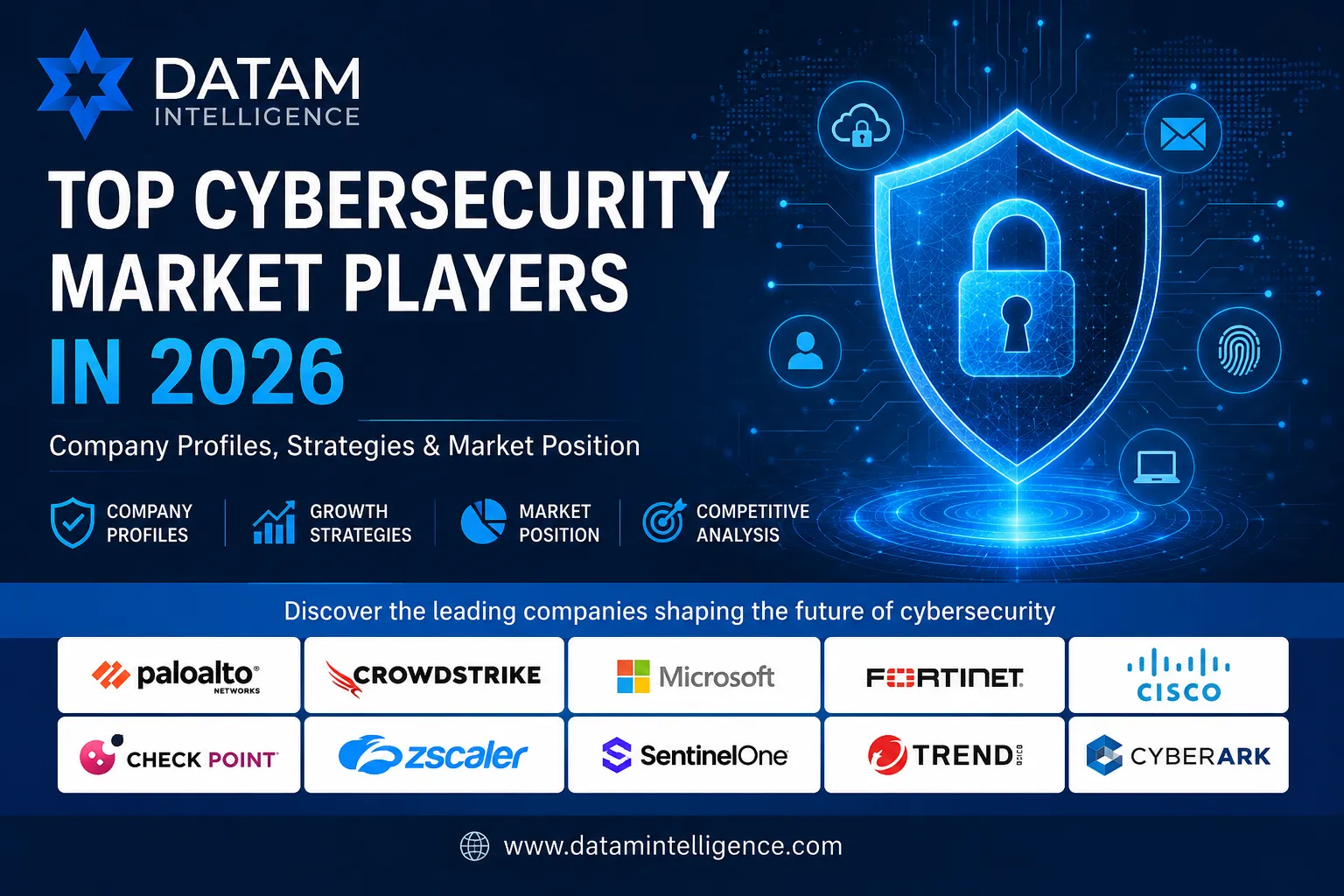
For organizations looking to optimize their security investments, the market leaders can be categorized by their core architectural anchor points:
- The Unified Platform Giant: Palo Alto Networks (Network, Cloud, SecOps, and Identity)
- The AI-Native Endpoint Leaders: CrowdStrike, SentinelOne
- The Infrastructure & Cloud Ecosystems: Microsoft Security, Cisco Security, Fortinet
- The Edge & Zero-Trust Pioneers: Zscaler, Cloudflare
- The Enterprise Prevention Specialists: Check Point Software Technologies, Trend Micro
Cybersecurity Market Overview: The Macro Drivers of 2026
The global cybersecurity ecosystem is expanding at an accelerated pace, propelled by five dominant enterprise realities:
- The Rise of Agentic & Shadow AI: Threat actors are deploying autonomous AI agents capable of continuous, machine-speed vulnerability probing. Concurrently, employees are introducing risk by connecting unauthorized internal data pipelines to public LLMs (Shadow AI).
- Identity as the New Perimeter: With traditional network boundaries thoroughly dissolved, identity has become the primary target. Cloud intrusions leveraging credential abuse rose by over 130% over the past year, turning identity protection into a zero-trust mandate.
- Sovereign Cloud Compliance: Heightened geopolitical friction and rigorous international data frameworks (such as Europe’s NIS 2 and the Cyber Resilience Act) are forcing global enterprises to deploy sovereign AI cloud stacks with localized data infrastructure control.
- Continuous Threat Exposure Management (CTEM): Periodic, static vulnerability scanning is no longer sufficient. Organizations are shifting toward real-time internal inventory tracking, actively mapping exposed APIs, forgotten cloud workspaces, and third-party dependencies.
LMDX Component Placeholder
To help potential clients visualize the consolidation curve, a market landscape diagram or vendor positioning index will be rendered here upon publication.
Deep-Dive Profiles: The Top Cybersecurity Market Players
1. Palo Alto Networks
Company Overview
Palo Alto Networks stands as the largest pure-play cybersecurity powerhouse globally, pioneered by its relentless pursuit of complete platfor mization. The big news defining its 2026 market dominance is the finalization of its blockbuster acquisition of CyberArk. By integrating CyberArk’s premier Privileged Access Management (PAM) alongside its recent acquisition of Chronosphere (observability), Palo Alto Networks has built a closed-loop platform spanning networks, cloud, SecOps, and identity.
Key Strengths
- Prisma Cloud & AIRS 3.0: Industry-leading cloud posture management paired with advanced runtime protection for enterprise AI models.
- Cortex XSIAM & AgentiX: An AI-driven security operations platform that leverages autonomous agents to find and automatically remediate infrastructure vulnerabilities.
- Integrated Identity Platform: The newly launched Idira platform, supercharged by CyberArk's backend, secures both human and autonomous machine identities under a singular management plane.
Growth Strategy
Palo Alto Networks is actively incentivizing enterprise clients to abandon legacy point vendors by offering sweeping, platform-wide multi-year consolidation agreements, bridging security and IT data observability into a single repository.
2. CrowdStrike
Company Overview
CrowdStrike remains a dominant force in endpoint security and managed threat hunting. Demonstrating impressive market resilience, the vendor has achieved annualized recurring revenue (ARR) surpassing $5.25 billion, fueled by the aggressive expansion of its AI-native Falcon platform far beyond traditional endpoints.
Key Strengths
- Falcon Platform Architecture: A single, lightweight host agent that delivers rapid, friction-free enterprise deployment.
- Identity Threat Detection & Response (ITDR): Advanced behavioral telemetry that stops credential-based lateral movement in real time.
- Falcon Over Watch: Market-leading managed detection, response, and proactive human-in-the-loop threat hunting.
Growth Strategy
Crowd Strike is leaning heavily into its custom AI core (Charlotte AI) to automate complex incident response workflows, while positioning its cloud-native architecture as the ideal, lightweight alternative to heavy on-premises security stacks.
3. Microsoft Security
Company Overview
Microsoft holds unparalleled market influence due to its ubiquitous presence within enterprise IT environments. By embedding security telemetry directly into Windows, Azure, and Microsoft 365, it operates as a default fabric provider for global organizations.
Key Strengths
- Ecosystem Ubiquity: Deep native integrations across Microsoft Defender, Microsoft Sentinel (SIEM/SOAR), and Entra ID.
- Security Copilot: A highly mature generative AI assistant that significantly reduces the complexity of alert triaging for internal SOC analysts.
- Hyper-Scale Threat Intel: Processing trillions of security signals daily across its global consumer and enterprise footprints.
Growth Strategy
Microsoft's primary strategy relies on its commercial bundling models, enabling enterprise customers to upgrade existing licensing tiers to secure comprehensive, cloud-wide protection with minimal procurement friction.
4. Fortinet
Company Overview
Fortinet is a global powerhouse in secure networking, consistently leading the market in firewall shipments and unified edge architecture. Its specialized ASIC (Application-Specific Integrated Circuit) hardware technology allows it to deliver network protection at significantly lower power consumption and costs than software-only configurations.
Key Strengths
- FortiGate Next-Generation Firewalls: Industry standard for high-throughput, low-latency hardware protection.
- Universal SASE & SD-WAN: Converged networking and security services optimized for highly distributed branch offices and remote workforces.
- Fortinet Security Fabric: Integrated visibility across operational technology (OT), industrial control systems, and traditional IT environments.
Growth Strategy
Fortinet is capitalizing on the convergence of networking and security, expanding its footprint within critical infrastructure, manufacturing, and edge-computing environments that require deep hardware-level enforcement.
5. Cisco Security
Company Overview
Cisco Security has successfully re-engineered its security identity around its massive acquisition of Splunk. By marrying Cisco's legendary network visibility with Splunk’s enterprise data analytics analytics engine, the company has created an expansive corporate telemetry footprint.
Key Strengths
- Full-Stack Visibility: Unmatched ability to ingest network traffic, endpoint, and application logs into a centralized dashboard.
- Duo Security & Umbrella: Highly dependable secure access, multi-factor authentication (MFA), and secure internet gateway systems.
- Talos Threat Intelligence: One of the world's largest commercial threat intelligence teams, powering proactive defenses across all Cisco hardware.
Growth Strategy
Cisco is driving hard into unified security data platforms, helping large enterprises ingest, normalize, and analyze disparate security data silos without incurring massive storage overhead.
6. Check Point Software Technologies
Company Overview
Check Point maintains an authoritative presence across government, financial services, and highly regulated industries through its unwavering, prevention-first architectural philosophy.
Key Strengths
- Infinity Platform: A fully consolidated architecture achieving the industry’s highest independent catch rates for malware and phishing vectors.
- CloudGuard Portfolio: Automated compliance management and security workflow enforcement natively built into active CI/CD development pipelines.
- AI-Driven Email Security: Advanced protection engines boosted by recent acquisitions (like Lakera and Veriti) targeting zero-day phishing attacks.
Growth Strategy
Check Point is positioning itself as the premier choice for zero-trust compliance, focusing heavily on industries where data sovereignty, strict regulatory governance, and absolute threat prevention are non-negotiable mandates.
7. Zscaler
Company Overview
Zscaler remains a dominant disruptor in the cloud security domain, built entirely on the principle that the internal corporate network should no longer be trusted. Its Zero Trust Exchange™ completely replaces legacy VPN infrastructures.
Key Strengths
- Zero Trust Network Access (ZTNA): Direct user-to-application cryptographic connections that eliminate the risk of lateral threat movement within a network.
- Secure Web Gateway (SWG): High-speed, inline inspection of all internet traffic, safely isolating malicious code away from the local user device.
- Deception Technologies: Automated creation of internal network honeypots to detect and trap sophisticated lateral attackers instantly.
Growth Strategy
Zscaler is expanding rapidly into cloud workload protection and B2B secure connectivity, actively helping enterprises deprecate their costly, complex routing hardware in favor of direct, cloud-native edge access.
8. SentinelOne
Company Overview
SentinelOne is an aggressive innovation leader built on fully autonomous, machine-learning-driven endpoint protection and security data optimization.
Key Strengths
- Singularity XDR Platform: Real-time, fully automated threat remediation and cryptographic "rollback" capabilities on local endpoints without requiring cloud connectivity.
- Singularity Data Lake: A highly efficient, scalable data platform that allows organizations to store and search historical logs at a fraction of standard enterprise costs.
- Purple AI: An advanced autonomous threat-hunting interface designed to radically accelerate security analyst investigation speeds.
Growth Strategy
SentinelOne is positioning itself as the high-performance, open-ecosystem alternative to closed security platforms, winning market share by highlighting its speed, automated response mechanisms, and cost-effective data management.
9. Trend Micro
Company Overview
Trend Micro is a widely trusted global leader providing comprehensive cross-layer threat defense, with deeply rooted expertise in hybrid cloud environments, server data centers, and multi-cloud container security.
Key Strengths
- Trend Vision One Platform: A robust, consolidated XDR environment mapping risks across email, endpoints, servers, cloud workloads, and networks.
- Cloud One Workload Security: Deep, specialized protection for cloud-native applications, container pipelines, and legacy data center servers.
- Vulnerability Research Leadership: Backed directly by the Zero Day Initiative (ZDI), the world's largest vendor-agnostic bug bounty program.
Growth Strategy
Trend Micro is focusing on unified cyber risk management, allowing enterprise tech leaders to discover, assess, and mitigate their entire digital attack surface vulnerabilities via a single risk score metric.
5 Competitive Trends Shaping Enterprise Procurement
| Trend | Strategic Priority for IT Leaders | Expected Impact |
|---|---|---|
| Platformization over Point Tools | Consolidating separate tools onto single-vendor control planes. | Reduces operational complexity, eliminates integration blind spots, and lowers licensing overhead. |
| Agentic AI Security Operations | Deploying autonomous AI security agents to manage defenses. | Shifts incident response from manual human triage to real-time, automated machine-speed remediation. |
| Identity-First Security | Treating user and machine identities as the fundamental security perimeter. | Neutralizes the threat of valid credential abuse and mitigates lateral server movement during a breach. |
| Cryptographic Post-Quantum Pilots | Commencing early migration toward post-quantum cryptography (PQC). | Safeguards encrypted enterprise data pools against future "harvest now, decrypt later" decryption risks. |
| Hardware-Backed Device Attestation | Mandating real-time, cryptographic proof of local device integrity. | Ensures only verified, untampered endpoints can request access to sensitive cloud databases. |
Explore AI in Cybersecurity Market analysis report.
Analyst Perspective & Strategic Recommendations
The data is clear: enterprise cybersecurity is no longer a challenge of choosing individual tool features. It is an architectural battle over data orchestration and operational visibility. Security stacks that require manual engineering to bridge disconnected data silos create the operational gaps that modern, AI-driven threats exploit.
Organizations evaluating their security posture over the coming year should focus on three foundational principles:
- Prioritize Ingestion Efficiency: Choose vendors that allow you to consolidate your log architecture without imposing cost structures that force you to discard valuable threat telemetry.
- Enforce Identity/Data Convergence: Ensure your identity architecture natively communicates with your network and cloud workload protection platforms. The 2026 merger landscape proves that identity and infrastructure are now inseparable.
- Build for Resilience, Not Just Prevention: Assume your perimeter will face compromised credentials. Structure your defenses around real-time visibility, automated workload containment, and rapid blast-radius reduction.
Benchmark Your Organization's Cyber Resilience Strategy
Are you currently navigating vendor consolidation, scaling secure AI infrastructure, or reviewing your zero-trust identity architecture? Selecting the right strategic partner requires matching your specific enterprise footprint with the vendor ecosystem best suited for your long-term scale.
Read complete comprehensive 2026 Cybersecurity market Evaluation report.