


Introduction
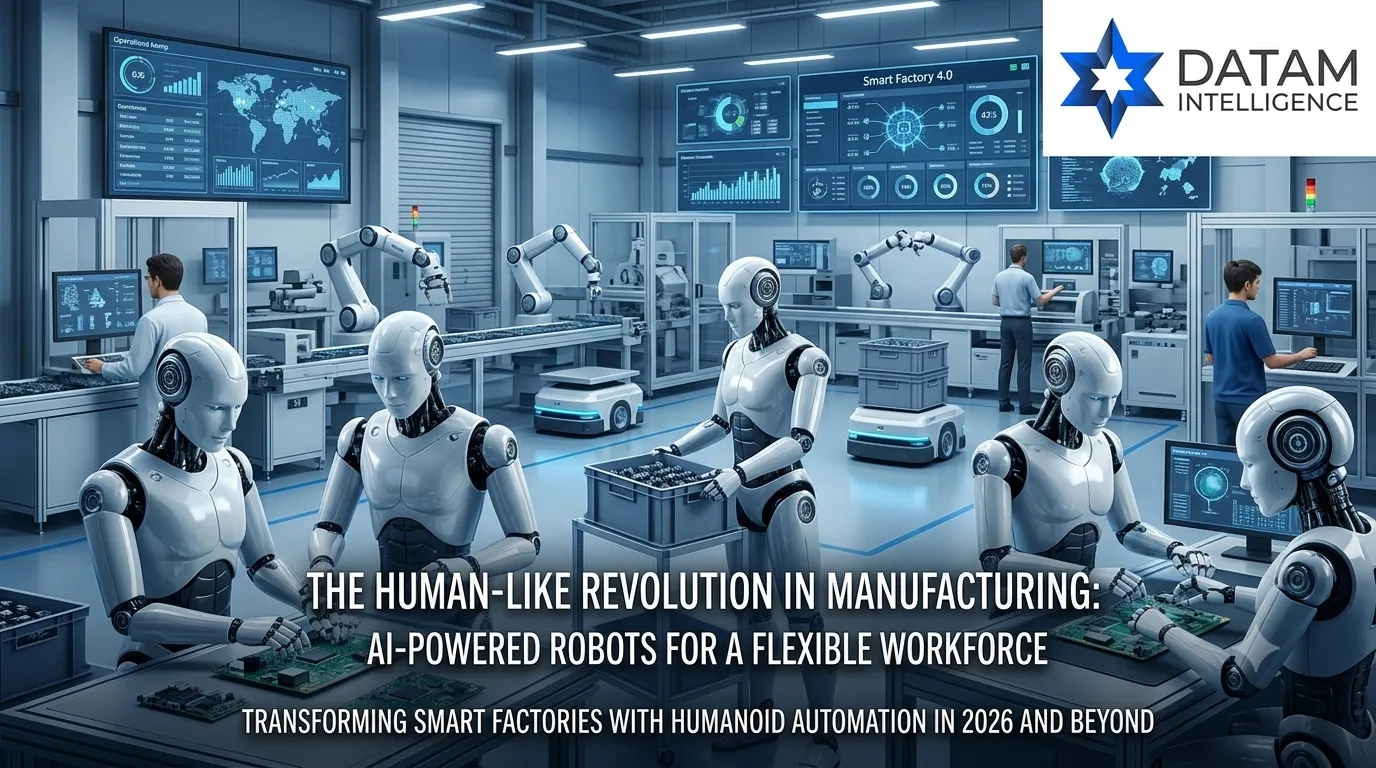
The manufacturing industry is entering a new era of automation driven by artificial intelligence (AI), robotics, and humanoid robotic systems. Unlike traditional industrial robots designed for repetitive tasks, humanoid robots are built to operate in human-centric environments, work alongside employees, and perform complex physical activities using advanced perception, learning, and decision-making capabilities.
In 2026, leading automotive, electronics, logistics, and industrial manufacturers are accelerating investments in humanoid robots to address labor shortages, improve workplace safety, and increase production efficiency.
Companies including Tesla, BMW, Mercedes-Benz, Figure AI, Agility Robotics, Apptronik, and leading robotics innovators are testing and deploying humanoid robots across manufacturing environments.
DataM Intelligence analysts highlight that the Humanoid Robot Market is transitioning from experimental robotics development toward commercial-scale industrial adoption. The market is expected to witness accelerated expansion as enterprises invest in AI-driven automation, intelligent robotic systems, and human-machine collaboration technologies. With the global humanoid robot market projected to grow from US$3.22 billion in 2025 to US$58.93 billion by 2033 at a CAGR of 43.83%, manufacturers and technology providers are increasingly exploring humanoid robots as a strategic solution for improving productivity, addressing labor shortages, and enabling next-generation smart factory operations.
Explore the Future of Humanoid Robotics
Want deeper insights into market size, growth opportunities, competitive landscape, and future trends?
Explore the latest Humanoid Robot Market Report by DataM Intelligence to understand industry growth, key players, emerging technologies, and investment opportunities.
Request a Sample Report Today and gain access to comprehensive market intelligence for strategic decision-making.
What Are Humanoid Robots in Manufacturing?
Humanoid robots are AI-enabled robots designed with a human-like structure, including arms, legs, sensors, cameras, and advanced control systems. These robots can perform tasks traditionally handled by human workers while operating within existing factory environments.
Unlike conventional automation systems, humanoid robots provide greater flexibility because they can:
- Navigate human-designed workplaces
- Handle multiple tasks without major infrastructure changes
- Learn new operations using AI models
- Collaborate safely with human employees
- Adapt to changing production requirements
What are humanoid robots used for in manufacturing?
Humanoid robots are used in manufacturing for assembly operations, material handling, quality inspection, machine tending, warehouse activities, and repetitive industrial tasks. Their ability to work in existing factory environments makes them a promising solution for next-generation smart factories.
Why Are Manufacturers Investing in Humanoid Robots?
Manufacturing companies are adopting humanoid robots due to several major industry challenges:
1. Global Labor Shortages
A shortage of skilled manufacturing workers has increased demand for automation solutions capable of supporting human teams.
Humanoid robots can perform physically demanding and repetitive jobs while allowing employees to focus on higher-value activities.
2. Flexible Factory Automation
Traditional industrial robots often require fixed production lines and customized infrastructure.
Humanoid robots offer flexibility by performing different tasks within existing manufacturing facilities without extensive modifications.
3. Artificial Intelligence Advancements
Recent breakthroughs in:
- Generative AI
- Computer vision
- Machine learning
- Robotics foundation models
have significantly improved humanoid robot capabilities.
AI enables robots to understand environments, learn tasks faster, and make autonomous decisions.
4. Smart Manufacturing Transformation
As manufacturers move toward Industry 4.0 and smart factories, humanoid robots are becoming an important component of connected industrial ecosystems.
Top 10 Companies Using and Developing Humanoid Robots in Manufacturing (2026)
The manufacturing sector is becoming one of the most important early adoption markets for humanoid robots as companies look for flexible automation solutions to improve productivity, address labor shortages, and build next-generation smart factories.
Unlike traditional industrial robots designed for specific repetitive tasks, humanoid robots are being developed to operate in human-centric environments, allowing manufacturers to integrate automation into existing facilities with minimal infrastructure changes.
Leading automotive manufacturers, robotics companies, and AI innovators are investing heavily in humanoid robotics technology. The following companies are at the forefront of humanoid robot development and industrial deployment in 2026.
1. Tesla – Optimus Humanoid Robot for Factory Automation
Tesla is one of the most prominent companies advancing humanoid robots for industrial applications through its Optimus humanoid robot program.
Tesla is developing Optimus as a general-purpose robotic worker capable of performing tasks within manufacturing environments, particularly in automotive production facilities.
Key Manufacturing Applications:
- Material handling and transportation
- Component movement across production areas
- Repetitive assembly support
- Factory assistance operations
- Handling physically demanding tasks
Tesla’s long-term vision is to integrate humanoid robots into its manufacturing ecosystem to improve operational efficiency, enhance workplace safety, and support scalable production.
2. BMW – Humanoid Robots for Automotive Manufacturing
BMW is exploring humanoid robotics applications to support future automotive manufacturing operations.
The automotive industry is expected to become one of the largest markets for humanoid robots due to its complex production processes, repetitive workflows, and demand for flexible automation.
BMW has evaluated humanoid robot solutions for potential applications in production environments.
Potential Manufacturing Applications:
- Assembly line assistance
- Handling automotive components
- Supporting repetitive production activities
- Logistics and material movement
- Improving worker ergonomics and safety
Humanoid robots could help BMW create more adaptable manufacturing systems while complementing human workers.
3. Mercedes-Benz – AI-Powered Humanoid Robots in Production
Mercedes-Benz is investigating the use of advanced robotics and AI-powered automation solutions within manufacturing facilities.
The company has been exploring humanoid robots to support industrial workflows and improve production flexibility.
Potential Industrial Applications:
- Factory logistics
- Transporting materials
- Supporting repetitive physical operations
- Assisting manufacturing teams
- Automating physically demanding activities
The adoption of humanoid robots could help automotive manufacturers respond to workforce challenges while improving production efficiency.
4. Figure AI – General-Purpose Humanoid Robots for Industry
Figure AI is one of the leading humanoid robotics companies developing general-purpose robots for commercial and industrial environments.
The company’s humanoid robot technology focuses on creating AI-powered robotic workers capable of learning and performing complex tasks.
Industrial Applications:
- Manufacturing automation
- Warehouse operations
- Material handling
- Industrial labor support
- Repetitive physical workflows
Figure AI has gained significant attention due to its partnerships, investments, and focus on combining artificial intelligence with advanced robotics hardware.
5. Agility Robotics – Digit Humanoid Robot for Logistics and Manufacturing
Agility Robotics developed Digit, a bipedal humanoid robot designed for commercial and industrial applications.
Digit is designed to operate in environments created for humans, making it suitable for logistics centers, warehouses, and manufacturing facilities.
Key Applications:
- Material transportation
- Warehouse automation
- Factory logistics
- Repetitive handling tasks
- Supporting human workers
Agility Robotics is helping accelerate the transition toward flexible robotic automation by developing robots capable of working safely alongside people.
6. Apptronik – Apollo Humanoid Robot for Industrial Automation
Apptronik is developing Apollo, a general-purpose humanoid robot designed for industrial applications.
Apollo focuses on supporting industries where repetitive physical work, logistics activities, and workforce limitations create automation opportunities.
Industrial Capabilities:
- Autonomous material handling
- Warehouse support
- Manufacturing assistance
- Human-robot collaboration
- Repetitive task automation
Apptronik is positioning Apollo as a flexible robotic workforce solution for manufacturing and supply chain operations.
7. Figure AI + BMW Manufacturing Partnership – AI Robotics Deployment
Figure AI has expanded its industrial focus through collaborations with automotive manufacturers to test humanoid robots in real-world production environments.
Automotive factories represent a major opportunity for humanoid robots because they require:
- High-volume production
- Complex assembly operations
- Material movement
- Flexible automation
AI-powered humanoid robots could enable manufacturers to automate additional tasks that were previously difficult for conventional robots to handle.
8. Boston Dynamics – Advanced Humanoid Robotics Development
Boston Dynamics is recognized globally for advanced robotic systems and continues to develop next-generation humanoid robotics technologies.
Its humanoid robot platform focuses on advanced mobility, manipulation, and autonomous capabilities.
Potential Industrial Applications:
- Factory automation
- Inspection operations
- Material handling
- Complex industrial environments
- Dangerous task execution
Boston Dynamics’ robotics expertise has contributed significantly to advancements in dynamic movement and robotic intelligence.
9. Sanctuary AI – AI-Powered General-Purpose Robots
Sanctuary AI is developing humanoid robots designed to perform human-like tasks through advanced artificial intelligence systems.
The company focuses on creating robots capable of learning tasks and operating in real-world environments.
Industrial Applications:
- Manufacturing support
- Retail operations
- Logistics activities
- Workplace assistance
- Repetitive task automation
Sanctuary AI’s approach combines robotics hardware with AI systems designed for general-purpose task execution.
10. UBTECH Robotics – Humanoid Robots for Industrial and Commercial Applications
UBTECH Robotics is one of the leading humanoid robot developers in China, focusing on industrial, commercial, and service robotics applications.
The company has developed humanoid robotic platforms targeting enterprise adoption.
Applications Include:
- Industrial automation
- Manufacturing assistance
- Education and research
- Commercial service environments
- Human-machine interaction
UBTECH is contributing to the expansion of humanoid robotics adoption across Asian manufacturing markets.
11. 1X Technologies – AI Humanoid Robots for Industrial Automation
1X Technologies is developing AI-powered humanoid robots designed to operate in real-world environments and support labor-intensive industries.
The company focuses on creating safe, intelligent robots capable of performing tasks alongside humans.
Industrial Applications:
- Manufacturing assistance
- Logistics operations
- Material handling
- Repetitive physical tasks
- Workplace automation
1X Technologies is advancing the concept of robotic workers by combining artificial intelligence, autonomous movement, and human-safe interaction capabilities.
12. PAL Robotics – Humanoid Robots for Research and Industrial Applications
PAL Robotics develops humanoid and mobile robotic systems for industrial, research, and commercial applications.
The company has developed humanoid platforms designed to support human environments and collaborative workflows.
Potential Manufacturing Applications:
- Factory assistance
- Research and development activities
- Human-robot collaboration
- Inspection tasks
- Industrial workflow support
PAL Robotics has contributed to humanoid robotics advancement through its focus on autonomous navigation, manipulation, and service robotics.
13. Fourier Intelligence – General-Purpose Humanoid Robotics
Fourier Intelligence is developing humanoid robotic platforms focused on industrial automation, healthcare, and human-machine interaction.
The company’s humanoid robot platform aims to combine AI intelligence with advanced robotic movement capabilities.
Industrial Applications:
- Manufacturing support
- Assembly assistance
- Logistics automation
- Industrial training environments
- Human-machine collaboration
Fourier Intelligence is expanding its role in the humanoid robotics ecosystem by developing robots designed for scalable commercial adoption.
14. Xiaomi – CyberOne Humanoid Robot Development
Xiaomi has entered the humanoid robotics sector with its CyberOne humanoid robot, demonstrating capabilities in AI perception, motion control, and human interaction.
While Xiaomi’s humanoid robot development is still evolving, the company’s expertise in artificial intelligence, sensors, electronics, and manufacturing provides a strong foundation for future robotics applications.
Potential Industrial Applications:
- Smart factory operations
- Manufacturing assistance
- Human-machine interaction
- Industrial research
- AI robotics development
Xiaomi’s entry highlights the growing convergence between consumer technology companies and industrial robotics.
15. Kawasaki Robotics – Humanoid Robotics for Industrial Automation
Kawasaki Robotics is a major industrial robotics company exploring advanced robotic technologies for next-generation manufacturing environments.
With decades of experience in industrial automation, Kawasaki is positioned to contribute to the evolution of humanoid and collaborative robotics.
Industrial Applications:
- Automotive manufacturing
- Assembly operations
- Factory automation
- Material handling
- Industrial collaboration
Kawasaki’s manufacturing expertise and global robotics presence make it an important player in the transition toward intelligent industrial automation.
Emerging Humanoid Robotics Ecosystem: Industry Outlook
The expansion of companies developing humanoid robots demonstrates that the market is moving beyond traditional automation toward AI-enabled robotic workers capable of performing diverse industrial tasks.
The competitive landscape includes:
- Automotive manufacturers investing in factory automation
(Tesla, BMW, Mercedes-Benz) - AI robotics startups developing general-purpose humanoids
(Figure AI, Apptronik, Agility Robotics, 1X Technologies) - Industrial robotics leaders advancing automation platforms
(Boston Dynamics, Kawasaki Robotics, PAL Robotics) - Technology companies entering robotics markets
(Xiaomi, UBTECH)
As AI models, sensors, actuators, and robotics hardware continue improving, humanoid robots are expected to become an important component of future manufacturing ecosystems.
Real-World Applications of Humanoid Robots in Manufacturing
Assembly Line Support
Humanoid robots can assist workers with repetitive assembly operations, improving productivity and reducing physical strain.
Examples:
- Installing components
- Handling parts
- Tool transportation
Material Handling and Logistics
Factories require continuous movement of materials between production areas.
Humanoid robots can support:
- Part transportation
- Warehouse operations
- Inventory movement
Quality Inspection
With AI vision systems, humanoid robots can inspect products and identify manufacturing defects.
Applications include:
- Visual inspection
- Product verification
- Process monitoring
Dangerous Manufacturing Tasks
Humanoid robots can perform hazardous operations involving:
- Heavy materials
- Unsafe environments
- Repetitive physical activities
This improves employee safety while maintaining production efficiency.
Humanoid Robots vs Traditional Industrial Robots
| Feature | Traditional Robots | Humanoid Robots |
|---|---|---|
| Flexibility | Limited | High |
| Environment Adaptation | Requires customization | Human workplace compatible |
| Task Variety | Single-purpose | Multi-purpose |
| AI Capability | Limited | Advanced AI integration |
| Human Collaboration | Limited | Designed for collaboration |
Future Opportunities in the Humanoid Robot Market
The future of humanoid robots extends far beyond traditional automation. As artificial intelligence, robotics hardware, and machine learning technologies continue to advance, humanoid robots are expected to become an important component of the next generation of intelligent workforce solutions.
From smart factories to healthcare facilities and service industries, humanoid robots are creating new opportunities for businesses seeking flexible automation, improved operational efficiency, and solutions to workforce challenges.
Manufacturing: The First Major Adoption Market for Humanoid Robots
Manufacturing is expected to remain one of the largest and earliest adoption markets for humanoid robots due to its structured operating environments, repetitive workflows, and increasing demand for automation.
Unlike conventional industrial robots that are often designed for specific tasks, humanoid robots can operate in existing factory environments built for humans, enabling manufacturers to introduce automation with fewer infrastructure changes.
Key Factors Driving Manufacturing Adoption:
Structured Industrial Environments
Factories typically have predictable layouts, defined workflows, and controlled operating conditions, making them suitable environments for humanoid robot deployment.
Repetitive and Physically Demanding Tasks
Humanoid robots can support workers by performing repetitive activities such as material handling, component movement, assembly assistance, and machine operations.
Rising Labor Costs and Workforce Challenges
Manufacturers worldwide are exploring humanoid robots to address labor shortages, improve productivity, and reduce dependency on physically demanding manual processes.
Smart Factory Transformation
The integration of humanoid robots with artificial intelligence, industrial IoT, and automation systems is expected to accelerate the development of next-generation smart factories.
AI-Powered Workforce Transformation
Humanoid robots are expected to evolve from task-specific machines into intelligent digital workers capable of adapting to changing operational requirements.
Powered by advanced AI models, computer vision, sensors, and machine learning algorithms, future humanoid robots will be able to understand environments, learn new processes, and collaborate with human teams.
Future Capabilities of AI-Powered Humanoid Robots:
Learning New Industrial Processes
Advanced AI systems will enable robots to learn new tasks through demonstrations, simulations, and real-time data analysis.
Human-Robot Collaboration
Humanoid robots will increasingly work alongside employees, supporting workers with physically demanding, repetitive, or hazardous activities.
Multi-Role Industrial Support
Instead of performing a single predefined function, future humanoid robots may handle multiple roles across manufacturing, logistics, inspection, and operational support.
Adaptive Decision-Making
AI-powered robots will become more capable of responding to changing environments and making autonomous decisions within defined operational parameters.
Expansion of Humanoid Robots Into New Industries
While manufacturing is expected to be the initial growth driver, humanoid robots are likely to expand into multiple industries as technology maturity increases and costs decline.
Healthcare
Humanoid robots could support healthcare providers through:
- Patient assistance
- Elderly care support
- Rehabilitation services
- Medical facility logistics
- Administrative assistance
The growing demand for healthcare automation and aging populations are expected to create significant opportunities for robotic solutions.
Logistics and Warehousing
The logistics sector is expected to become a major application area due to increasing e-commerce demand and the need for efficient supply chain operations.
Potential applications include:
- Warehouse material movement
- Order fulfillment support
- Inventory handling
- Distribution center automation
Retail and Customer Services
Humanoid robots may enhance retail operations by supporting:
- Customer assistance
- Inventory management
- Product information services
- Store operations
AI-powered robots could help businesses improve customer engagement while optimizing operational efficiency.
Construction
The construction industry could benefit from humanoid robots performing:
- Material transportation
- Site assistance
- Hazardous task execution
- Inspection activities
Robotic solutions may help improve safety and productivity in challenging work environments.
Defense and Security
Humanoid robots may support defense and security operations through:
- Hazardous environment operations
- Remote assistance
- Surveillance support
- Emergency response activities
Their ability to operate in environments designed for humans creates potential advantages for specialized applications.
Hospitality
The hospitality industry may adopt humanoid robots for:
- Guest assistance
- Service support
- Facility operations
- Customer interaction
As AI capabilities improve, robots could provide personalized and efficient service experiences.
Long-Term Market Outlook
The humanoid robot market is moving toward a future where robots are not only automation tools but also intelligent collaborators capable of supporting human productivity across industries.
According to DataM Intelligence analysis, the global humanoid robot market is projected to grow significantly as organizations invest in AI-powered automation, advanced robotics, and flexible workforce solutions. The convergence of artificial intelligence, robotics, and industrial automation is expected to create substantial opportunities for manufacturers, technology providers, investors, and businesses adopting next-generation robotic systems.
As adoption expands beyond factories into healthcare, logistics, retail, construction, defense, and hospitality, humanoid robots are positioned to become a transformative technology shaping the future of work.
Investment Opportunities in Humanoid Robotics
The humanoid robot ecosystem is attracting investments across:
- Robotics hardware
- Artificial intelligence platforms
- Semiconductor technologies
- Sensors
- Battery systems
- Automation software
Investors and technology companies are increasingly viewing humanoid robots as a major growth opportunity within the next generation of industrial automation.
Key Market Trends Driving Humanoid Robot Adoption in 2026
AI and Robotics Convergence: Advanced AI models are improving robot intelligence and autonomy.
Rising Manufacturing Automation Demand: Companies are investing in flexible automation solutions.
Labor Workforce Challenges: Industrial organizations are searching for solutions to workforce gaps.
Smart Factory Development: Connected manufacturing ecosystems are accelerating robotic adoption.
FAQS
Which companies are leading humanoid robot development?
Leading humanoid robot companies include Tesla, Figure AI, Agility Robotics, Apptronik, and other robotics innovators developing AI-powered robotic systems for industrial applications.
How are humanoid robots used in factories?
Humanoid robots are used for assembly assistance, material handling, inspection, warehouse operations, and repetitive manufacturing tasks.
Will humanoid robots replace manufacturing workers?
Humanoid robots are expected to support workers by automating repetitive and physically demanding tasks rather than completely replacing human employees.
Why are companies investing in humanoid robots?
Companies are investing in humanoid robots to improve productivity, reduce operational costs, address labor shortages, and create more flexible manufacturing systems.
Conclusion
Humanoid robots are emerging as a transformative technology for the manufacturing sector. With advancements in AI, robotics, and automation, companies are moving from traditional fixed robotics toward flexible robotic workers capable of operating in human environments.
As global manufacturers continue investing in smart factories and AI-driven automation, humanoid robots are expected to become a critical technology shaping the future of industrial production.
The companies leading this transformation today are positioned to influence the next generation of manufacturing innovation.