


Rare Earths Are No Longer Just a Mining Story
Rare earth elements are used in permanent magnets, electronics, vehicles, energy systems and defense equipment. Yet the commercial pinch point is often downstream of the mine. Ore must be concentrated, chemically separated into individual oxides, converted into metals and alloys, and processed into components such as NdFeB magnets.
That distinction became more visible in 2025, when China introduced export controls covering specified medium and heavy rare-earth-related items, including samarium, gadolinium, terbium, dysprosium, lutetium, scandium and yttrium. The controls underscored a practical risk for buyers: a company may have access to mineral resources and still rely on another country for processing or finished materials.
The strategic question has shifted from “Who has the deposit?” to “Who can deliver the qualified material, in the required form, on a dependable schedule?”
Request for Exclusive Sample on Rare Earth Elements Market
Global Rare Earth Industry at a Glance
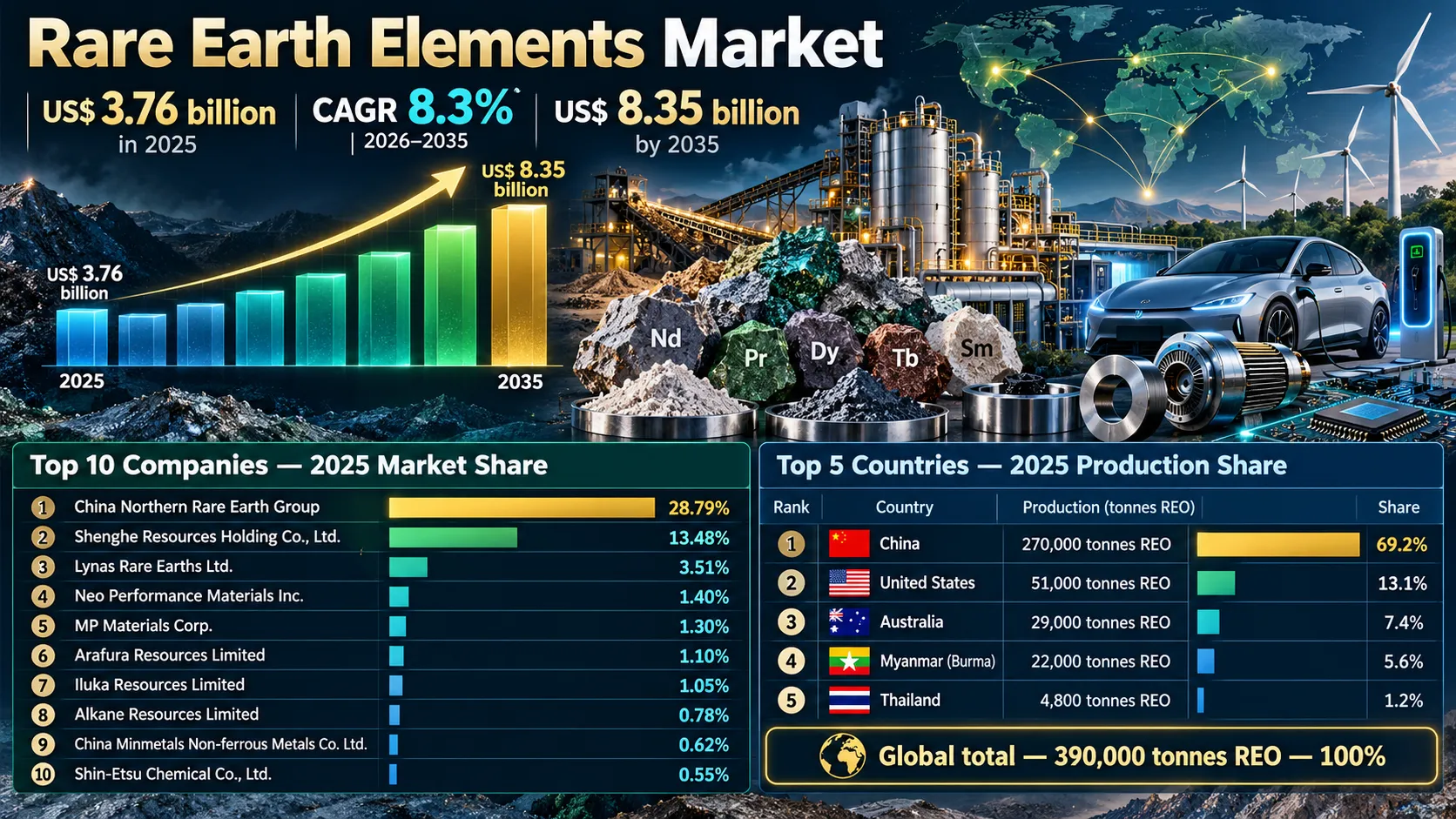
The U.S. Geological Survey estimated global mine production at about 390,000 metric tons of rare-earth-oxide equivalent in 2025. China produced 270,000 tons, while the United States produced 51,000 tons. These figures describe mine output, not the volume of separated oxides, metals, or magnets available to manufacturers.
That distinction is essential. A country can extract rare-earth-bearing ore without having enough domestic separation capacity to turn it into customer-ready products. Likewise, a producer may supply mixed rare-earth carbonate or concentrate rather than a specific oxide or magnet alloy.
For procurement teams, “non-China supply” needs to be defined precisely. Does it refer to the mine, the separation plant, the metal producer, or the final magnet? Each stage affects traceability, lead times, pricing, and exposure to policy changes.
Top 5 Countries by Rare Earth Production Share in 2025
Based on USGS estimates, the five largest producers by mine output were China, the United States, Australia, Burma (Myanmar), and Thailand. As global production was about 390,000 tons, their shares were:
| Country | 2025 mine production | Approximate share |
| China | 270,000 tons | 69.20% |
| United States | 51,000 tons | 13.10% |
| Australia | 29,000 tons | 7.40% |
| Burma (Myanmar) | 22,000 tons | 5.60% |
| Thailand | 4, 000 tons | 1.00% |
Shares are calculated from rounded USGS production estimates and may not total 100% because of rounding and other producing countries.
China’s lead is clear, but mine share alone does not capture its position in processing and manufacturing. The United States’ output largely comes from Mountain Pass, California, while Australia’s production is closely associated with Lynas. Myanmar’s output is relevant to regional supply, particularly for heavy rare earths, but it does not represent a fully diversified mine-to-magnet chain.
4. Mining Is Only the Beginning: Understanding the Rare Earth Value Chain
The rare-earth value chain has several distinct stages:
- Mining and concentration: Ore or mineral sands are extracted and upgraded into concentrate.
- Cracking and leaching: Chemical processing makes the rare earths available for separation.
- Separation: Individual elements are separated into oxides, often through complex solvent-extraction circuits.
- Metal and alloy production: Oxides are converted into metals and magnet alloys.
- Magnet manufacturing: Alloys are formed into magnets and qualified for specific applications.
- Recycling: Manufacturing scrap and end-of-life products can provide secondary material, though collection and recovery economics vary.
A supply agreement should identify which stages are controlled by the supplier and which depend on contractors, overseas facilities or third-party feedstock. It should also specify product form and quality: a concentrate, mixed carbonate, separated oxide and finished magnet are not interchangeable.
5. Top 10 Rare Earth Element Companies
These companies represent different positions in the supply chain. Their inclusion reflects strategic role and operating footprint, not a common production or revenue metric.
China Northern Rare Earth
Based in Inner Mongolia, China Northern Rare Earth is associated with the Bayan Obo resource base and has operations across rare-earth processing and materials. Its scale and proximity to established industrial customers make it a significant participant in the light rare-earth segment. Buyers assessing the company should distinguish resource access from the particular product, processing route and export permissions relevant to a contract.
China Rare Earth Group
China Rare Earth Group brings together assets and capabilities spanning resource development, smelting and separation, functional materials, recycling and trade. Its official site describes a portfolio of 62 mining rights across several provinces, including Jiangxi, Guangxi, Hunan, Shandong and Guangdong. This broad footprint matters because rare-earth supply is shaped by the coordination of mining, processing and commercial channels, not just by one deposit.
Lynas Rare Earths
Lynas is one of the most prominent rare-earth producers operating outside China. Its chain links the Mt Weld mine in Western Australia with processing in Kalgoorlie and separation in Malaysia. In 2025, Sojitz announced that it had begun importing heavy rare earths from Australia-produced material processed by Lynas, extending Japan’s access beyond light rare earths. The arrangement also illustrates how financing, distribution and long-term offtake can connect a producer to an end-market.
MP Materials
MP Materials operates Mountain Pass in California and is expanding into separation and magnet production. The company reported that it began manufacturing NdFeB permanent magnets at its Fort Worth facility in December 2025. Its U.S. Department of Defense partnership supports plans for a larger magnet facility, with commissioning expected in 2028. The commercial test will be whether feedstock, processing yields and customer qualification can scale together.
Iluka Resources
Iluka is developing the Eneabba refinery in Western Australia, intended to produce separated rare-earth oxides from stockpiled and other rare-earth-bearing material. The company says the refinery is designed for capacity of up to 23,000 tonnes of rare-earth oxides a year, including NdPr and dysprosium-terbium oxides. The project’s strategic value will depend on commissioning, feedstock availability and securing customers for its separated products.
Arafura Rare Earths
Arafura is advancing the Nolans project in Australia’s Northern Territory, designed to combine mining, beneficiation and processing into a rare-earth oxide operation. Its main strategic proposition is a potential new source of NdPr for permanent magnets. As with any development-stage project, buyers should monitor financing, construction milestones, permitting and the timing of customer qualification before treating planned capacity as available supply.
USA Rare Earth
USA Rare Earth is developing a mine-to-magnet business around its Round Top project in Texas and magnet manufacturing plans in the United States. Its portfolio includes Less Common Metals, a UK-based rare-earth metal and alloy producer. The company’s opportunity lies in linking mining and downstream manufacturing; execution depends on project delivery, feedstock quality, processing performance and customer qualification. Buyers should separate announced capacity from material already produced at commercial scale.
Shenghe Resources
Shenghe Resources operates across rare-earth products and related processing and trading activities. Its international footprint and involvement in mineral-sands and rare-earth projects make it a relevant participant in cross-border supply. For buyers, the key diligence questions are product origin, processing location, element mix and the specific entity responsible for delivery under a contract.
Neo Performance Materials
Neo Performance Materials focuses on specialty materials and downstream applications, including rare-earth-based products and permanent magnets. Its position highlights a commercial reality: users often need engineered materials that satisfy exact performance standards, not a generic oxide. Qualification, technical support and the ability to adjust product specifications can be as important to customers as access to raw material.
Energy Fuels
Energy Fuels is using its White Mesa Mill in Utah to recover rare earths from monazite-bearing feedstock. In March 2026, the company announced production of its first kilogram of terbium oxide at the site. The milestone points to the potential for U.S. heavy rare-earth production, while future output will depend on feedstock, plant expansion, permitting and successful commercial-scale operation.
Top 10 Rare Earth Companies: Competitive Positioning
The companies fall into three broad groups:
- Established scale and integrated systems: China Northern Rare Earth and China Rare Earth Group benefit from extensive domestic industrial networks.
- Operating or advancing non-China processing: Lynas, MP Materials, Iluka and Energy Fuels are building or operating important parts of the alternative supply chain.
- Projects and downstream specialization: Arafura, USA Rare Earth, Shenghe and Neo bring project development, trading, materials or magnet capabilities that address specific gaps.
This comparison should not be read as a simple leaderboard. A buyer seeking separated dysprosium oxide may have different viable suppliers from a buyer seeking NdFeB magnets or mixed carbonate.
Who Has the Competitive Edge?
The edge belongs to companies that can connect secure feedstock with reliable processing and qualified customers. Lynas stands out for operating a substantial non-China mining and separation chain. MP Materials is advancing a U.S. mine-to-magnet pathway. China’s major groups retain scale and industrial integration. Iluka’s potential contribution depends on delivering Eneabba, while Energy Fuels is pursuing a niche in U.S. heavy rare-earth processing.
In practice, customers should judge suppliers by operating performance and delivery history, not capacity targets alone. A plant’s nameplate capacity does not establish product consistency, recovery rates or customer acceptance.
Why Rare Earth Supply Chains Are Becoming a Boardroom Issue
Rare earths now connect procurement decisions to trade policy, product design and business continuity. Export controls can affect intermediate materials even when a manufacturer buys finished components through a distributor. A disruption may also force redesign or requalification, which can take longer than finding a replacement vendor.
Executives should therefore map exposure by element and product form. Dysprosium and terbium, for example, have different supply dynamics from cerium or lanthanum. The same is true of oxide versus alloy versus magnet supply.
What Should Buyers Watch Before Signing Supply Agreements?
Before committing, buyers should confirm:
- Origin and processing: Where were the ore, separated oxide, metal, alloy and finished component produced?
- Specifications: What purity, particle size, magnetic performance and tolerance limits apply?
- Qualification: Has the material passed the buyer’s own production-line and product testing?
- Volume and timing: Are contracted quantities supported by operating output or future capacity?
- Price mechanisms: How are price changes, index references and exceptional cost movements handled?
- Contingencies: What happens if export licensing, feedstock or plant outages delay delivery?
- Traceability and compliance: Can the supplier document chain of custody and relevant regulatory requirements?
These provisions turn “diversification” into a measurable procurement plan.
Where Are the Next Rare Earth Opportunities Emerging?
Near-term opportunities are appearing in separation outside China, heavy rare-earth recovery, magnet alloy production, recycling and customer-specific magnet manufacturing. The commercial bottleneck is often not a lack of announced projects, but the time and capital needed to build, commission and qualify process plants.
Recycling can help reduce dependence on newly mined material, especially where manufacturers can collect clean production scrap. It is less straightforward with mixed end-of-life products, where collection, sorting and recovery costs may outweigh the value of recovered elements.
Japan’s Strategic Position in the Rare Earth Supply Chain
Japan’s approach combines overseas sourcing, investment, distribution and demand-side planning. Sojitz and JOGMEC have supported Lynas through Japan Australia Rare Earth, and Sojitz has served as a distributor of Lynas products in Japan. Its 2025 announcement of heavy rare-earth imports from Lynas showed how long-term commercial relationships can add new product categories to an established supply route.
For Japanese manufacturers, diversification is not simply about replacing one country with another. It requires alternate sources that can meet specifications, sustain deliveries and fit into existing magnet and component supply chains. Recycling, material efficiency and magnet design choices can further reduce exposure.
Rare Earth Industry Outlook 2030-2035
By 2030-2035, the most consequential changes are likely to be at the midstream and downstream stages: more separation capacity outside China, additional metal and alloy production, and new magnet plants tied to automotive, wind, robotics and defense demand. Whether these projects become durable suppliers will depend on process yields, power and chemical costs, skilled labor, permitting and stable offtake.
The next phase will reward companies that can prove repeatable output and customer acceptance. Announced mines will remain important, but dependable conversion into qualified material is what will make supply chains more resilient.
Read Complete Research Report: https://www.datamintelligence.com/research-report/rare-earth-elements-market