


Electronic Medical Records Company Research Insight
The electronic medical records market is no longer defined simply by digitizing patient charts. The competitive battle has moved toward cloud delivery, interoperability, artificial intelligence, ambient documentation, patient engagement, revenue-cycle integration and the ability to connect clinical data across hospitals, physician practices and regional health systems. That makes scale important, but it also makes workflow depth and installed-base trust difficult to displace.
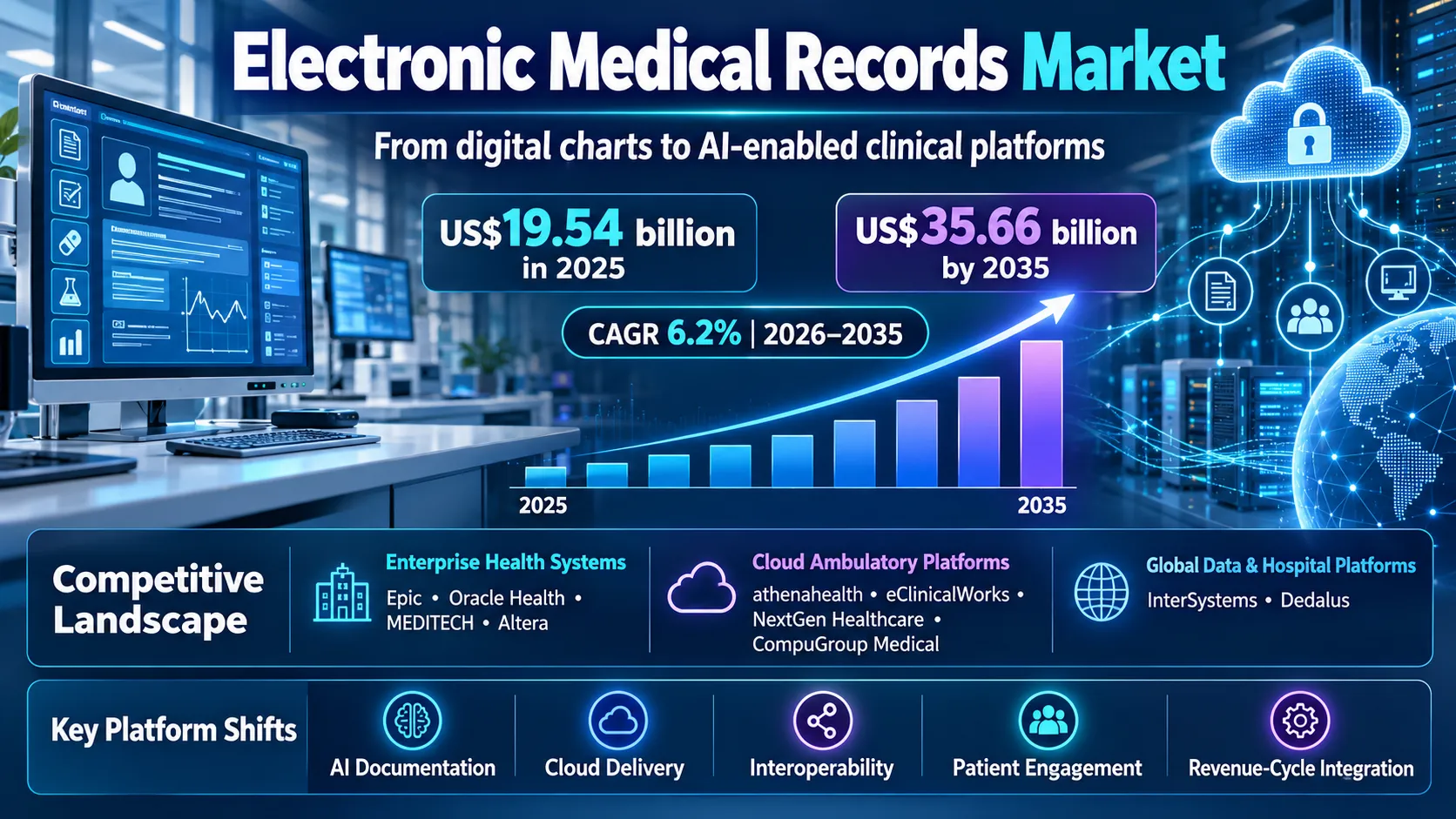
According to DataM Intelligence, the global Electronic Medical Records Market reached US$ 19.54 billion in 2025 and is expected to reach US$ 35.66 billion by 2035, growing at a CAGR of 6.2% during 2026 to 2035. The market is segmented by type into traditional EMRs, speech-enabled EMRs, interoperable EMRs and other solutions, with cloud-based and on-premise delivery models serving hospitals, healthcare providers, patients and other end users. DataM expects cloud-based delivery to remain the leading model as providers prioritize scalability, remote access, lower infrastructure burden and easier integration.
DataM currently lists Altera Digital Health, athenahealth, EkaCare, HealthPlix, Oracle, Meditab, Practo Technologies, Medical Information Technology (MEDITECH), NXGN Management/NextGen Healthcare and Epic Systems among the major players. For a 2025 base-year global competitive landscape, that list needs updating. Epic, Oracle Health, MEDITECH, athenahealth, Altera and NextGen should remain. However, EkaCare, HealthPlix, Meditab and Practo are more appropriate as regional or ambulatory-market participants than as global Top 10 companies. eClinicalWorks, InterSystems, Dedalus and CompuGroup Medical should be added because of their larger installed bases, broader geographic reach and stronger current EHR/EMR platform relevance.
The market is now shaped by three competitive models. Epic and Oracle Health compete for large health-system enterprise platforms. MEDITECH, Altera, InterSystems and Dedalus are important in hospital and regional health-system modernization. athenahealth, eClinicalWorks, NextGen and CompuGroup Medical are especially relevant in ambulatory, physician-practice and cloud-based workflows. The strongest vendors increasingly combine the medical record with AI, patient access, billing, analytics and data-exchange capabilities rather than selling a standalone charting system.
Request Exclusive Sample: https://www.datamintelligence.com/download-sample/electronic-medical-records-market
Top 10 Companies Analysis
Epic Systems Corporation
Epic is one of the most influential companies in the global EMR and EHR market because of its position across large hospitals, integrated delivery networks and ambulatory care. Its competitive strength comes from platform breadth. Epic combines inpatient and outpatient records, patient engagement, revenue cycle, analytics, interoperability and specialty workflows inside a tightly integrated environment.
The company is also moving aggressively into native artificial intelligence. In 2026 Epic rolled out AI Charting, which listens during patient visits, drafts clinical notes and queues orders for clinician review. Epic has also expanded AI across clinicians, patients and operational workflows. More than 85% of Epic customers were using Epic AI by early 2026, showing that AI is becoming part of the core EHR rather than a separate add-on.
Interoperability remains another major advantage. Epic says Care Everywhere exchanges more than 30 million patient record documents daily, including substantial exchange with organizations using other EHR platforms. The key risk is concentration. Large health systems can become deeply dependent on the platform, while smaller organizations may see implementation cost, change management and complexity as barriers.
Oracle Health
Oracle Health remains one of the most important global enterprise EHR competitors because it combines the former Cerner installed base with Oracle cloud, database and AI capabilities. The company competes in large hospitals and health systems where the EHR is expected to connect clinical, financial, operational and population-health workflows.
Oracle is repositioning the platform around a redesigned AI-powered EHR. The current Oracle Health EHR includes embedded AI, cloud delivery, AI-generated summaries, voice interaction, clinical intelligence and personalized workflows. During 2026 Oracle also expanded its Clinical AI Agent into coding, dictation, chart review and order creation, while launching additional patient-facing AI capabilities.
The competitive opportunity is significant because Oracle can connect the EHR to its broader cloud and enterprise technology stack. The challenge is execution. The company must modernize a very large installed base while convincing providers that the next-generation platform can improve usability, reliability and clinician experience without creating disruptive migration risk.
MEDITECH
MEDITECH remains a major hospital EHR company through Expanse, with particular strength among community hospitals, regional health systems and organizations seeking an integrated alternative to the largest enterprise platforms. Its position has strengthened as Expanse has moved toward cloud-native architecture, mobile workflows and broader interoperability.
The HCA Healthcare rollout is strategically important. In 2026 MEDITECH reported Expanse live across major HCA divisions, including large-scale deployments across dozens of hospitals. The company has also expanded cloud delivery through MEDITECH as a Service and continued winning rural and independent hospitals that want a unified record without adopting the most complex enterprise platforms.
MEDITECH is also embedding ambient intelligence and AI into Expanse. In 2026 it introduced native ambient listening for physicians and nurses alongside additional AI tools. Its strength is an established hospital base and improving cloud architecture. Its challenge is competing for the largest academic and multinational health systems where Epic and Oracle have greater scale.
athenahealth
athenahealth is one of the strongest cloud-based ambulatory EHR companies and is especially relevant to physician groups, multispecialty practices and outpatient organizations. Its competitive model differs from large hospital-centric platforms because athenaOne combines EHR, practice management, patient engagement and revenue-cycle workflows in a network-based cloud environment.
In 2026 athenahealth made AI-native athenaOne experiences broadly available to more than 170,000 clinicians. These capabilities are designed to support real-time encounter documentation, chart preparation and workflow recommendations directly inside the EHR. This matters because ambulatory customers increasingly judge EHR vendors on measurable time savings rather than basic digital record functionality.
athenahealth benefits from cloud deployment, a large ambulatory network and integrated financial workflows. Its main limitation is that it does not have the same enterprise inpatient footprint as Epic, Oracle, MEDITECH or Dedalus. Its competitive strength is therefore deepest in outpatient care, physician practices and organizations seeking lower infrastructure burden.
Altera Digital Health
Altera Digital Health remains an important hospital EHR company through Sunrise and Paragon. It should remain in the Top 10 because it has a meaningful installed base across the United States and international markets and continues to invest in modernization rather than operating only as a legacy platform provider.
In 2026 Altera reported multiple Sunrise and Paragon go-lives, contract renewals and upgrades. Fourteen hospital systems extended Sunrise partnerships, while KPC Health expanded its use of Paragon Denali across seven hospitals. These renewals matter because retention is a critical competitive measure in a market where switching enterprise EHRs can take years and cost health systems heavily.
Altera is also adding AI directly into clinical workflows. Sunrise Thread AI is being piloted as a native ambient scribe and documentation assistant. The company’s strength is its established hospital base and choice of different EHR platforms for different care settings. The challenge is defending share as hospitals consolidate onto fewer strategic enterprise vendors.
eClinicalWorks
eClinicalWorks should be added to the Top 10 because it is one of the largest ambulatory cloud EHR providers and has a substantial physician-practice footprint. Its portfolio combines EHR, practice management, population health, patient engagement and revenue-cycle tools, making it relevant to outpatient providers that want an integrated technology stack.
The company has made AI medical documentation a central part of its current strategy through Sunoh.ai. During 2026 eClinicalWorks highlighted multiple provider organizations using the integrated AI scribe to reduce documentation time and improve chart completion. The key differentiator is deep integration with structured EHR fields rather than requiring clinicians to copy notes from a separate application.
eClinicalWorks is strongest in ambulatory settings rather than large acute-care hospital systems. That does not reduce its global relevance because outpatient care represents a large volume of EMR users. Its competitive advantage is cloud scale and physician workflow focus. The risk is intense competition from athenahealth, NextGen and specialty-focused EHR vendors.
NextGen Healthcare
NextGen Healthcare remains an important ambulatory EHR and practice-management company, particularly across specialty practices, community health centers and multispecialty groups. Its platform combines clinical documentation, patient engagement, interoperability, analytics and financial workflows, allowing practices to manage both care delivery and business operations.
The company has continued to position AI and intelligent automation as core elements of its product direction. In 2026 NextGen was recognized across multiple ambulatory EHR specialties, including cardiology, community health centers, internal medicine and pulmonology. That specialty depth is important because ambulatory providers often need highly specific workflow configuration rather than a generic record system.
NextGen’s strength is its long-standing practice-market presence and specialty expertise. Its challenge is maintaining differentiation as ambient AI, patient portals, interoperability and revenue-cycle automation become standard expectations across almost every ambulatory EHR platform.
InterSystems
InterSystems should be added because it has a large international healthcare technology presence through TrakCare and the newer IntelliCare platform. Unlike vendors concentrated mainly in the United States, InterSystems has meaningful exposure across multiple international health systems and government-led digital health environments.
In 2026 InterSystems was recognized as a Leader in enterprise EHR evaluations and achieved an important regulatory milestone when IntelliCare became the first unified AI-native EHR to receive Class IIa medical-device certification under the European Medical Device Regulation. This reflects a strategy of integrating AI into the core clinical record rather than layering it on as a separate productivity tool.
InterSystems also benefits from deep expertise in healthcare data platforms and interoperability. That gives it an advantage where national or regional health systems need to connect fragmented records. Its challenge is that its brand is less visible than Epic or Oracle among some hospital buyers, particularly in North America.
Dedalus Group
Dedalus is one of the companies most clearly missing from the current DataM Top 10. It has a major hospital EHR footprint across Europe and other international markets through ORBIS, Dedalus Care and related platforms. Its strength is especially visible in public health systems and multiregional hospital networks.
According to Dedalus, KLAS data for 2025 showed the company recorded the highest number of contracted hospital beds for the fourth consecutive year, with almost 10,000 beds contracted during the year. Dedalus also reported an installed presence across 1,637 inpatient hospitals in Europe, Latin America, Africa, the Middle East and Oceania, positioning it among the largest international hospital EHR vendors by footprint.
The company’s competitive advantage is international hospital scale and a strong European base. Its challenge is portfolio complexity created by years of acquisitions and regional product variation. Successful modernization will depend on creating more consistent cloud, data and user experiences across markets.
CompuGroup Medical
CompuGroup Medical should be included because it has broad healthcare software exposure across physician practices, ambulatory EHRs, laboratories, pharmacies and related digital-health workflows. Its position is particularly relevant in Europe and the United States, where it serves a large base of office-based providers and smaller healthcare organizations.
The company has continued to add AI to EHR and document workflows. It launched an ambient AI capability inside its EHR environment and in 2026 introduced CGM INDEX.AI for healthcare document automation. This reflects the broader market shift toward reducing manual charting and administrative work rather than competing only on record storage or basic practice-management features.
CompuGroup Medical’s advantage is geographic reach and breadth across ambulatory healthcare software. The challenge is fragmentation. It competes across many regional products and customer types, while larger competitors increasingly market unified cloud platforms with a single enterprise architecture.
Competitor Analysis: Top Electronic Medical Records Market Players
| Company | Core Position | Strategic Focus | Main Demand Exposure | Competitive Strength |
Epic Systems Corporation | Large enterprise EHR leader | Integrated EHR, AI, interoperability and patient engagement | Large hospitals, IDNs, academic medical centers, ambulatory networks | Installed-base depth, integrated platform and data exchange |
| Oracle Health | Enterprise hospital EHR and cloud platform | Next-generation AI EHR, cloud and clinical automation | Large health systems, hospitals and public-sector healthcare | Global installed base plus Oracle cloud and AI stack |
| MEDITECH | Hospital EHR platform | Expanse cloud, mobile, AI and interoperability | Community hospitals, regional systems and large IDNs | Strong hospital footprint and flexible cloud deployment |
| athenahealth | Cloud ambulatory EHR leader | AI-native athenaOne and network-based workflows | Physician groups, ambulatory providers and multispecialty practices | Cloud scale and integrated clinical-financial workflows |
| Altera Digital Health | Hospital EHR vendor | Sunrise, Paragon modernization and embedded AI | Community hospitals, regional systems and international hospitals | Established installed base and multiple hospital platforms |
| eClinicalWorks | Large ambulatory cloud EHR vendor | Integrated AI documentation, population health and RCM | Physician practices, FQHCs and outpatient networks | Large ambulatory footprint and deep workflow integration |
| NextGen Healthcare | Specialty ambulatory EHR and PM vendor | Specialty workflows, AI and practice automation | Specialty groups, community health centers and multispecialty practices | Specialty depth and integrated practice operations |
| InterSystems | International EHR and health-data platform | AI-native EHR, interoperability and regional data exchange | Hospitals, public health systems and international networks | Global data integration capability and international reach |
| Dedalus Group | Major European hospital EHR vendor | Hospital modernization, ORBIS and multiregional EHR deployments | Public hospitals and health systems across Europe and other regions | Large international inpatient footprint |
| CompuGroup Medical | Ambulatory and healthcare software group | EHR automation, AI documentation and connected workflows | Physician practices, clinics, labs and smaller provider organizations | Broad geographic reach and ambulatory software base |
Request Exclusive Sample: https://www.datamintelligence.com/download-sample/electronic-medical-records-market
The table shows why the EMR market is difficult to evaluate using one measure. Epic and Oracle Health matter most in large enterprise health systems. MEDITECH, Altera, InterSystems and Dedalus remain important in hospital modernization across different geographies. athenahealth, eClinicalWorks, NextGen and CompuGroup Medical are stronger in ambulatory care. The common competitive direction is clear: the medical record is becoming an AI-enabled clinical and operational platform rather than a standalone documentation repository.
Who Are Other Companies Influencing the Market?
Several companies outside the Top 10 remain important. Veradigm retains relevance across ambulatory clinical and data workflows following the separation of the former Allscripts hospital business into Altera Digital Health. Netsmart is highly important in behavioral health, human services and post-acute care. Greenway Health also remains established across physician practices and ambulatory care, while Tebra and AdvancedMD are important among smaller practices and independent providers.
The companies removed from the current DataM Top 10 should not disappear from the competitive landscape. EkaCare, HealthPlix, Meditab and Practo are relevant in India and selected ambulatory markets. HealthPlix has built a strong physician-focused digital platform in India, while Practo connects practice-management and patient-access workflows. EkaCare is relevant to digital health records and India’s broader health-data ecosystem. These companies are strategically important regional players but do not have the same global enterprise footprint as Dedalus, InterSystems, eClinicalWorks or CompuGroup Medical.
AI specialists are also influencing competition even when they do not sell a full EHR. Microsoft through Dragon Copilot and Nuance, Abridge, Suki, Nabla and other ambient documentation companies are changing buyer expectations for clinical documentation. Their influence is forcing core EHR vendors to embed native ambient AI or form tighter partnerships so clinicians do not need to work across disconnected applications.
Cloud and infrastructure providers also influence the market. Microsoft Azure, Amazon Web Services, Google Cloud and Oracle Cloud increasingly sit underneath healthcare data, analytics and AI workloads. Their role matters because EHR modernization is becoming tied to cloud migration, cybersecurity, data-platform strategy and generative AI governance rather than only replacement of the clinical user interface.
What Is Driving Competition in the Market?
Competition is being driven first by artificial intelligence and documentation burden. Ambient listening, automated note generation, order creation, coding support and chart summarization are moving from optional add-ons toward expected EHR capabilities. Epic, Oracle Health, MEDITECH, athenahealth, Altera, eClinicalWorks and others are all embedding these functions directly into clinical workflows. Buyers increasingly want proof that AI saves clinician time without creating additional review or compliance risk.
Interoperability is the second major competitive line. Health systems want a longitudinal patient record that can follow the patient across different providers, facilities and applications. FHIR APIs, national exchange frameworks and cross-organizational data sharing are therefore central to vendor selection. Epic’s Care Everywhere scale and InterSystems’ data-platform heritage illustrate two different ways vendors are building competitive advantage around data movement.
Cloud migration is another structural driver. The DataM report expects cloud-based delivery to lead the market because of scalability, lower infrastructure requirements and easier integration. For vendors, this means the competitive issue is no longer whether cloud matters, but how quickly they can move large legacy hospital customers onto secure cloud architectures without disrupting clinical operations.
Health-system consolidation is also reshaping purchasing. When hospitals merge or physician groups are acquired, buyers often try to standardize on fewer EHR platforms. That favors vendors capable of supporting inpatient, ambulatory, specialty, revenue-cycle and patient-engagement workflows across a large enterprise. It also creates pressure on smaller or regional vendors that may be displaced during platform rationalization.
Cybersecurity, regulatory compliance and data governance are becoming larger parts of the buying decision. Medical records contain highly sensitive information and are operationally critical. A system outage can affect scheduling, prescribing, laboratory workflows and clinical decision-making. Vendors that can combine strong security, regulatory certification and resilient cloud operations will have an advantage as ransomware and privacy risks remain high.
The next phase of competition will probably favor companies that can combine a trusted clinical record with embedded AI, cloud delivery, interoperability, patient engagement and financial workflows. For the 2025 base-year global competitive landscape, the strongest Top 10 list is Epic Systems Corporation, Oracle Health, MEDITECH, athenahealth, Altera Digital Health, eClinicalWorks, NextGen Healthcare, InterSystems, Dedalus Group and CompuGroup Medical. The key changes to the current DataM list are adding eClinicalWorks, InterSystems, Dedalus and CompuGroup Medical while moving EkaCare, HealthPlix, Meditab and Practo into the wider competitive landscape.