


The Thermal Materials Race
High performance computing is entering a new thermal cycle as artificial intelligence workloads push chips, racks and data halls toward higher power density. The result is a new race in materials innovation across thermal interface materials, cold plates, dielectric fluids and advanced heat spreaders. These materials are moving from engineering details into strategic infrastructure choices because they now influence compute density, uptime, power efficiency and the cost of serving AI demand.
Heat Is Becoming a Limit on Compute Growth
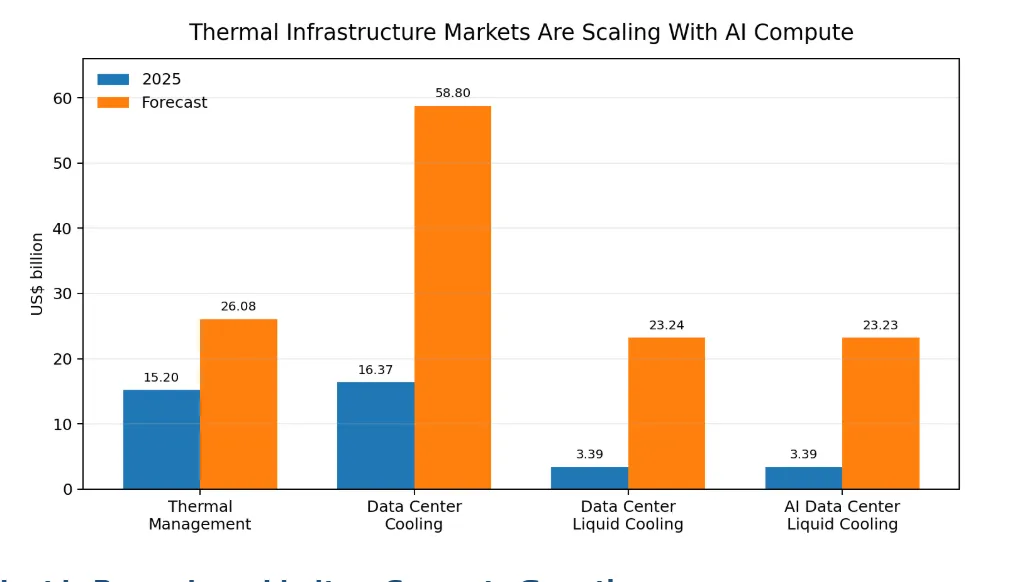
The clearest reason thermal materials matter is that AI infrastructure is becoming denser at the same time that power availability is becoming harder to secure. DataM Intelligence estimates that the broader Thermal Management Market reached US$ 15.20 billion in 2025 and is expected to reach US$ 26.08 billion by 2033. The Data Center Cooling Market is expected to grow from US$ 16.37 billion in 2025 to US$ 58.80 billion by 2035, while the AI Data Center Liquid Cooling Market is projected to expand from US$ 3.39 billion in 2025 to US$ 23.23 billion by 2035.
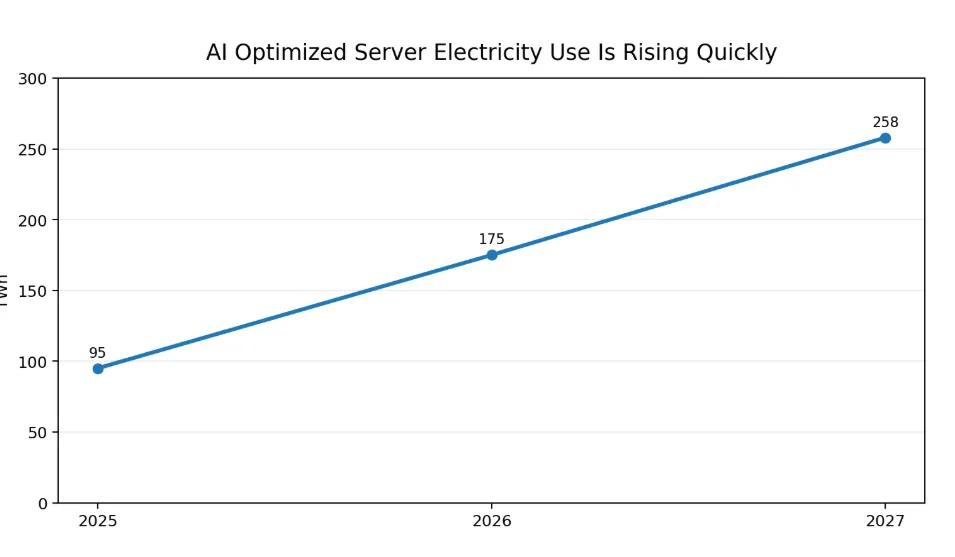
This growth is tied to a simple infrastructure reality. AI accelerators concentrate heat in a small physical footprint, which makes the thermal path from chip surface to coolant loop more important. As rack densities rise, the weak points in that path become more visible. Poor interface contact, uneven heat spreading, coolant compatibility issues and thermal cycling stress can all reduce system performance or shorten equipment life.
For comprehensive market sizing and growth insights across the thermal systems landscape, request a sample to explore the Thermal Management Market report from DataM Intelligence. The report provides detailed analysis of market trends, key growth drivers, technology developments, and emerging opportunities shaping the future of thermal management solutions.
Thermal Materials Are Moving From Component Choice to Platform Strategy
In earlier compute cycles, thermal materials were often treated as supporting components selected late in the design process. In the current HPC cycle, thermal design is moving earlier because materials decisions influence chip packaging, server architecture, rack layout and facility cooling. The issue is broader than removing heat from a single processor. It is about creating a stable thermal chain that allows accelerators to run at high utilization without throttling or avoidable energy waste.
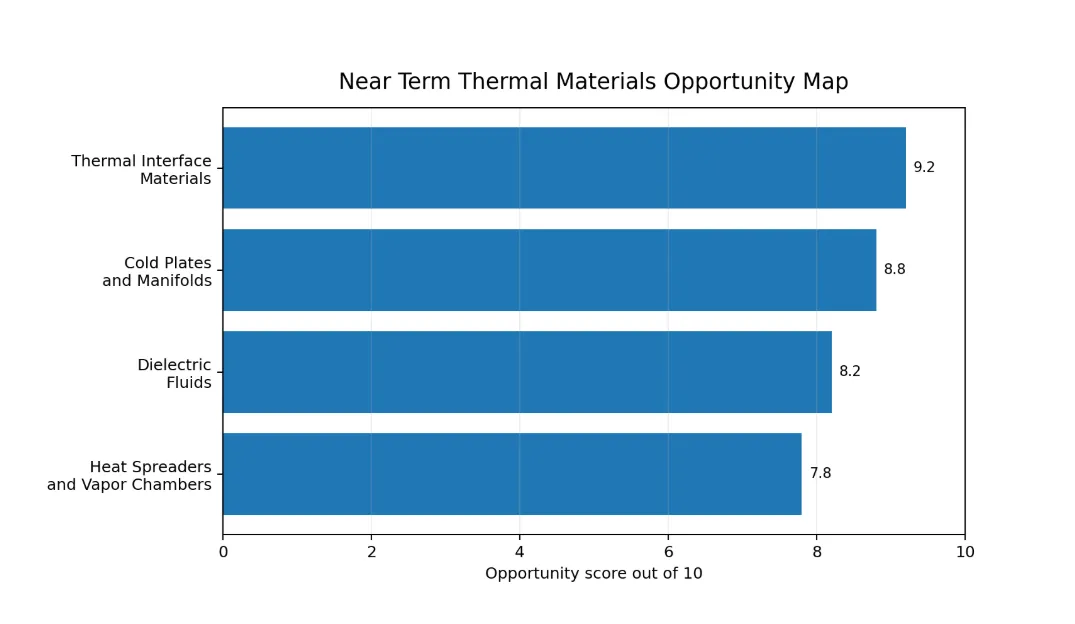
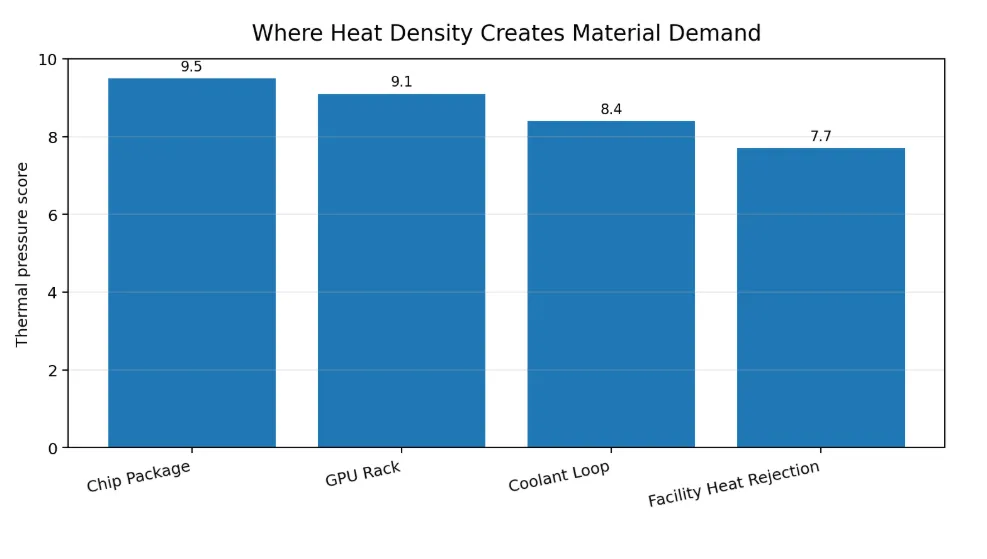
The most important materials opportunities are appearing in four areas. Thermal interface materials must fill microscopic gaps while handling high thermal cycling. Cold plates and manifolds must deliver low pressure drop with reliable contact at the chip level. Dielectric fluids must balance heat transfer, safety, stability and hardware compatibility. Advanced heat spreaders must move heat laterally across packages where chiplets and stacked memory create uneven hotspots.
For in-depth insights into data center cooling market dynamics, cost considerations, and growth opportunities, explore the Data Center Cooling Market report from DataM Intelligence. The report provides comprehensive analysis of cooling technologies, adoption trends, market drivers, and the evolving infrastructure requirements supporting next-generation data centers.
Liquid Cooling Is Raising the Performance Standard
Liquid cooling is one of the strongest signals that the thermal materials race has entered a more commercial phase. DataM Intelligence estimates that the Data Center Liquid Cooling Market will grow from US$ 3.39 billion in 2025 to US$ 23.24 billion by 2035. The same report notes that direct to chip cooling accounted for 42.9 percent of market share and that less than 30 percent of global data centers currently use liquid cooling technologies. That gap points to a long adoption runway.
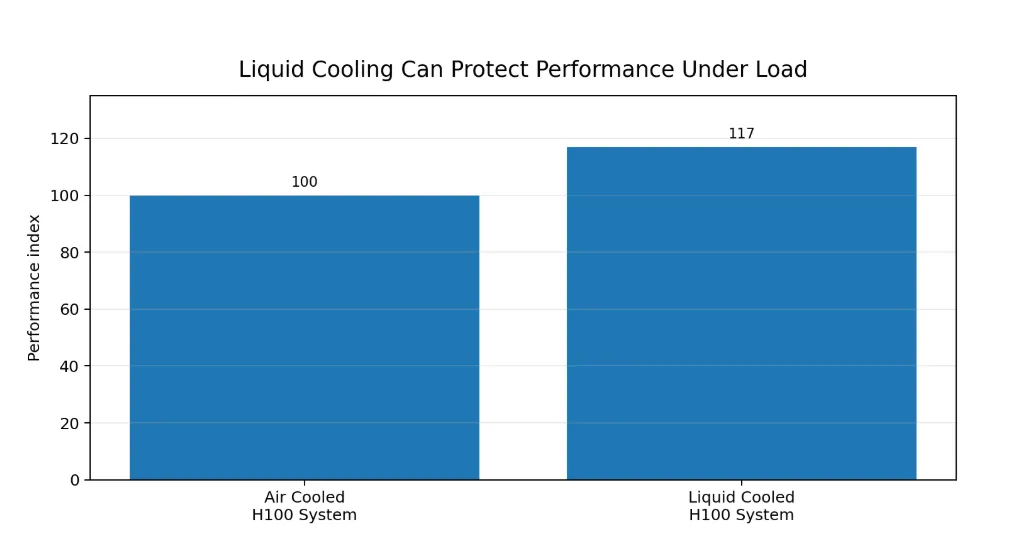
The performance case is becoming stronger as well. A 2025 benchmark comparing liquid cooled and air cooled H100 GPU systems found that liquid cooled systems maintained GPU temperatures between 41 and 50 degrees Celsius, while air cooled systems fluctuated between 54 and 72 degrees Celsius under load. The study also reported 17 percent higher performance in the liquid cooled system. This is the type of evidence that pulls thermal materials into performance planning because cooler operation can protect throughput, reliability and power efficiency.
For a comprehensive assessment of the growing liquid cooling market opportunity, request a sample report to explore the Data Center Liquid Cooling Market report from DataM Intelligence. The report provides in-depth insights into market trends, adoption patterns, technological advancements, and key growth opportunities driving the transition toward advanced cooling solutions for high-performance computing and AI-driven data center infrastructure.
Why HPC Is Changing the Materials Specification Sheet
HPC and AI infrastructure place new demands on materials because heat is no longer evenly distributed. Advanced packages combine accelerators, chiplets, memory stacks and interconnect layers that create local hotspots. The materials used around these components must manage conductivity, compliance, long term stability and manufacturability at the same time. A material with strong thermal conductivity can still fail commercially if it pumps out, cracks, contaminates coolant or cannot be applied consistently at scale.
This is why the next materials cycle will be judged through four buyer priorities. First, thermal resistance must fall without creating mechanical stress. Second, materials must survive repeated temperature swings during long AI training runs and idle cycles. Third, they must fit automated manufacturing and service workflows. Fourth, they must support sustainability goals through lower energy loss, safer chemistry and compatibility with reuse or refurbishment models.
The Supplier Opportunity Is Moving Across the Full Thermal Stack
The strongest near term supplier opportunity is likely to come from materials that solve practical deployment problems. Thermal interface suppliers can benefit as AI server makers require better gap filling, lower resistance and improved lifetime reliability. Cold plate suppliers can benefit as liquid ready server designs expand. Fluid suppliers can benefit as immersion and hybrid architectures require stable dielectric chemistries. Heat spreader suppliers can benefit as chip packaging becomes more heterogeneous and hotspots become harder to manage.
The market is also attracting strategic investment because thermal capability now affects data center capacity. DataM Intelligence notes that cooling can determine whether high density AI racks can be deployed without rebuilding entire facilities. This creates value for suppliers that can prove reliability, shorten deployment cycles and integrate with server OEMs, facility engineers and cloud buyers.
For detailed insights into AI-driven cooling adoption and workload-specific requirements, explore the AI Data Center Liquid Cooling Market report from DataM Intelligence. The report provides comprehensive analysis of market trends, technology advancements, application segments, and emerging opportunities shaping the future of liquid cooling solutions for AI-powered data center infrastructure.
Regional Demand Will Follow Power Density and Water Pressure
North America remains a leading demand center because hyperscale AI clusters, semiconductor design workloads, cloud AI platforms and colocation upgrades are concentrated in the United States. DataM Intelligence estimates that the United States Data Center Power Market reached US$ 3.50 billion in 2025 and could reach US$ 6.25 billion by 2033. Grid delays, power delivery constraints and site limitations make thermal efficiency commercially important because operators need to place more compute into constrained sites.
Asia Pacific is likely to be one of the fastest growing regions as cloud infrastructure, sovereign AI programs and data localization accelerate investment in China, India, Japan and South Korea. Europe will add a different form of demand. Operators in Europe are more likely to evaluate cooling through energy efficiency, water usage, heat reuse and carbon reporting. This creates opportunities for closed loop liquid cooling, water efficient systems and materials that can support reliable heat recovery.
For comprehensive insights into power density trends and grid-connected infrastructure planning, request a sample report to explore the US Data Center Power Market report from DataM Intelligence. The report provides detailed analysis of market dynamics, power infrastructure requirements, capacity expansion trends, and emerging opportunities supporting the growth of next-generation data center ecosystems.
Material Innovation Will Decide Which Facilities Can Host Premium AI Workloads
The next phase of high performance computing will reward operators and suppliers that treat thermal design as a core part of compute strategy. Chipmakers will continue raising accelerator performance. Server OEMs will keep packing more compute into rack scale systems. Data center operators will keep looking for ways to improve revenue per square foot while controlling power use and water exposure.
Thermal materials sit between all of these goals. Better materials can lower thermal resistance, extend equipment life, reduce cooling energy and enable higher rack density. Weak materials can create throttling, downtime risk and retrofit complexity. As AI workloads shift from pilot projects to production infrastructure, the thermal materials race will become one of the most important innovation battlegrounds in the HPC supply chain.