


Every electric vehicle sold today is creating tomorrow’s battery recycling industry
That statement captures one of the most important shifts taking place in the global battery economy. For more than a decade, the battery industry has been measured by how fast it can manufacture cells, build gigafactories, secure lithium supply, and bring down the cost of electric mobility. That phase is not over. In fact, battery manufacturing is still expanding rapidly across China, Europe, North America, India, South Korea, Japan, and Southeast Asia.
But the next phase of competition will look different. It will not be defined only by how many batteries the world can produce. It will be defined by how efficiently the industry can recover, refine, reuse, and recirculate the materials locked inside those batteries.
The reason is simple. EV adoption is rising. Energy storage systems are scaling. Gigafactory capacity is expanding faster than many supply chains can comfortably support. At the same time, critical mineral shortages, geopolitical supply risks, and environmental concerns are forcing governments and companies to rethink the way battery materials are sourced.
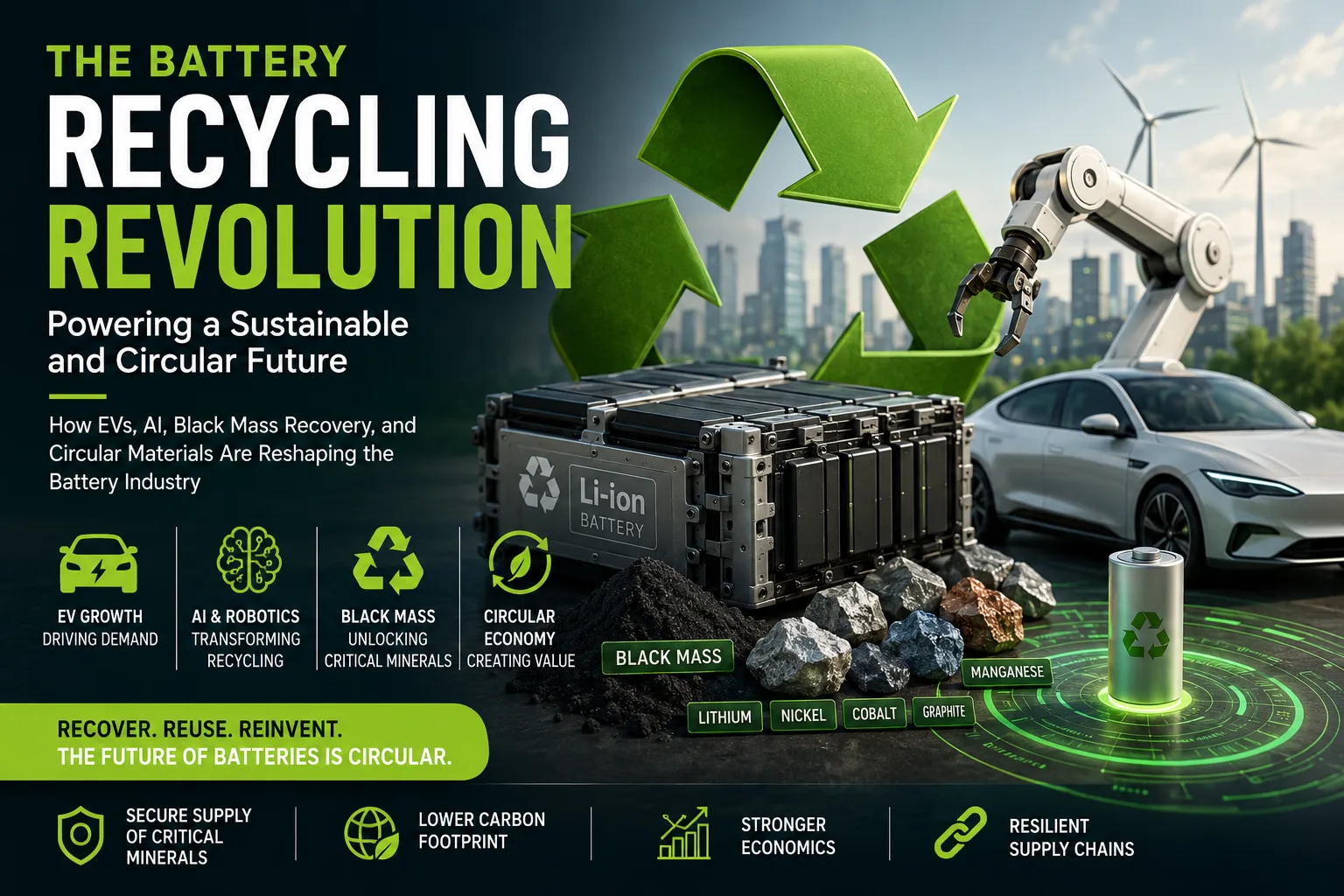
Battery recycling is no longer a narrow waste-management service. It is becoming a strategic materials industry.
A spent lithium-ion battery is not just waste. It is a concentrated reserve of lithium, nickel, cobalt, manganese, copper, aluminum, graphite, and other valuable materials. In some clean mobility and electronics recycling streams, rare earth materials from magnets and adjacent components are also becoming part of the broader recovery opportunity. As electric vehicles, grid batteries, e-bikes, consumer electronics, and industrial battery systems reach end of life, these products are creating a new resource base above ground.
This is why the global conversation is shifting from disposal to circularity. Battery recycling is becoming part of industrial policy, energy security strategy, ESG planning, and battery cost optimization. Companies that once treated recycling as an afterthought are now viewing it as a future source of competitive advantage.
Why Battery Recycling Is Suddenly a Global Priority
The battery recycling industry is accelerating because battery demand is no longer driven only by electric cars. EVs remain the largest growth engine, but stationary energy storage is becoming a powerful second pillar.
This matters because batteries are now central to two major transitions at once: transport electrification and power grid decarbonization. Electric vehicles need high-performance batteries to replace internal combustion engines. Renewable-heavy power systems need large-scale storage to balance solar and wind generation. Data centers, factories, homes, and utilities also need batteries to improve energy reliability.
CATL’s expectation that energy storage could become half of its business by 2030 shows how quickly battery demand is expanding beyond vehicles. This is a major signal for recyclers. A larger battery market means a larger future stream of end-of-life batteries, manufacturing scrap, and recoverable materials.
The pressure is also coming from mineral supply chains. Lithium, nickel, cobalt, graphite, and manganese are not just industrial inputs. They are now strategic resources. Countries that depend heavily on imported battery materials are looking for ways to reduce exposure to price volatility, trade restrictions, and concentrated supply chains.
China’s dominance in battery manufacturing and processing has made this issue even more urgent. Many countries are not trying to eliminate China from the battery supply chain, but they are trying to reduce overdependence. Recycling gives them a practical way to build domestic material recovery capacity without waiting years for new mines to be permitted, financed, developed, and connected to refining infrastructure.
This is why lithium-ion battery recycling and EV battery recycling are gaining attention from automakers, battery manufacturers, recyclers, governments, utilities, and investors. Recycling is not a replacement for mining today, but it can become a meaningful secondary supply source over time.
The global battery industry has entered a stage where end-of-life batteries, production scrap, and used battery packs are becoming strategic assets. The companies that understand this early will be better positioned as material shortages become more visible and circular economy rules become stricter.
The Rise of Urban Mining: The New Gold Rush
Battery recycling is often described through the lens of sustainability, but its economic logic is equally important. The industry is built around a powerful idea: the world has already mined, refined, and manufactured huge quantities of battery materials. If these materials can be recovered efficiently, they can re-enter the supply chain instead of being lost in landfills or low-value waste streams.
This is the basis of urban mining.
Urban mining means recovering valuable materials from products, infrastructure, and waste already circulating in the economy. In the battery industry, it means extracting critical minerals from used batteries, battery manufacturing scrap, consumer electronics, electric two-wheelers, energy storage systems, and EV battery packs.
Traditional mining starts with ore. Urban mining starts with waste.
| Traditional Mining | Urban Mining |
|---|---|
| Digging ore from the ground | Recovering metals from used batteries |
| Often high emissions and land disturbance | Lower material loss when recovery systems are efficient |
| Long development and permitting cycle | Existing and growing waste stream |
| Exposed to geological uncertainty | Linked to battery deployment and collection systems |
| Dependent on natural resource location | Can be built close to demand centers and manufacturing hubs |
| Linear extraction model | Circular supply model |
The appeal is clear. A used battery already contains refined industrial materials. The challenge is not discovering them. The challenge is collecting, sorting, dismantling, processing, and purifying them at scale.
This is why urban mining is becoming a new gold rush for critical minerals recovery. Automakers want secure access to recycled materials. Battery producers want to reduce dependence on volatile raw material markets. Governments want domestic supply resilience. Investors want exposure to a sector tied to electrification, energy storage, and circular economy policy.
The opportunity extends across the battery materials demand ecosystem. Lithium, nickel, cobalt, graphite, manganese, copper, and aluminum all have recovery potential, although economics vary by chemistry and process. High-nickel and cobalt-containing batteries have historically offered stronger recycling economics. LFP batteries are more challenging because they contain lower-value iron and phosphate, but the growth of LFP adoption is pushing the industry to develop better recovery models.
Urban mining also changes the way companies think about waste. In a linear system, waste is a cost. In a circular system, waste is feedstock. That distinction is central to the future of battery material recovery and the broader Battery Materials Recycling Market.
Black Mass: The Most Important Material Most People Have Never Heard Of
If there is one term that will define the next stage of battery recycling, it is black mass.
Black mass is the dark powdery mixture produced after lithium-ion batteries are discharged, dismantled, crushed, shredded, and mechanically processed. It typically contains valuable battery materials such as lithium, nickel, cobalt, manganese, and graphite, along with other battery components and impurities depending on the battery chemistry and process route.
For investors, recyclers, and battery manufacturers, black mass is important because it is the bridge between battery waste and recovered critical minerals.
A recycler may collect battery packs, modules, cells, consumer batteries, or production scrap. After mechanical processing, the material can be converted into black mass. This black mass can then be processed further through hydrometallurgical or other refining systems to recover battery-grade or near-battery-grade materials.
The value of black mass depends on several factors:
The first is chemistry. Nickel manganese cobalt batteries, nickel cobalt aluminum batteries, lithium cobalt oxide batteries, and LFP batteries all produce different material profiles. Cobalt-rich and nickel-rich chemistries can be more valuable, while LFP requires different economics.
The second is purity. Black mass contaminated with plastics, aluminum, copper, electrolyte residue, or mixed chemistries can be harder to refine. Better sorting and cleaner pre-processing can improve downstream recovery.
The third is location. Black mass trade is increasingly influenced by policy, permitting, transport rules, and national critical mineral strategies. Countries do not want all valuable battery waste exported without domestic value creation.
The fourth is downstream capacity. Producing black mass is not enough. The real strategic value comes from refining it into usable materials that can return to cathode, anode, and battery manufacturing supply chains.
This is why new facilities are being planned globally to process end-of-life batteries into black mass and recover critical minerals. The industry is moving from simple collection to integrated recycling and refining. Companies want to control more of the value chain, from collection and dismantling to black mass production, hydrometallurgical processing, and material qualification.
For the battery recycling market, black mass is not just an intermediate material. It is becoming a traded product, a strategic resource, and a key indicator of how mature a country’s battery recycling ecosystem is.
How AI and Robotics Are Transforming Battery Recycling
Battery recycling is not easy. EV battery packs are large, heavy, high-voltage, chemically complex, and highly variable in design. Packs differ by manufacturer, model, chemistry, format, casing, module structure, fasteners, adhesives, electronics, thermal systems, and safety architecture.
That variability creates a major bottleneck. Manual dismantling is slow and can expose workers to electrical, thermal, and chemical risks. Fully shredding packs without careful pre-processing can reduce material quality and increase safety challenges. The industry needs smarter ways to identify, sort, dismantle, and recover materials.
This is where AI and robotics are beginning to reshape battery recycling.
AI-powered sorting systems can help identify battery types, chemistries, formats, labels, shapes, and risk characteristics. Machine vision can inspect packs, modules, and cells before they enter processing lines. Automated systems can improve routing decisions, separating batteries that should be reused, repurposed, dismantled, discharged, shredded, or sent for specialized treatment.
Robotics can support one of the hardest parts of the process: disassembly.
Robotic battery dismantling has strong potential because robots can handle repetitive and hazardous operations. They can remove covers, loosen fasteners, separate modules, cut structural components, and reduce direct human exposure to dangerous battery conditions. New research is also showing progress in vision-guided robotic systems capable of battery pack disassembly with less dependence on fixed tooling.
This does not mean humans disappear from recycling plants. In the near term, the strongest model may be human-robot collaboration. Robots can handle repetitive, dangerous, or precision tasks, while technicians manage exceptions, quality checks, and complex decisions. Over time, AI systems may become better at interpreting pack designs, using battery passport data, and guiding disassembly strategies.
The ranking potential for topics such as AI battery recycling, robotic battery recycling, and automated battery dismantling is strong because this is still an emerging conversation. Many industry discussions focus on hydrometallurgy and black mass, but automation may become just as important. A recycling plant that can process batteries safely, consistently, and at high throughput will have a major advantage.
The battery recycling industry will not scale on chemistry alone. It will also scale on software, sensing, data, machine vision, and robotics.
Direct Recycling Could Change Everything
Most lithium-ion battery recycling today relies on two broad process routes: pyrometallurgy and hydrometallurgy.
Pyrometallurgy uses high-temperature treatment to recover valuable metals. It is robust and can handle mixed feedstock, but it can be energy-intensive and may lose some materials unless paired with additional recovery steps.
Hydrometallurgy uses chemical leaching and refining to recover metals from black mass. It can achieve high recovery rates for valuable materials when properly designed, but it requires chemical management, wastewater treatment, and careful process control.
Both routes are important. But the emerging method that could change the economics of battery recycling is direct recycling.
Direct recycling aims to preserve or regenerate functional battery materials instead of breaking them all the way down into basic chemical constituents. In simple terms, it tries to repair or restore cathode materials so they can be reused with less processing.
This is a major idea because cathode materials are among the most valuable components in many lithium-ion batteries. If a recycler can directly regenerate cathode materials, it may reduce energy use, shorten processing steps, retain more material value, and improve economics.
Direct recycling is especially interesting for closed-loop recovery systems. Instead of converting a battery material into metal salts and then rebuilding cathode materials from scratch, direct regeneration can potentially bring spent cathode materials back into useful condition.
The benefits could include lower energy consumption, reduced chemical intensity, higher material retention, lower emissions, and more efficient circular manufacturing. However, direct recycling also faces challenges. It requires cleaner feedstock, better sorting, chemistry-specific processes, strong quality control, and confidence from battery manufacturers that recovered materials can meet performance standards.
This is why direct recycling is not replacing hydrometallurgy overnight. It is more likely to grow alongside existing methods. High-volume mixed feedstock may still flow into hydrometallurgical systems, while cleaner and chemistry-specific streams may become candidates for direct regeneration.
Recent research highlights growing interest in direct regeneration and closed-loop recovery systems for cathode materials. This is one of the most important innovation areas to watch because it could shift recycling from material recovery to material preservation.
The Circular Economy Is Becoming a Competitive Advantage
The battery industry is moving from a linear model to a circular model.
The old model was simple: mine materials, refine them, manufacture batteries, use them, dispose of them. That model is no longer sustainable at the scale required for global electrification.
The new model is more complex, but also more resilient: design batteries with recovery in mind, track materials through the supply chain, extend battery life, reuse packs where possible, recover materials at end of life, and return those materials to manufacturing.
This is the circular battery economy.
Closed-loop battery manufacturing is becoming an important strategic goal. In a closed-loop system, production scrap and end-of-life batteries are collected, processed, refined, and returned to new battery manufacturing. This can reduce dependence on virgin mining, lower carbon footprint, improve supply security, and support regulatory compliance.
Producer responsibility regulations are accelerating this shift. Governments increasingly require battery manufacturers, importers, and producers to recover materials and create traceable recycling systems. The EU Battery Regulation is one of the strongest examples of this direction, requiring sustainability, traceability, due diligence, and battery passport-related compliance for key battery categories.
India has also introduced battery waste rules built around Extended Producer Responsibility, requiring producers to meet collection and recycling obligations. These frameworks are important because recycling cannot scale without collection. A recycling plant is only as strong as its feedstock network.
Circularity is also becoming a customer expectation. Automakers and electronics companies are under pressure to reduce Scope 3 emissions, disclose supply chain impacts, and prove that materials are sourced responsibly. Recycled content can help support those goals, especially when recovered materials meet quality and traceability requirements.
This is why the circular battery economy is not just an environmental theme. It is becoming a commercial advantage. Companies that can prove circular material flows may win stronger customer trust, regulatory alignment, financing support, and supply chain resilience.
The Next Recycling Challenge: LFP, Sodium-Ion, and Solid-State Batteries
Most battery recycling discussions focus on lithium-ion batteries, especially nickel and cobalt-based chemistries. That made sense during the early EV growth cycle, when NMC and NCA batteries were central to many electric vehicle platforms.
But the battery chemistry landscape is changing.
LFP batteries are growing rapidly because they are cost-effective, durable, thermally stable, and less dependent on nickel and cobalt. For automakers and energy storage developers, LFP has major advantages. For recyclers, it creates a different challenge.
LFP batteries contain lithium, iron, and phosphate, but they do not contain the same high-value nickel and cobalt content that historically supported recycling economics. This means recyclers need better methods to recover lithium and handle LFP cathode materials profitably. As LFP volumes rise, the industry cannot ignore this chemistry. It must develop scalable LFP recycling models.
Sodium-ion batteries are another emerging challenge. Sodium is more abundant than lithium and may offer cost and supply chain advantages, especially for stationary energy storage and selected mobility applications. However, sodium-ion battery recycling will require different recovery strategies because the chemistry, value distribution, and material priorities differ from lithium-ion systems.
Solid-state batteries may introduce another layer of complexity. They promise higher safety and energy density potential, but their materials, interfaces, solid electrolytes, and manufacturing designs may require new recycling methods. Recycling systems built only for today’s liquid-electrolyte lithium-ion batteries may not be enough for tomorrow’s solid-state cells.
This is why the industry is already preparing for future battery chemistries beyond traditional lithium-ion systems. The next recycling leaders will not be companies that can process only one battery type. They will be companies that can adapt across chemistries, formats, and material streams.
Battery recycling must become chemistry-aware, data-driven, and flexible.
India’s Growing Opportunity in Battery Recycling
India has a major opportunity to build a domestic battery recycling ecosystem.
The country’s EV market is expanding across two-wheelers, three-wheelers, passenger vehicles, buses, and commercial fleets. Battery demand is also increasing through renewable energy storage, telecom backup, industrial systems, and consumer electronics. As these batteries age, India will need safe, efficient, and regulated systems to collect and recycle them.
India’s opportunity is not only about waste management. It is about resource security.
India imports many battery materials and components. Domestic battery recycling can help reduce dependence on imported critical minerals over time, support local cell manufacturing, and create a secondary materials base for the clean energy economy. It can also reduce unsafe informal recycling practices and improve environmental outcomes.
Government support is moving in this direction. India’s Battery Waste Management Rules introduced Extended Producer Responsibility obligations for producers, manufacturers, and importers. This creates a formal structure for collection, recycling, and reporting. Such rules are essential because battery recycling needs organized reverse logistics.
Recent developments show that India’s recycling ecosystem is becoming more serious. A lithium-ion battery and rare-earth recycling facility has been established in Uttar Pradesh to strengthen domestic recovery capabilities. This is important because India’s clean mobility future will require not only batteries, but also magnets, electronics, motors, and other material-intensive components.
For India, the recycling opportunity sits at the intersection of EV manufacturing, domestic critical mineral strategy, circular economy policy, and industrial growth. The country can build capacity not only in battery assembly, but also in material recovery, black mass processing, rare earth recovery, and secondary battery value chains.
This creates strong relevance for EV battery recycling and secondary batteries as India moves from adoption to ecosystem building.
Battery Recycling Innovations to Watch in 2026
The battery recycling industry is entering a period of fast innovation. Five areas deserve close attention.
1. AI-powered battery sorting
AI can improve the identification of battery types, chemistries, formats, and risk levels. Better sorting improves safety and helps recyclers direct feedstock to the right process route.
2. Robotic battery dismantling
Robotics can reduce worker exposure to high-voltage systems and improve dismantling consistency. As battery packs become more diverse, flexible automation will become increasingly valuable.
3. Black mass refinement
Producing black mass is only the first step. The next competitive frontier is refining black mass into high-quality materials that can return to the battery supply chain.
4. Direct cathode regeneration
Direct recycling could preserve more value by regenerating cathode materials instead of breaking everything down into basic chemical inputs. This could improve economics for selected feedstock streams.
5. Smart battery collection systems
Collection remains one of the biggest barriers to recycling scale. Cities are already piloting smart collection systems that simplify battery recycling, reduce fire risks, and improve material recovery. These systems can make it easier for consumers to safely return lithium-ion batteries and battery-embedded devices.
These innovations show that battery recycling is becoming a technology industry. It is no longer defined only by trucks, bins, shredders, and furnaces. It is increasingly shaped by software, sensors, robotics, material science, compliance platforms, and advanced refining.
What the Battery Industry Will Look Like by 2035
By 2035, battery recycling will likely be a core part of the global battery value chain.
Recycling will become a major source of lithium. It may not replace mining completely, but it will become too important to ignore. Countries with large EV fleets and strong collection systems will have access to growing domestic material streams.
Gigafactories will integrate recycling more closely. Manufacturing scrap is already one of the most attractive recycling feedstocks because it is cleaner and more predictable than end-of-life batteries. Over time, gigafactories may increasingly connect with recycling partners or build recycling capacity nearby.
Closed-loop batteries will become mainstream. Automakers and battery manufacturers will compete on recycled content, carbon footprint, traceability, and circular supply chain credentials. Recycled materials will not be viewed as inferior if they meet technical standards. They will be viewed as strategic.
Battery passports will become standard in major markets. Digital records can help track battery chemistry, origin, composition, state of health, ownership history, and end-of-life instructions. This will make reuse, repurposing, dismantling, and recycling more efficient.
Recycled materials will compete directly with mined materials. The strongest recycling ecosystems will produce materials that meet the cost, quality, and consistency expectations of battery manufacturers. When that happens, recycled lithium, nickel, cobalt, graphite, and manganese will become mainstream industrial inputs.
The structure of the industry will also change. Today, many companies specialize in only one part of the recycling chain. By 2035, more integrated models may emerge, combining collection, diagnostics, second-life applications, dismantling, black mass production, refining, and material supply agreements.
Battery recycling will become a strategic layer of the battery economy.
Conclusion
The battery recycling revolution is not a distant possibility. It is already underway.
Every EV sold, every gigafactory built, every stationary storage system deployed, and every battery-powered device discarded is adding to the future supply of recoverable materials. The world cannot build a truly sustainable battery economy if it treats end-of-life batteries as waste.
The next decade will not be defined only by how many batteries the world manufactures, but by how efficiently it recovers and reuses the materials inside them. Companies that master recycling, circularity, black mass recovery, AI-enabled sorting, robotic dismantling, and direct material regeneration will become the real winners of the battery economy.
Battery recycling is no longer the end of the value chain.
It is becoming the beginning of the next one.