


Testing, Inspection & Certification, commonly known as TIC, is the backbone of product safety, regulatory compliance, quality assurance and market access. In simple terms, TIC services verify whether a product, system, component or process meets required standards before it reaches customers or enters a regulated market.
Why Testing, Inspection & Certification Matters More Than Ever
The role of Testing, Inspection & Certification has expanded far beyond basic compliance checks. In automotive, TIC now protects brand reputation, supports global vehicle approvals, reduces recall risk, and helps manufacturers launch new technologies with confidence. As vehicles become electric, software-defined, connected and increasingly automated, the question is no longer only “Is this vehicle roadworthy?” It is also “Is this vehicle safe across millions of digital, electrical, mechanical and environmental conditions?”
This is why the automotive TIC industry is gaining strategic importance among OEMs, Tier 1 suppliers, component manufacturers, fleet operators, charging infrastructure providers and mobility technology companies. The strongest demand is emerging where regulation, innovation and consumer safety expectations overlap. That includes ADAS testing, electric vehicle testing, battery safety, connected vehicle certification, cybersecurity validation, functional safety, EMC testing, full vehicle homologation and durability testing.
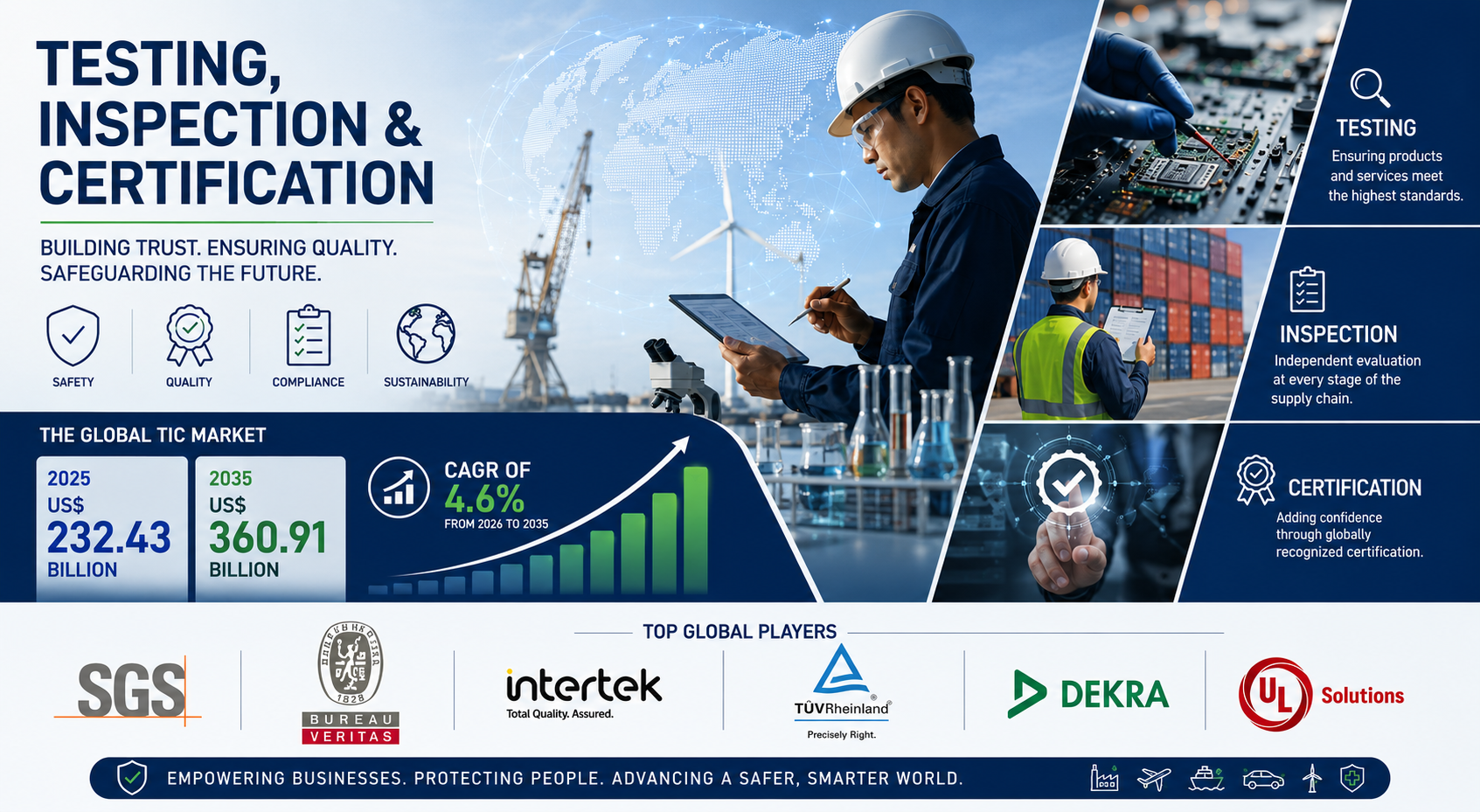
According to DataM Intelligence's latest published Report, “Global Testing, Inspection & Certification Market size is expected to reach US$ 360.91 billion by 2035, growing with a CAGR of 4.6% during the forecast period 2026-2035.”
What Are TIC Services in the Automotive Industry?
Automotive TIC services include testing, inspection, certification, auditing, validation, calibration and homologation activities across vehicles, systems and components. Testing confirms performance under controlled conditions. Inspection checks whether products, facilities or processes meet defined requirements. Certification provides formal proof that a vehicle, part, system or process complies with applicable standards or regulations.
For automotive companies, TIC services are used across the full product lifecycle. During design, they support material selection, simulation, prototype validation and safety assessment. During development, they help verify brakes, emissions, batteries, electronic systems, software, sensors, structure, durability and environmental performance. Before launch, full vehicle homologation and certification support market entry. After launch, inspection, software update validation and fleet testing help maintain safety and compliance throughout the vehicle’s life.
Where Are the Most Attractive Opportunities by Vehicle Type?
Passenger Cars: Largest Volume and Broadest TIC Demand
Passenger cars remain the largest opportunity for automotive TIC because they carry the highest production volumes and face intense safety, emissions, ADAS and consumer-rating scrutiny. Every new model refresh creates demand for crash testing, emissions testing, EMC testing, environmental testing, infotainment validation, cybersecurity checks and connected vehicle certification.
The strongest opportunity in passenger cars is not only traditional inspection. It is the rising complexity of software, sensors, comfort electronics, driver monitoring systems and electrified powertrains. TIC providers that can combine physical testing with software validation, simulation and regulatory advisory services will be better positioned to win OEM programs.
Electric Vehicles: Fastest Growth and Highest Technical Complexity
Electric vehicles offer the strongest growth opportunity within automotive Testing, Inspection & Certification. EVs require a wider testing scope than conventional vehicles because they depend on high-voltage architecture, battery packs, charging systems, thermal management, electric motors, inverters, onboard chargers, power electronics and battery management software.
The highest-value opportunities in EV TIC are battery safety testing, abuse testing, thermal runaway assessment, battery lifecycle testing, charging interoperability, electric component testing, high-voltage safety, EMC testing and environmental testing. EV manufacturers also need support for international market access because battery and charging regulations differ across regions.
Light Commercial Vehicles: Fleet Electrification and Last-Mile Delivery
Light commercial vehicles are becoming a very attractive TIC segment because of e-commerce growth, urban delivery demand, fleet electrification and telematics adoption. Fleet owners want vehicles that can operate reliably under high daily utilization, stop-start driving patterns, route variability and charging schedule pressure.
For TIC service providers, the opportunity lies in durability testing, fleet testing, connected vehicle certification, battery performance validation, telematics reliability, charging infrastructure compatibility and total cost of ownership assessment. LCV customers are highly practical. They care less about futuristic features and more about uptime, payload, charging time, range consistency and maintenance predictability.
Heavy Commercial Vehicles: Lower Volume, Higher-Margin Testing
Heavy commercial vehicles offer smaller unit volumes than passenger cars but often produce higher-margin TIC opportunities. Trucks and buses require rigorous durability, braking, emissions, structural, vibration, powertrain, safety and environmental testing. Electrification, hydrogen mobility and advanced driver assistance systems are also adding new certification layers.
For heavy commercial vehicles, the most attractive TIC opportunities include durability testing, emissions compliance, battery-electric and fuel-cell system validation, brake performance, axle and suspension testing, vibration testing, thermal management, charging depot safety and driver assistance system validation for large vehicles.
Which Automotive TIC Service Areas Offer the Strongest Revenue Opportunity?
Across OEM and Tier 1 customers, the strongest revenue opportunities are shifting toward services that solve complex, high-risk problems. Basic testing still matters, but premium growth is coming from advanced validation and certification areas.
ADAS testing is one of the strongest revenue pools because modern vehicles rely on cameras, radar, lidar, ultrasonic sensors, domain controllers and software algorithms. These systems must be tested across weather, lighting, road geometry, vulnerable road users, lane markings, traffic conditions and edge cases.
Functional safety is another high-value area because software and electronics now control braking, steering, powertrain, battery management and driver assistance functions. OEMs and Tier 1 suppliers need validation aligned with safety goals, hazard analysis, risk assessment and system-level reliability.
Full vehicle homologation continues to offer stable revenue because global vehicle launches require compliance across multiple regions. Homologation services are especially valuable for export-oriented OEMs, EV startups and Chinese, Indian or Asian manufacturers expanding into Europe, North America and the Middle East.
Connected vehicle certification is also gaining momentum. Vehicles now communicate with mobile apps, cloud platforms, charging networks, diagnostic tools and over-the-air software systems. That creates demand for cybersecurity testing, software update compliance, data protection reviews and connectivity performance validation.
How Is Demand Shifting Across ADAS, Functional Safety, Fleet Testing and Homologation?
Demand is moving from one-time laboratory testing to continuous validation. Earlier, a vehicle could be tested, certified and launched with fewer post-launch updates. Today, vehicles receive software updates, ADAS improvements, infotainment changes and cybersecurity patches after sale. This changes the TIC model.
ADAS testing is moving from controlled track scenarios toward real-world, simulation-supported and scenario-based testing. Functional safety demand is expanding because electronic systems are becoming more integrated and safety-critical. Fleet testing is gaining importance because OEMs need real-world evidence of range, charging behavior, battery degradation, ADAS performance and component durability. Full vehicle homologation remains essential, but it is now linked more closely with cybersecurity, software updates, emissions, battery compliance and connected services.
Connected vehicle certification is one of the fastest-changing areas. As vehicles become digital platforms, certification must cover not only the vehicle hardware but also software, communication interfaces, user data, cloud connectivity and update governance.
EV Testing Areas Creating the Highest Growth Potential
The most attractive EV testing opportunities are concentrated in four areas.
First, battery safety testing is essential because the battery pack is the most expensive and safety-sensitive part of an electric vehicle. TIC demand includes thermal runaway, crush, vibration, short circuit, overcharge, water ingress, fire resistance, lifecycle and abuse testing.
Second, charging infrastructure testing is rising as public and private charging networks expand. Chargers must be tested for electrical safety, communication protocols, grid compatibility, payment systems, connector reliability and environmental performance.
Third, interoperability testing is becoming critical. Drivers expect vehicles, chargers, apps and payment platforms to work smoothly together. For fleets, interoperability failures can disrupt operations and reduce vehicle utilization.
Fourth, electric component testing is gaining demand across motors, inverters, converters, onboard chargers, connectors, cables, sensors and thermal systems. These components must perform safely under heat, vibration, moisture, voltage fluctuations and long operating cycles.
Testing Equipment Categories Seeing Stronger Demand
The demand for testing equipment is rising in line with vehicle complexity. Chassis dynamometers remain important for powertrain, emissions, performance and range testing. Emission testers continue to be needed for internal combustion engines, hybrids and regulatory compliance, especially in markets where ICE vehicles will remain active for many years.
Battery analyzers are among the fastest-growing equipment categories because battery health, lifecycle, capacity, charging behavior and safety performance are central to EV quality. Durability testers are gaining demand as OEMs try to reduce warranty costs and validate vehicles faster. Vibration testers are also becoming more important because electronic modules, battery packs, sensors and connectors must survive real-world road conditions.
In short, the strongest equipment demand is moving toward battery analyzers, high-voltage safety equipment, vibration testers, environmental chambers, ADAS targets, sensor simulation systems, EMC chambers and durability testing platforms.
How Service Providers Should Prioritize TIC Investments
TIC service providers should not invest equally across every service area. The best strategy is to prioritize capabilities that combine regulatory necessity, technical complexity and recurring client demand.
EMC testing should be a high priority because EVs, ADAS systems and connected vehicles rely on sensitive electronics. Poor electromagnetic compatibility can affect safety, reliability and user experience.
Materials testing remains important for lightweighting, battery enclosures, interiors, crash structures and sustainability claims. Crash testing should be prioritized where providers serve passenger car OEMs, safety-focused brands or markets influenced by consumer safety ratings.
Environmental testing is attractive because batteries, electronics, sensors and charging components must perform under heat, cold, humidity, salt, dust and vibration. Engine testing will remain relevant for hybrids, commercial vehicles and markets where internal combustion engines continue to dominate, but investment should be selective.
System testing offers the best long-term margin potential. As vehicles become integrated platforms, clients need partners who can test how hardware, software, sensors, batteries, connectivity and safety systems work together. Providers that offer system-level validation rather than isolated component testing will have stronger client acquisition and pricing power.
2026 Update in the TIC Industry
In 2026, the TIC industry is entering a more technology-intensive phase. Automotive clients are no longer looking only for compliance certificates. They are seeking testing partners that can help them launch safer EVs, validate ADAS performance, manage software update risks, meet battery regulations, prove cybersecurity readiness and accelerate global market access.
The biggest 2026 shift is the convergence of electric mobility, software-defined vehicles and stricter safety expectations. EV growth is increasing demand for battery testing and charging certification. ADAS protocols are becoming more demanding and more real-world focused. Cybersecurity and software update compliance are becoming central to vehicle approval. Commercial vehicle TIC is also gaining attention as fleets move toward electrification, telematics and depot charging.
For TIC companies, 2026 is a year to move up the value chain. The winners will be those that invest in advanced labs, simulation, digital testing platforms, battery expertise, cybersecurity capabilities, homologation advisory and global certification networks. Traditional inspection will remain necessary, but the highest growth will come from complex, specialized and regulation-linked services.
Frequently Asked Questions (FAQs)
1. What is Testing, Inspection & Certification?
Testing, Inspection & Certification refers to services that verify whether products, systems, processes or facilities meet required standards, regulations and quality expectations.
2. Why is TIC important in the automotive industry?
TIC is important because it helps ensure vehicle safety, regulatory compliance, product quality, environmental performance and customer trust before vehicles or components enter the market.
3. What are automotive TIC services?
Automotive TIC services include vehicle testing, component testing, inspection, certification, homologation, emissions testing, crash testing, ADAS validation, EV battery testing and cybersecurity assessment.
4. Which vehicle segment offers the best TIC opportunity?
Passenger cars offer the largest volume opportunity, while electric vehicles offer the highest growth potential. Light commercial vehicles and heavy commercial vehicles provide strong opportunities in fleet testing, durability, electrification and compliance.
5. Which TIC services have the strongest revenue potential?
ADAS testing, EV battery testing, full vehicle homologation, functional safety, EMC testing, cybersecurity certification and connected vehicle certification offer some of the strongest revenue opportunities.
6. Why is EV testing growing so quickly?
EV testing is growing because electric vehicles require validation of batteries, charging systems, high-voltage components, thermal management, power electronics, safety systems and interoperability with charging infrastructure.
7. What is ADAS testing?
ADAS testing validates advanced driver assistance systems such as automatic emergency braking, lane keeping, adaptive cruise control, blind spot detection, driver monitoring and parking assistance.
8. What is full vehicle homologation?
Full vehicle homologation is the approval process that confirms a vehicle meets all required regulatory, safety, environmental and technical standards for sale in a specific market.
9. Why is EMC testing important for vehicles?
EMC testing ensures that electronic systems can operate safely without causing or suffering from electromagnetic interference, which is critical for EVs, ADAS, infotainment and connected vehicles.
10. What is the future of the TIC industry?
The future of TIC will be shaped by electric vehicles, connected mobility, autonomous driving, cybersecurity, sustainability, battery regulation, software updates and global market access requirements.
Read the Full Report on Testing Inspection and Certification Market: https://www.datamintelligence.com/research-report/testing-inspection-and-certification-market
DataM Intelligence is a renowned provider of market research, delivering deep insights through pricing analysis, market share breakdowns, and competitive intelligence. The company specializes in strategic reports that guide businesses in high-growth sectors such as nutraceuticals and AI-driven health innovations.
Contact:
Fabian
DataM Intelligence 4market Research LLP
6th Floor, M2 Tech Hub, DataM Intelligence 4market Research LLP, Lalitha Nagar, Habsiguda, Secunderabad, Hyderabad, Telangana 500039
USA: +1 877-441-4866
Email: [email protected]