


Introduction: Why 2026 Is Becoming a Defining Year for Semiconductor Investment
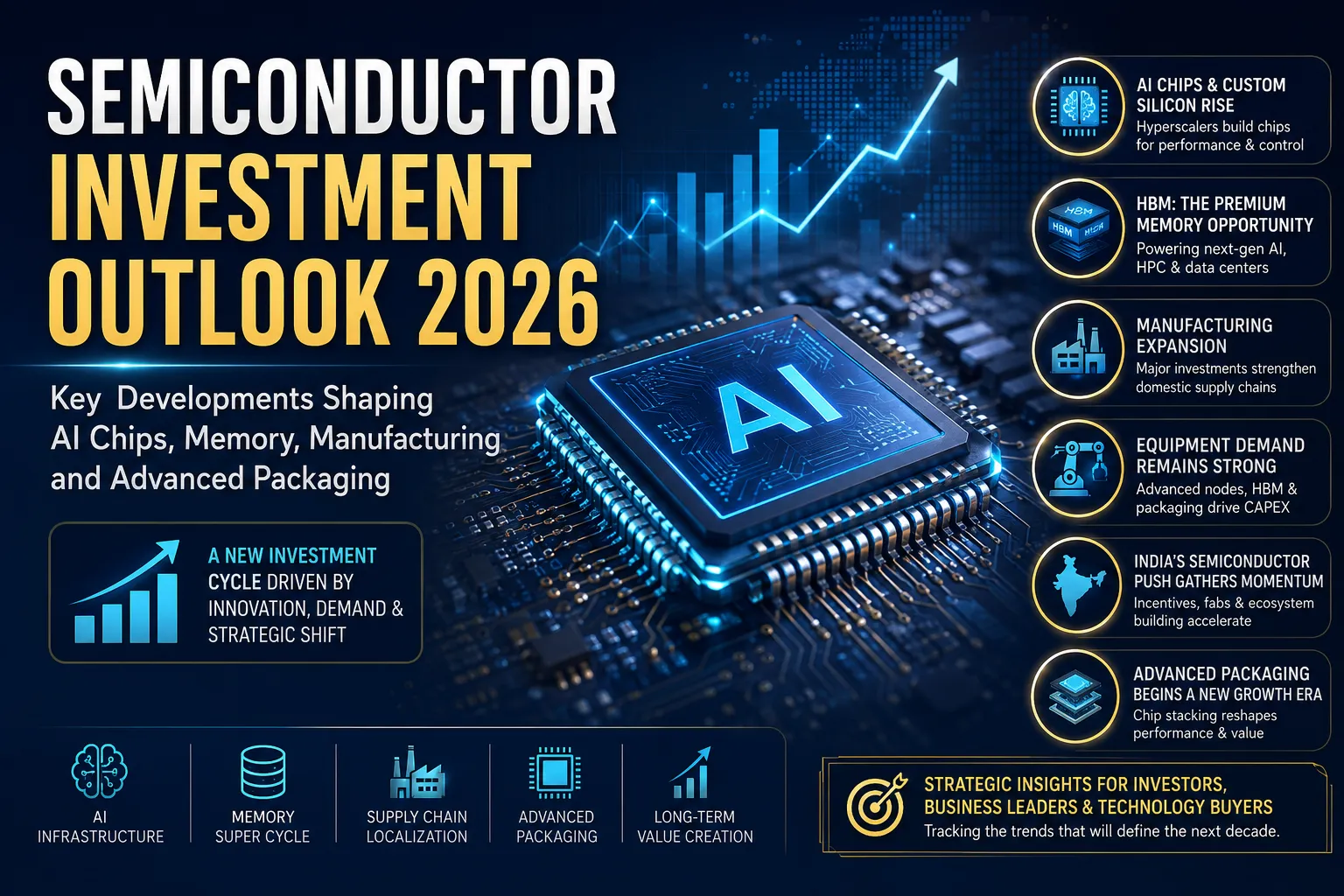
The global semiconductor industry is entering one of its most important investment cycles in decades. What was once a cyclical chip market driven mainly by smartphones, PCs and consumer electronics is now being reshaped by AI infrastructure, high-bandwidth memory, advanced packaging, data centers, sovereign manufacturing policies and supply-chain localization.
The latest semiconductor developments show one clear direction: capital is moving toward technologies that can support faster AI training, more efficient inference, secure domestic production and higher-performance chip architectures.
Key Developments
| Development | Strategic Meaning |
Micron’s expanded U.S. investment plan | AI memory is becoming a national manufacturing priority |
| Meta’s in-house AI chip plan | Hyperscalers want more control over custom silicon |
| Semiconductor stock volatility | Investors are becoming selective, not bearish |
| Strong global semiconductor sales | End-market demand remains structurally strong |
| India’s semiconductor incentives | Regional manufacturing is becoming a global priority |
South Korea’s chip-stacking breakthrough | Advanced packaging is becoming a major value pool |
This is not just another semiconductor news cycle. It is a signal that the industry is moving into a new phase where memory, packaging, equipment, infrastructure and regional manufacturing capacity will define competitive advantage.
1. AI Memory Is Becoming the Core Semiconductor Investment Theme
Micron Technology’s plan to invest more than US$250 billion in the United States through 2035 is one of the strongest indicators that AI memory demand is moving from short-term opportunity to long-term infrastructure priority. Micron also announced plans to invest up to US$3 billion to strengthen the U.S. semiconductor supply-chain ecosystem, including strategic support for GlobalWafers’ 300mm silicon wafer manufacturing facility in Texas and a 10-year raw silicon wafer supply agreement.
The investment matters because AI workloads are memory-hungry. Large language models, generative AI systems, high-performance computing platforms and AI data centers require extremely fast access to data. That is increasing demand for DRAM, NAND, HBM, SSDs and advanced storage architectures.
From an investment perspective, memory is no longer a supporting segment of the semiconductor industry. It is becoming a strategic layer of AI infrastructure.
Why this matters for the semiconductor market
- AI training requires high memory bandwidth
- Inference workloads increase demand for efficient memory access
- Data centers need larger memory capacity per server
- Automotive and industrial electronics require reliable embedded memory
- Supply-chain security is pushing memory production closer to end markets
According to DataM Intelligence, the global memory chip market reached US$227.00 billion in 2025 and is expected to reach US$739.46 billion by 2035, growing at a CAGR of 12.50% during 2026–2035. The growth is supported by rising demand for memory and storage devices in connected cars, automotive safety systems, data centers and enterprise storage applications.
This makes memory one of the most important semiconductor investment themes of 2026. The strongest opportunities are likely to emerge in HBM, advanced DRAM, enterprise SSDs, data center memory and AI-optimized storage solutions.
Request for Exclusive Sample on Memory Chip Market
2. HBM Is Becoming the Premium Memory Opportunity in AI Infrastructure
Within the broader memory market, High Bandwidth Memory (HBM) is becoming one of the most attractive growth areas. HBM is critical because AI processors need to move massive volumes of data quickly between memory and compute engines.
Traditional memory architectures are not enough for large AI models. GPUs, CPUs, ASICs and AI accelerators increasingly need multi-terabyte-per-second bandwidth, lower latency and higher power efficiency. That is why HBM is becoming central to AI data center design.
DataM Intelligence estimates that the High Bandwidth Memory Market was valued at US$3.58 billion in 2025 and is projected to reach US$29.65 billion by 2035, growing at a CAGR of 23.63% during 2026–2035. The report identifies AI, high-performance computing, cloud data centers, advanced graphics and next-generation processors as major growth drivers.
HBM investment signals to watch
| HBM Signal | Why It Matters |
| HBM3E commercialization | Supports faster AI training and inference |
| HBM4 development | Next wave of AI memory performance |
| GPU and accelerator demand | Drives premium memory attachment |
| Advanced packaging bottlenecks | Limits supply and supports pricing power |
| Asia-Pacific manufacturing strength | Shapes global supply concentration |
For semiconductor companies, HBM is no longer just a memory product. It is becoming a strategic AI infrastructure component. For investors and technology buyers, HBM capacity, packaging partnerships and supply agreements will become key indicators of future competitiveness.
Request for Exclusive Sample on High Bandwidth Memory Market
3. Hyperscaler Custom Chips Are Creating New Demand for Semiconductor Equipment
Meta’s plan to begin manufacturing its in-house AI chip, reportedly named Iris, highlights a major industry shift: large technology companies want more control over their AI compute stack. The development lifted shares of major semiconductor equipment companies such as Applied Materials, Lam Research and KLA, as investors linked custom AI chip production with higher demand for wafer fabrication equipment.
This trend is important because custom silicon does not reduce semiconductor industry demand. In many cases, it expands demand across the value chain.
When hyperscalers develop AI chips, they require:
- Foundry capacity
- Wafer fabrication tools
- Metrology and inspection systems
- Etching and deposition equipment
- Advanced packaging partners
- Thermal management solutions
- High-bandwidth memory integration
AI chip demand creates a wider equipment cycle
AI workloads → Custom AI chips → More wafer starts → Higher equipment demand → More advanced packaging → Stronger semiconductor ecosystem growth
According to DataM Intelligence, the global semiconductor manufacturing equipment market was valued at US$143.33 billion in 2025 and is forecast to reach US$306.61 billion by 2035, expanding at a CAGR of 7.90% during 2026–2035. Growth is being supported by AI accelerators, high-performance computing, automotive electrification, 5G infrastructure, industrial IoT and national semiconductor localization programs.
This shows why equipment suppliers remain strategically important. The next phase of semiconductor growth will not be driven only by chip designers. It will also depend on the companies that supply lithography, deposition, etching, testing, cleaning, bonding, metrology and inspection systems.
Request From Exclusive Sample on Semiconductor Manufacturing Equipment Market
4. Semiconductor Stock Volatility Shows Short-Term Risk, Not Weak Market Fundamentals
Semiconductor stocks experienced sharp volatility after a strong rally, with concerns around AI capital expenditure, valuations and future earnings expectations weighing on the sector. Forbes reported that the recent semiconductor selloff was linked to Wall Street concerns over AI capex growth, with pressure on Intel, Micron and AMD.
However, this volatility should not be confused with weak industry fundamentals. The semiconductor market is moving through a phase where investors are becoming more selective. Broad optimism is being replaced by a focus on execution, margins, supply security and exposure to the strongest demand pools.
The key distinction is simple:
| Short-Term Market Concern | Long-Term Industry Reality |
| Valuation pressure | AI infrastructure demand remains strong |
| Profit-taking after a rally | Memory, equipment and packaging needs are expanding |
| AI capex uncertainty | Data centers still require more compute capacity |
| Earnings caution | Semiconductor sales continue to show momentum |
For companies across the semiconductor value chain, this environment rewards businesses with clear exposure to AI chips, HBM, advanced packaging, equipment, silicon wafers, data centers and localized manufacturing.
The strongest opportunities are not in every chip category equally. They are concentrated in areas where demand is structural, supply is constrained and technology complexity is rising.
5. Global Semiconductor Sales Confirm Strong Market Momentum
The Semiconductor Industry Association reported that global semiconductor sales reached US$120.6 billion in May 2026, up 9.2% from April 2026 and 104.1% higher than May 2025.
This data confirms that demand is not limited to one segment. AI is the headline growth engine, but several end markets are supporting semiconductor expansion.
Key demand drivers in 2026
- AI data centers: GPUs, AI accelerators, HBM, networking chips and power semiconductors
- Automotive electronics: ADAS, EV powertrains, infotainment and software-defined vehicles
- Cloud computing: CPUs, GPUs, ASICs, memory and storage
- Industrial automation: sensors, microcontrollers, edge AI and power electronics
- Consumer devices: smartphones, PCs, wearables and connected devices
DataM Intelligence estimates that the Artificial Intelligence chip market reached US$77.59 billion in 2025 and is expected to reach US$275.14 billion by 2033, growing at a CAGR of 16.64% during 2026–2033. Growth is being driven by rapid AI adoption across data centers, cloud computing, edge devices and enterprise applications.
This makes AI chips one of the most important growth engines for the broader semiconductor market. The opportunity is not limited to GPU suppliers. It extends to ASICs, FPGAs, CPUs, AI accelerators, chiplets, HBM, advanced packaging, power management and data center infrastructure.
Request For Exclusive Sample on AI Chip Market
6. India’s Semiconductor Push Opens a New Regional Manufacturing Corridor
India’s semiconductor ambitions gained fresh momentum with reports that Tata Electronics’ semiconductor facility in Jagiroad, Assam, will receive ₹14,044 crore in government incentives. The project is associated with a reported investment of ₹27,000 crore, making it one of India’s most important semiconductor manufacturing initiatives.
This development is important because semiconductor manufacturing is becoming increasingly regionalized. Governments are no longer treating chip production as only an industrial activity. It is now linked to economic security, technology leadership, defense readiness, electronics manufacturing and supply-chain resilience.
Why India matters in the semiconductor supply chain
| Area | Strategic Importance |
| Assembly and testing | Entry point for semiconductor ecosystem development |
| Electronics manufacturing | Creates domestic demand for components |
| Government incentives | Reduces investment risk for large projects |
| Talent base | Supports engineering, design and operations |
| Supply-chain diversification | Reduces dependence on concentrated regions |
India’s semiconductor opportunity is not only about building fabs. It is about creating a wider ecosystem that includes chip design, packaging, assembly, testing, materials, equipment services, electronics manufacturing and skilled workforce development.
For global semiconductor companies, India is becoming a market to watch for long-term manufacturing diversification. For suppliers, the opportunity extends into cleanroom infrastructure, gases, chemicals, testing systems, packaging materials, automation and facility management.
7. Advanced Packaging Is Becoming the Next High-Value Semiconductor Opportunity
As chip scaling becomes more difficult, advanced packaging is becoming one of the most important routes to higher semiconductor performance. Instead of relying only on smaller transistor nodes, chipmakers are using 2.5D packaging, 3D packaging, chiplets, fan-out packaging, hybrid bonding and heterogeneous integration to improve performance, efficiency and density.
A recent breakthrough from South Korea shows how fast this area is evolving. POSTECH reported that a Korean research team developed a technology that enables the stable stacking of more than ten ultrathin semiconductor chips, each only one-fifth the thickness of a human hair. The research points to higher integration density and potential improvements in AI hardware performance.
This is why packaging is becoming as important as chip design. AI processors need logic, memory and interconnects to work together efficiently. Advanced packaging enables that integration.
According to DataM Intelligence, the global advanced packaging semiconductor market reached US$22.48 billion in 2025 and is expected to reach US$46.98 billion by 2035, growing at a CAGR of 7.80% during 2026–2035. Growth is supported by AI accelerators, high-performance computing, data center processors, chiplet architectures and heterogeneous integration.
Why advanced packaging is now strategic
- It connects memory closer to processors
- It improves performance without relying only on node shrinking
- It supports chiplet-based design
- It improves power efficiency for AI workloads
- It helps solve bandwidth bottlenecks
- It creates new demand for OSAT, foundry and equipment partnerships
The next semiconductor leaders will not be defined only by who designs the fastest chip. They will also be defined by who can package, integrate and scale those chips efficiently.
Request For Exclusive Sample on Advanced Packaging Semiconductors Market
8. Data Center Infrastructure Is Becoming a Semiconductor Demand Multiplier
AI chip investment is directly connected to data center infrastructure. Every new AI accelerator cluster requires power, cooling, monitoring, asset management, uptime planning and infrastructure optimization. As AI workloads increase rack density and energy intensity, data center operations become more complex.
DataM Intelligence estimates that the global Data Center Infrastructure Management market was valued at US$3.47 billion in 2025 and is projected to reach US$13.98 billion by 2033, expanding at a CAGR of 19.40% during 2026–2033. Growth is driven by demand for infrastructure visibility, power efficiency, asset lifecycle management, cyber-physical security and AI-enabled operational intelligence.
This is relevant to the semiconductor investment outlook because data centers are no longer passive buyers of chips. They are becoming the operating environment that determines which chips get adopted at scale.
AI data center requirements influencing semiconductor demand
| Data Center Need | Semiconductor Impact |
| Higher compute density | More GPUs, ASICs and AI accelerators |
| Faster memory access | Stronger demand for HBM and advanced DRAM |
| Power efficiency | Growth in power management chips |
| Thermal control | Demand for efficient chip architectures |
| Uptime management | Need for monitoring and control systems |
| Edge deployment | Demand for smaller, efficient AI chips |
Semiconductor companies that understand the full AI infrastructure stack will be better positioned than companies focused only on chip-level performance.
Request For Exclusive Sample on Data Center Infrastructure Management Market
Strategic Takeaways
- AI-first product portfolios will define market leaders, with investments centered on AI accelerators, custom ASICs, HBM, advanced DRAM, chiplets, and advanced packaging.
- Next-generation semiconductor manufacturing will drive equipment demand, creating strong opportunities in lithography, etching, deposition, metrology, inspection, wafer cleaning, and advanced packaging technologies.
- Supply chain resilience is becoming a competitive advantage, making long-term supplier partnerships, regional sourcing, and component risk management essential for OEMs.
- AI-ready infrastructure is now a strategic priority, requiring secure GPU and HBM supply, power-efficient architectures, advanced thermal management, infrastructure monitoring, and optimized AI clusters.
- Companies that integrate design, manufacturing, packaging, and infrastructure strategies will be best positioned to capitalize on the next AI-driven semiconductor investment cycle.
Frequently Asked Questions
1. What is driving semiconductor investment in 2026?
The main drivers are AI infrastructure, high-bandwidth memory demand, custom AI chips, advanced packaging, semiconductor equipment expansion, government incentives and supply-chain localization.
2. Why are AI chips important for semiconductor market growth?
AI chips are critical because generative AI, machine learning, computer vision, autonomous systems and data center workloads require specialized processors with high compute efficiency and fast memory access.
3. Why is HBM important for AI infrastructure?
HBM provides high bandwidth, low latency and improved power efficiency. These features are essential for AI accelerators and GPUs used in training and running large AI models.
4. What is driving semiconductor equipment demand?
Demand is being driven by new fabs, advanced node manufacturing, memory expansion, AI accelerator production, chiplet integration, advanced packaging and tighter process control requirements.
5. Why is advanced packaging becoming important?
Advanced packaging allows chipmakers to integrate logic, memory and multiple dies into compact, high-performance packages. This improves AI chip performance, power efficiency and bandwidth.
6. Why is India becoming important in semiconductor manufacturing?
India is becoming important because of government incentives, electronics manufacturing growth, semiconductor ecosystem development and global supply-chain diversification.
7. Will semiconductor stock volatility affect long-term industry growth?
Short-term stock volatility can affect valuations, but it does not change the long-term demand drivers. AI infrastructure, memory, equipment, advanced packaging and regional manufacturing remain strong structural themes.
Conclusion: Semiconductor Investment Is Moving Toward AI-Centric Infrastructure
The latest semiconductor developments show that the industry is moving into a new phase of growth. The focus is no longer only on producing more chips. The focus is on producing the right chips, in the right regions, with the right memory, packaging, equipment and infrastructure behind them.
Micron’s U.S. investment, Meta’s custom AI chip strategy, strong semiconductor sales, India’s manufacturing incentives and South Korea’s packaging breakthrough all point in the same direction: the next semiconductor investment cycle will be AI-centric, memory-intensive, infrastructure-led and regionally diversified.
For companies across the value chain, the opportunity is significant. But success will require more than capacity expansion. It will require strategic positioning across AI chips, HBM, advanced packaging, semiconductor manufacturing equipment, data center infrastructure and supply-chain resilience.
The semiconductor industry in 2026 is not simply growing. It is being rebuilt around the demands of AI.
Sources: DataM Intelligence Market Outlooks
| Research Report | Market Size and Forecast | CAGR | One-Line Growth Driver |
Artificial Intelligence Chip Market | US$77.59 billion in 2025 to US$275.14 billion by 2033 | 16.64% | AI adoption across data centers, cloud, edge devices and enterprise workloads is driving demand for specialized AI chips. |
Memory Chip Market | US$227.00 billion in 2025 to US$739.46 billion by 2035 | 12.50% | Connected vehicles, data centers and enterprise storage demand are expanding memory and storage requirements. |
Semiconductor Manufacturing Equipment Market | US$143.33 billion in 2025 to US$306.61 billion by 2035 | 7.90% | AI accelerators, HPC, automotive electrification, 5G and localization programs are increasing equipment demand. |
Advanced Packaging Semiconductor Market | US$22.48 billion in 2025 to US$46.98 billion by 2035 | 7.80% | AI accelerators, chiplets, HPC and heterogeneous integration are making packaging a strategic bottleneck. |
Data Center Infrastructure Management Market | US$3.47 billion in 2025 to US$13.98 billion by 2033 | 19.40% | AI workloads, power efficiency, infrastructure visibility and operational resilience are driving DCIM adoption. |
High Bandwidth Memory Market | US$3.58 billion in 2025 to US$29.65 billion by 2035 | 23.63% | AI, HPC, cloud data centers and advanced graphics are accelerating HBM adoption. |