


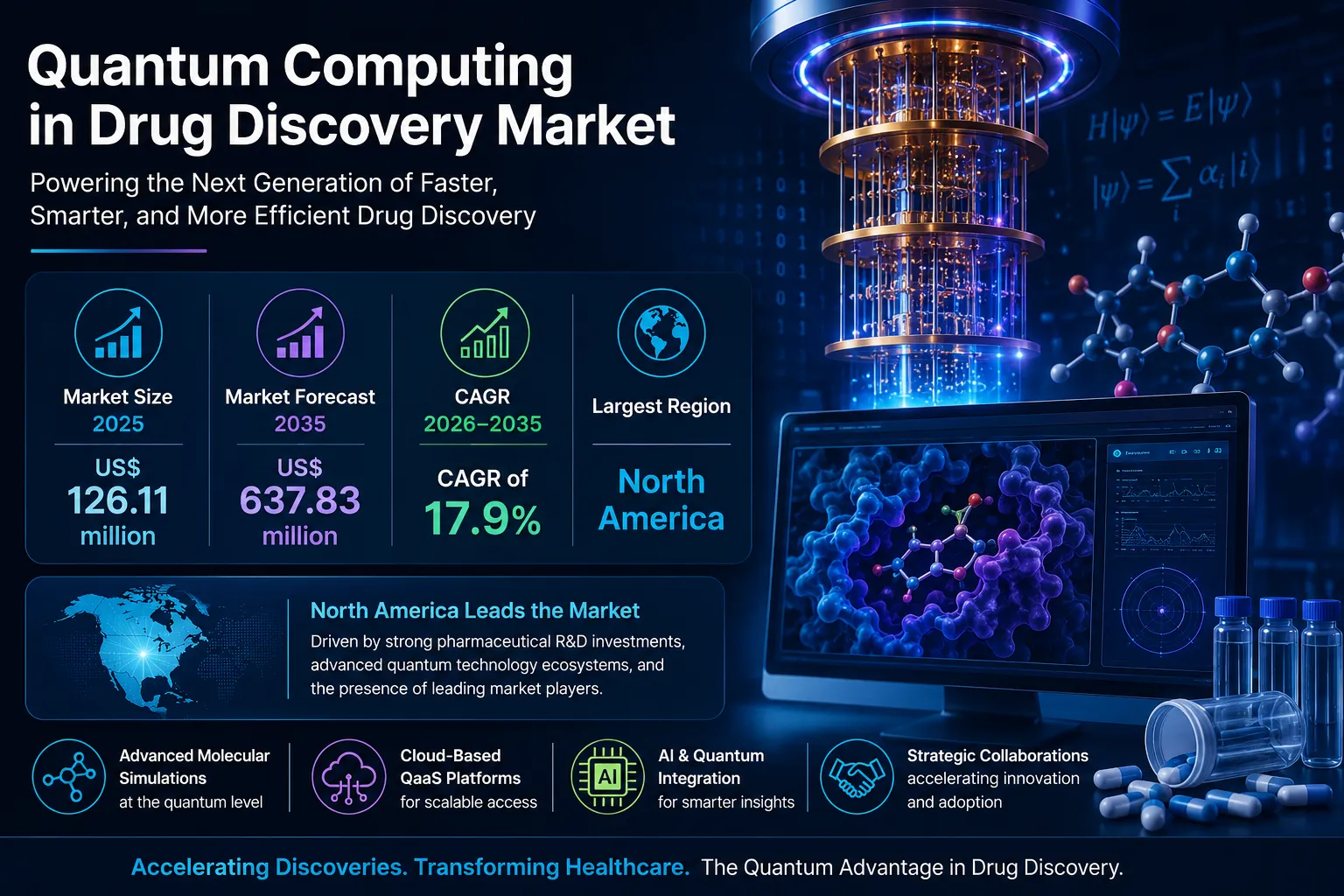
According to DataM Intelligence, a global market intelligence and consulting firm, has released its latest analysis showing the Global Quantum computing in Drug Discovery Market reached US$ 126.11 million in 2025 and is expected to reach US$ 637.83 million by 2035, growing with a CAGR of 17.9% during the forecast period 2026-2035. Growing pharmaceutical R&D investments, increasing adoption of quantum-classical hybrid computing, expansion of cloud-based quantum platforms, and rising demand for faster drug discovery workflows are driving the growth of the quantum computing in drug discovery market. The market is benefiting from advancements in molecular simulation, quantum optimization, and AI-enabled drug discovery applications, which improve the prediction of drug-target interactions and accelerate lead identification and optimization.
Additionally, increasing strategic collaborations between quantum technology providers and pharmaceutical companies, coupled with the growing availability of cloud-based Quantum-as-a-Service (QaaS) platforms, are expected to further accelerate the adoption of quantum computing across drug discovery and development processes.
Request for Exclusive Sample of this Report: https://www.datamintelligence.com/download-sample/quantum-computing-in-drug-discovery-market
Key Takeaways
- The global Quantum Computing in Drug Discovery Market is projected to reach US$ 637.83 million by 2035, expanding at a CAGR of 17.9% during 2026–2035, indicating strong commercialization potential across pharmaceutical R&D.
- Growing demand to reduce drug discovery timelines and pharmaceutical R&D costs is accelerating the adoption of quantum computing technologies for molecular simulation, drug-target interaction analysis, and lead optimization.
- Cloud-based QaaS adoption is accelerating quantum drug discovery, supported by strong enterprise cloud usage, with 89% of organizations using multi-cloud strategies, 73% using hybrid cloud environments, and 94% utilizing cloud services.
- The integration of artificial intelligence (AI), high-performance computing (HPC), and quantum computing is enhancing predictive capabilities and accelerating drug development workflows.
- North America dominates the market, supported by strong pharmaceutical R&D infrastructure, government funding, and the presence of leading quantum technology companies. The region generated approximately 22.6% of global quantum computing revenue (US$ 510.9 million) in 2025.
Rising Demand to Reduce Drug Discovery Time and R&D Costs Drives Market Growth
The increasing cost and complexity of pharmaceutical research are driving the adoption of advanced computational technologies such as quantum computing to improve drug discovery efficiency. Traditional drug development processes often require years of laboratory testing and billions of dollars in investment, creating a strong need for technologies that can accelerate candidate identification and reduce failure rates. Quantum computing enables highly accurate molecular simulations and drug-target interaction modeling at the electron level, helping researchers optimize hit identification, lead optimization, and preclinical candidate selection more effectively than conventional computing methods.
For instance, in December 2025, Excelsior Sciences, a US-based privately held, venture-backed biotechnology and drug discovery company, raised US$95 million and including a US$70 million Series A financing round and a US$25 million grant from New York's Empire State Development, to accelerate small-molecule drug development using AI-driven automation. The company stated that conventional small-molecule development cycles that typically take four months or longer can potentially be reduced to approximately two weeks through automated and computationally enhanced workflows, while also saving an additional 12–18 months before clinical trials begin.
Cloud-Based Deployment Model Driving Scalable Adoption in Quantum Drug Discovery
Cloud-based deployment has emerged as a critical segment within the quantum computing in drug discovery market, enabling pharmaceutical companies, biotechnology firms, and research institutions to access advanced quantum computing capabilities without investing in expensive on-premises infrastructure. The growing availability of Quantum-as-a-Service (QaaS) platforms is accelerating adoption by providing scalable access to quantum hardware, software, and hybrid quantum-classical computing environments through the cloud. These platforms support computationally intensive applications such as molecular simulation, reaction pathway analysis, target identification, and lead optimization, helping organizations reduce infrastructure costs while accelerating research workflows. According to Flexera's 2025 State of the Cloud Report, 89% of organizations use a multi-cloud strategy, while 73% adopt hybrid cloud environments, and 94% of organizations report using cloud services in some form, demonstrating the growing preference for cloud-based access to advanced computing resources.
For instance, in August, 2025, Mitsui & Co., in collaboration with QSimulate and Quantinuum, launched QIDO (Quantum-Integrated Discovery Orchestrator), a hybrid quantum-classical chemistry platform designed to accelerate research and development in drug discovery, materials science, and chemistry. The platform combines advanced computational chemistry, quantum computing, and AI technologies to improve molecular simulations and chemical reaction analysis.
North America Leads the Quantum Computing in Drug Discovery Market Through Strong Pharmaceutical R&D Investments and Advanced Quantum Technology Ecosystems
North America continues to lead the global quantum computing in drug discovery market, supported by its extensive pharmaceutical R&D infrastructure, concentration of leading quantum computing companies, and strong government-backed quantum technology initiatives. The region hosts major quantum technology providers such as IBM, Microsoft, IonQ, Rigetti Computing, and D-Wave Quantum, which are actively collaborating with pharmaceutical and biotechnology organizations to advance molecular simulation and drug discovery applications. The region's leadership is further reflected in broader quantum computing adoption trends. North America generated approximately 22.6% (US$510.9 million) in quantum computing revenue in 2025. The region benefits from a robust ecosystem of technology companies, research institutions, and healthcare organizations that are accelerating the commercialization of quantum-enabled drug discovery solutions.
The region's position is also reinforced by substantial investments in quantum innovation. In 2026, the U.S. government announced a US$2 billion quantum technology investment initiative, while IBM disclosed plans to invest more than US$10 billion in quantum computing development through 2029, strengthening North America's leadership in quantum infrastructure, software development, and pharmaceutical research applications.
Competitive Landscape and Strategic Developments
The quantum computing in drug discovery market is highly competitive due to increasing investments in quantum hardware, software platforms, cloud-based quantum services, and advanced computational drug discovery solutions aimed at accelerating pharmaceutical R&D. Leading companies in the market, including IBM, D-Wave Quantum Inc., Microsoft, Rigetti & Co, LLC., Intel Corporation, Fujitsu, Xanadu, Quantum Brilliance Pty Ltd, Zapata Quantum, Inc., QuEra Computing Inc., and Qubit Pharmaceuticals, are strengthening their market positions through strategic collaborations with pharmaceutical companies, technological innovations in quantum algorithms and molecular simulation, expansion of Quantum-as-a-Service (QaaS) offerings, and investments in next-generation quantum computing infrastructure. Where IBM market share is 18% and Microsoft market share is 14%.
Key Developments:
- In March 2026, University College London (UCL), in collaboration with partners including NVIDIA, announced a breakthrough hybrid quantum-GPU computing framework at NVIDIA GTC 2026. The initiative integrates quantum computing with high-performance GPU acceleration to tackle computationally intensive scientific challenges, including molecular simulation, computational chemistry, and drug discovery applications. The hybrid architecture is designed to improve the efficiency of complex molecular modeling and optimization workflows by combining the strengths of quantum processors and classical GPU systems, enabling researchers to accelerate drug candidate identification and simulation processes.
- In December 2025, IonQ and CCRM (Centre for Commercialization of Regenerative Medicine) announced a strategic quantum-biotechnology collaboration aimed at accelerating the development of advanced therapeutics and next-generation healthcare solutions. Through this partnership, the organizations will explore the application of quantum computing technologies to address complex biological and pharmaceutical challenges, including drug discovery, molecular modeling, biomarker identification, and regenerative medicine research.
- In April 2026, Centre for Quantum Technologies (CQT) Singapore and Qubit Pharmaceuticals announced a strategic collaboration to advance quantum algorithms for drug discovery and molecular simulation. The partnership focuses on developing and optimizing quantum computing approaches capable of addressing complex pharmaceutical challenges, including molecular modeling, protein-ligand interaction analysis, and drug candidate optimization.
Leading Company Profiles and Strategic Developments
IBM Corporation (US)
- IBM Corporation is a global technology leader and one of the most prominent companies advancing quantum computing applications for drug discovery, molecular simulation, and computational chemistry. With an estimated 18% share of the quantum computing in drug discovery market, IBM maintains a strong competitive position through its IBM Quantum platform, through its IBM Quantum platform, the company provides cloud-based access to quantum computing systems, quantum software tools, and hybrid quantum-classical computing capabilities that enable researchers and pharmaceutical organizations to explore complex molecular interactions and accelerate drug development processes. IBM's leadership is further supported by its extensive quantum hardware portfolio, including systems exceeding 1,000 qubits, and its global cloud-based quantum infrastructure that enables scalable access to advanced computational resources. IBM operates one of the world's largest quantum computing ecosystems, with more than 275 organizations participating in the IBM Quantum Network, including pharmaceutical companies, healthcare institutions, research laboratories, and academic organizations.
- In April 2026, IBM highlighted the growing impact of its quantum computing technologies on healthcare and biology research through collaborations with leading academic institutions and industry partners. The company demonstrated how IBM Quantum systems are being utilized to explore complex biological mechanisms, molecular interactions, and computational chemistry challenges that are critical to next-generation drug discovery. By combining quantum computing with AI and high-performance computing capabilities, IBM aims to improve molecular modeling accuracy, accelerate biomolecular simulations, and support the development of novel therapeutics.
Analyst Opinion about Quantum Computing in Drug Discovery
The Quantum Computing in Drug Discovery Market is poised for significant long-term growth, driven by the pharmaceutical industry's increasing need to accelerate drug development, improve molecular prediction accuracy, and reduce the high costs associated with traditional R&D processes. As quantum technologies continue to advance, they are expected to evolve from experimental research tools into commercially viable solutions across target identification, molecular simulation, lead optimization, and preclinical candidate selection. The integration of quantum computing with artificial intelligence (AI), high-performance computing (HPC), and computational chemistry is creating new opportunities to analyze complex molecular interactions with unprecedented precision. Simultaneously, the expansion of cloud-based Quantum-as-a-Service (QaaS) platforms is improving accessibility by enabling organizations to leverage quantum capabilities without substantial infrastructure investments. Companies that successfully combine quantum expertise with computational biology, molecular modeling, and AI-driven drug design are expected to gain a competitive advantage.
Pharmaceutical Industry Leaders Actively Investing in Emerging Technologies to Accelerate Drug Development and R&D Efficiency
Large pharmaceutical companies represent the strongest buyer segment due to mounting pressure to accelerate drug development and improve R&D productivity. Buyers are investing in quantum-powered molecular simulation, drug-target interaction analysis, and lead optimization platforms. The pharmaceutical companies segment is identified as the leading end-user category in the market.
Biopharmaceutical Companies Seeking Advanced Technologies to Accelerate Drug Discovery and Therapeutic Development
Biopharmaceutical firms are increasingly adopting quantum-enabled platforms to enhance biologics research, precision medicine, and complex molecular modeling.
A growing focus on personalized therapies and rare disease treatments is increasing demand for advanced computational capabilities.
Contract Research Organizations (CROs) Expanding Technology Investments to Enhance Drug Discovery and Development Services
CROs are emerging as significant buyers as they seek to improve service offerings and shorten development timelines for pharmaceutical clients. Adoption improves competitiveness by enhancing research efficiency and reducing project turnaround times.
Academic and Research Institutes Advancing Scientific Innovation Through Adoption of Emerging Drug Discovery Technologies
Universities and research institutions remain important early adopters, supported by government funding and expanding quantum research initiatives. Investments in quantum chemistry, computational biology, and molecular simulation research continue to increase globally.
Organizations Leveraging Cloud-Based Quantum Computing Platforms for Scalable Drug Discovery Applications
Organizations increasingly prefer cloud-based quantum computing services over on-premises infrastructure. 89% of organizations use multi-cloud strategies, 73% use hybrid cloud environments, and 94% utilize cloud services, supporting growing demand for Quantum-as-a-Service (QaaS) models.
Cloud deployment is becoming the leading adoption model because it eliminates large infrastructure investments and provides scalable access to quantum resources.
Related Reports links