


The semiconductor industry was dominated by AI infrastructure, advanced manufacturing investment, and the race to secure a geographically resilient chip supply. But the more durable commercial story sits beneath the accelerator market. Every AI server, electric vehicle, solar inverter, industrial motor drive and energy-storage system depends on power semiconductors that can convert, control and protect electricity efficiently.
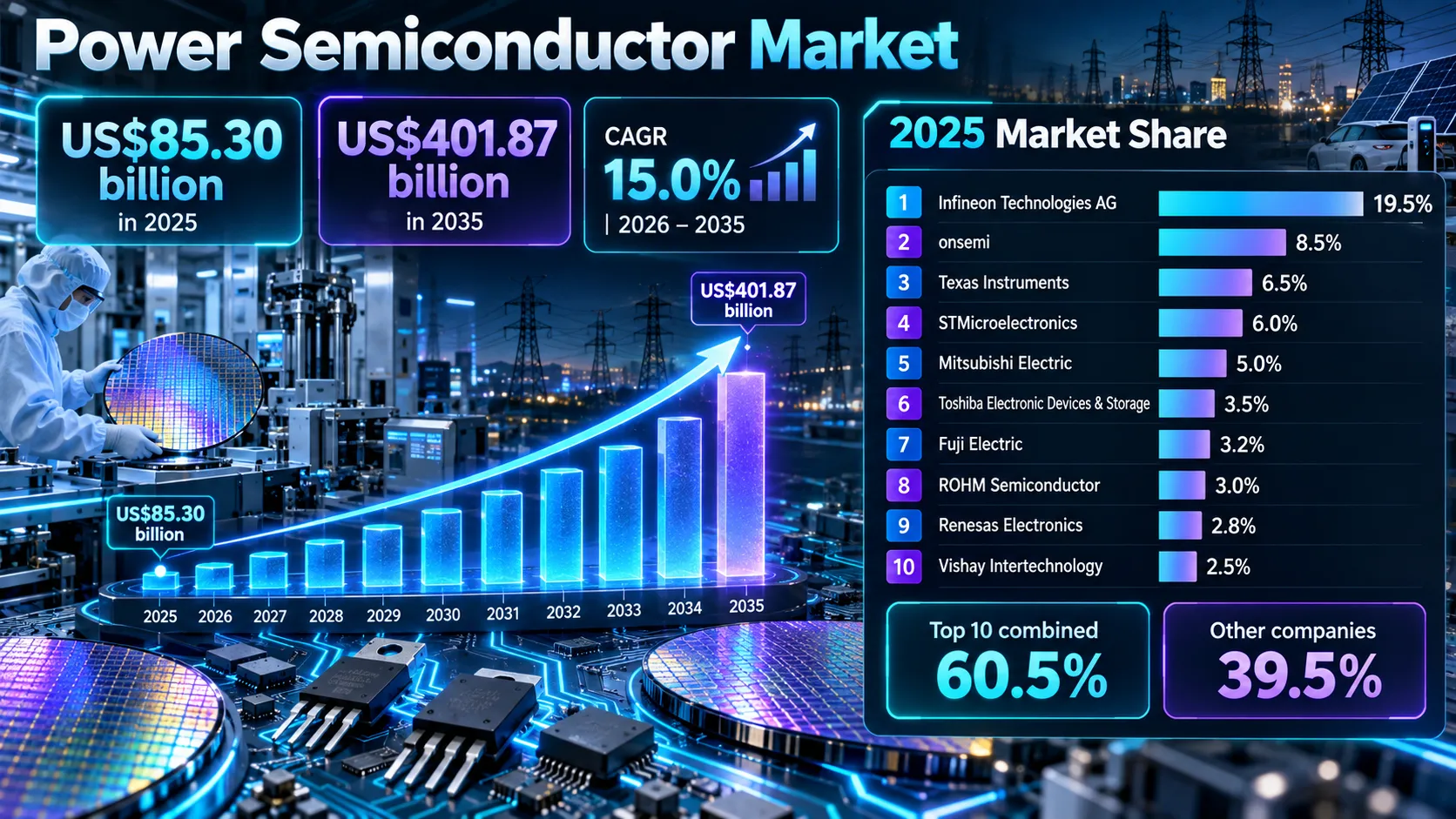
The global power semiconductor market was valued at US$85.30 billion in 2025 and is projected to reach US$401.87 billion by 2035, expanding at a 15% CAGR during 2026–2035. This growth is not based on one end market. It is being shaped by the convergence of AI data-center buildouts, transport electrification, renewable-power deployment, industrial automation and the need to reduce energy losses across electronic systems.
September’s semiconductor developments demonstrate why power devices are moving from a component-level procurement decision to a strategic infrastructure consideration. Factory capacity, regional manufacturing, advanced packaging, optical connectivity and high-density compute are all changing the demand profile for power-management ICs, MOSFETs, IGBTs, silicon carbide devices, gallium nitride solutions and integrated power modules.
Request Sample: https://www.datamintelligence.com/download-sample/power-semiconductor-market
The Semiconductor Cycle Is Becoming an Infrastructure Cycle
The reported possibility of a second U.S. manufacturing hub for TSMC, Samsung’s US$1 billion commitment to AI infrastructure platform Helix Digital Infrastructure and Singapore’s renewed industrial ambition all signal the same reality: semiconductor strategy is now closely tied to national infrastructure strategy. Governments and corporations are competing not only to own intellectual property, but also to secure fabs, equipment, energy, skilled labour, packaging capacity and supply-chain control.
This has direct implications for the power semiconductor market. A fab expansion requires high-reliability power distribution, UPS systems, motion-control equipment, cooling and cleanroom infrastructure. A new AI data center requires high-current conversion, voltage regulation, power backup and thermal management from the utility connection to the server board. Electrified industrial systems require increasingly efficient switching and control devices. Each investment wave therefore creates demand beyond logic and memory chips.
The September report that global semiconductor-equipment billings increased sharply in the second quarter of 2026 reinforces this view. Equipment investment is a leading indicator of future manufacturing activity, but it also signals rising demand for the electrical infrastructure that keeps advanced production and high-density compute operating. For power semiconductor suppliers, the opportunity is not simply to sell discrete devices. It is to participate in complete efficiency, conversion and control solutions.
AI Data Centers Turn Power Efficiency into a Competitive Advantage
AI data centers are reshaping the technical requirements placed on power systems. Traditional enterprise facilities were already energy intensive, but AI clusters combine dense GPU or accelerator deployments, high-speed networking, advanced cooling and continuous workloads. The result is a growing need to manage power delivery with lower losses, higher reliability and greater visibility.
Power semiconductors sit at the centre of this architecture. They are used in power supplies, DC-DC converters, UPS systems, battery management, voltage regulators, cooling equipment, server racks and power-distribution units. As rack density rises, small efficiency gains at each conversion stage can have a meaningful impact on facility operating cost, cooling demand and system resilience.
This is why September’s investment in AI infrastructure and optical connectivity matters to power-device suppliers. Funding for photonics and AI-cluster interconnects indicates that compute systems are becoming more complex and more power intensive. Faster connectivity does not reduce the need for power innovation; it increases the value of efficient power delivery around processors, memory, network switches and cooling systems.
Silicon carbide and gallium nitride technologies are particularly relevant where higher switching frequency, improved thermal performance or compact system design can improve total system efficiency. Silicon will remain indispensable across many applications, but customers are increasingly evaluating where wide-bandgap materials can justify a higher initial device cost through lower energy consumption, smaller passive components or reduced cooling requirements.
Electrification Still Creates the Largest Long-Term Volume Opportunity
AI is accelerating premium demand, but electrification remains a central source of volume growth for power semiconductors. Electric vehicles use power devices in traction inverters, onboard chargers, DC-DC converters and charging systems. Renewable-energy systems require efficient inverters and converters. Battery-energy-storage projects need power modules for charging, discharging and grid balancing. Industrial automation relies on drives, robotics, welding, pumps and factory equipment that require precise motor control.
This creates a broad and diverse market rather than a single-cycle opportunity. Automotive customers tend to demand long qualification periods, high reliability and secure supply. Renewable-energy customers focus on conversion efficiency, operating temperature and system lifetime. Industrial buyers often value performance across harsh environments, long product availability and module-level support. Data-center operators focus on efficiency, density, resilience and total cost of ownership.
Suppliers that can serve several of these end markets have a strategic advantage. They can balance demand cycles, invest in common technology platforms and build application expertise that supports premium pricing. However, they also need disciplined product roadmaps. A power device that performs well in an EV inverter will not automatically meet the needs of a compact consumer charger or a data-center power shelf.
Regional Manufacturing Is Now a Procurement Priority
September’s manufacturing and policy developments show that power semiconductor buyers must assess more than device specifications. A qualified component may still create risk if it is exposed to a single geographic production base, long logistics routes or uncertain export conditions.
The United States is increasing its manufacturing footprint as companies seek supply-chain security and proximity to major technology customers. Singapore is reinforcing its role as a stable advanced-manufacturing location. India is expanding its semiconductor ecosystem through policy support and investment attraction. Europe, meanwhile, faces an important strategic debate: subsidy commitments alone may not create enough demand for locally produced advanced chips and equipment.
For procurement teams, the implication is clear. Supplier selection should include manufacturing footprint, wafer sourcing, packaging capacity, test locations, export-control exposure and business-continuity plans. Local or regional sourcing may not be the lowest-cost option in every case, but it can reduce disruption risk for critical infrastructure applications.
Japan remains especially important in this equation. Its industrial power-electronics companies, materials suppliers, equipment ecosystem and automotive relationships give it a durable role in the global value chain. For international suppliers, Japan is both a competitive market and a source of technology partnerships in industrial, automotive and energy applications.
Top Five Companies Shaping the Power Semiconductor Market
The competitive landscape is led by companies with different technology, channel and end-market strengths. The top five provide a useful view of how the market is evolving.
- Infineon Technologies AG held an indicative 19.5% market share in 2025. Its position reflects broad exposure to automotive, industrial, renewable energy and power-management applications. Infineon’s strategic strength is its ability to pair a large silicon portfolio with expanding silicon carbide capability and deep application support.
- onsemi, with an indicative 8.5% share, is strongly positioned in intelligent power, sensing and automotive electrification. Its focus on silicon carbide and vehicle power systems makes it an important supplier for OEMs and tier-one partners seeking efficient, high-voltage solutions.
- Texas Instruments held an indicative 6.5% share and remains influential through its analogue and embedded-processing breadth. Its large customer base across industrial, automotive and communications equipment gives it a strong route to power-management design wins, even where customers do not require a discrete power-device specialist.
- STMicroelectronics, with an indicative 6% share, brings a combination of automotive relationships, industrial power devices and microcontroller capability. This makes the company relevant to customers seeking more integrated system solutions for electrified and connected products.
- Mitsubishi Electric held an indicative 5% share and remains particularly important in high-power industrial applications. Its presence in factory automation, rail, energy systems and power modules gives it a differentiated role where reliability, lifecycle support and high-voltage performance matter.
The next competitive tier includes Toshiba Electronic Devices & Storage, Fuji Electric, ROHM Semiconductor and Renesas Electronics. These companies are important watchpoints for buyers seeking regional supply, specialised power modules, automotive capability and technology options across silicon, silicon carbide and power-management ICs.
The Supplier Decision Is Becoming More Complex
Power semiconductor sourcing can no longer be reduced to cost per device. Buyers should first define the operating environment: voltage, current, switching speed, thermal load, lifetime expectation and certification requirements. They should then assess whether the supplier can provide the right packaging, module integration, application engineering and long-term availability.
Supply assurance is the second critical requirement. A technically suitable component can still become a project risk if its wafer supply, assembly location or logistics route is vulnerable. Multi-source strategies, qualified alternatives and visibility into a supplier’s manufacturing roadmap are increasingly valuable.
Finally, companies should evaluate technology roadmaps rather than only current catalogues. Silicon will remain essential, yet SiC and GaN adoption is accelerating in selected high-efficiency applications. The right supplier will help customers determine when wide-bandgap technologies deliver genuine system value and when established silicon solutions remain the better economic choice.
Power Semiconductor Leadership Will Be Defined by Efficiency and Execution
The global power semiconductor market is entering a period in which technical efficiency and supply-chain execution carry equal weight. AI data centers are making power density and conversion losses a strategic issue. EVs, renewable energy and industrial automation are increasing demand for reliable, high-performance devices. Regional manufacturing policies are changing how buyers assess supply risk.
The strongest companies will not simply sell components. They will combine device innovation, application expertise, dependable capacity, qualified packaging and a clear technology roadmap. For investors, suppliers and buyers, the opportunity lies in identifying where power-semiconductor demand is becoming mission critical-and which partners can deliver at scale.
DataM Intelligence helps businesses evaluate power semiconductor demand, technology transitions, competitor strategies, supplier ecosystems and country-level opportunity across automotive, energy, industrial and data-center markets.