


Introduction
Smart metering is often discussed in terms of digital meters, real-time billing, energy analytics, and grid modernization. But behind every smart meter rollout, there is one critical layer that decides whether the system works efficiently: communication infrastructure.
Utilities need a reliable way to move data between meters, data concentrators, substations, and central systems. This data may include consumption readings, outage alerts, tamper events, voltage information, load profiles, and remote connection or disconnection commands.
Several communication technologies can support smart metering, including cellular, RF mesh, LoRaWAN, Wi-SUN, fiber, Ethernet, and satellite. However, one technology continues to stand out for cost-sensitive, large-scale electricity networks: Power Line Communication, commonly known as PLC.
PLC allows data to travel over the same electrical wires that already deliver power. This makes it one of the most practical and cost-efficient communication options for smart metering, especially in regions where installing new communication infrastructure is expensive or difficult.
In simple terms, Power Line Communication turns the electricity network into a data network.
Request Exclusive Sample Report on Power Line Communication Market
What Is Power Line Communication?
Power Line Communication is a communication technology that transmits data through existing power lines. Instead of building a separate communication network, utilities can use their existing low-voltage and medium-voltage electrical infrastructure to carry digital signals.
In smart metering, PLC is commonly used to connect smart electricity meters with a local data concentrator. The concentrator then sends the collected meter data to the utility’s head-end system using cellular, fiber, Ethernet, or another backhaul technology.
How PLC Works in Smart Metering
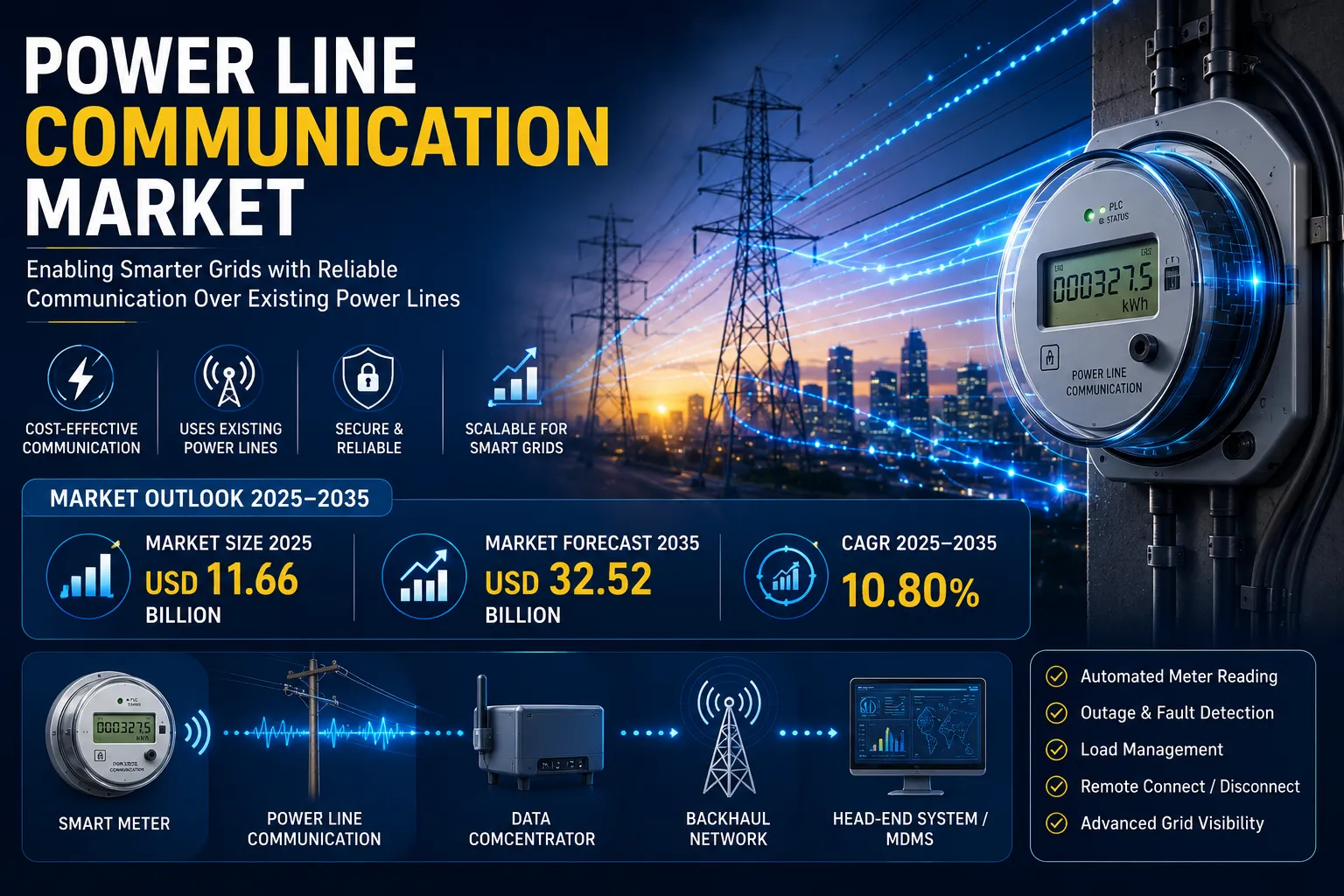
A typical PLC-based smart metering architecture looks like this:
| Network Layer | Function |
| Smart Meter | Measures energy consumption and sends data through power lines |
| Power Line Communication Network | Carries meter data over existing electrical wiring |
| Data Concentrator Unit | Collects data from multiple meters in a neighborhood or transformer area |
| Backhaul Network | Sends aggregated data to the utility’s central system |
Head-End System / Meter Data Management System | Processes, validates, stores, and analyzes meter data |
Request Exclusive Sample Report on Power Line Communication Market
This structure makes PLC especially useful for Advanced Metering Infrastructure, where thousands or millions of meters need to communicate regularly with utility systems.
Why PLC Is Important for Smart Metering
Smart meters are not valuable only because they measure electricity. They are valuable because they can communicate.
Without communication, a smart meter becomes little more than a digital meter. With communication, it becomes part of a connected grid.
PLC supports smart metering by enabling:
- Automated meter reading
- Remote billing data collection
- Load profiling
- Outage detection
- Voltage monitoring
- Tamper detection
- Remote connect and disconnect
- Demand response programs
- Distribution network visibility
- Prepaid and time-of-use metering
This is why PLC is often called the low-cost communication layer behind smart metering. It may not always be the fastest communication technology, but it is highly practical for the type of data smart meters usually need to send.
Smart meters do not require video-level bandwidth. They need dependable, secure, and cost-effective communication for small but important data packets. PLC fits this requirement well.
Why Utilities Choose PLC for Smart Metering
PLC has remained relevant because it solves one of the biggest challenges in utility communication: network coverage without building a new network.
Key Benefits of PLC in Smart Metering
| Benefit | Why It Matters |
| Uses existing power lines | Reduces the need for separate communication infrastructure |
| Lower deployment cost | Useful for mass smart meter rollouts |
| Good fit for electricity utilities | The communication path follows the power distribution network |
| Works well in dense meter areas | Suitable for urban and semi-urban smart metering |
| Supports remote meter reading | Reduces manual meter reading cost |
| Improves outage visibility | Helps utilities detect local power failures faster |
| Supports AMI expansion | Enables two-way communication between meters and utility systems |
Can be combined with RF or cellular | Supports hybrid smart grid communication models |
Request Exclusive Sample Report on Power Line Communication Market
For utilities, cost matters at scale. A small increase in communication cost per meter can become a major investment burden when millions of meters are involved. PLC reduces this pressure by using infrastructure that already exists.
PLC vs Other Communication Technologies in Smart Metering
PLC is not the only option for smart meter communication. Each technology has advantages and limitations. The right choice depends on geography, meter density, grid structure, cost, regulation, and utility strategy.
| Technology | Strengths | Limitations |
| PLC | Low infrastructure cost, uses power lines, good for utility-owned networks | Signal quality can be affected by electrical noise and grid conditions |
| RF Mesh | Strong neighborhood-level connectivity, self-healing networks | Requires radio planning and may face coverage issues in some areas |
| Cellular | Wide coverage, faster deployment, useful for dispersed meters | Recurring network costs and dependence on telecom operators |
| LoRaWAN / LPWAN | Low power, long range, good for IoT-style applications | May require gateway infrastructure and has bandwidth limits |
| Fiber | High speed and reliable | Expensive for last-mile smart meter connectivity |
| Satellite | Useful for remote areas | Higher cost and latency compared with terrestrial networks |
Request Exclusive Sample Report on Power Line Communication Market
PLC is especially attractive when utilities want ownership, low operating cost, and direct use of the electricity distribution network.
Narrowband PLC: The Workhorse of Smart Metering
Most smart metering applications use narrowband PLC rather than broadband PLC.
Narrowband PLC operates at lower frequencies and is designed for applications where small amounts of data need to be transmitted reliably over power lines. This makes it suitable for smart meters, grid sensors, street lighting control, distribution automation, and basic smart grid communication.
Why Narrowband PLC Fits Smart Metering
Narrowband PLC is a good fit because smart meters usually send:
- Meter readings
- Event logs
- Outage notifications
- Voltage data
- Load profiles
- Firmware or configuration updates
- Tamper alerts
- Remote command responses
These data packets are important but not very large. Utilities need reliability and coverage, not high-speed internet performance.
This makes narrowband PLC more practical than broadband PLC for many smart metering deployments.
Key PLC Standards Used in Smart Metering
PLC adoption has improved because of open standards and interoperable technology ecosystems. Standards help reduce vendor lock-in, support device compatibility, and improve confidence in large-scale deployments.
Major PLC Standards and Technologies
| Standard / Technology | Relevance |
| G3-PLC | Used for smart metering, smart grid, and IoT communication over power lines |
| PRIME | Designed for advanced metering management and smart grid applications |
| IEEE 1901.2 | Narrowband PLC standard for smart grid applications |
| ITU-T G.9903 | Standard linked with G3-PLC technology |
| DLMS/COSEM | Commonly used data exchange model for smart metering interoperability |
Request Exclusive Sample Report on Power Line Communication Market
These standards matter because smart metering projects often run for many years. Utilities need technology that can support long asset lifecycles, multi-vendor environments, and future upgrades.
Where PLC Delivers the Most Value
PLC is not always the best option for every meter or every network. But it delivers strong value in specific use cases.
Best-Fit Applications for PLC
| Use Case | PLC Advantage |
| Residential smart meters | Cost-effective communication over existing low-voltage lines |
| Urban smart metering | Efficient for dense meter networks |
| Apartment buildings | Useful where meters are connected to the same electrical infrastructure |
| Distribution transformer areas | Strong fit for collecting data from meters under the same transformer |
| Prepaid metering | Supports remote monitoring and balance updates |
| Outage detection | Helps identify last-gasp meter events and local failures |
| Street lighting control | Uses existing electrical circuits for communication |
| Grid monitoring | Supports voltage and event data from the distribution network |
Request Exclusive Sample Report on Power Line Communication Market
PLC becomes especially powerful when combined with smart meters that can capture more than consumption data. Voltage levels, outage events, phase information, and power quality indicators can help utilities improve distribution grid visibility.
Challenges in PLC-Based Smart Metering
PLC is practical, but it is not perfect. Power lines were designed to transmit electricity, not data. This creates technical challenges that utilities must manage.
Common PLC Challenges
- Electrical noise from appliances and industrial equipment
- Signal attenuation over long distances
- Transformer and network topology limitations
- Interference from switching devices
- Variable grid conditions
- Different wiring quality across regions
- Cybersecurity requirements
- Interoperability across devices and vendors
These challenges do not make PLC unsuitable. They simply mean PLC networks must be planned carefully. Utilities need proper network design, meter placement, concentrator positioning, field testing, standards-based devices, and ongoing monitoring.
In many deployments, utilities use hybrid communication models. PLC may be used for the last-mile meter network, while cellular, fiber, or RF is used for backhaul. This combination can improve reliability and flexibility.
PLC and Smart Metering in Emerging Markets
PLC is highly relevant in emerging markets because smart meter rollouts are often cost-sensitive. Utilities need communication networks that can scale across millions of households without creating unsustainable deployment costs.
In many countries, smart metering is being driven by:
- High aggregate technical and commercial losses
- Manual meter reading inefficiencies
- Electricity theft and tampering
- Need for prepaid metering
- Demand for accurate billing
- Grid modernization programs
- Renewable energy integration
- Urbanization and rising electricity demand
PLC can support these goals because it allows utilities to build communication capability on top of the existing distribution network.
This is especially important in markets where telecom coverage may be inconsistent, cellular data costs may be high, or building separate RF infrastructure may be difficult.
How PLC Supports Utility Business Models
Power Line Communication is more than a technical layer. It can influence the economics of utility operations.
Business Benefits of PLC-Based Smart Metering
| Business Area | Impact |
| Billing efficiency | Reduces manual meter reading and billing delays |
| Revenue protection | Supports tamper detection and abnormal usage alerts |
| Customer service | Enables faster response to billing disputes and outages |
| Operational cost | Lowers field visit requirements |
| Grid planning | Provides better visibility into load and voltage behavior |
| Demand response | Supports time-based tariffs and consumption management |
| Prepaid electricity | Enables remote balance updates and control |
| Outage management | Improves outage detection and restoration tracking |
Request Exclusive Sample Report on Power Line Communication Market
For utilities, the biggest value is not only the communication cost. It is the ability to create a connected meter network that improves operational decisions.
PLC in the Future Smart Grid
The role of PLC is expanding beyond basic smart meter reading. As distribution grids become more complex, utilities need more intelligence at the edge of the network.
The future grid will include:
- Rooftop solar
- Electric vehicle charging
- Battery energy storage
- Smart appliances
- Distributed energy resources
- Dynamic tariffs
- Microgrids
- Grid automation
- Power quality monitoring
These changes increase the need for communication between the utility and the low-voltage network. PLC can support this transition by acting as a practical connectivity layer for meters and grid-edge devices.
However, future smart grids will not depend on one communication technology alone. The market is moving toward hybrid communication architecture, where PLC works alongside RF, cellular, fiber, and IoT networks.
In this model, PLC remains valuable because it provides a cost-effective last-mile communication layer that is already physically connected to the electricity network.
Strategic Outlook: Why PLC Still Matters
Some technologies are attractive because they are new. PLC remains attractive because it is practical.
The electricity grid already reaches every meter. PLC uses that reach as a communication advantage. This is why it continues to matter in smart metering even as wireless and cellular technologies expand.
For utilities planning large-scale smart meter deployment, PLC offers three strategic advantages:
- Lower infrastructure cost
- Utility-controlled communication path
- Natural alignment with the power distribution network
Its role will be strongest in markets where cost control, large-scale coverage, and distribution network visibility are top priorities.
The next phase of PLC growth will likely be shaped by:
- Hybrid PLC and RF communication
- Standards-based smart metering systems
- Stronger cybersecurity frameworks
- Better noise management
- Improved interoperability
- Smart grid applications beyond billing
- Integration with distribution automation
PLC may not be the most visible part of smart metering, but it is one of the most important. It is the quiet communication layer that helps turn electricity meters into grid intelligence points.
Frequently Asked Questions (FAQ)
What is Power Line Communication in smart metering?
Power Line Communication in smart metering is a technology that sends meter data through existing electrical power lines. It allows smart meters to communicate with data concentrators and utility systems without requiring a separate communication network for every meter.
Why is PLC used in smart meters?
PLC is used in smart meters because it is cost-effective, uses existing electrical infrastructure, and supports automated meter reading, outage alerts, tamper detection, remote commands, and utility data collection.
Is PLC better than RF or cellular for smart metering?
PLC is not always better, but it is often more cost-effective where utilities can use existing power lines. RF and cellular may be better in areas with difficult grid topology, long distances, or where wireless coverage is stronger. Many utilities use hybrid systems combining PLC with RF, cellular, or fiber.
What is the difference between narrowband PLC and broadband PLC?
Narrowband PLC is designed for low-data-rate applications such as smart metering and grid monitoring. Broadband PLC supports higher data rates but is less commonly used for basic smart meter communication. Smart metering usually requires reliable small-data communication rather than high-speed internet performance.
What are G3-PLC and PRIME?
G3-PLC and PRIME are widely used PLC technologies for smart metering and smart grid applications. They define how devices communicate over power lines and help support interoperability across smart meters, data concentrators, and utility systems.
What are the main challenges of PLC communication?
The main challenges include electrical noise, signal attenuation, network topology issues, transformer limitations, interoperability, and cybersecurity. These challenges can be managed through proper network design, standards-based equipment, and hybrid communication models.
Is PLC suitable for emerging markets?
Yes. PLC is well suited for many emerging markets because it reduces the need for new communication infrastructure. It can support large-scale smart meter rollouts, prepaid metering, loss reduction, and better billing accuracy.
Can PLC support future smart grid applications?
Yes. PLC can support smart grid applications such as outage detection, voltage monitoring, street lighting control, distribution automation, and grid-edge data collection. However, future smart grids will likely use PLC as part of a hybrid communication architecture.
Read Complete Research Report: https://www.datamintelligence.com/research-report/power-line-communication-market