


PCB Supply Chain Crisis: How Geopolitical Disruptions and AI Demand Are Driving Material Costs and Lead Times Higher
Hormuz disruption, sulfur chemistry and AI-era material intensity are colliding upstream of board fabrication
| >270% CCL price increase Reported YoY / market impact | 20 weeks CCL lead time From ~4 weeks in India | ~40-45% Bare PCB inflation Industry / US producer price signals |
The PCB shortage is no longer one bottleneck. In 2026, geopolitical disruption around the Strait of Hormuz hit sulfur, sulfuric acid and petrochemical chains at the same time that AI infrastructure was absorbing glass cloth, copper foil, advanced laminate capacity and tungsten-carbide drilling consumables. The result is a layered cost shock moving from upstream chemistry into CCL, prepreg, fabrication lead times and finally bare-board pricing.
1. Hormuz Turned a Distant Shipping Risk Into a PCB Material Risk
The PCB industry does not buy sulfur as a headline input, but it depends on supply chains that do. Sulfur feeds sulfuric acid production, and sulfuric acid sits upstream of metals processing, chemical refining and resin-related industrial systems. The Middle East also supplies petrochemical feedstocks used in advanced laminate chemistry. When shipping through Hormuz tightened in 2026, these upstream dependencies became visible inside electronics procurement.
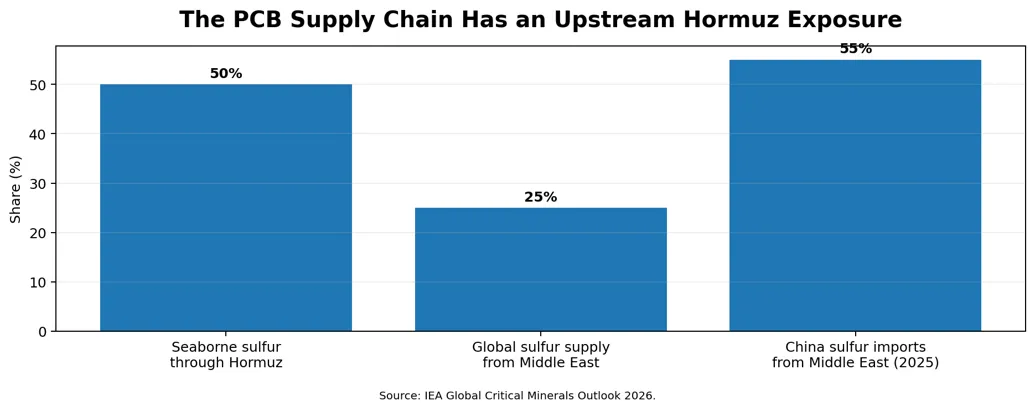
The IEA estimates that roughly half of global seaborne sulfur trade passes through the Strait of Hormuz, while the Middle East accounts for about one-quarter of global sulfur supply. China sourced 55% of its sulfur imports from the Middle East in 2025. Sulfuric acid prices doubled from about US$144/t in February 2026 to US$283/t in April, illustrating how quickly the disruption moved into chemical input pricing.
Request Sample: https://www.datamintelligence.com/download-sample/printed-circuit-board-pcb-market
Why this matters for PCB buyers: upstream shortages do not need to hit finished laminate plants directly. They can transmit through resin chemistry, copper processing, freight, energy and regional supplier allocation.
2. Laminate Inflation Has Moved Beyond a Normal Commodity Cycle
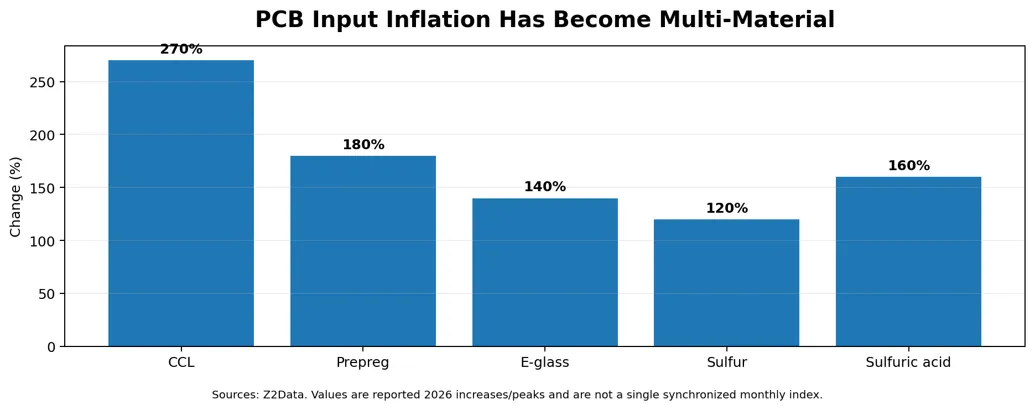
Z2Data reports that mainstream copper-clad laminate grades rose more than 270% year over year, while prepreg increased around 180% and E-glass roughly 140%. Sulfur and sulfuric acid were also reported up as much as 120% and 160%, respectively, during the 2026 shock. These figures come from different points in the year, but together they show the breadth of the inflation rather than a single-metal spike.
Evertiq’s November update shows the squeeze is now spreading into standard FR-4, not only premium AI laminates. Producers are reallocating glass cloth, copper foil and press capacity toward higher-margin low-loss materials, which means geopolitical supply risk and AI capacity prioritization are reinforcing each other.
3. Lead-Time Expansion Is Becoming as Important as Price
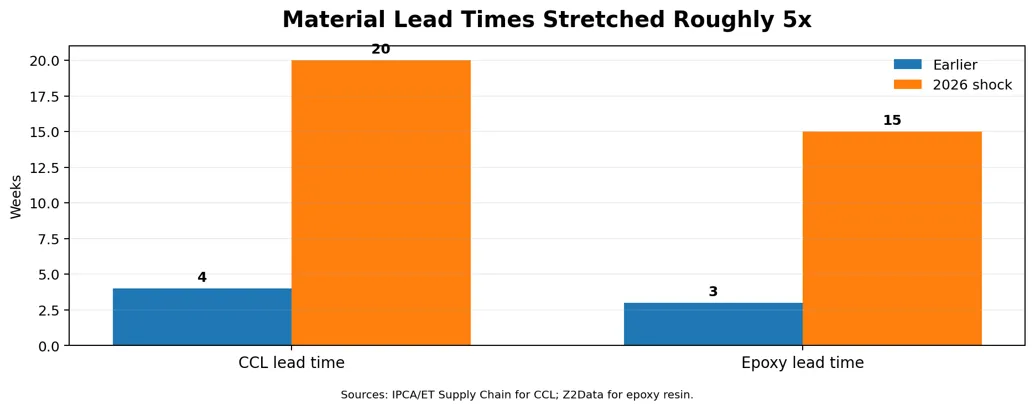
Price inflation is only one procurement problem. IPCA-linked reporting in India shows CCL delivery moving from around four weeks to as long as 20 weeks during the 2026 shock. Z2Data separately reports epoxy resin lead times moving from roughly three weeks to around 15 weeks for some producers. That fivefold expansion changes working-capital needs, safety-stock policy and the feasibility of short customer delivery commitments.
For high-layer and high-speed designs, the risk is higher because material substitutions are harder. A buyer can often redesign around a standard FR-4 equivalent. It is much more difficult to change a qualified high-speed laminate, thin-glass prepreg or heavy-copper stack-up without restarting signal-integrity, thermal or reliability validation.
4. Higher-Layer AI Boards Amplify the Consumables Shock
AI demand is not simply competing for laminate. It also increases manufacturing intensity. More layers mean more drilling, routing, lamination cycles and tighter registration requirements. Evertiq reports that tungsten-carbide PCB drill bits rose by more than 50% from late 2025 to Q3 2026 because drill life declines as layer counts and drilling intensity increase.
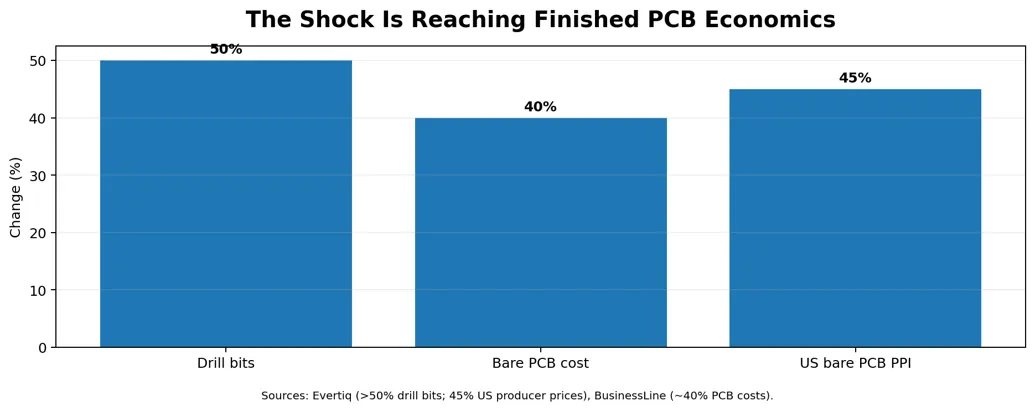
The cost transmission is now visible in finished-board pricing. BusinessLine reported PCB costs almost 40% higher in November 2026, while Evertiq cited official U.S. producer prices for bare PCBs running 45% above a year earlier in August. The gap between raw-material inflation and finished-board inflation reflects the fact that material is only one part of total fabrication cost, but it also shows how much of the upstream shock is now reaching customers.
What Procurement Teams Need to Watch
| Signal | What changes | Commercial implication |
| CCL / prepreg allocation | Supplier availability can change weekly | Qualify equivalent laminate groups before a shortage forces redesign |
| Hormuz / sulfur risk | Chemical and freight costs can reprice rapidly | Track upstream feedstocks even when they are not direct PCB BOM items |
| Drill-bit inflation | High-layer boards consume tooling faster | Model cost per panel by layer count, hole count and tool life |
| Quote validity | Prices are becoming material-linked and shorter-dated | Expect re-openers, surcharges and shorter fixed-price windows |
| Lead-time volatility | 4-20 week swings can break customer schedules | Increase forecast visibility and reserve capacity earlier |
Why This Creates a New PCB Intelligence Requirement
The strategic question is no longer simply which PCB supplier offers the lowest fabrication price. Buyers now need to understand which plants have secure allocations of copper-clad laminate, glass cloth, copper foil and specialty resin, which stack-ups are exposed to thin-glass or low-loss bottlenecks, which suppliers can qualify substitutes without long engineering delays and how geopolitical disruptions are changing regional lead times.
For PCB manufacturers, the opportunity is equally specific. Suppliers with multi-source laminate qualification, regional inventory, stronger upstream contracts and the ability to migrate customers between equivalent material systems can defend margins and win allocation-sensitive programs. The value of market intelligence therefore shifts from annual demand forecasting toward real-time material, capacity, supplier and pricing visibility.
Report Description Overview Addition
The printed circuit board market is entering a period of unusually high supply-chain volatility as geopolitical disruption and AI-driven material demand converge. Middle East shipping disruption has exposed upstream dependencies in sulfur, sulfuric acid, petrochemicals and energy, while copper-clad laminate, prepreg, glass fabric, copper foil and epoxy resin have all experienced significant price and availability pressure. Mainstream CCL grades have reported price increases above 270% year over year in parts of the market, with delivery windows stretching from weeks to several months. These shocks are increasingly visible in finished-board economics, with bare PCB pricing rising sharply across multiple regions and customers facing shorter quotation validity and more frequent material surcharges.
At the same time, the impact is uneven across the PCB value chain. High-layer AI server boards and high-speed networking platforms consume more laminate, glass cloth, copper foil and drilling consumables than conventional electronics, allowing data-center demand to absorb scarce high-end capacity while automotive, industrial, telecom and defense buyers face tighter allocation. This is increasing the strategic value of multi-source laminate qualification, regional supplier diversification, alternative material approval and real-time lead-time tracking. As a result, PCB competitiveness is increasingly determined not only by fabrication capability and board complexity, but also by control over upstream materials, supplier allocation and the ability to protect customers from geopolitical and capacity-driven disruptions.