


Artificial intelligence is moving beyond centralized cloud environments and closer to where data is generated. This shift is driving one of the most significant infrastructure transformations in enterprise technology: the rise of AI in Edge Computing.
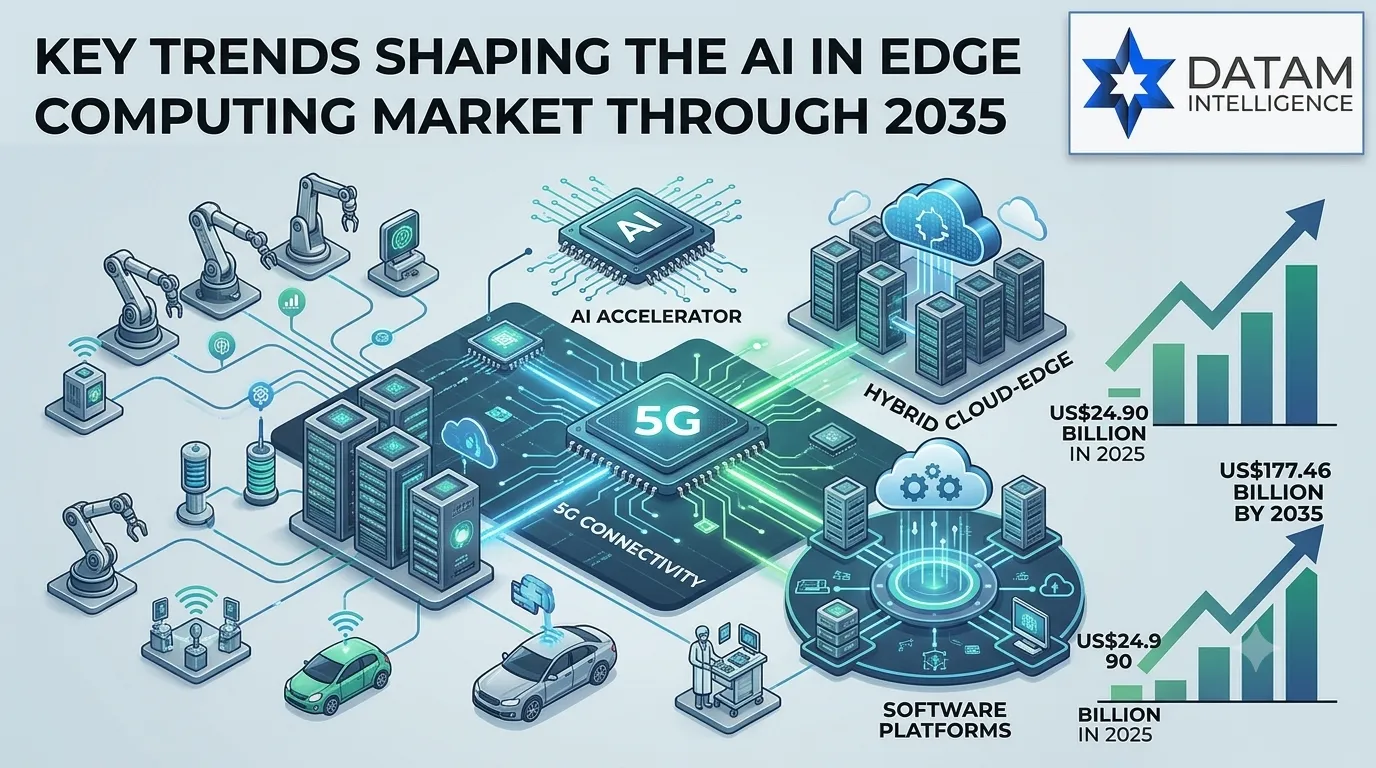
According to DataM Intelligence analysis, the global AI in Edge Computing Market is projected to grow from US$24.90 billion in 2025 to US$177.46 billion by 2035, expanding at a CAGR of 21.7%. The market's growth reflects increasing demand for real-time decision-making, localized data processing, and intelligent automation across industries.
As organizations modernize operations and deploy AI at scale, several trends are expected to redefine the competitive landscape over the next decade.
Download a Free Sample of the AI in Edge Computing Market Report
Gain access to exclusive market insights, emerging technology trends, competitive intelligence, and strategic analysis shaping the future of AI-powered edge infrastructure. Explore market growth opportunities, key adoption areas, regional trends, and industry developments to make informed business decisions.
What is AI in Edge Computing?
AI in Edge Computing refers to deploying artificial intelligence models closer to devices, sensors, gateways, industrial equipment, and local servers rather than relying exclusively on centralized cloud infrastructure. This enables faster data processing, reduced latency, improved privacy, and greater operational resilience.
Industries such as manufacturing, healthcare, automotive, telecommunications, logistics, and retail are increasingly adopting Edge AI to support mission-critical applications that require real-time intelligence.
Trend 1: Real-Time AI Inference Becomes a Strategic Business Imperative
The growing demand for instant decision-making is transforming real-time AI inference from a technological advantage into a business necessity. Organizations across industries are increasingly moving away from traditional batch-processing models and adopting AI systems capable of analyzing and responding to data in real time. Applications such as autonomous vehicles, industrial robotics, predictive maintenance, smart surveillance, video analytics, and connected healthcare devices require immediate insights to ensure operational efficiency, safety, and business continuity. Relying solely on centralized cloud infrastructure can introduce latency that limits the effectiveness of these mission-critical applications.
As a result, enterprises are investing heavily in distributed AI architectures that enable data processing closer to the source. This shift reduces response times, minimizes network dependency, and improves overall system performance. As organizations continue to prioritize low-latency intelligence and operational agility, real-time AI inference is expected to remain one of the most significant drivers of growth in the AI in Edge Computing market through 2035.
Key Growth Drivers:
- Rising demand for real-time decision-making capabilities
- Increased adoption of autonomous and connected systems
- Growing need to reduce latency in critical operations
- Expansion of industrial automation and smart infrastructure
- Greater reliance on edge-based analytics for operational efficiency
Trend 2: AI Accelerators Will Emerge as Strategic Infrastructure Assets
As AI models become more sophisticated, the limitations of traditional CPU-based computing architectures are becoming increasingly apparent. To support advanced AI workloads at the edge, organizations are deploying specialized hardware designed to deliver higher processing performance with lower power consumption. AI accelerators are rapidly becoming a foundational component of edge infrastructure, enabling organizations to execute complex inference tasks efficiently in distributed environments.
The market is witnessing significant investment in hardware innovation focused on improving computational efficiency, reducing energy consumption, and supporting increasingly demanding AI applications. For enterprises developing long-term Edge AI strategies, selecting the right hardware architecture is becoming a critical factor in achieving scalability, performance, and competitive differentiation.
Key AI Accelerator Technologies:
- Neural Processing Units (NPUs)
- Graphics Processing Units (GPUs)
- Tensor Processing Units (TPUs)
- Field Programmable Gate Arrays (FPGAs)
- Application-Specific Integrated Circuits (ASICs)
Strategic Benefits:
- Faster AI inference performance
- Improved energy efficiency
- Lower operational costs
- Enhanced scalability for edge deployments
- Better support for advanced AI applications
Trend 3: Edge AI and 5G Will Unlock New Enterprise Opportunities
The convergence of Edge AI and 5G connectivity is creating new possibilities for intelligent, real-time applications across industries. By providing ultra-low latency, high bandwidth, and reliable connectivity, 5G networks enable AI systems to process and act on information closer to end users and connected devices. This capability is particularly important for applications that require immediate responses and continuous data exchange.
Telecommunications providers are increasingly investing in Multi-Access Edge Computing (MEC) infrastructure to bring computing resources closer to network endpoints. As 5G adoption expands globally, organizations will gain access to new opportunities for innovation, automation, and digital service delivery.
Key Applications Enabled by Edge AI and 5G:
- Smart factories and Industry 4.0 environments
- Autonomous transportation systems
- Connected healthcare networks
- Industrial automation solutions
- Smart city infrastructure
- Advanced video analytics and surveillance
Business Impact:
- Faster data processing and decision-making
- Enhanced customer experiences
- Reduced network congestion
- Greater operational efficiency
- New revenue-generating service models
Trend 4: Manufacturing Will Continue to Lead Edge AI Adoption
Manufacturing remains one of the most advanced adopters of Edge AI technologies and is expected to maintain its leadership position throughout the forecast period. Industrial organizations are increasingly integrating AI into production environments to improve efficiency, optimize operations, and reduce operational risks. By processing machine and sensor data locally, manufacturers can gain real-time visibility into operations while minimizing reliance on centralized cloud infrastructure.
The growing adoption of Industrial IoT (IIoT) technologies is further accelerating demand for Edge AI solutions. Manufacturers are leveraging AI-powered analytics to improve productivity, reduce downtime, and support intelligent automation initiatives.
Primary Manufacturing Applications:
- Predictive maintenance
- Automated quality inspection
- Asset monitoring
- Process optimization
- Worker safety systems
- Industrial robotics
Key Benefits:
- Reduced equipment downtime
- Improved operational efficiency
- Lower maintenance costs
- Enhanced production quality
- Faster response to operational issues
Trend 5: Healthcare Edge AI Adoption Will Accelerate
Healthcare organizations are increasingly embracing Edge AI to improve patient care, enhance clinical decision-making, and streamline operations. The ability to process sensitive healthcare information locally enables providers to generate faster insights while maintaining strict privacy and compliance standards. As healthcare systems continue to digitize and connected medical devices become more prevalent, the need for real-time intelligence at the point of care is becoming increasingly important.
Edge AI is helping healthcare providers manage growing volumes of patient data while reducing delays associated with cloud-based processing. This capability is particularly valuable in environments where rapid clinical intervention can directly influence patient outcomes.
Key Healthcare Applications:
- Medical imaging analysis
- Remote patient monitoring
- Wearable health technologies
- Clinical diagnostics
- Smart healthcare infrastructure
Benefits for Healthcare Providers:
- Faster clinical decision-making
- Improved patient outcomes
- Enhanced data privacy
- Reduced network dependency
- Greater operational efficiency
Trend 6: Hybrid Cloud-Edge Architectures Will Become the Enterprise Standard
The future of enterprise AI lies in the integration of cloud and edge environments rather than choosing one over the other. Organizations are increasingly adopting hybrid architectures that leverage the strengths of both computing models. Cloud environments provide scalable resources for AI training and centralized management, while edge environments enable real-time processing and localized decision-making.
This approach allows enterprises to optimize performance, scalability, security, and cost efficiency while supporting increasingly complex AI deployments across distributed environments.
Core Components of Hybrid Architectures:
- Cloud-based model training
- Edge-based AI inference
- Centralized governance and oversight
- Distributed execution and processing
Business Advantages:
- Greater scalability
- Improved operational performance
- Enhanced security and compliance
- Better cost management
- Faster deployment of AI applications
Trend 7: Software Platforms Will Become the Primary Value Layer
As Edge AI deployments scale, software is emerging as the primary driver of long-term value creation. While hardware provides the computational foundation, software platforms enable organizations to manage, optimize, and secure distributed AI environments effectively. Enterprises increasingly require centralized tools that simplify the deployment and management of AI across thousands of connected devices.
The growing complexity of edge ecosystems is driving demand for advanced software solutions that support automation, governance, and lifecycle management.
Critical Software Capabilities:
- AI model optimization
- Device orchestration
- Lifecycle management
- Security monitoring
- Remote updates
- AI governance and compliance
Why Software Matters:
- Simplifies large-scale deployments
- Improves operational visibility
- Enhances security management
- Reduces administrative complexity
- Supports long-term scalability
Trend 8: Data Sovereignty and Cybersecurity Will Influence Technology Investments
As organizations process increasing volumes of sensitive data at the edge, cybersecurity and regulatory compliance are becoming central considerations in purchasing decisions. Enterprises must ensure that distributed AI systems can protect critical information while complying with evolving regional and industry-specific regulations.
Edge AI supports these objectives by enabling localized processing, reducing unnecessary data transmission, and improving overall resilience against cyber threats and network disruptions.
Key Advantages of Edge AI for Security and Compliance:
- Reduced data transmission risks
- Enhanced privacy protection
- Localized data control
- Regulatory compliance support
- Improved operational resilience
Industries Driving Adoption:
- Healthcare
- Financial services
- Energy and utilities
- Defense and public sector
- Critical infrastructure
Trend 9: Asia-Pacific Will Become the Fastest-Growing Regional Market
While North America currently leads the AI in Edge Computing market, Asia-Pacific is expected to record the highest growth rate through 2035. Rapid industrialization, expanding digital infrastructure, and strong government support for emerging technologies are creating significant opportunities across the region.
Countries such as China, Japan, South Korea, India, and several Southeast Asian nations are investing heavily in automation, smart manufacturing, telecommunications infrastructure, and AI-driven innovation.
Major Growth Drivers:
- Rapid industrial automation
- Expansion of electronics manufacturing
- Rising robotics adoption
- Smart factory investments
- Telecommunications infrastructure development
- Government-led digital transformation initiatives
Regional Opportunities:
- Manufacturing modernization
- Smart city development
- Advanced healthcare systems
- Industrial IoT deployment
- Telecom network expansion
Trend 10: The Rise of Distributed Intelligence
The future of AI and edge computing is increasingly centered on distributed intelligence a model in which computing resources operate across devices, gateways, edge locations, telecommunications networks, and cloud environments. This approach enables organizations to distribute processing power closer to where data is generated, reducing latency and improving system performance.
As enterprises continue to prioritize speed, autonomy, and scalability, distributed intelligence is emerging as a foundational pillar of next-generation digital infrastructure. Industry experts increasingly refer to this evolution as "Edge Intelligence," representing the convergence of AI, connectivity, and decentralized computing.
Key Benefits of Distributed Intelligence:
- Faster decision-making
- Reduced network congestion
- Improved scalability
- Greater operational autonomy
- Enhanced system resilience
Long-Term Impact:
- Accelerates enterprise digital transformation
- Supports autonomous operations
- Improves real-time responsiveness
- Enables scalable AI deployment
- Creates the foundation for future intelligent ecosystems
Strategic Outlook: What Will Define Winners Through 2035?
The next decade of AI in Edge Computing will be shaped by organizations that successfully combine:
- Advanced AI accelerators
- Scalable software ecosystems
- 5G-enabled connectivity
- Hybrid cloud-edge architectures
- Strong cybersecurity frameworks
- Industry-specific AI applications
Market leaders will focus on delivering intelligent infrastructure that enables real-time decision-making while maintaining security, compliance, and operational efficiency.
With the market forecast to reach US$177.46 billion by 2035, AI at the edge is evolving from an emerging technology trend into a foundational component of enterprise digital transformation strategies.
About the AI in Edge Computing Market Report
The DataM Intelligence AI in Edge Computing Market Report provides comprehensive analysis of market size, growth forecasts, technology trends, competitive landscape, regional opportunities, investment outlook, and strategic recommendations for stakeholders across the Edge AI ecosystem. Organizations can leverage the report to evaluate market opportunities, benchmark competitors, and develop long-term growth strategies.
Why is Edge AI growing rapidly?
Edge AI is growing because businesses require real-time data processing, lower latency, enhanced privacy, reduced bandwidth costs, and reliable AI decision-making closer to where data is generated. These benefits are accelerating adoption across manufacturing, healthcare, telecom, and smart infrastructure.
What are the key trends shaping the AI in Edge Computing Market through 2035?
The key trends shaping the AI in Edge Computing Market include real-time AI inference, growth of AI accelerators, expansion of 5G-enabled Edge AI, increasing industrial automation, healthcare adoption, hybrid cloud-edge architectures, software-driven edge management, stronger cybersecurity requirements, rapid Asia-Pacific growth, and the emergence of distributed intelligence. These trends are expected to drive the market from US$24.90 billion in 2025 to US$177.46 billion by 2035.